





Reading Museum and Art Gallery
24 April – 7 August 2021
by CLIVE ASHWIN
Until the late 1950s drawing, and in particular drawing in the context of the life class, dominated the curricula of most art schools. Supervised drawing from observation was widely regarded as the foundation and training ground for the plastic arts, in which I include painting, sculpture, construction and cognate media.
One of the centres for this practice was the art school of the University of Reading, especially during its period under the direction of JA Betts, its charismatic professor of fine art from 1933 to 1963. In addition to his activity as a teacher and advocate of drawing, Betts had the foresight to collect master drawings from all periods, often using them as instructional aids. Betts described himself as a pupil of Walter Sickert. This is not difficult to believe, since Sickert was a prolific and enthusiastic teacher in several art schools.
This exhibition presents a wide range of drawings from Betts’ remarkable personal collection, now held by the university, and includes works by Rubens, Samuel Palmer, Charles Keene, Sickert and Whistler. Master drawings are supplemented by student and staff drawings from the Betts period.
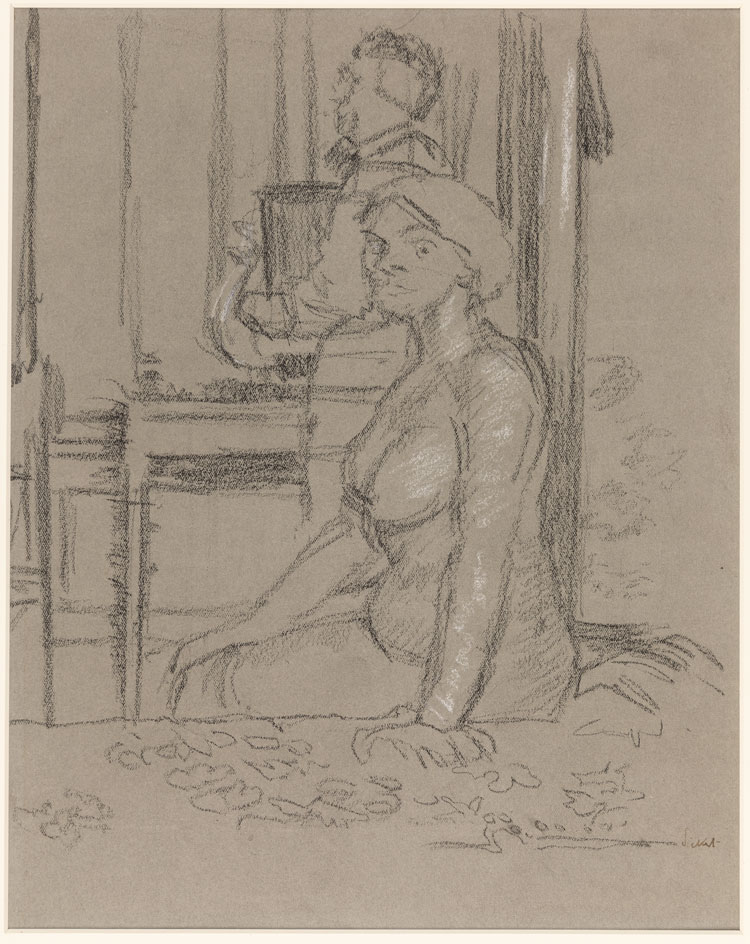
Walter Richard Sickert (1860-1942). Marie Seated on a Bed, c1911-12. Pencil, chalk and white heightening on grey paper, 38 x 28.2 cm. University of Reading Art Collection, AC/10536. Photo: Laura Bennetto.
When I went to the university art school as a student in the late 1950s, these objectives were epitomised in the work of several contrasted traditions. The emphasis at art schools such as Reading was to treat drawing as a way of examining, exploring and recording the facts of vision, uncoloured by preconceived values or aesthetic presumptions. Drawings were often referred to as “documents”, a gathering of information in order to sharpen perception and provide a basis for other work, such as painting. The life room was a kind of laboratory of perception in the quest for visual truth.
So what are the alternatives? The most obvious is the use of drawing as a way of developing or acquiring a sense of “style”. In the mid-20th century, this was epitomised by the work of Augustus John, a product of the Slade School. In addition to recording the world around him, real and imagined, John was intent on working in a distinctive style, in his case characterised by a sweeping expressive line. Here the facture of the drawing takes on a peculiar charm of its own, comparable with a page of fine calligraphy, regardless of what it depicted.
If one tradition can be described as “empirical”, or based on observation, the alternative can be described as “idealist”, in the sense of searching for a pre-existent ideal. This kind of idealism is often complemented by a range of preferred subject matter. While the empirical approach, epitomised by Sickert, accepted or preferred the ordinary, the banal or even the sordid, John was drawn to the romantic charm of Romany life in an idealised dream-like landscape.
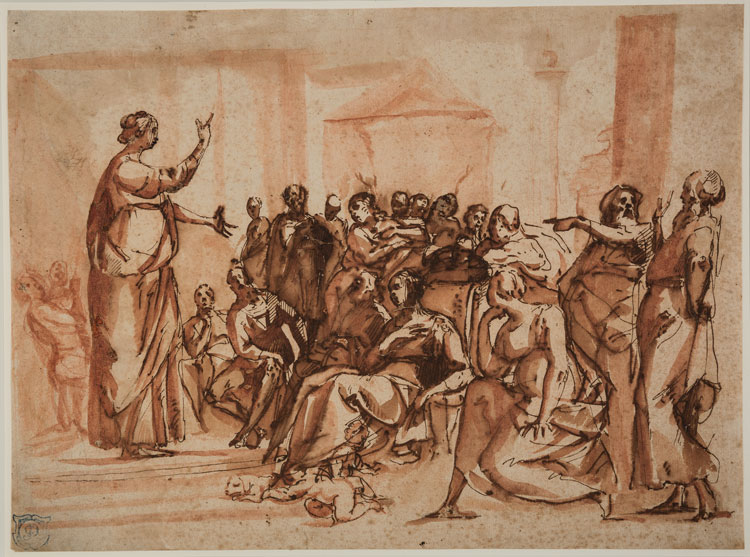
Attributed to Flaminio Allegrini (1587-1683) or Francesco Allegrini (1615/20 - after 1679). St Catherine and the Philosophers. Ink and wash, 25.4 x 34.4 cm. University of Reading Art Collection, UAC/10540. Photo: Laura Bennetto.
The tradition of drawing from memory provides a fascinating counterpoint to this polarisation. Alphonse Legros, director of the Slade School of Art 1876–92, was a pupil of Lecoq de Boisbaudran, an ardent proponent of drawing from memory. This is significant, because drawing from memory depends on the acquisition of a repertoire of preconceived forms, ways of depicting something, whether it is an ear or an armchair. In the life room, this can lead to a situation in which the student is not in fact drawing what is perceived at all, but simply matching it with an extensive repertoire of preconceived and remembered forms.
In a sense, all drawing is a form of drawing from memory, albeit the momentary pause between observing and recording. However, there is a clear distinction between this form of compressed memory and memory exercised temporally remote from the observed object, perhaps by days or weeks.
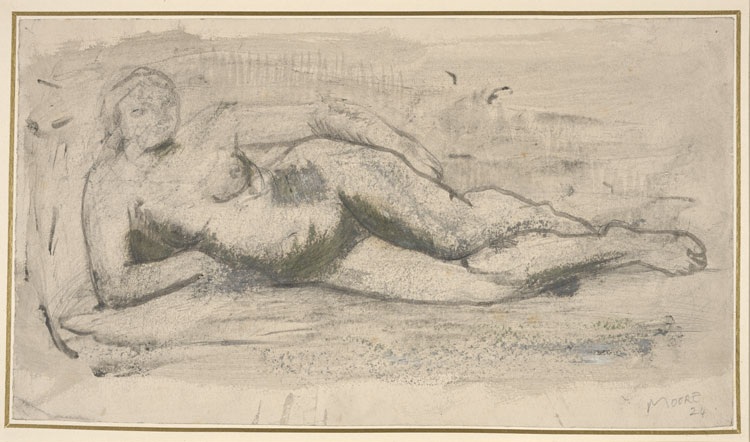
Henry Moore (1898-1986), Reclining Nude, 1924. Pencil, gouache and wash, 29.8 x 42.3 cm. British Museum. Reproduced by permission of the Henry Moore Foundation. © The Trustees of the British Museum.
The drawings featured in the exhibition cover a remarkably wide range of approaches, from Keene’s ability to capture personality in a few lines to the majestic monumentality of Henry Moore. The very fine Sickerts exemplify a quality of his drawings that is often overlooked. This is his ability to convey space as a continuum that flows outwards from the margins of the drawing. All the drawing gives us is a nude on a bed, but in our imaginations we get a room, a whole house, and the sound of traffic in the street outside.
Betts’ own drawings are far from homogeneous in style or approach. At an early stage, he was clearly drawn to a static monumentality, almost sculptural in character. This was superseded by a quasi-vorticist manner, before resolving into the empirical style of close observation that characterised his teaching mission.
Few changes in education have been as sudden and profound as the abandonment of the life room culture in the late 50s and early 60s. When I started teaching at an art college in 1966, only one student in our fine art department wished to continue to draw and paint from life. He was regarded with amused tolerance and given a room in an annex some way from the main building so that he did not disturb or infect the more important work being done elsewhere.
What brought about this dramatic change? There were several causes. The groundswell of modernism, originating in Paris and other continental centres in the opening years of the century and so long held at bay, had turned into a cultural tsunami, sweeping away everything in its path. By the 50s, this had been compounded by the influence of recent American art from across the Atlantic. Studio International played a central role in spreading the word of the new art in British art colleges, introducing students to genres such as abstract expressionism, colour field painting and pop art.
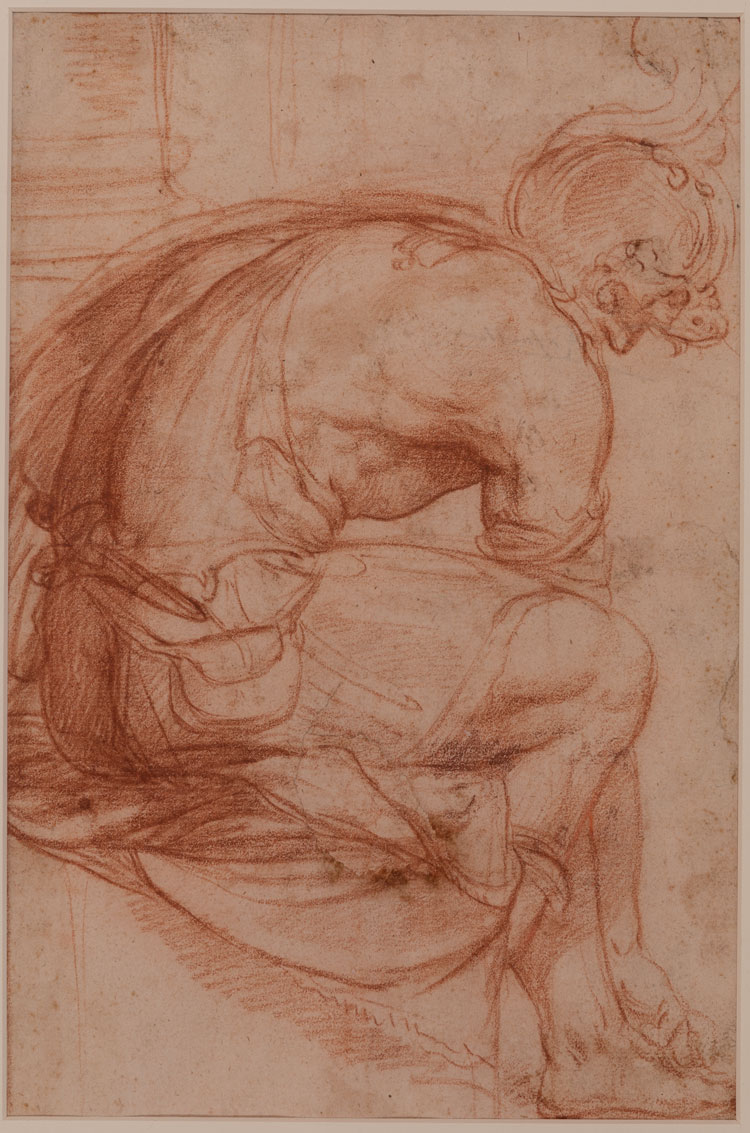
16th-century Italian School. Seated Roman Soldier. Chalk, 25.5 x 25.5 cm. University of Reading Art Collection, UAC/10576. Photo: Laura Bennetto.
At the pedagogical level, course structure at many British colleges adopted the concept of “basic design”, a universal language of abstract form with its own logic and rules. Significant figurative artists such as Victor Pasmore, whose early work is represented in the exhibition, explicitly repudiated figurative art as no longer relevant to the modern age, together with the associated baggage of the life room and observational drawing.
One of the purposes of any exhibition is not only to gather together and present work from a defined period or culture, but to give us an opportunity to reflect on ourselves, our current preoccupations, practices and values. When the apparatus of the life room was dismantled and thrown out, was anything important lost?
Ask anyone with an informed interest in art to identify the most significant British painters of the last 40 years, then, for many, Lucian Freud and David Hockney would come somewhere near the top of the list. Both were products of the art college training system represented in the present exhibition. This is not a matter of coincidence: a substantial sector of their work bears the hallmark of a direct relation to the early practice of close observational drawing.
The life studio has survived or been reintroduced in specific institutions, but it has not as yet regained the central foothold it once enjoyed. Perhaps the time has come for a national debate regarding its likely future.
The exhibition and its related catalogue invite us to reflect on a culture that has now been largely superseded, and ask us whether it still has something significant to offer education and art today.

Click on the pictures below to enlarge
To coincide with his first UK exhibition, Agua Salada at Hauser & Wirth Somerset, Angel Otero talked...
Paula Rego: Dance Among Thorns
With more than 140 works on show, this exhibition encompasses the breadth of Rego’s art, from her ...
Handpicked: Painting Flowers from 1900 to Today
A smorgasbord of flower paintings from the last 125 years, exploring meaning, metaphor, accuracy and...
Klima Biennale Wien 2026: Unspeakable Worlds
Vienna’s climate biennale takes place across the city with institutional exhibitions and public pr...
Troublemakers and Prophets: Elizabeth Allen and Other Visionary Artists
The amazing story of an artist, who saw herself as a contemporary prophet, and made patchwork artwor...
Bellmer Nauman Pondick: Material Desire
Focusing on the work of Rona Pondick, Hans Bellmer and Bruce Nauman, this exhibition considers how b...
-300.jpg)
Spanish artist Angela de la Cruz’s twisted canvases and collapsed objects are a reflection of the ...
,-Red-Devil-(soul-2),-Drifting-Leaves,-1972-300.jpg)
Senga Nengudi: Performance Works 1972-1982
Featuring photographic works, archival materials and films of key performance pieces, this exhibitio...
-Cecily-Brown-Photo-(c)-Jo-Underhill-300.jpg)
A painter’s painter, whose dynamic landscapes take viewers on a walk, Cecily Brown returns to Lond...
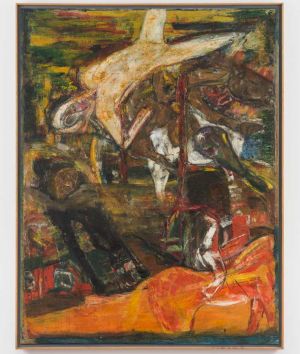
Frank Bowling: Seeking the Sublime
Though containing just 10 works, this exhibition demonstrates the breadth of the British-Guyanese ar...
This exhibition explores ageing from the 1500s on, but it was the contemporary works here that reson...
This show focuses on honouring ancient relationships between people, land and water, with new work f...
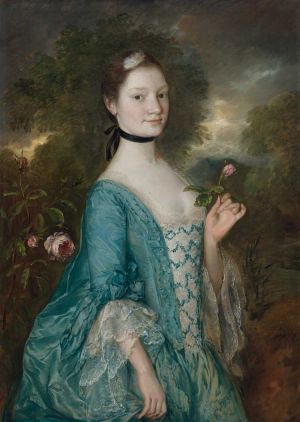
Gainsborough: The Fashion of Portraiture
Despite once saying he was sick of portraits, Gainsborough was one of the most sought-after portrait...
Histories of erasure, displacement, annihilation and colonisation are told with power, subtlety, cla...
-(8)-300.jpg)
Hurvin Anderson’s paintings, which here stretch across his career, blend his British and Caribbean...
-(c)-DACS,-London,-2026-and-Chiharu-Shiota.-300.jpg)
Chiharu Shiota: Threads of Life
Chiharu Shiota’s immersive web-like installations, fashioned from coloured thread and found object...
-(c)Rob-Battersby-6-1000-300.jpg)
Paul Eastwood, who is dyslexic, attempts to explore neurodiversity and the complexities of language,...
The artist and writer Morgan Quaintance, winner of the 2025 Film London Jarman Award among other acc...
Maggie’s: Architecture That Cares
Celebrating 30 years of the distinctive Maggie’s Centres for cancer care, this exhibition highligh...
Euan Uglow: An Arc from the Eye
His almost scientific methods of observation led Euan Uglow to take months, even years to finish a p...
A look behind the scenes of the travelling exhibition on Berthe Weill
The show celebrating the pioneering Parisian avant-garde gallerist opened in New York before travell...
Hammershøi: The Eye That Listens
A substantial retrospective reveals the mysteries and anomalies of magnetic Danish master Vilhelm Ha...
Barbados Museum & Historical Society challenges narrative around slavery
These two fascinating, interrelated exhibitions – one of a 19th-century Black Barbadian, the other...
Melania Toma explains her interest in collective and interspecies perspectives, her dynamic process,...

Ilana Halperin: What Is Us and What Is Earth
Collaborating with artists, scientists, geologists and nature itself, through her exquisite works, H...
Alberto Greco: Viva el Arte Vivo
The Reina Sofia recovers the art of a queer Argentinian maverick who believed he could turn anything...
The first major museum exhibition of Catherine Opie’s work in the UK charts her career from when s...
British-Nigerian artist Onyeka Igwe is having a busy year. She talks about Our Generous Mother, her ...
An absolute tour de force celebrates the life – and second life – of an artist who has progresse...
Rose Wylie: The Picture Comes First
Don’t be fooled by the cartoonish depictions, Rose Wylie is constantly finding new ways of thought...

Copyright © 1893–2026 Studio International Foundation.
The title Studio International is the property of the Studio International Foundation and, together with the content, are bound by copyright. All rights reserved.
 |
 |
 |
|---|
 Sickert in Venice. Dulwich Picture Gallery, London. 2009
 Royal Academy Summer Exhibition 2004
 Home and Garden: Paintings and Drawings of English Middle Class Urban Domestic Space 1914 to the present
 David Hockney Portraits
 David Hockney: Painting on Paper