




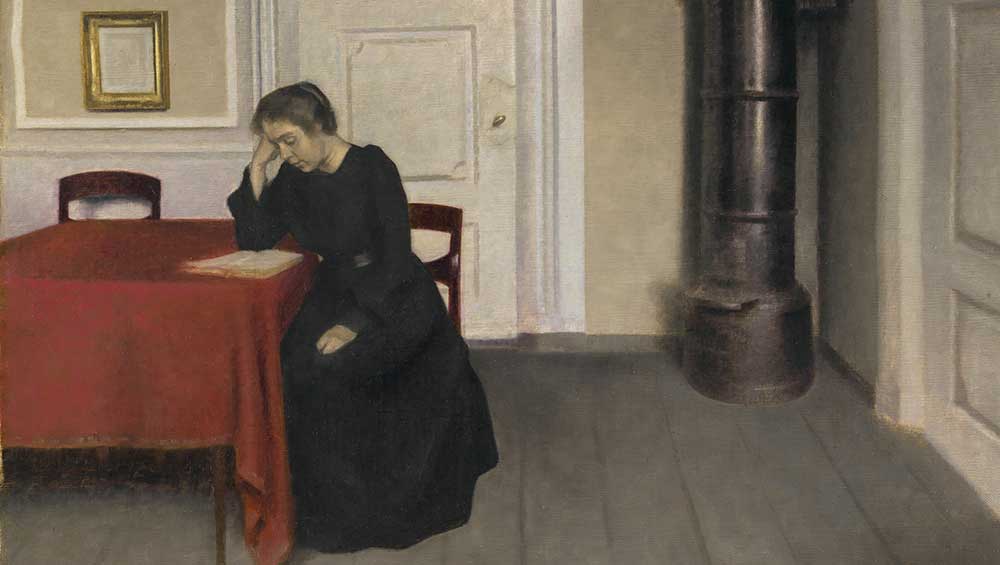
Vilhelm Hammershøi, A Room in the Artist’s Home in Strandgade, Copenhagen, with the Artist’s Wife, 1902 (detail). Oil on canvas, 63.5 x 60 cm. SMK, National Gallery of Denmark, Copenhagen. © SMK.
Museo Nacional Thyssen-Bornemisza, Madrid
17 February – 31 May 2026
by JOE LLOYD
The first-floor apartment of Strandgade 30 might be the most-painted interior in art history. Between 1898 and 1909 it was the home of Vilhelm Hammershøi (1864-1916), today Denmark’s best-known artist, and his wife, Ida. Over and over again, Hammershøi captures the white-painted wooden doors, lilac-grey walls and sparse furniture of his home, whose minimalism seems to pre-empt contemporary Scandinavian design. “How much better homes would look,” he said in a 1909 interview, “if all this ‘rubbish’ could be got rid of!” Sometimes, Ida or a housemaid appears, often with her back turned, reading, playing piano or engaged in some household task. On other occasions, the house appears empty, likely silent. Time seems suspended. Perishable items appear very rarely: when they do, like a knob of butter in one 1901 picture, they feel like a jolt awakening the viewer from a dream.
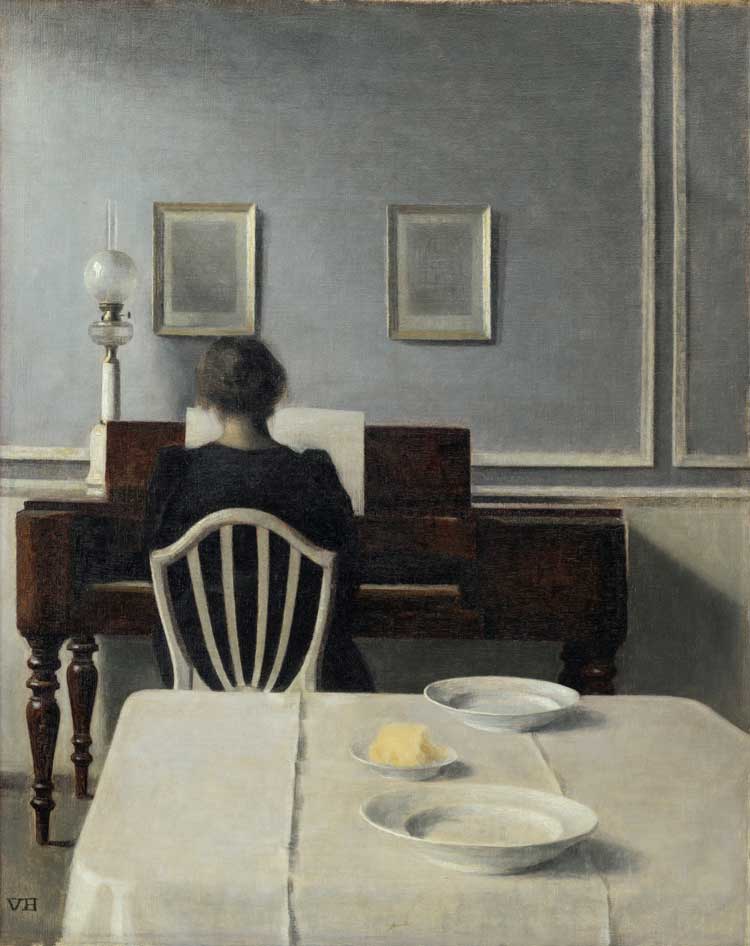
Vilhelm Hammershøi, Interior with Woman at Piano, Strandgate 30, 1901. Oil on canvas, 55.9 x 45.1 cm. Prize collection. Photo: © Bruno Lopes.
Hammershøi would often finish his paintings by adding a gauzy grey haze, undercutting the verisimilitude of his paintings. The discord between photorealism and the blur might pre-empt Gerhard Richter, as does his occasional use of actual photographs as source images. His apparently harmonious compositions abound with uncanny details. Why is there a knob of butter but nothing else to eat? Why do the flowerpots contain no flowers? We can seldom see much of the outside world. The pale Øresund light rarely brings more than a slight illumination into this muted space – though when it does, as in one 1900 masterpiece, we can see the dust motes shimmer in the sunbeams.
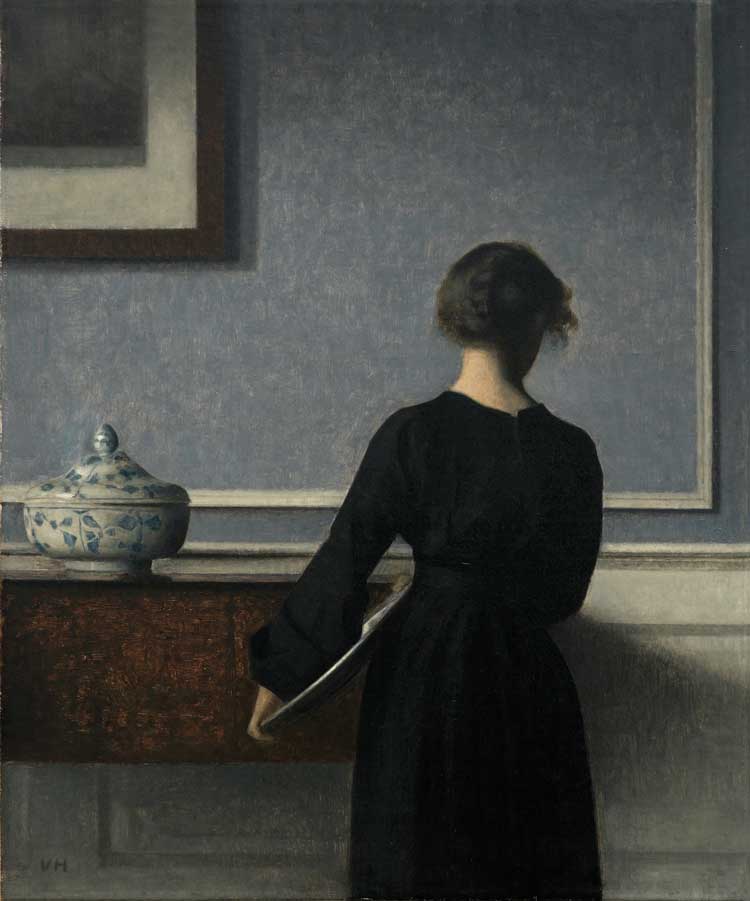
Vilhelm Hammershøi Interior, Young Woman Seen from behind. Oil on canvas. 60.5 x 50.5 cm. Randers Kunstmuseum, Randers. Photo: © Randers Kunstmuseum.
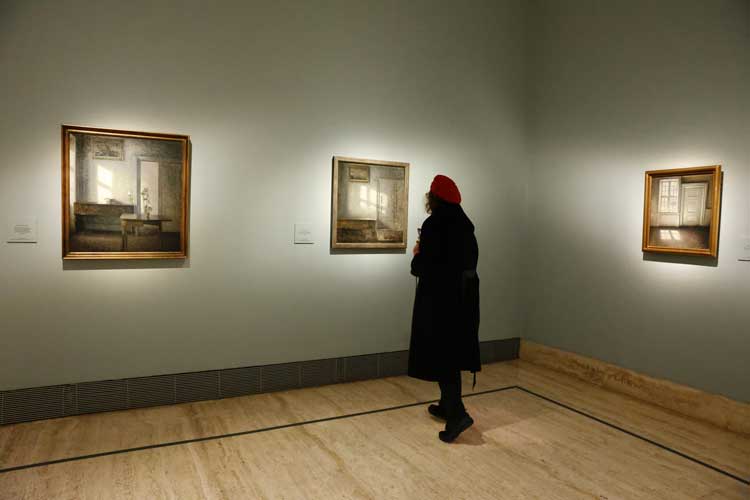
When numerous Hammershøi paintings are gathered together, as at the Thyssen-Bornemisza’s suitably grey-walled exhibition, one can register minute differences. The scene depicted in one pair of paintings from 1900 and 1901 differs only in the detailing of an ajar door and the small artworks that hang on a wall. Idea stands enigmatically in the murk, her back turned to us, closed off and unreadable. A slightly later painting, called Open Doors (1905), removes the figure and changes the angle by which a door is ajar, subtly morphing the contours of the space. It is as if the doors are in secret conversation. Despite being so well-charted, Strandgade 30 can feel as unknowable as the people within it.
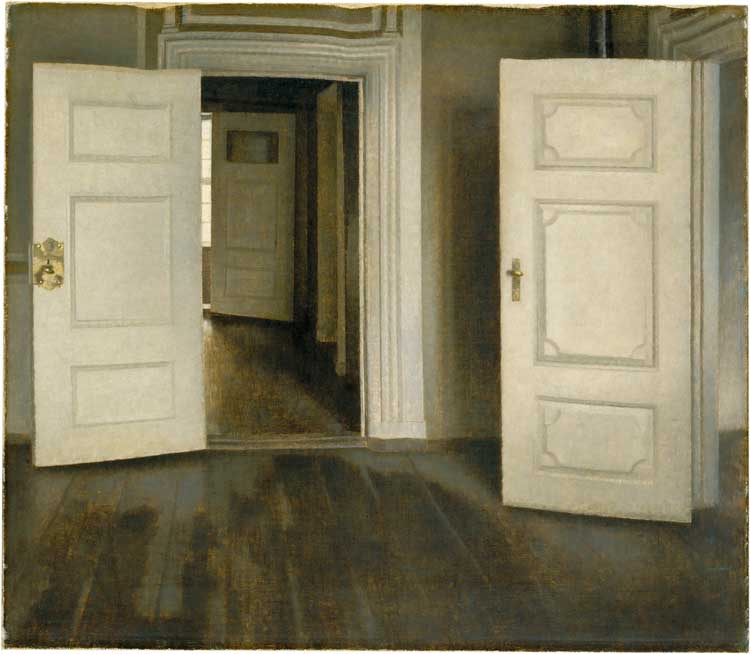
Vilhelm Hammershøi, Open Doors, 1905. Oil on canvas, 52 x 60 cm. The David Collection, Copenhagen. Photo: © The David Collection.
Hammershøi was inspired by the genre scenes of the Dutch golden age. But Hammeshøi’s austerity contrasts with the luxurious textiles and objets d’art often found in these showpieces, as in a Pieter de Hooch work at the Thyssen demonstrates. James McNeill Whistler was another clear inspiration, in the greyness of his palette, the lightness of his paint and the misty pallor of his surfaces. Hammershøi even depicted his mother in the same seated pose as in Whistler’s famous rendition. Yet his interior paintings have an uneasy ambience of their own.
His intentions remain mysterious. Is he capturing an oppressive staidness? Are his woman prisoners, trapped in an unknown interiority, forced to roam these hushed spaces? Or was the retiring Hammershøi just painting where he felt safe to be? Walter Benjamin claimed that, confronted with urban and industrial growth, the 19th-century bourgeoisie were obsessed with the security of their homes. Perhaps the dour palette comes from the weather; Copenhagen is not Nice. We will never know the motivations behind his strange mode. Hammershøi was taciturn, as admirers including Rainer Maria Rilke found, and left only a few clues behind. We do know that he found aesthetic satisfaction in the empty room. “I have always thought,” he stated in 1907, “there was a great deal of beauty in such a room, even without people in it, perhaps precisely when there was no one there.” He also thought that “neutral and reduced” colours give paintings their “best effect”.
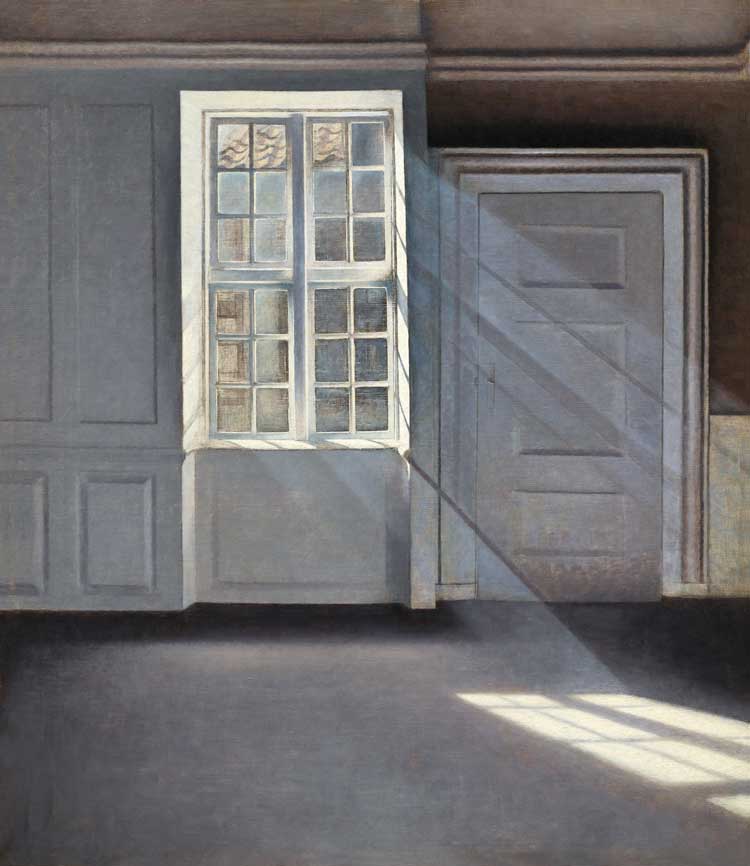
Vilhelm Hammershøi, Sunbeams, 1900. Oil on canvas, 70 x 59 cm. Ordrupgaard, Copenhagen. Photo: © Anders Sune Berg.
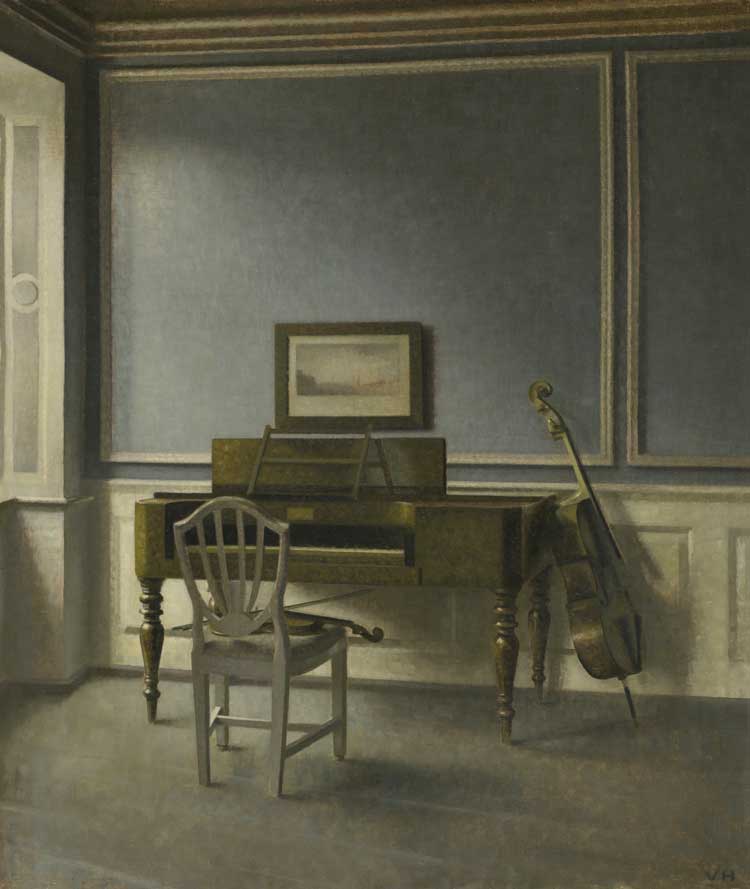
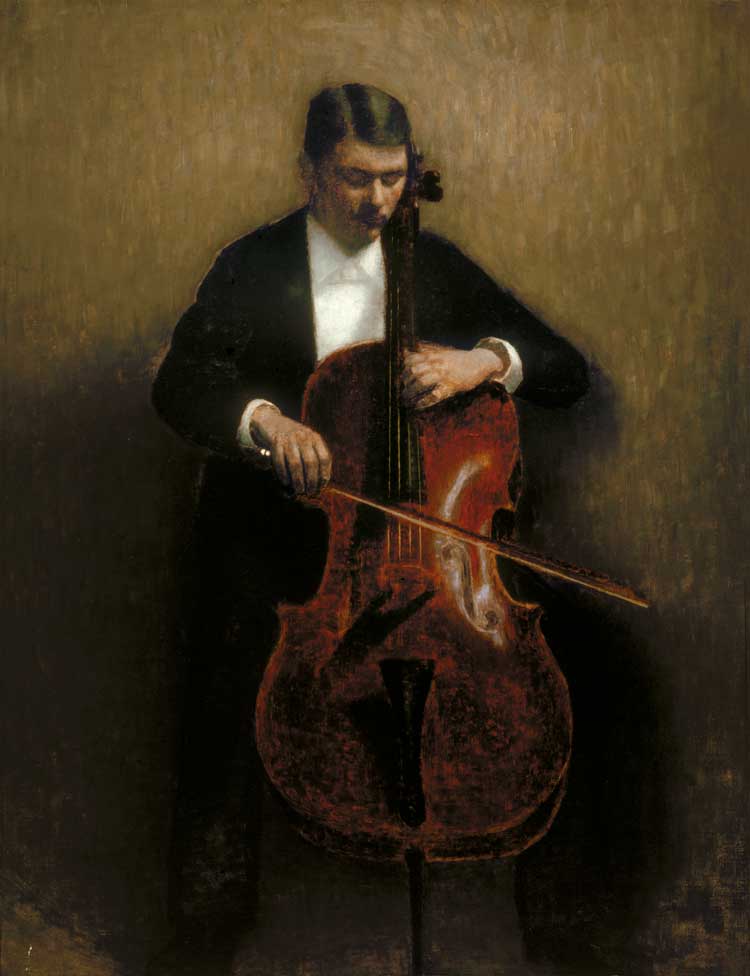
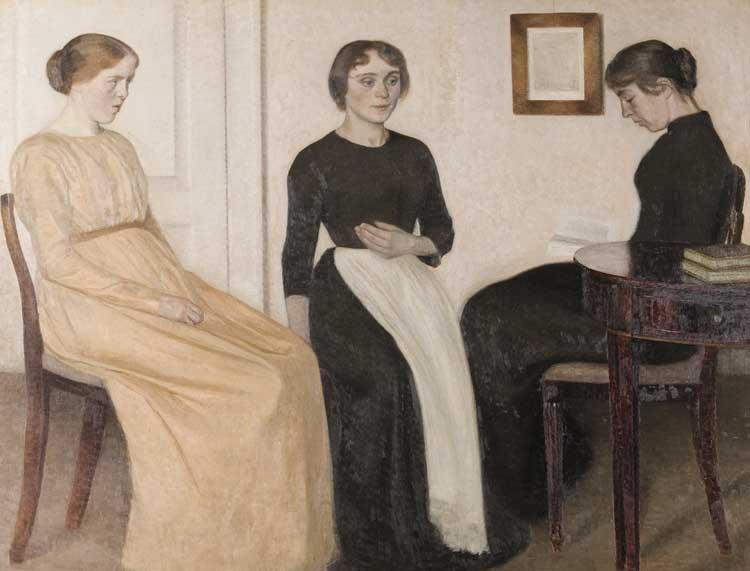
We know that he was not as reclusive as his paintings suggest. He was part of a group of artists, also including Carl Holsøe and Ida’s brother, Peter Ilsted, who shared the same devotion to quiet interiors – albeit never as quiet as Hammershøi’s. Silence did not always reign at 30 Strandgade. The Hammershøis hosted musical gatherings around the piano, and they counted musicians among their inner circle. An 1893 portrait of the concert cellist Henry Bramsen shows him mid bow stroke, man and instrument united, as if nothing else in the world matters as much as producing music. There also appears to have been a genuine affinity between the Hammershøis. Ida often serves as a featureless prop in her husband’s interiors. But his direct depictions of her – from a double portrait in 1892 to a 1907 picture of her stirring coffee – seem filled with a warts-and-all affection.
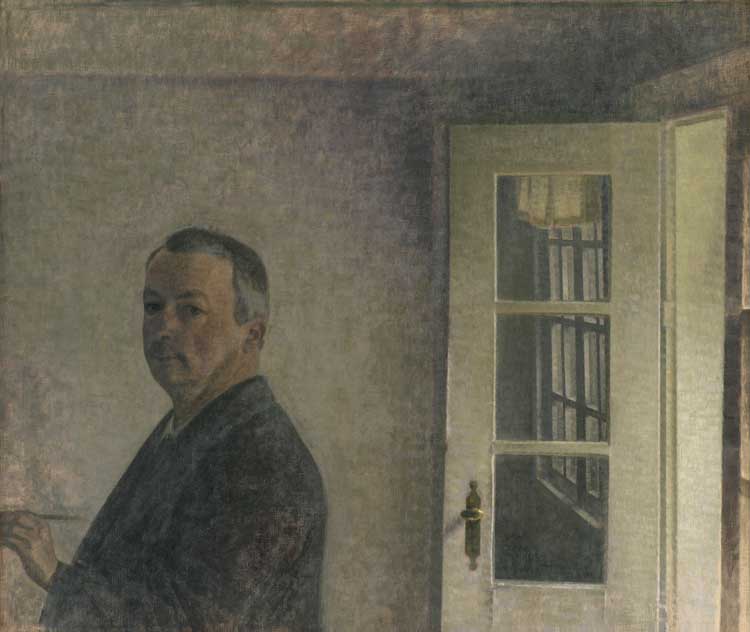
Vilhelm Hammershøi, Self-Portrait. The Cottage Spurveskjul at Sorgenfri, North of Copenhagen, 1991. SMK, National Gallery of Denmark, Copenhagen. © SMK.
Even though Hammershøi did not live a life of unbroken, housebound solemnity, there is an unsettling dimness to the world he depicts. Sometimes his subjects were macabre: in 1888, he painted a young girl with then-incurable tuberculosis. More often, they are disconcertingly cold. A four-person gathering in Evening in the Drawing Room (1904) feels as if the sitters are about to expose each other’s darkest secrets, like the climax of a Dogme 95 film. The same forbidding atmosphere hangs in his depictions of buildings. The earliest painting on display in Madrid, Farmhouse Corner (1883), depicts part of a rural structure in closeup. Despite the glow of the sun, it feels like the set for a claustrophobic horror film. Almost two decades later, two paintings of the British Museum in London (1906) turn that bustling sanctuary into a gloomy sepulchre, shielding itself from a dead, unpeopled street.
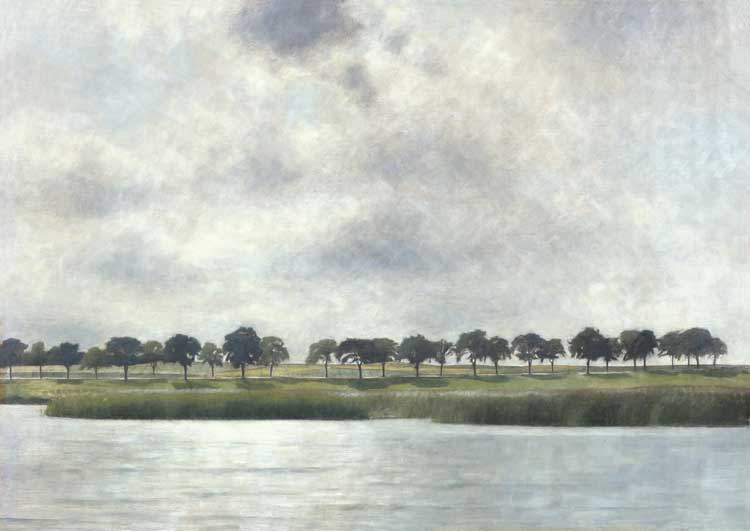
Vilhelm Hammershøi, Sun Shower, Lake Gentofte, 1903. Oil on canvas, 42.5 x 60.5 cm. Ordrupgaard, Copenhagen. Photo: © Anders Sune Berg.
If there is some relief from this tone, it comes when Hammershøi ventured into the countryside. His landscapes are not exactly cheery. They often depict the flat agricultural land surrounding Copenhagen with an unsentimental realism. Yet, on at least a handful of occasions in the works at the Thyssen, the sun does shine, and the copses look inviting. Yet even these have an eerie emptiness, as if everyone had had to flee from some encroaching disaster. Perhaps it is better to stay inside and watch the dust after all.
Click on the pictures below to enlarge

Copyright © 1893–2026 Studio International Foundation.
The title Studio International is the property of the Studio International Foundation and, together with the content, are bound by copyright. All rights reserved.
 |
 |
 |
|---|


-1000-300.jpg)


 Wu Tsang – interview: ‘I’m drawn to stories that have messy politics’
 'Poet of Light' Vilhelm Hammershoi: The Poetry of Silence