




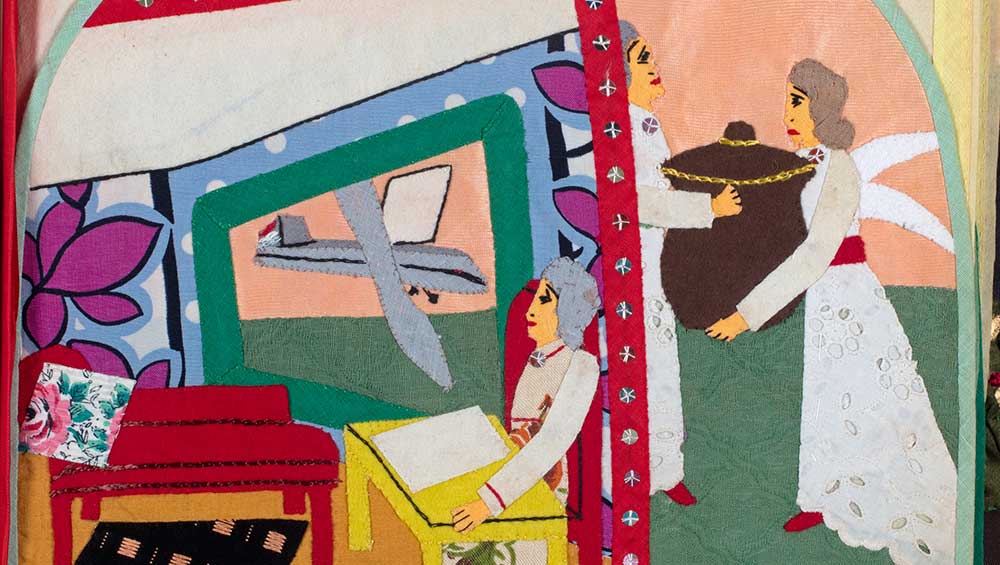
Elizabeth Allen, The Autobiraggraphy of her called Elizabeth Allen, In the Year of Grace, 1961 (detail). Photo: © Jamie Woodley and Compton Verney.
Compton Verney, Warwickshire
28 March – 31 August 2026
by ANNA McNAY
On many levels, this is yet again a story of a female artist who, despite having achieved the giddy heights of success during her lifetime, fell out of the limelight and became another unknown name to today’s audience. At the same time, however, thanks to the insightful curation, this exhibition is far more than that, offering both an introduction to the life and work of Elizabeth “Queen” Allen, but also a superb display, in its own right, of thematically and materially related works right up to the current time.
Allen (originally Koch – the family changed their name to Allen in the early years of the 20th century, when it was not advisable to advertise one’s German origins), or Queen, as she was generally known, is introduced to visitors by a crash course timeline outside the galleries. From her birth in 1883 – to a German immigrant tailor and his Irish tailoress wife, above a baker’s shop in Tottenham, London, as one of 17 children – to her death in 1967, her life is condensed into key moments, predominantly in her final two years. Her story itself is remarkable – born with a congenital condition that caused one leg to be shorter than the other, living with chronic pain, thrown out of home for being an atheist, and spending the rest of her life living alone (until joined by an art student, Bridget Poole, in 1963), in poverty, in a cabin in the forest in Kent. An atheist she certainly wasn’t, however: she merely rejected more traditional interpretations of the Bible, and of a God who would inflict suffering such as her own, preferring a personal understanding of the scriptures, in particular the 15 apocryphal books that stand apart from the normal canon, and of an alternative Christ, who came to live instead of to die. And it is primarily these beliefs that appear in her carefully crafted artworks, patchworked into being using leftover scraps of material, buttons and sequins. She didn’t own any art books or publications, so the pictures she created were from her imagination, a visual expression of her deeply held beliefs and thoughts on what was happening in the world outside her cabin. Inherent in them is also a strong “folk art” element.
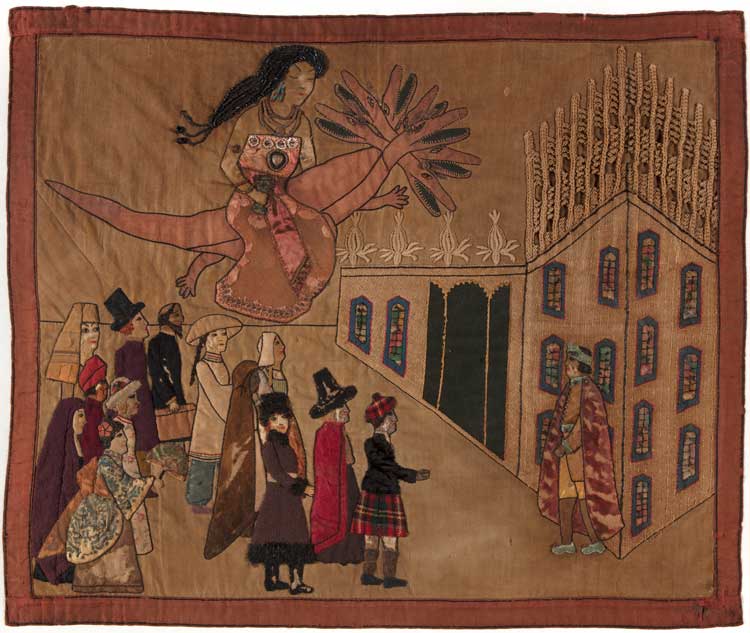
Elizabeth Allen, Babylon Riding on the Great Red Dragon, c1966. Photo: © Jamie Woodley and Compton Verney.
A couple of examples of these religious pieces include The Great Silence (exhibited 1967), which is thought to refer to the 400-year-long intertestamental period, or the “400-year silence”, during which the apocryphal books were written, and Babylon Riding on the Great Red Dragon (exhibited 1966), which depicts its protagonist riding a many-headed, toothed beast, holding her golden cup full of wickedness, and, below her, figures representing faiths and nations from around the world (all in national dress), being received by Christ, next to a palace representing his kingdom. Queen believed that she was able to understand messages in the Bible, which, until that time, had not been discovered by priests or scholars. The book of The Revelation of St John the Divine, in the New Testament apocalyptic literature, which foretold the Second Coming of Christ and the Last Judgement, was another favourite work, and visions of the end of the world are often referenced in her pictures.
Queen also produced some non-religious works, albeit often with a moralising bent, including Population Explosion (1965) (in the folk art collection of Compton Verney), made in response to a news report she heard about a woman in South America who had taken a faulty fertility drug and given birth to seven stillborn babies (shown here lined up in a bed), which may certainly still have contained some moralistic message professing caution when intervening with God’s divine creation, and Alice in Jungle-Land (1965), which shows her and Bridget amid a menagerie of fantastical creatures. Describing this work, Queen wrote in a letter: “I am Alice and this world of wars and strife and thugs and poverty is the Jungle-land in which Bridge and I are living. And I have lived in it for 83 years, and I ought to know.”
-(c)-Penny-Slinger.jpg "Penny Slinger, The Uninvited Guest, 1969-77. © Penny Slinger. Courtesy Richard Saltoun Gallery, London, Rome and New York.")
Penny Slinger, The Uninvited Guest, 1969-77. © Penny Slinger. Courtesy Richard Saltoun Gallery, London, Rome and New York.
Bridget described how Queen would sit on the couch, which served as her bed at night, and made pictures on her knees, cutting a shape straight out of the cloth, not using any template. As Queen worked, Bridget would read to her from the newspaper, and they listened to the Home Service on the radio. The Black Feet Are Kicking (exhibited 1966) again shows how Queen is influenced by contemporary world news as she mixes a biblical story with her response to a report on the radio celebrating the independence of African nations. It is executed entirely in black fabric on a creamy-white ground, apart from the sequins on the heads of the figures and their thread necklaces. In the top right-hand corner, a sequin eye looks down from a large brick-like object. Queen would have seen this loss of British colonial territory as fulfilling the prophecy that a large stone would fall on a succession of different empires, from the apocalyptic writing in the book of Daniel.
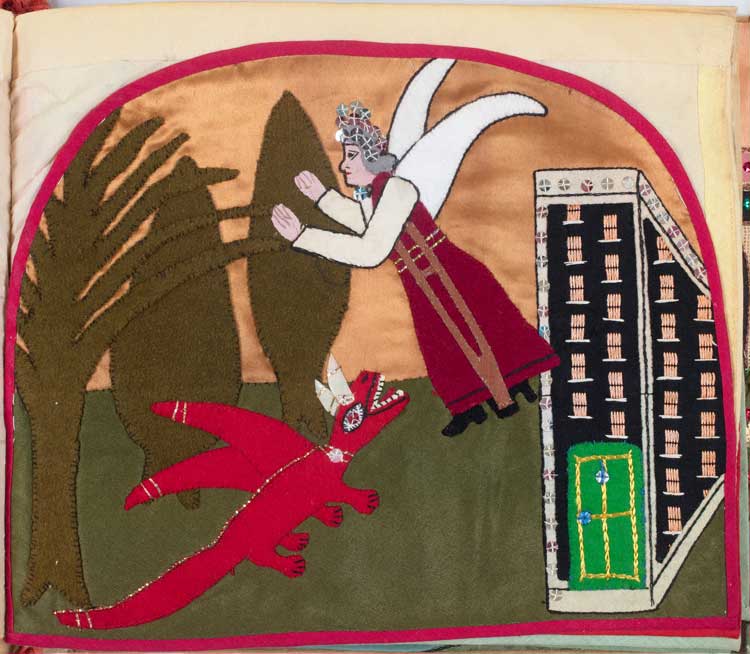
Elizabeth Allen, The Autobiraggraphy of her called Elizabeth Allen, In the Year of Grace, 1961. Photo: © Jamie Woodley and Compton Verney.
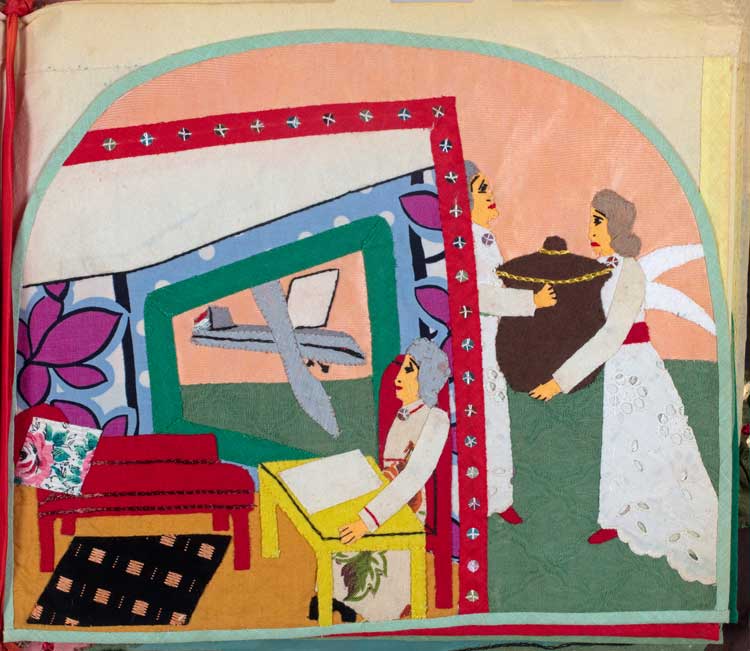
In 1961, Queen created her masterpiece, Autobirragraphy – a textile book, with pictures, depicting scenes from her life, and accompanying handwritten words, Bible verses, calculations and prophecies (including her prediction that the world would end in 1996). The title is a pun on her works, which she called “rag pictures”. The best thing about this book is that, unlike with her individual pieces, there is no discolouration caused by the paraffin fumes from her cabin.
In 1965, Bridget told her college teachers about Queen and her work, and they, in turn, spoke to a group of established artists, including Patrick Heron, Trevor Bell and Michael Kidner. These artists recognised Queen’s work as of great interest and importance, and, thanks to them, exhibitions were organised, first in London, then across the UK, and then worldwide. The art critic Norbert Lynton wrote in the Guardian on 19 February 1966: “Patrick Heron, trying to characterise the qualities he sees in [Queen’s work], alludes to Matisse, to Indian Mogul miniatures, to Etruscan frescoes, and to Paul Klee, among others, and these comparisons do not seem far-fetched. Instead, one is tempted to add to them – to point to Sienese painting of the Renaissance or to the subtler inventions of Max Ernst.”
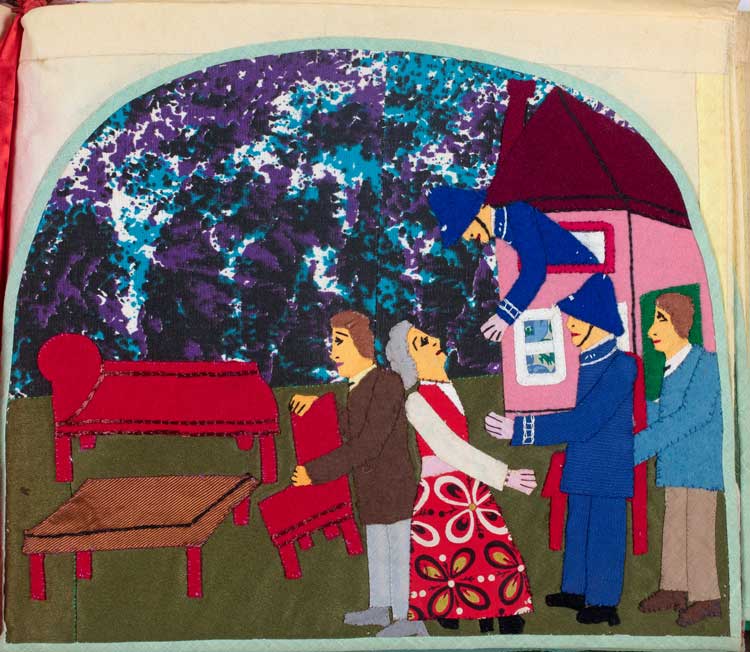
Elizabeth Allen, The Autobiraggraphy of her called Elizabeth Allen, In the Year of Grace, 1961. Photo: © Jamie Woodley and Compton Verney.
In total, 12 of Queen’s works are on display in the exhibition, one belonging to the museum’s collection, and each of the others representing a feat of its own in being traced, as nearly all her works are in private collections, having been bought in the 60s and not necessarily documented. Overall, it is thought that fewer than 150 works by Queen exist. Sadly, no catalogue has been produced to document this exhibition, either. Speaking to Ila Colley, the curator, there was certainly enough information and enthusiasm to hand. She explains that putting together the exhibition was a mixture of finding the works, learning more about them and learning more about Queen, and then trying to think about how that might be pertinent to today. “I think what we landed on,” she says, “is this kind of magic in her work, which comes from the connecting of disparate things. There’s an importance to storytelling and how we are bombarded with rhetoric from different directions and left with the task of reconstellating these things in a way that makes sense to us. And I think that’s what Allen was trying to do, to make meaning from the fragments of information and stories that we have around us.”
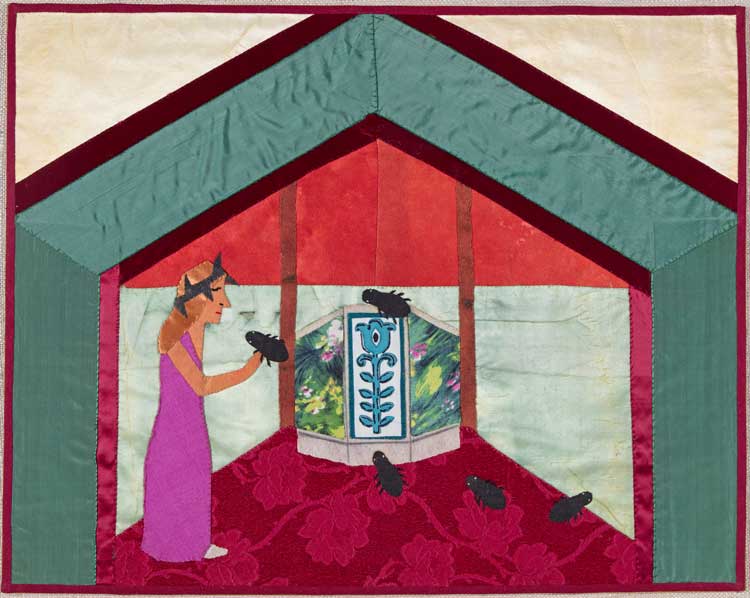
Elizabeth Allen, Beetles Come and Go but Christ Remains Forever, c1967. Photo: © Jamie Woodley and Compton Verney.
By far the most humorous of the Allen works on display is Beetles Come and Go but Christ Remains Forever (exhibited 1967), showing Jesus in a pink robe, with a crown of thorns, in a room with five black beetles. It is Queen’s response to a remark by John Lennon claiming that the Beatles had become more popular than Jesus. This is her retort saying that her Christ is far more important than any measly beetles. This picture is a beautiful example of how Queen used the trope of a fabric frame to complete the work. Also of note is the inclusion, by each of Queen’s works, of little samplers for visitors to touch and get an idea of the feel of the different textures of materials being used. This is the first time the venue has experimented with creating such a multisensory experience, and I hope it will prove successful.
-Suzanne-Treister.jpg "Suzanne Treister, Study for Hexen 5.0/Tarot/V The Hierophant - Spiritual Ecology, 2024. Courtesy Annely Juda Fine Art, London and P.P.O.W, New York.")
Suzanne Treister, Study for Hexen 5.0/Tarot/V The Hierophant - Spiritual Ecology, 2024. Courtesy Annely Juda Fine Art, London and P.P.O.W, New York.
Of the works of other artists on display, those especially worthy of mention include a tarot card from the series HEXEN 5.0 by Suzanne Treister (2024), advocating for understanding between humans and the natural world, and a beadwork flag, Bossou (2008), by the Haitian artist Mireille Delice, who turned to art-making after being visited by Vodou spirits in her dreams. Both these pieces echo Queen’s interest in divinity and fate. Echoing her use of scraps of material, Helen Chadwick’s Untitled (figure with flowers) (1986) collages fragments of photocopies, made from Chadwick’s naked body, drapery and flowers, to represent the sexually liberated body of a “new Eve”. A two-part work by Jesse Jones, Thou Shalt Not Suffer (2019), looks to the witch trials and the Sheela na gig to overthrow patriarchic structures and reclaim feminine sexuality and power
.jpg "Grace Ndiritu, The Rehearsal, 2026. Courtesy Grace Ndiritu and Post Hippie Productions.")
Grace Ndiritu, The Rehearsal, 2026. Courtesy Grace Ndiritu and Post Hippie Productions.
Two videos, commissioned for the exhibition, include one short (three minutes) by the outsider artist Grace Currie Magic Artist and a longer one (13 minutes), The Rehearsal (2026), by the British-Kenyan artist Grace Ndiritu. Currie’s animation, her first time working with this medium, was made in partnership with Disability Arts in Shropshire and explores how she makes her large-scale paintings at home, looking at the characters and rituals involved. It is hard to watch this film without smiling. Ndiritu’s, on the other hand, tells the tale of an alternative female Christ-like figure, who works on Wall Street and is an ecological activist. The story is structured around the days of Holy Week and examines possible ways to cope with living with our current levels of uncertainty.
-Saroj-Patel-Tridevi-Courtesy-the-artist-(2).jpg "Saroj Patel, Tridevi: Creator, Preserver and Destroyer, 2023. Courtesy the artist.")
Saroj Patel, Tridevi: Creator, Preserver and Destroyer, 2023. Courtesy the artist.
My favourite work, however, is Tridevi: Creator, Preserver and Destroyer (2023) by Saroj Patel. This was inspired by the artist’s experience of being a mother to children with dual heritage and feeling caught between different traditions and backgrounds. Patel, like Queen with her rags, has used strips of sari material to create a large, hanging installation, its colourfully knotted ropes pooling on to the ground, surrounding a central highchair-like object. The Hindu concept of Tridevi refers to the three goddesses Saraswati, Lakshmi and Parvati, who, as a trio, represent the feminine aspects of the Creator, Protector and Destroyer.
In her informative essay on Queen, which can be read on a website dedicated to the artist, created by the antiques expert Mark Hill (worth a visit in its entirety), Hazel Conway concludes: “It is difficult to reconcile the esteem in which Elizabeth Allen’s work was held by prominent artists of the 1960s with the lack of recognition of her name today, just over 50 years later.”1 Sadly I don’t know that this exhibition, brilliant as it is, will make a lasting difference. But, while it is a shame there is no accompanying catalogue, it makes it all the more important to see the show firsthand and learn about this amazing woman whom time sadly forgot.
Reference
1. Queen’s Pictures: The Life & Work Of The Artist Elizabeth Allen by Hazel Conway, initially published in Quilt Studies, the Journal of The British Quilt Study Group, issue 18, 2017, and now available online.
Click on the pictures below to enlarge
-Rebecca-Nassauer.jpg)

Copyright © 1893–2026 Studio International Foundation.
The title Studio International is the property of the Studio International Foundation and, together with the content, are bound by copyright. All rights reserved.
 |
 |
 |
|---|
-1000-300.jpg)
 In the Kingdom of the Gods and Goddesses
 The Art Scene in Santa Fe
 Martin Ramirez Masters the Secret of Time
 Two seekers of light - Ammi Phillips and Mark Rothko - meet in Manhattan
 Patrick Heron: the growing legacy of genius