



,-Red-Devil-(soul-2),-Drifting-Leaves,-1972.jpg)
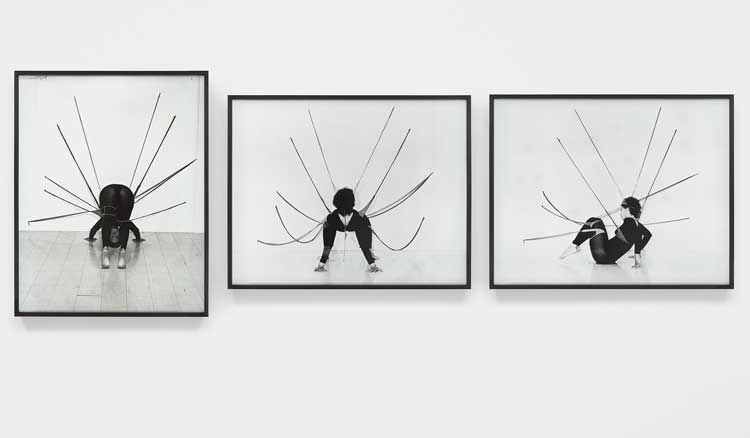
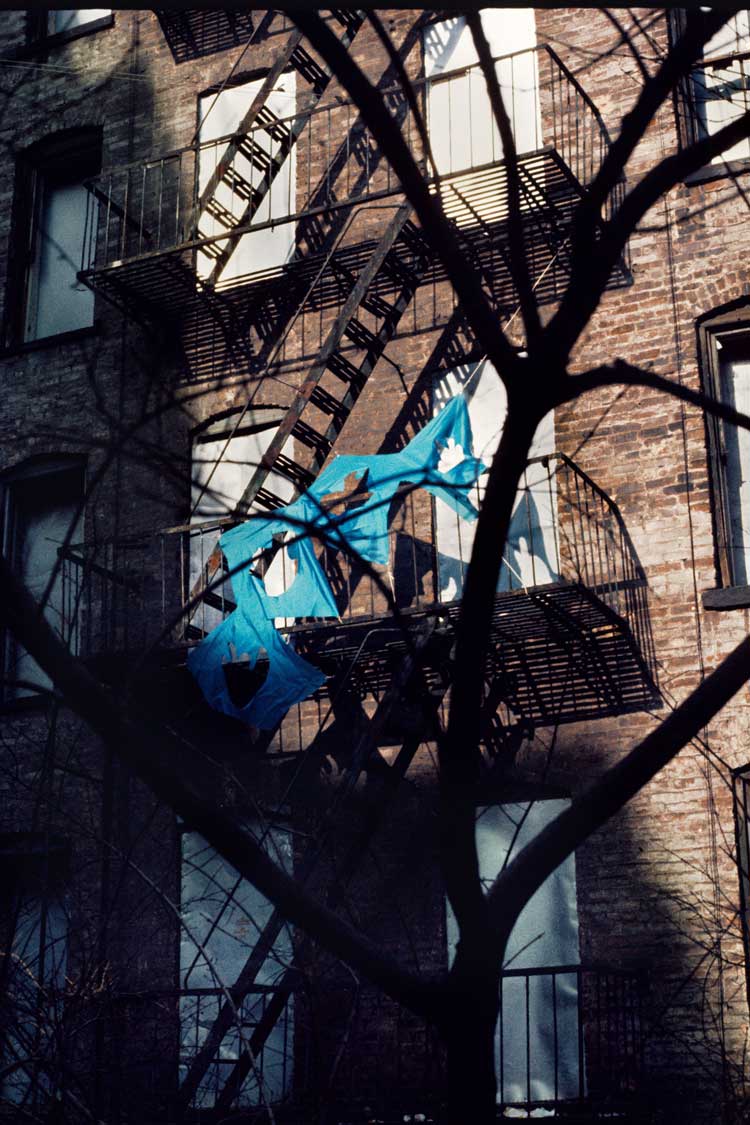
Senga Nengudi, Down (Purple), Red Devil (soul 2), Drifting Leaves, 1972. C-prints, Triptych courtesy of Sprüth Magers and Thomas Erben Gallery, New York. Photo: Doug Harris.
Whitechapel Gallery, London
1 April – 14 June 2026
by BETH WILLIAMSON
Archival exhibitions are always difficult beasts to tackle. It is not easy to be faithful to the artist and the work as it was, while simultaneously bringing it meaningfully alive in the present day. This exhibition is more successful than most in both respects. How? Well, first of all, the work of trailblazing Senga Nengudi (b1943) has had little exposure outside the US. It was only in 2018 that the African-American artist’s first solo institutional show opened in the UK. That expansive exhibition at the Henry Moore Institute, Leeds, then toured to Fruitmarket, Edinburgh, and covered the entire range of Nengudi’s practice. The current archival exhibition at Whitechapel Gallery is more focused, looking with exactitude at a single decade of the artist’s performance work from 1972 to 1982. The reason for showing this now is, we are told, to place the work in dialogue with that of Veronica Ryan (also showing at Whitechapel).
.jpg "Senga Nengudi with Cheryl Banks and Lawrence D.")
Senga Nengudi with Cheryl Banks and Lawrence D. 'Butch' Morris, Air Propo, 1981 (Film still). Single channel video, colour, with sound 10:45 min. Courtesy of Sprüth Magers and Thomas Erben Gallery, New York.
Born in Chicago and raised in Los Angeles, Nengudi trained at California State University in Los Angeles, gaining a BA in art and dance in 1966 and an MA in sculpture 1971. In the period between these degrees, she spent a year at Waseda University in Tokyo studying Japanese culture. Here, she became interested in traditional Japanese ritual practice and in the Gutai group, a contemporary association of avant-garde artists whose main practice concerned action and performance. Bringing performance into her work, she also spent time in New York with artists such as David Hammons and Maren Hassinger, equally sympathetic to this way of working. Collaborating with these artists, creating work typified by experimentation, collective practice and social commentary, Nengudi developed her individual practice to work at the interstice of sculpture, performance and choreography.
,-1972.jpg "Senga Nengudi, Down (Purple), 1972. C-print, 105.4 x 70.8 x 4.8 cm. Courtesy of Sprüth Magers and Thomas Erben Gallery, New York. Photo: Doug Harris.")
Senga Nengudi, Down (Purple), 1972. C-print, 105.4 x 70.8 x 4.8 cm. Courtesy of Sprüth Magers and Thomas Erben Gallery, New York. Photo: Doug Harris.
In the early 70s, Nengudi made what she called “spirit flags” in New York. A tryptic of photographic prints, Down (Purple), Red Devil (soul 2), Drifting Leaves (1972), shows the flag-like forms suspended outside in alleyways and across fire escapes. Her idea was to capture the “spirit” of the people she observed on the streets of Harlem where she lived. This coincided with a heroin epidemic in the US with Harlem particularly affected. She saw people under the influence of the drug, upright but swaying. In a similar way, her flags swayed in the wind and the weather.
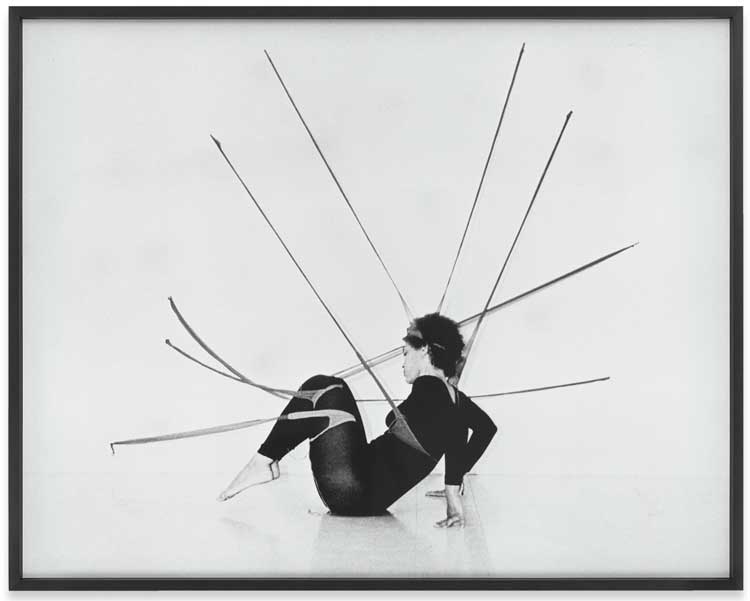
Senga Nengudi, Performance Piece, 1977 (detail). Silver gelatin prints, triptych, overall dimensions, 300.8 x 104.1 cm. Courtesy Sprüth Magers and Thomas Erben Gallery, New York.
Photo: Harmon Outlaw.
Nengudi began appearing in performance works from 1976, bringing her body into dialogue with sculptural forms and elements. At first performing without an audience, she was able to carefully create her presentation through photographs such as in Inside/Outside (1977) where Nengudi creates a work with her body, hosiery and inner tubes from tyres. She conceals her face, as indeed she does in Studio Performance with RSVP (1976). In the latter, Nengudi performs with hosiery to explore her experience of her own body following the birth of her first child. The elasticity of the material enables the artist to reference the body’s fleshiness while investigating its resilience and subversion. In Performance Piece (1977), photographs show Nengudi’s collaborator Hassinger relating to one of Nengudi’s RSVP works. This particular performance was the first public activation of the work.
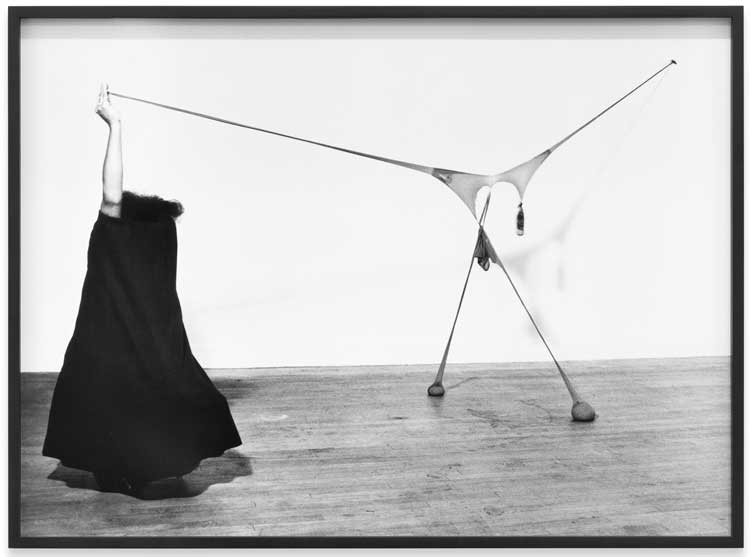
Senga Nengudi, Studio Performance with R.S.V.P., 1976. Silver gelatin print, 76.2 x 104.1 cm. Courtesy Sprüth Magers and Thomas Erben Gallery, New York. Photo: Ken Peterson.
Archival vitrines house informative displays of photographs and ephemera. The first focuses on the artist’s time in New York from 1971 to 1974. It was then that Nengudi began to transform her practice through performance. Even after leaving in 1974, she continued to return frequently for her work. She was a key artist at the gallery Just Above Midtown (JAM) from 1977 where gallerist Linda Goode Bryant foregrounded this sort of work. In Los Angeles, Nengudi and others founded Studio Z, a community of Black artists. They explored experimental forms and non-art spaces such as car parks, pavements and parks to stage performances such as Flying (1982) and Ceremony for Freeway Fets (1978). This focus on public artworks was influenced in part by the Comprehensive Employment and Training Act programme that ran from 1973 to 1982.
Two video pieces populate this archive exhibition too. RSVP, already mentioned, has been activated many times by Hassinger over the years to create an evolving series of sculptural forms that create a space for performance. Most recently, Hassinger activated the work at White Cube in London in 2014. Nengudi regards the performer and the sculptural elements as dance partners, like Fred Astaire and Ginger Rogers. She explained: “What I wanted with the nylons, with RSVP, [was] that the mover would be as sensitive to the sculpture as they would to a dance partner, and the sculpture would then respond to it.” At just over eight minutes long, this video shows the responsive nature of the performance.
.jpg "Senga Nengudi with Cheryl Banks and Lawrence D.")
Senga Nengudi with Cheryl Banks and Lawrence D. 'Butch' Morris, Air Propo, 1981 (Film still). Single channel video, colour, with sound 10:45 min. Courtesy of Sprüth Magers and Thomas Erben Gallery, New York.
In Air Propo (1981), Nengudi performs with the dancer, vocalist and performer Cheryl Banks-Smith and the musician Lawrence D “Butch” Morris. This improvised performance was made for the JAM gallery. Here, Nengudi deploys circular breathing techniques to turn her body into an instrument and in dialogue with Morris’s cornet. It is a high-octane performance with Nengudi bent double due to loss of breath, “losing the self and allowing this other spirit to come through”. She describes the action as a “spiritual endeavour”, and Nengudi’s performance here has me wondering if she is trying to recapture the “spirit” in those early spirit flags, expelling the air from her lungs and seeing where that takes her, enabling a continuous and uninterrupted stream of sound despite everything. Losing the self in the service of performance.
Click on the pictures below to enlarge
,-Red-Devil-(soul-2),-Drifting-Leaves,-1972.jpg)
.jpg)
.jpg)

Copyright © 1893–2026 Studio International Foundation.
The title Studio International is the property of the Studio International Foundation and, together with the content, are bound by copyright. All rights reserved.
 |
 |
 |
|---|
-1000-300.jpg)
 Collection Sandretto Re Rebaudengo: Have you seen me before?
 The Bloomberg Commission: Giuseppe Penone
 Rothko in Britain
 The British Council Collection; Passports
 Sophie Calle: Talking to Strangers