




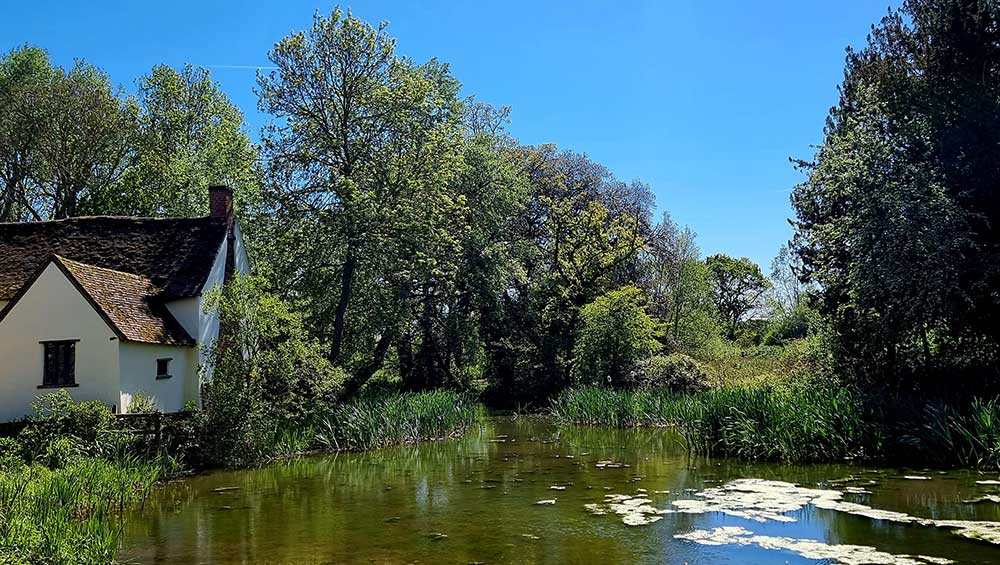
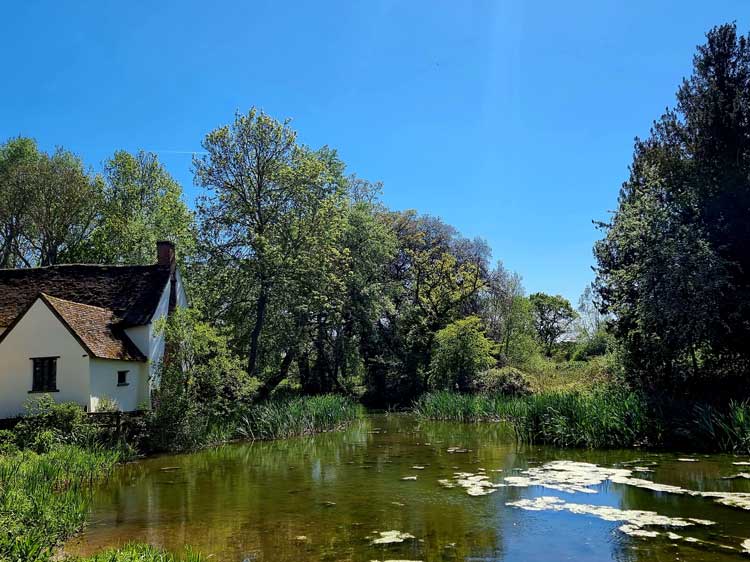
The Hay Wain view, Flatford Mill, Suffolk, 2026. Photo: Juliet Rix.
Multiple Venues, Suffolk, UK
Spring 2026 onwards
by JULIET RIX
This year, 11 June, marks 250 years since the birth of John Constable (1776-1837), one of the UK’s most famous artists and one of its most English. The anniversary is being celebrated in his native Suffolk with a variety of exhibitions about the artist, those who influenced him and those he has influenced. Suffolk’s “Constable Country” was so-called even in his lifetime. He was born in East Bergholt, educated in Dedham (just over the Essex border) and Lavenham, and was a regular visitor to his father’s mills at Flatford and Dedham on the River Stour. Although Constable spent time in London, he returned constantly to this area of Suffolk throughout his life, and this landscape provided the subject and setting for his most successful and popular works.
The Suffolk countryside was Constable’s muse (“The sound of water escaping the mill dams … willows, old rotten banks, slimy posts, and brickwork. I love such things … As long as I do paint I shall never cease to paint such places”). It was also his family home, and Christchurch Mansion in Ipswich is kicking off the year’s celebrations with an exhibition, Constable: A Cast of Characters, in which we meet the artist’s relatives, friends and mentors, as well as discovering personal items including his paintbox and two locks of his baby hair.
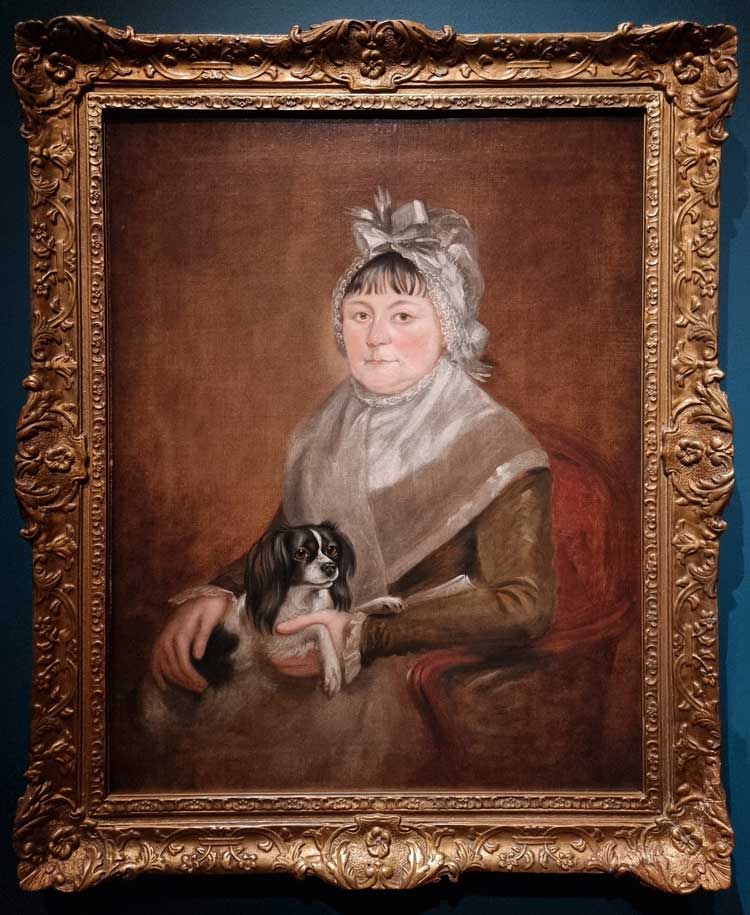
John Constable. Ann Constable (1748-1815), c1800-05. Oil on canvas, 110 x 90 x 6.5 cm. Colchester and Ipswich Museums Service: Colchester City Council Collection. Photo: Juliet Rix.
The show starts appropriately with portraits of his parents: his father, mill owner Golding Constable (1739-1816) painted by Daniel Gardner (1750-1805) in 1804-05 (previously attributed to John Constable); his mother Ann (1748-1815) in an evidently early portrait by her son probably made soon after he became a student at the Royal Academy in 1800. His parents reluctantly accepted John’s desire to become an artist and his mother encouraged him to work in the more lucrative genres of portraiture and religious paintings. Occasionally, when bills had to be paid or he needed to curry favour with a mentor, he followed her advice.
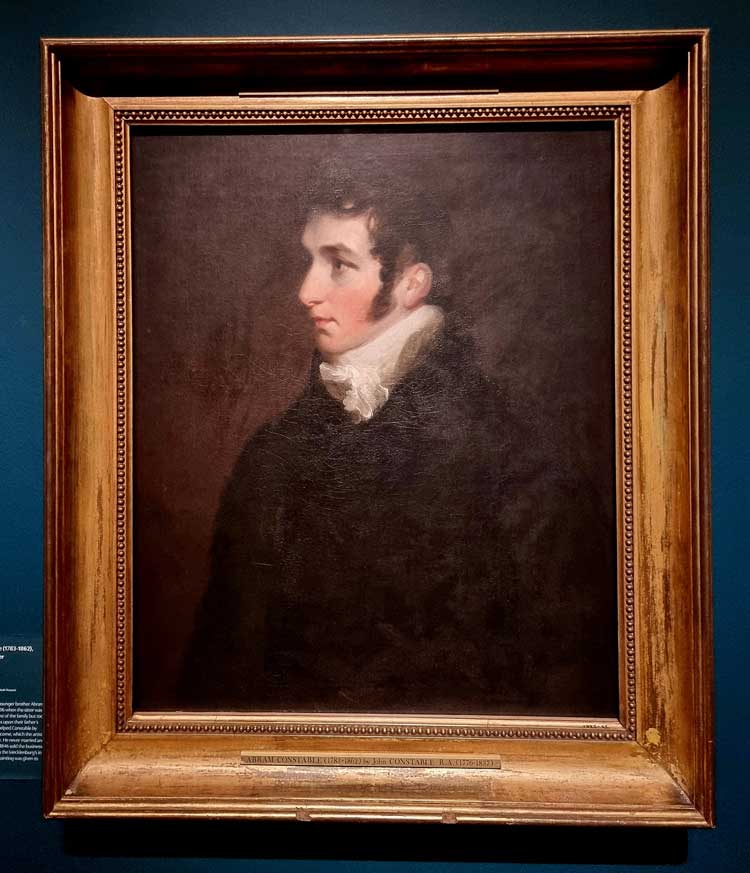
John Constable, Abram Constable (1783-1862), the artist's brother, c1806. Oil on canvas, 76 x 63.5 cm. Colchester and Ipswich Museums Service: Ipswich Borough Council Collection.
Constable was the fourth of six children and the second of three sons. His elder brother seems to have had a mental disability of some kind and so John was supposed to take on the family milling business. It was soon clear that John was determined to be an artist and, fortunately for him, the youngest son, Abram (1783-1862), was willing and able to take over the family business when their father died. Abram remained in their home area of Suffolk all his life and his management of the family finances enabled Constable to be an artist. We meet Abram here in an 1806 portrait by his brother in which the family resemblance is clear.
The most touching of John Constable’s depictions of his family are a handful of rarely seen sepia sketches of his children, lent from a private collection. Even Sasha Constable (the artist’s great-great-great-granddaughter) who has sculptures in the exhibition, had never seen them before and, unfortunately, we are not allowed to reproduce them. They are, though, wonderfully tender, particularly one dated 1831 of Constable’s daughter Maria Louisa known as Minna (1819-1885) with her baby brother Lionel (1828-1887) curled sleepily in her arms.
Lionel was only six months old when Constable’s beloved wife, Maria, died of TB leaving him sole parent of seven children under 12. It is clear from his images and his writings, that Constable was a loving father. His attachment to family may have been one reason why, despite the greater admiration for his work in Paris than in London, he was not lured to France (“I would rather be a poor man [in England] than a rich man abroad”). In addition, of course, to his love of the Suffolk countryside.
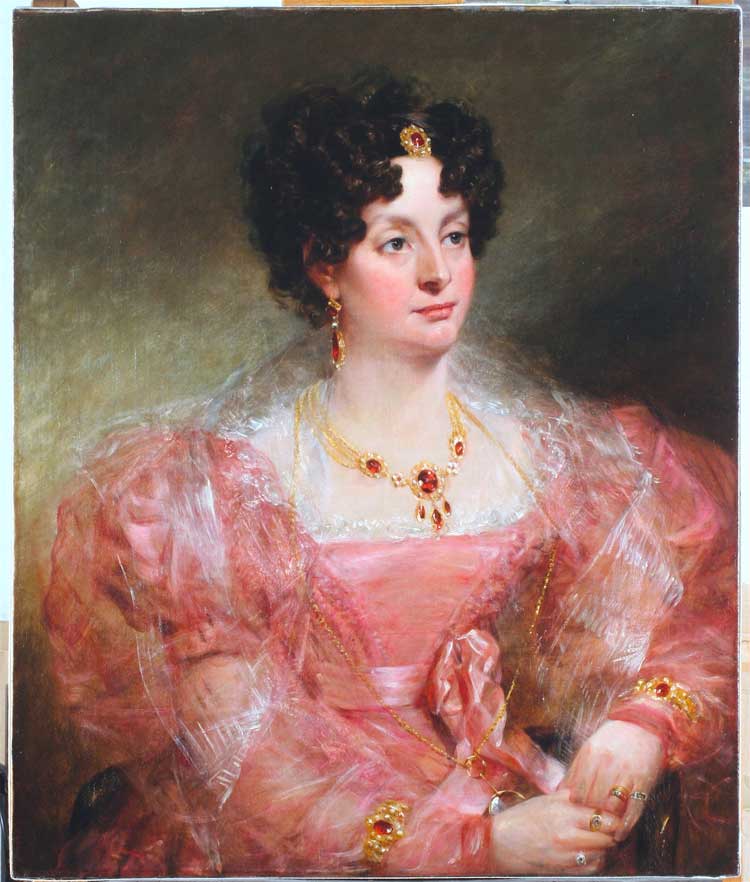
John Constable. Emily Treslove (1783-1865), 1826. Oil on canvas, 104 x 90 cm (framed). Sarah Cove ACR, Constable Research Project.
Among pictures of mentors, friends and neighbours in this show, are a couple of particularly accomplished portraits quite unlike anything we might normally associate with Constable. The most striking is the portrait of Emily Treslove, a neighbour of Constable’s in his London home in Charlotte Street. Dressed in a shimmering pink dress, garnet jewellery (a piece of which is in a display case nearby) and sheer silk gauze catching the light, Mrs Treslove looks more Van Dyck, good-day Gainsborough or John Singer Sargent than Constable. Clearly, he could do this when he needed to, and she paid him 40 guineas for the picture in 1826, writing at the time that: “My husband thinks it resembles me very much.” In 1829, however, she returned for a further sitting to make “alterations”, recently revealed to have been a thinning of her face, adjustments to her hairstyle and removal of a slight double chin. A little “Photoshopping” is nothing new.
-The-National-Gallery,-London.jpg "John Constable, The Hay Wain, 1821. Copyright The National Gallery, London.")
John Constable, The Hay Wain, 1821. Copyright The National Gallery, London.
This portrait was painted as Constable’s star began to rise following the success of The Hay Wain (which had failed to sell at the RA in 1821) at the Paris Salon of 1824 where King Charles X of France awarded it a gold medal. This most famous of Constable’s “six-footers” will be coming from its usual home in London’s National Gallery to Christchurch Mansion for the next exhibition in its Constable 250 series, The Hay Wain: Walking Constable’s Landscape). This will be the painting’s first visit to the county it depicts since, despite showing the mill pond at Flatford and the home of tenant farmer Willy Lott (both of which are still there as part of an open National Trust site). The Hay Wain was painted entirely in London.
Constable used memory, imagination and earlier studies of the area, which he had visited many times for “skying” (observing the sky and light) and sketching. To complement these, he asked John (Johnny) Dunthorne (1798-1832) for a sketch of a harvest cart (haywain). Dunthorne, Constable’s one and only studio assistant (whose home in East Bergholt, owned by the Constables, still stands very close to Constable’s birthplace and family home) duly made the sketch and sent it to London. We see Dunthorne himself in the “Characters” exhibition in a tiny self-portrait. He was an artist in his own right, exhibiting at the Royal Academy in 1827, but died young. Dunthorne’s father (also John), a carpenter, plumber and glazier in the village, was an important early artistic mentor for Constable whose family was not artistic. To the disapproval of snobbier locals, the “socially inferior” Dunthorne snr took the younger Constable sketching in the Suffolk countryside and they corresponded regularly when Constable was in London.
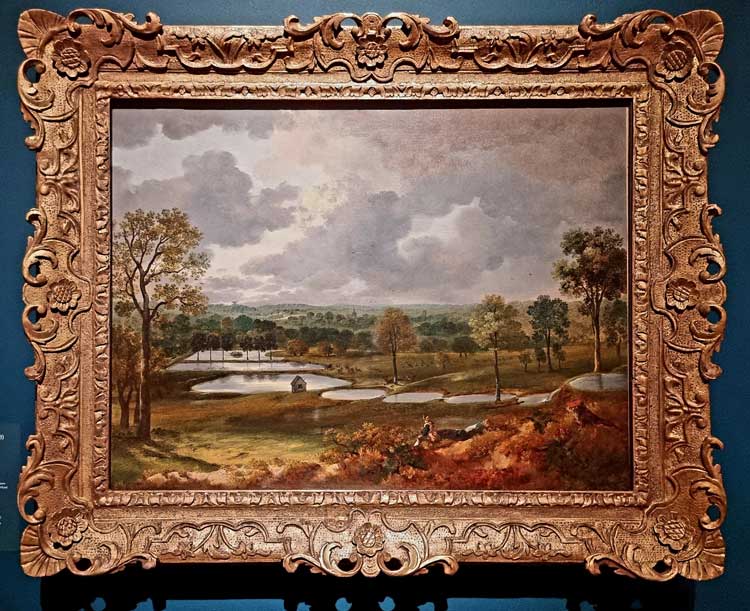
Thomas Gainsborough, Holywells Park, c1750-1755. Oil on canvas. Colchester and Ipswich Museums Service: Ipswich Borough Council Collection.
Influential, too, on the young Constable was an established Suffolk artist of the previous generation (who also came from a non-artistic background) – Thomas Gainsborough (1727-88). Gainsborough is best known for his portraits, but like Constable he did these primarily for money (which he needed to earn more than Constable, coming from a less financially secure background) while preferring to paint landscapes.
In the Characters exhibition, we find two Gainsborough landscapes: a reflective (in all senses) scene of ponds in Holywells Park (c1748-50) – which can still be seen in the now-public park – and View near the Coast (1750-55), a pastoral scene by water with a church spire strategically placed to provide some verticality in the landscape. The connection with Constable is not hard to see and we know that the younger artist sought out opportunities to study Gainsborough’s landscapes in private collections in Ipswich.
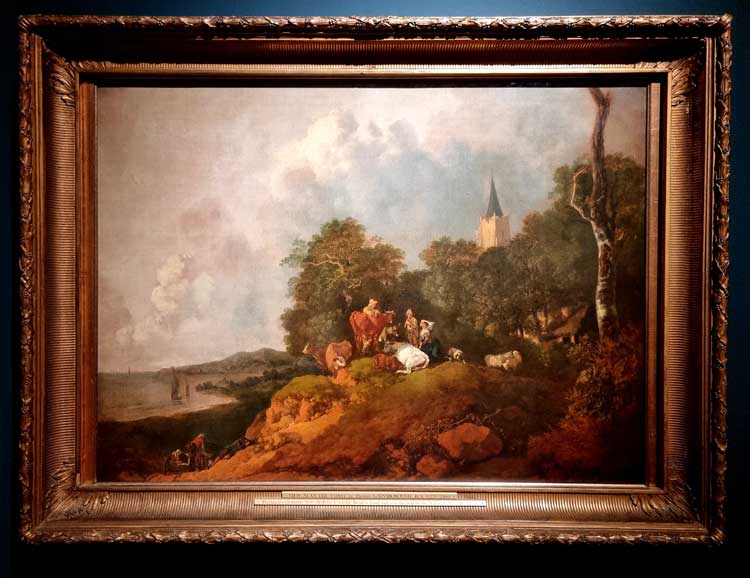
Thomas Gainsborough, View near the Coast, c1750-1755. Oil on canvas. Colchester and Ipswich Museums Service: Ipswich Borough Council Collection.
Gainsborough grew up in Sudbury (at the other end of the Stour Valley from Flatford Mill) where the family home is now Gainsborough’s House – house museum, art gallery and home to one of the most comprehensive collections of all things Gainsborough as well as the Constable family archive. A room here is permanently dedicated to Constable and for his 250th anniversary there are also three small temporary exhibitions. One is historic, Gainsborough, Turner and Constable: Inventing Landscape, and two contemporary, Remember Tomorrow by Kate Giles and Land, Sky, Light: New Landscapes by David Dawson.
In one room are six large-scale works by Dawson (b1960) – long-time assistant to Lucian Freud, with whom he shared a passion for Constable. All are of Montgomeryshire, Wales, where Dawson grew up on a hill farm and to which he returned after Freud’s death (“Dawson country”, if you will). Akin to Constable’s six-footers in scale and in their depiction of working landscapes, Dawson’s paintings peak with the most recent work, especially the gloriously lively Winter Feed (2025) full of colour, depth and a remarkable combination of calm and vibrancy.
20260504_JR.jpg "David Dawson, Winter Feed, 2025. Photo: Juliet Rix.")
David Dawson, Winter Feed, 2025. Photo: Juliet Rix.
In fact, you could apply to it something Constable said of one of own six-footers, The Leaping Horse (1825), which he described as: “lively – & soothing – calm and exhilarating, fresh – & blowing”. It is, though, East Anglian painter Giles (b1962) whose work directly quotes this Constable painting. Along with a selection of smaller semi-abstract landscapes responding to Constable works or Constable Country with bold brushstrokes and dominant skies, her show includes two large canvases – Leap (Noonday) (2026) and Leap (Nightjar), ( 2025). These are variations on The Leaping Horse, somewhat abstracted and in different lights. The Constable painting itself is at Gainsborough’s House, too, on loan from the Royal Academy. This calm-lively six-footer is the centrepiece of the Constable 250 Inventing Landscape exhibition. Set on the River Stour between Flatford and Dedham, it has Dedham Church in the background, just as you see it if you walk or boat along the river today, though in a slightly different position. Constable frequently repositioned churches for the best compositional effect; he painted “natural” landscapes but was a Romantic not a realist. “Painting is but another word for feeling,” he said, so he happily took artistic licence.
-20260501_jr.jpg "Kate Giles. Leap (Nightjar), 2025. Photo: Juliet Rix.")
Kate Giles. Leap (Nightjar), 2025. Photo: Juliet Rix.
The Inventing Landscape exhibition brings together smaller paintings and prints by a variety of landscape artists showing where Gainsborough began and Turner and Constable followed. There are lesser-known works by all three titular artists including a couple of Constable cloud studies and an interesting 1830s oil sketch of his favourite non-Suffolk subject, Salisbury Cathedral, where he regularly stayed with his great friend the Reverend (later Archdeacon) John Fisher, the nephew of the Bishop of Salisbury, one of his important patrons. This sketch is carefully worked, possibly in preparation for a print by his mezzotinter David Lucas. It is a particularly dark version of the subject, a lowering sky reflective of his feelings after the loss of his wife in 1828 and his friend Fisher in 1832.
Gainsborough, Turner and Constable all looked to the work of Claude Lorrain, to whom Constable referred as “the inimitable Claude”. Included here is the earliest known copy by Constable of a Lorrain print, A Classical Landscape after Claude Lorrain (1795), made five years before Constable joined the Royal Academy Schools. There are some luminous Turner watercolours, too, including Lichfield Cathedral (c1832), which sets sunset-warm stone against blues of sky and water, reflections blurring the boundaries between them. Also, the cooly lit Abergavenny Bridge, Monmouthshire: Clearing Up After a Showery Day (1799), one of several works Turner exhibited at the RA in 1799 that helped get him elected an Associate a year before Constable even joined as a student.
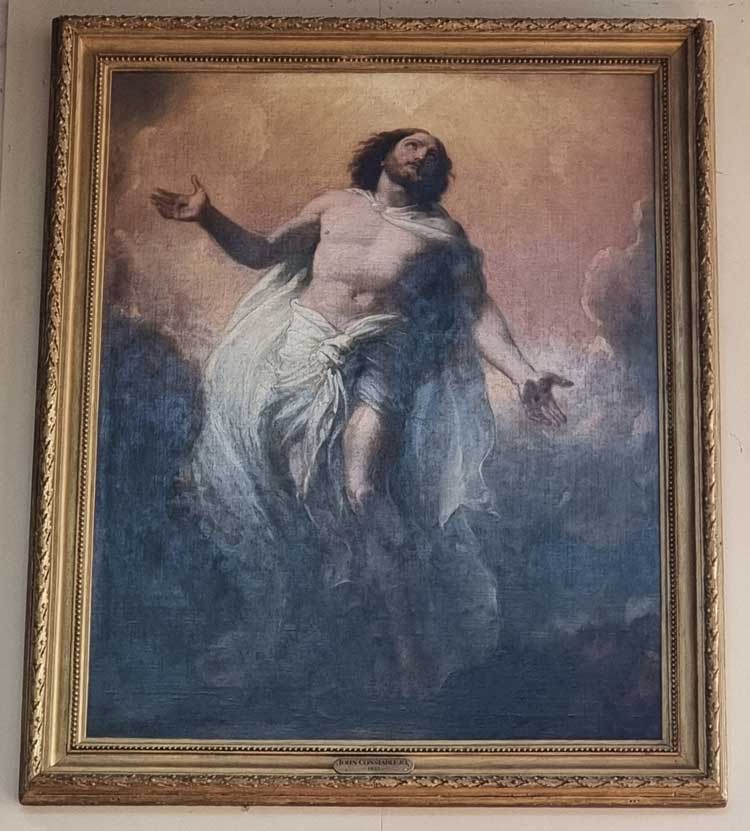
John Constable, The Ascension, Dedham Church, commissioned 1821, installed 1822. Photo: Juliet Rix.
At the RA Schools, Constable quickly found he preferred life drawing to sketching casts of classical sculpture. There are some gentle, markedly unprurient sketches of female nudes in the Characters show, and in the Gainsborough House Constable room is a striking painted study from an RA life session. A male nude in a twisted pose taken from a Michelangelo figure in the Sistine Chapel, it is an unexpected Constable, but somewhat reminiscent of another work we would not normally associate with one of the nation’s favourite landscape painters. Constable painted just three religious pictures, and in The Ascension, hung high in Dedham Church, a bare-chested Christ (frankly slightly less lively than the study) rises from a dark swirl of Constable clouds to a warmer, brighter clouds above.
The church lies next to Constable’s grammar school (the building is still there) and a short way from the Munnings Museum, in the Dedham house and studio owned by Alfred Munnings (1878-1959), president of the RA from 1944 to 1949. Munnings was involved in saving Gainsborough’s House and instrumental in protecting Constable Country from development in the 1940s, becoming the first president of the Dedham Vale Society.
Munnings, best known for his paintings of horses (for which he was lucratively commissioned), was an accomplished but conservative painter. A vociferous critic of modernism (“If you paint a tree, for God’s sake try to make it look like a tree”), he yearned for soul-soothing depictions of nature which he identified with Constable and one room in the museum is dedicated this season to Constable’s undoubted influence on him.
When she first opened the house to the public soon after Munnings’s death, his wife Lady Violet (a colourful character who carried her little black dog everywhere, first alive then stuffed) said she believed her husband was a reincarnation of Constable. Munnings may have loved the same landscapes and channelled some of Constable’s artistic preferences, but in character they were different. Constable was not a backward-looking artist; he was quite revolutionary in his time and has been credited with playing a part in the birth of impressionism, a movement much criticised by the Munningses of its day.
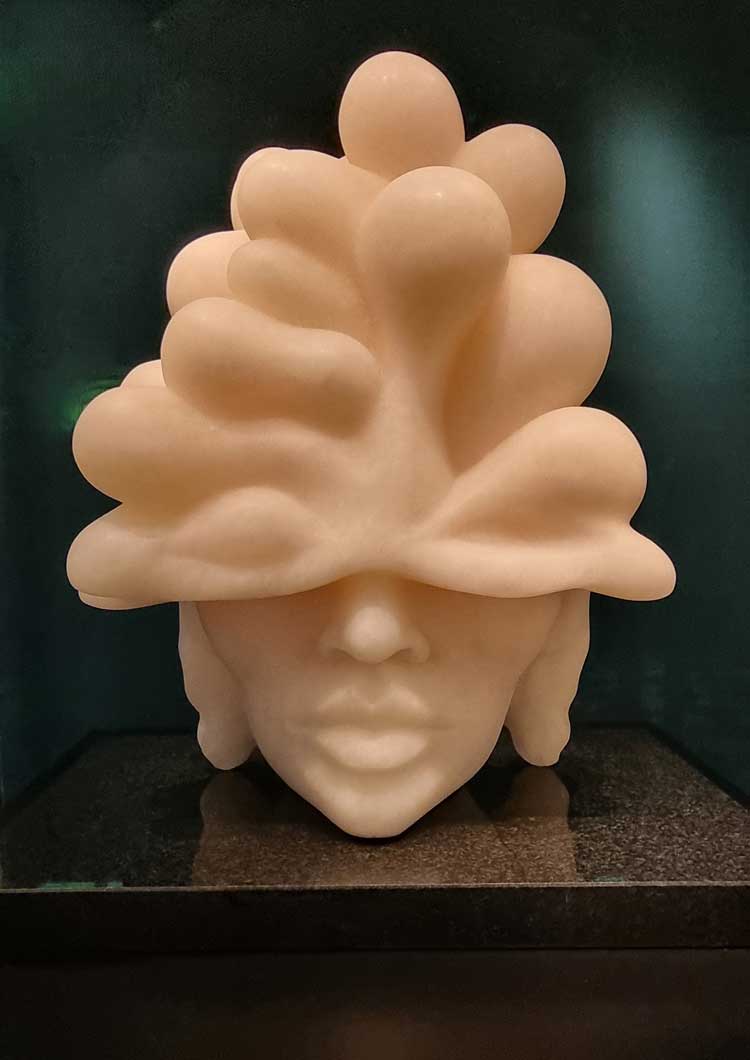
Sasha Constable, Under Cumuli, 2022. Pink alabaster and polished granite base, 41 x 40 x 25 cm. © Sasha Constable.
Constable’s influence doesn’t stop with Munnings, or indeed Freud, Dawson or Giles. Christchurch Mansion’s final exhibition of the Constable 250 year will be Constable to Contemporary, displaying work by local artists, professional and amateur, inspired by Constable. Its current Characters exhibition, meanwhile, gives us a glimpse of the next generations of Constables. Several sculptures are on show by Sasha Constable, direct descendent of John Constable’s third child, Charles Golding, the only one of his children to marry. There has been at least one artist in each generation, she says, and her work here includes Under Cumuli (2022), a pink alabaster head with bubbly clouds above it. It is described as a comment on the weight of anxiety experienced by so many during the Covid pandemic, but one can’t help, in the context, also associating it with Constable’s clouds. Here, too, is Beneath the Surface (2025-26) which riffs on Constable’s painting The Cornfield, in which a boy lies on the edge of a stream to drink. “Would you let a child drink from our streams at the moment?” Sasha asks, explaining that the sculpture shows her son, Valya Constable, submerged in a bubbly stream with salmon spawn indicating the clean water we so desperately need. Taking the family links to the youngest generation is an intriguing and remarkably accomplished drawing of a pair of legs by Valya, accepted for the children’s RA Exhibition when he was seven.
I wonder what will be in the exhibitions for Constable 300?
• Constable: A Cast of Characters, 28 March – 14 June 2026; The Hay Wain: Walking Constable’s Landscape, 11 July – 4 October; and Constable to Contemporary, 24 October 2026 – 28 February 2027 are at Christchurch Mansion, Ipswich, as part of Ipswich Museums’ Constable 250 Exhibitions.
• Gainsborough’s House Constable 250 exhibitions, Gainsborough, Turner and Constable: Inventing Landscape, Remember Tomorrow by Kate Giles and Land, Sky, Light: New Landscapes by David Dawson, run from 25 April – 4 October.
•The Influence of John Constable is at the Munnings Art Museum, Dedham, 1 April – 25 October.
Click on the pictures below to enlarge

Copyright © 1893–2026 Studio International Foundation.
The title Studio International is the property of the Studio International Foundation and, together with the content, are bound by copyright. All rights reserved.
 |
 |
 |
|---|

-1000-300.jpg)
 Sussex Landscape: Chalk, Wood and Water
 Frick Madison provides temporary home for the Frick Collection
 Constable and Brighton
 Constable: The Making of a Master
 A Dialogue with Nature: Romantic Landscapes from Britain and Germany