




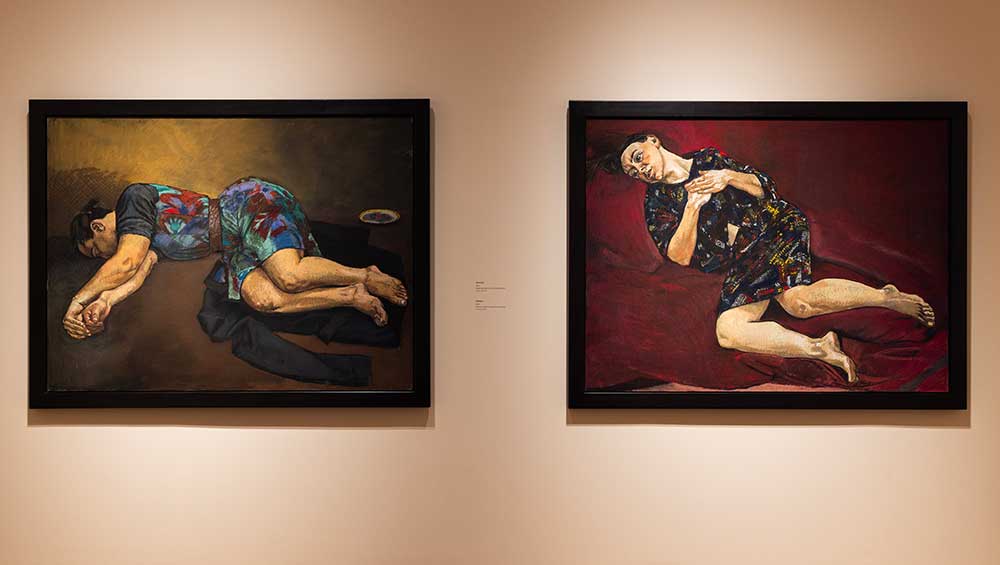
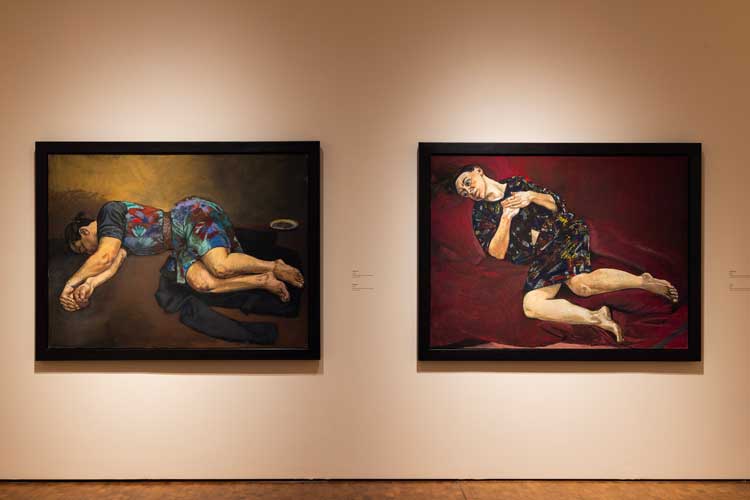
Installation view, Paula Rego: Dance among Thorns at Munch, Oslo, 2026. Photo: Ove Kvavik © Munchmuseet.
Munch Museum, Oslo
24 April – 2 August 2026
by CHRISTIANA SPENS
In The Dance (1988), a group of people move together on a moonlit beach where an ominous dark cliff-face looms up behind them: a man gazes sideways a little sinisterly, a woman dances along, others dance amid their long shadows on the chalk-blue ground. This is the scene that meets visitors to the new Paula Rego retrospective in Oslo’s Munch Museum, which stands on the edge of a deep blue fjord, bathed in fresh spring light. Held in a darker room, this painting presents a striking and encompassing vision, a shadow of the outside world – somewhat mystical on account of the full moon, and this sets the tone for our immersion in the fantastical and at times disturbing world that Rego created. It draws us in from the light outside, inviting us to this melancholic dance, with characters who seem at once strange and familiar, as if we have met them in a dream we can only just remember.
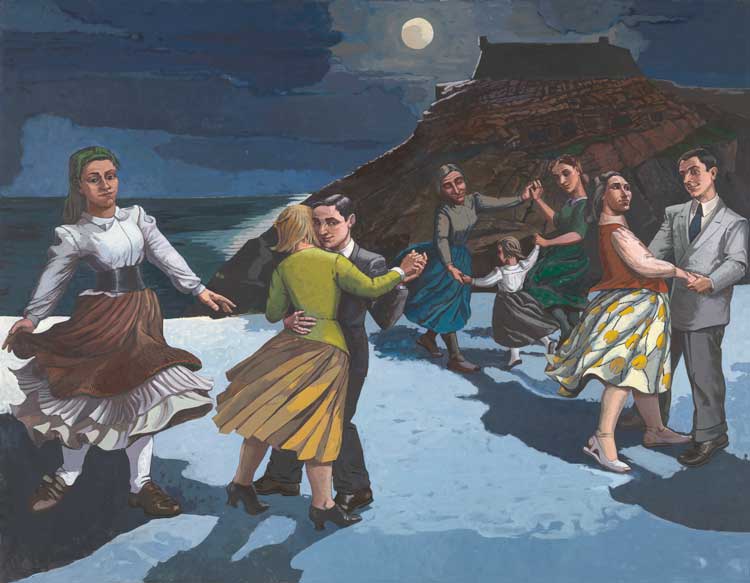
Paula Rego, The Dance, 1988. Acrylic paint on paper on canvas, 212.6 ×274 cm. Copyright: © The Estate of Paula Rego. Tate: Purchased 1989. Photo: Tate Images.
Paula Rego (1935–2022) was born and grew up in Portugal, on the coast of which this scene is set, but she moved to London as a teenager, took up a place at the Slade, and continued to live in the city until her death. It was during her teenage years that she became aware of some of the great painters, and Dance Among Thorns shows the influence that Edvard Munch (1863–1944), in particular, had on the young artist. This serves partly to introduce Rego’s work to a Nordic audience, to whom she is not that well known.
Some of Munch’s drawings and prints appear next to Rego’s larger works, almost like visual footnotes. These references do not overshadow the focus on Rego though, and Munch’s The Dance of Life (1899-1890), which Rego’s The Dance echoes, hangs a floor below, so that visitors will need to explore the floors of Munch paintings after they have seen this one (a welcome obligation for most). This subtle waltz between the two artists creates a sense of camaraderie, speaking to the emphasis that Rego placed on the relationships between people, whether loving or tense (or both); her probing of complex power dynamics, explicit and repressed. With more than 140 artworks, this is a vast exhibition. As we explore each room, in which striking characters look at us, or away from us, from their frames, the feeling is of communality, for better or worse, and the ways in which people rub up against one another, confront one another, merge and dance and hide. The rhythm of this dance pulses gently through each room so that, by the end, we are a part of it.
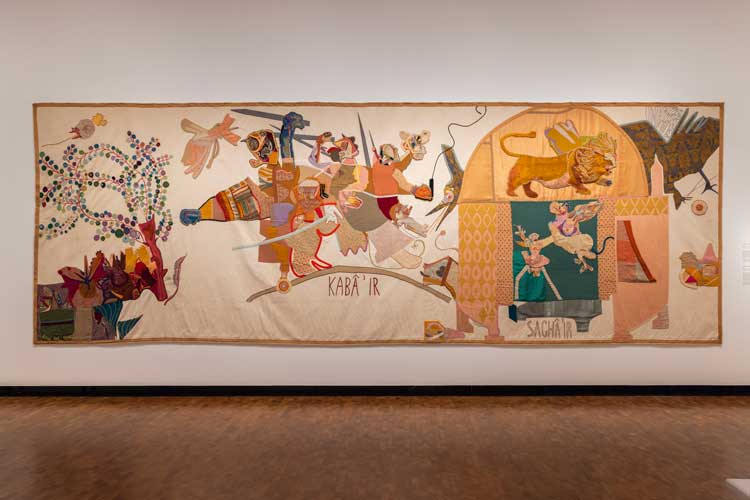
Paula Rego, Battle of Alcácer Quibir, 1966. Mixed-media tapestry, 250 x 650 cm. Installation view, Paula Rego: Dance among Thorns at Munch, Oslo, 2026. Photo: Ove Kvavik / © Munchmuseet.
In the first main room is a series of Rego’s early political collages, which I had not seen before. These large textile collages are impressive and cocoon-like, and the overtly political critique and her use of traditionally female materials give an interesting context to her more figurative works from later in her career. For the Battle of Alcácer Quibir (1966), for example, made of wool, silk, cotton and other fabrics, Rego took as her starting point the 1578 battle in which the Portuguese army under the young King Sebastian I was trounced by Moroccan troops, with 8,000 dead on the Portuguese side including the king. It is an example in which the visceral is mixed with the soft and grounds her later output, which she would refine over time, in painting, drawing, printmaking and puppetry.
Political critique combines with Rego’s depictions of female experience throughout the exhibition, and though the parallels between Munch and Rego are interesting and fitting, my interest was caught by some of the more obscure works. Rego made the series O Vinho (The Wine) in 2007, after a Portuguese winemaker approached her to create a series of wine labels, ostensibly to promote the product. Rego, however, created lithographs that – with a devastatingly satirical edge – laid bare the negative social consequences of alcoholism in Portugal at the time, and particularly its effect on mothers who turned to drink to self-medicate their exhaustion and chronic stress. In playful colours, Rego shows a series of scenes: in Two Loves, a woman cradles a wine bottle while her baby plays at her feet; in Feeding Time, two women seem to have passed out while a baby sits lopsided in a highchair, and in Nursing, a woman feeds her baby a bottle of wine. In Just Too Much, her depiction of a woman vomiting into a sink takes a grotesque turn. Unsurprisingly, the wine company was far from happy with Rego’s images.
.jpg "Paula Rego, Untitled no. 3, 1998. Pastel on paper on aluminium, 110 ×100 cm. Copyright: © The Estate of Paula Rego. Private Collection.
Photo: Courtesy The Estate of Paula Rego and Victoria Miro.")
Paula Rego, Untitled no. 3, 1998. Pastel on paper on aluminium, 110 ×100 cm. Copyright: © The Estate of Paula Rego. Private Collection.
Photo: Courtesy The Estate of Paula Rego and Victoria Miro.
Though these lithographs are just one small part of this vast show, they encapsulate her brilliance at exposing the grim social realities of lives hardened by relentless emotional labour, and the gender inequality underpinning them. Elsewhere in the show, the Untitled (The Abortion series) (1998), which Rego produced in protest at her home country’s oppressive reproductive laws at the time, shows women enduring backstreet abortions with pain and resilience. These issues are still relevant, and her wider capturing of the sheer pain and mundanity of female experiences that usually remain hidden and taboo is a great draw of her work. Like Munch, she manages to communicate the essence of emotional states shared by many but so often overlooked or repressed.
There is so much to celebrate in this show (indeed, too much to write about in a single review); the Munch Museum has managed to give space to the many works included here in such a way that visitors can truly explore them, finding their way to whatever personally interests them, but within a wider atmosphere of celebration and strength that the initial focus on dance sets up. There are also large pastel drawings of dancers, Dancing Ostriches from Walt Disney’s Fantasia (1995), stubbornly planting their feet in pointe shoes; fairytale characters rebelling and pouring out their stories and in subversive, grotesque ways, but with the playfulness of costume and folklore balancing out these darker aspects. I was drawn to the weird puppets Rego produced which, with their garish clown faces and bulging, fabric limbs, appear to be protesting their very existence.
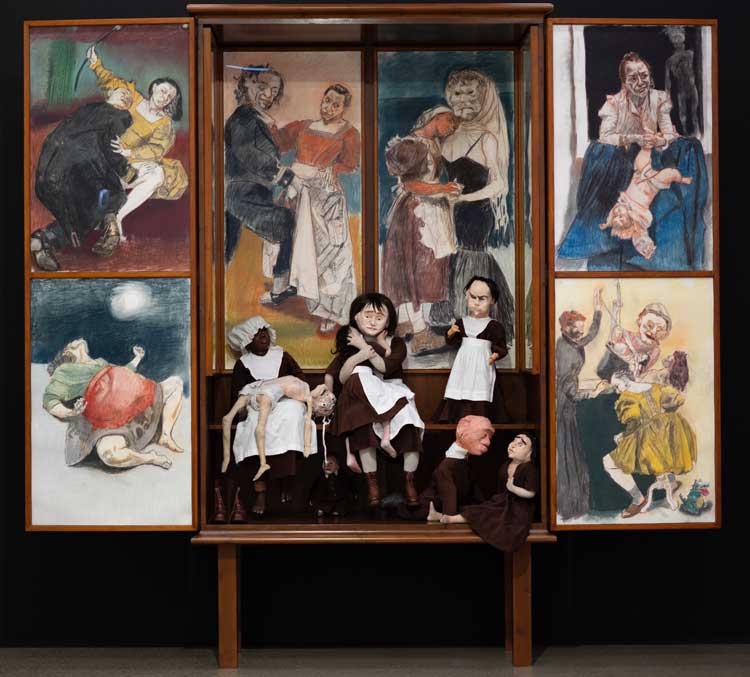
Paula Rego, Oratorio, 2009. Wood cabinet; conté pencil and pastel on paper; papier mâche and fabric, 332 ×349 × 81.9 cm overall. Copyright: © The Estate of Paula Rego. Courtesy The Estate of Paula Rego and Victoria Miro
Photo: Courtesy The Estate of Paula Rego and Victoria Miro.
Rego produces a carnival of human experience that is at once relatable and, despite everything, gleefully humorous. While this dance of life may at times be grotesque and horrific, the pace and energy of the dance itself, and Rego’s paintings that somehow capture this rhythm, err towards a kind of rebellious, sick joy in the midst of it all. Munch Museum’s retrospective sees this spirit in her work and presents it in such a way that it is hard to resist leaning into her dark fairytales.
Click on the pictures below to enlarge

Copyright © 1893–2026 Studio International Foundation.
The title Studio International is the property of the Studio International Foundation and, together with the content, are bound by copyright. All rights reserved.
 |
 |
 |
|---|

-1000-300.jpg)


 All Too Human: Bacon, Freud and a Century of Painting Life
 Vanessa Baird: You are Something Else
 Paula Rego: The Boy Who Loved the Sea and Other Stories
 Strange Worlds: Visions of Angela Carter
 Witches and Wicked Bodies