




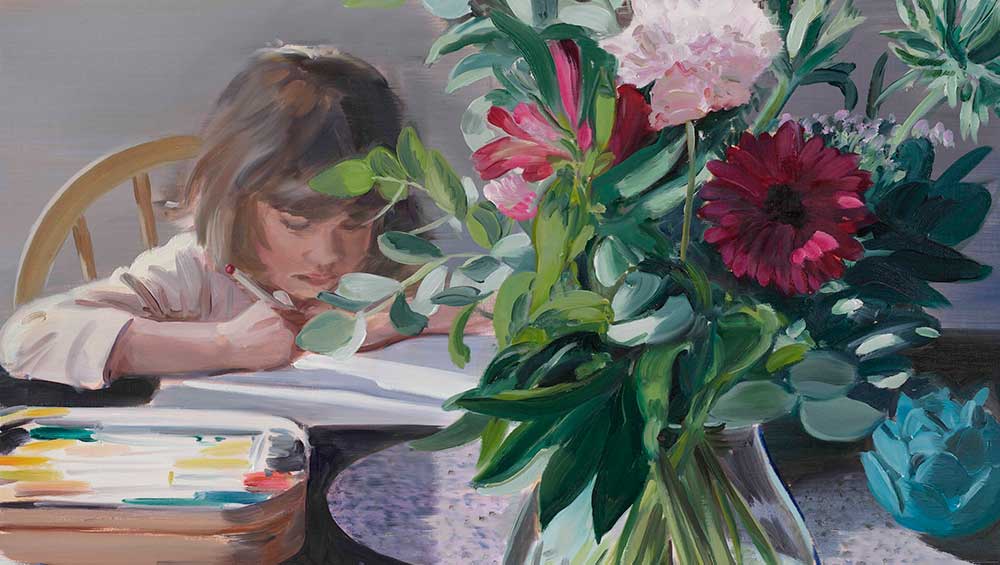
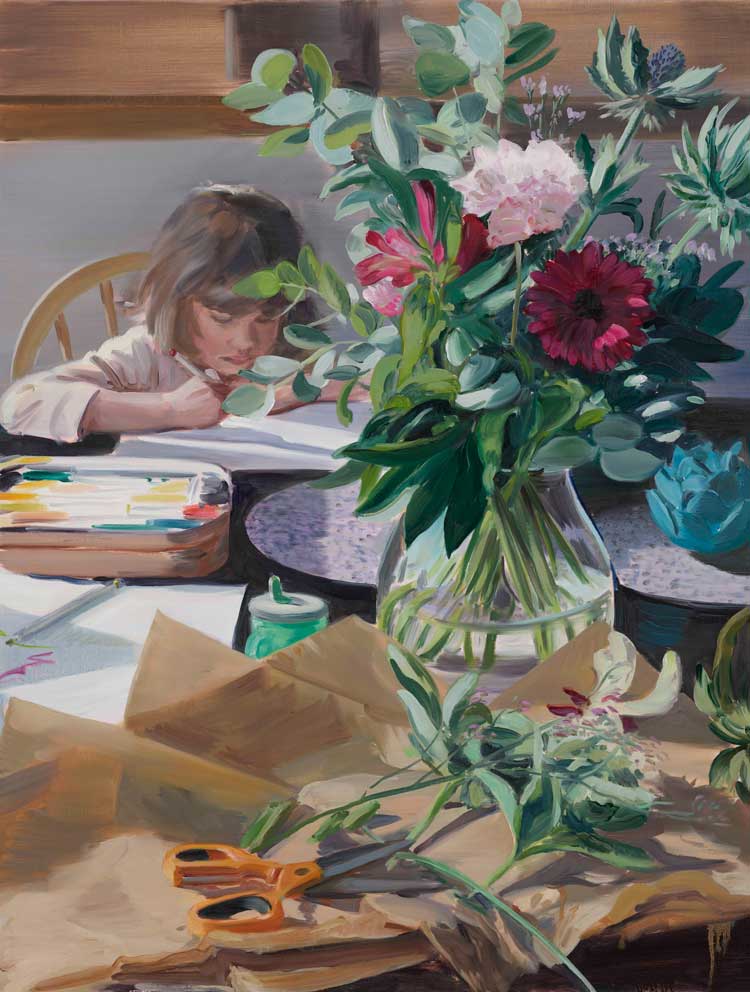
Caroline Walker, Kitchen Table, 2025 (detail). Oil on canvas. © Caroline Walker, Courtesy the Artist; GRIMM, Amsterdam / New York / London; Ingleby Gallery, Edinburgh; and Stephen Friedman Gallery, London and New York Photo: Isla Macer Law.
Kettle’s Yard, Cambridge
25 April – 6 September 2026
by ANNA McNAY
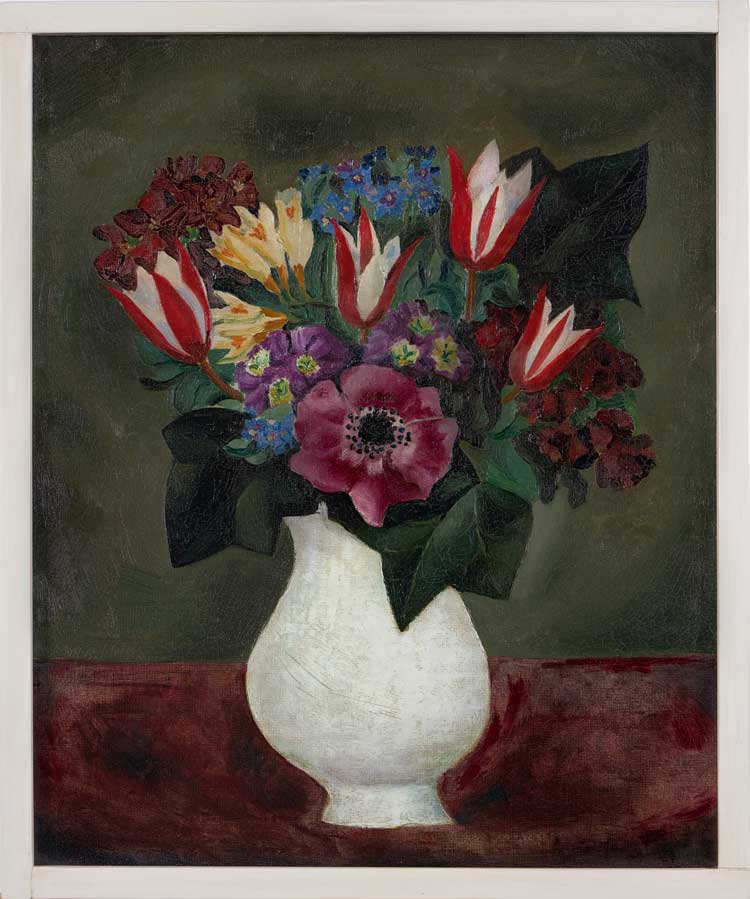
Fresh-cut flowers have always played an important part in the history of Kettle’s Yard house: Jim and Helen Ede, who lived there and amassed the gallery’s fantastic modernist art collection, rarely left a room without a small bouquet or posy. Today, this tradition is carried on by a volunteer team. In fact, the pleasure brought by the presence of flowers is such that even shelves introduced for hand gel during the Covid pandemic have now been repurposed as extra placements for vases. The current exhibition, Handpicked: Painting Flowers from 1900 to Today, does what it says on the tin; through a display of paintings by 46 artists, eight of whom have made new works especially, it showcases flower painting from the last 125 years and was inspired by the omnipresent cut flowers as much as by significant works in the collection, including Christopher Wood’s Flowers (1930) and Winifred Nicholson’s Cyclamen and Primula (c1923) (neither of which are included, but can be seen in the house).
While this might all sound simple, as Andrew Nairne, the director of Kettle’s Yard, pointed out in his introductory speech: “It’s not just about flowers!” Indeed, a rose is never just a rose – there are always associated emotions or memories or stories. These, too, are brought out in the two-room exhibition, just as they are, too, in the accompanying catalogue, which will have a life beyond the show as an anthology of paintings and flowers.
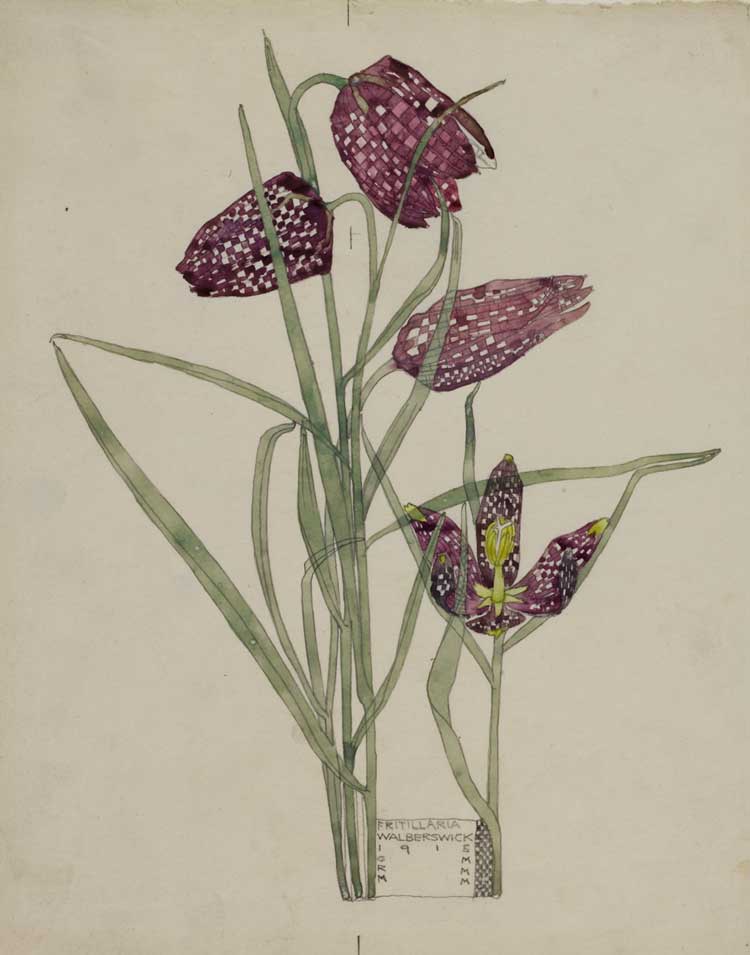
Charles Rennie Mackintosh, Fritillaria, 1915. Watercolour and pencil on paper, 25.3 x 20.2 cm. © The Hunterian, University of Glasgow.
The first room focuses on paintings from the 20th century, hanging on botanically inspired green and cream walls. Some of the pictures are scientifically accurate; others explore artistic licence and freedom of expression. A quote from Charles Rennie Mackintosh welcomes visitors, declaring: “Art is the flower – Life is the green leaf. Let every artist strive to make his flower a beautiful living thing, something that will convince the world that there may be, there are, things more precious, more beautiful – more lasting than life itself.”1 Accordingly, there is also an exquisitely delicate watercolour and pencil sketch by the artist, Fritillaria (1915), depicting one of my favourite and most ephemeral of flowers. As Abi Moore, a member of the Kettle’s Yard community panel – in close discussion with which this exhibition has been curated – describes it: “It’s a wonderful composition both as a botanical illustration and also simply a beautiful picture.”
The earliest works, just next to Rennie Mackintosh’s, however, are six colourful drawings of flowers and seedpods in the sketchbook of Isak of Igdlorpait (c1900), each drawing annotated by the artist in Kalaallisut (Greenlandic). His script has later been translated into Danish and, above his drawings, reads: “Flowers that look like a man’s heart!!”
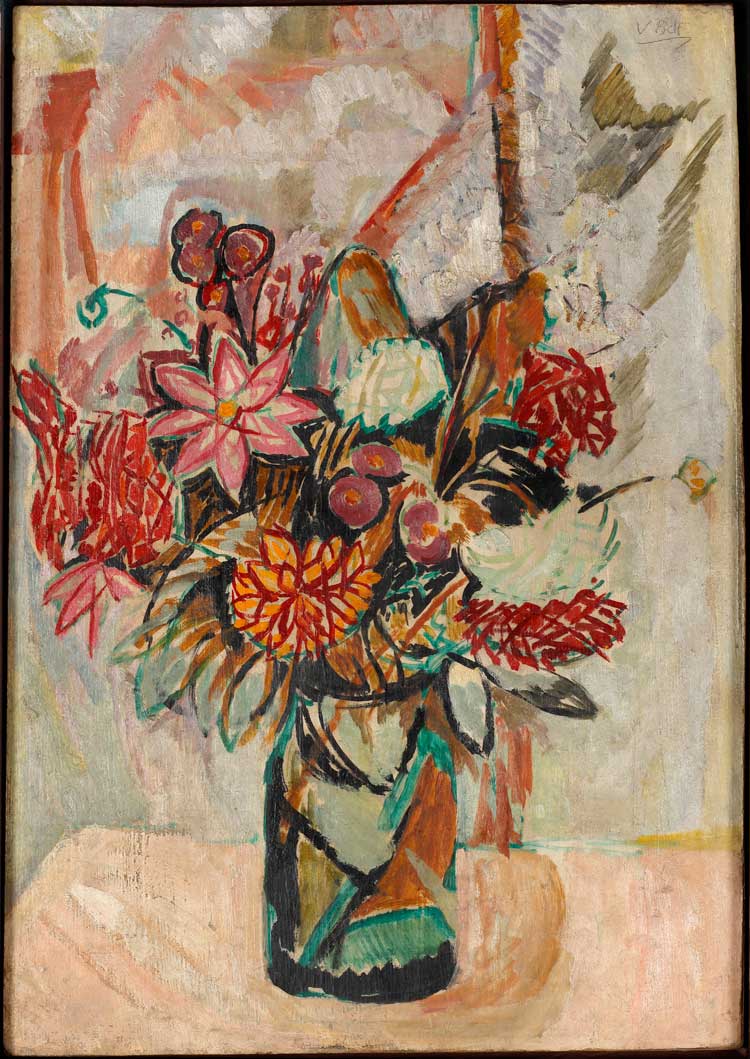
Vanessa Bell, Still-life of Dahlias, Chrysanthemums and Begonias, 1912. Oil on canvas. Courtesy Philip Mould and Company.
On entering the gallery, however, I was immediately drawn past these works to Vanessa Bell’s Still-Life of Dahlias, Chrysanthemums and Begonias (1912), with its layers of vibrant pink, red, orange and green brushstrokes. Bell went on to paint myriad flower compositions, but mostly these were later in life. She and Duncan Grant would paint together the flowers from their garden at Charleston. This painting, as far as I know, is her earliest flower composition, reflecting also her interest, at the time, in cubism.
While Bell had Charleston, Cedric Morris had Benton End. A plantsman and gardener of considerable note, as well as an artist, Morris “had an impeccable eye for a good plant and his artist’s eye lives on in a number of species that he spent time refining”.2 Known as “Benton irises”, these bearded varieties have recently become more popular and are currently being replanted in the garden before it opens – along with the house – to the public, managed by the Garden Museum. Irises and Tulips (1935), on loan from Philip Mould’s collection, doubtless includes some of his own variegated types.
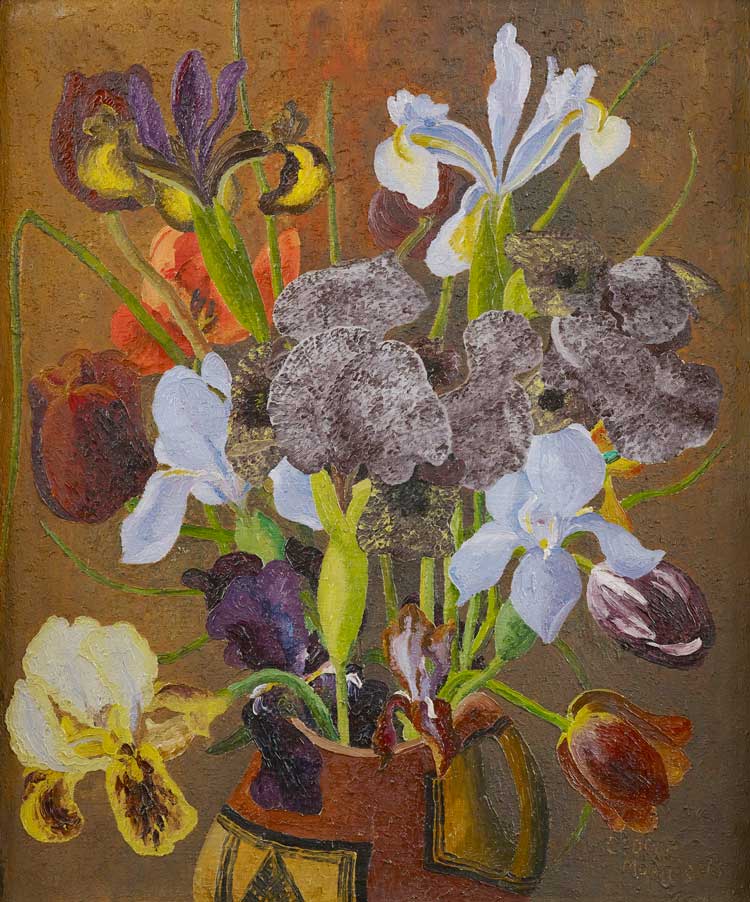
Cedric Morris, Irises and Tulips,1935. Oil on canvas. Private Collection care of Philip Mould & Company.
Although never a war artist, David Jones painted and wrote poetry about a significant number of war scenes. It is lovely, therefore, to see here a watercolour (Untitled, 1930) depicting three flower arrangements, painted so lightly that they are almost transparent, suggesting something ephemeral and elusive. Quite the opposite is the work facing this one, Flowers (1943) by David Bomberg, which comprises vivid and shocking gashes of red on a flaming canvas. This is one of a series of floral compositions that Bomberg used, on the suggestion of his wife, to express the intensity of his feelings and the violence of the world around him. Nearby, Eric Ravilious’s Ironbridge Interior (1941) is a gorgeous and clever watercolour and pencil, using the device of a painting within a painting – a still-life of flowers on a table tacked to the wall with two drawing pins – and also the shadow of trees seen through a window. Ravilious’s wife, Tirzah Garwood, in her Springtime of Flight (1950), is thought to be making reference to her husband’s death in a search-and-rescue flight in 1942.
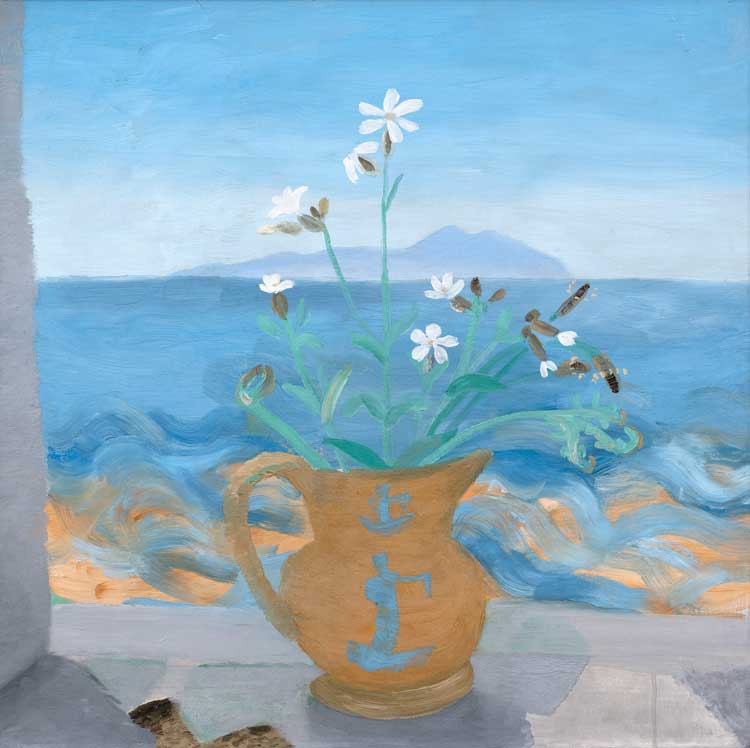
Winifred Nicholson, White Campion, 1940s. Oil on canvas. © Trustees of Winifred Nicholson.
Perhaps one of Gluck’s best-known works is Convolvulus (1940), which is quite remarkable when one considers how quickly the flowers wilt (within a couple of hours) and how long the artist took to complete the work (five weeks). That must have involved a lot of walks to replace the “model”. Similarly white flowers on a pale-blue background, Nicholson’s White Campion (c1940s) is absolutely charming, with the sky and horizon blending into water, and splendidly wiggly lines conjuring up waves lapping on a beach. In her essay, The Flower’s Response (1969), Nicholson wrote: “My paintbrush always gives a tremor of pleasure when I let it paint a flower.” This can certainly be felt here. Anne Redpath places her bright white flowers – White Cyclamen (1962) – against a dark background. This creates a striking impression: a still-life, where the emphasis is very much on life.
From one sublime to another, William Scott, in Still-Life – Flowers and Jug (1946), lays a bouquet of golden ranunculus next to a jug on what might be a table or a tray. The background is as golden as the flowers. Euan Uglow uses a similarly sunshiny ground in Narcissus on Yellow Background (1978). Minute crosses and lines show his close method of creating structure. Unlike many of the other artists here, who clearly take the flower as their subject, Uglow once said: “The proper subject of a painting is painting itself,” and that is evident here.
My absolute favourite painting in this room, though, is Bryan Pearce’s Still-Life (1987), with its flattened perspective. The background is split into five horizontal bands of colour: the sky; the sea; the beach – on which Pearce’s signature appears, reinforcing the constructedness of the picture; the white table edge; and the checkered grey table, on which stands a jug of red tulips and yellow daffodils. Its childlike simplicity is endearing and captures something of the eternal appeal and quality of flowers.
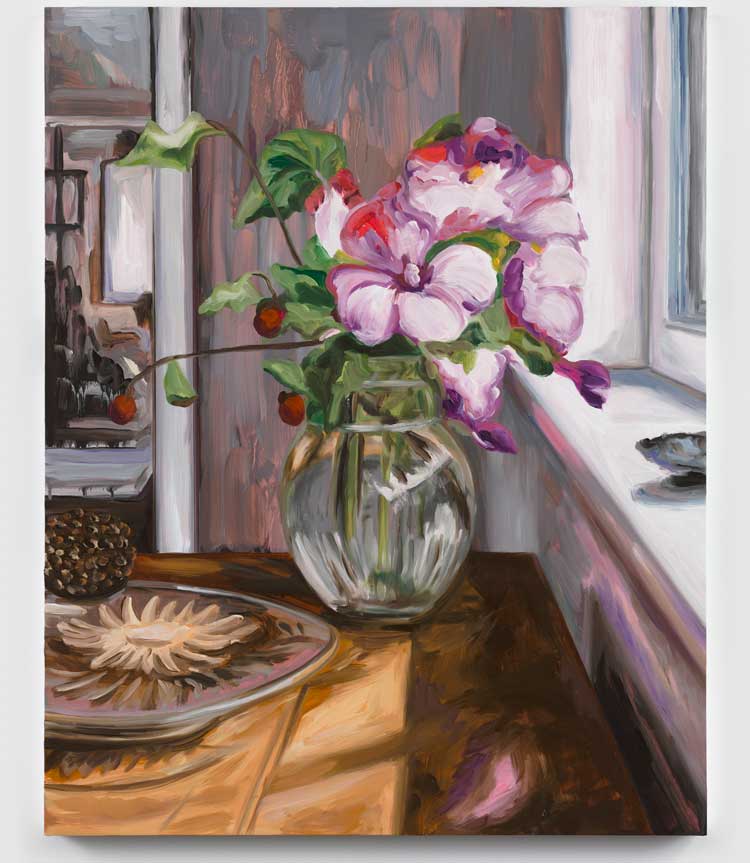
The second room brings us up to the present day and is just as much of an emotional ride as the first. There are several more pictures painted on strikingly dark backgrounds, including Emma Prempeh’s Study of Marigolds (Uganda) (2024); Judith Tucker’s Dark Marsh: Sea Aster (2022), which combines different times of night and day in one composition; Andrew Cranston’s Misshapes (2018), painted on the back of a book cover with a dream-like feel, which makes me think of the obviously missing artist from this exhibition, Miranda Boulton; and Clare Woods’ Sweet Hill (2026), painted on aluminium, so that the brushstrokes slip and slide in gleaming translucence. Woods’ picture is based on a photograph taken in Helen Ede’s bedroom. She typically paints flowers just past their bloom, stating that she wishes them to look dead, but that certainly doesn’t appear to be the case here: her flowers are radiant.
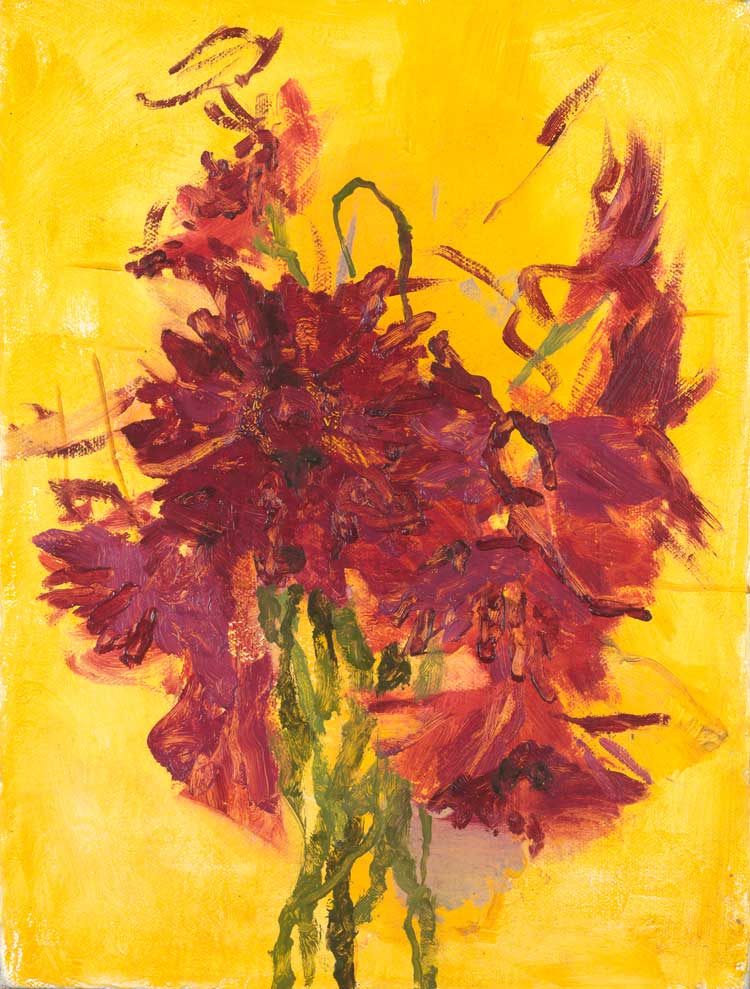
Jennifer Packer, Chrysanthemums, 2015. Oil on canvas, 30.4 x 22.8 cm (12 x 9 in). © Jennifer Packer.
Photo © The Fitzwilliam Museum, University of Cambridge.
Two other artists turn memento mori into memento vivere, and they are Gigi Ettedgui and Jennifer Packer. Ettedgui, with As It Falls (2025), depicts a jar containing a sprig of blossom that is losing its petals. “I think of my flowers as portraits,” she says, noting that while the blossoms fade and fall, the painting lives on. Packer, by contrast, whose Chrysanthemums (2015) uses an egg-yolk-yellow canvas, with red and pink blooms, and to me seems full of the joys of life, is one of a series intimately linked to the Black Lives Matter movement, as the artist dedicated them to the victims of police brutality and saw them as symbols of loss and mourning, like funeral bouquets. This just goes to show how ubiquitous the use of flowers is to mark significant moments and occasions in our lives. What for one person, or one culture, represents death, for another might express marital joy or the excitement of new life.
Joy Labinjo’s Perfect by Nature for Gift and Centrepiece (2022), against a dark background, is part of her series dedicated to Olaudah Equiano, one of the leading figures of the 18th-century anti-slavery movement in Britain. Like Packer, she uses flowers as a metaphor and speaks out about Black lives. Chris Ofili’s Untitled (Afromuse) (2005) is also part of a series, this time depicting imaginary people, flowers and birds – here we have a hybrid of all three. Jade Pollard-Crowe, another member of the community panel, describes it as uplifting and empowering “to see Black faces elevated to the beauty standard of the strelitzia, or the Bird of Paradise flower”.
A truly amazing and thought-provoking work is Waxflower (2025) by Bianca Raffaella, made in acrylic on board, using, at least in part, her fingers. This partially sighted artist is responding simultaneously to the physical qualities of the blooms she has in her studio and to her visual memory of flowers. This captures, perhaps more than any other piece, the ephemerality of these blossoms. Similarly delicate is, however, Celia Paul’s watercolour and pastel Delphinium, February 14th (2024). Her flower paintings, of which there are many, are typically titled with a date, like this one, which always carries significance for Paul. Here, of course, the viewer might recollect their own Valentine’s Day memories, while, with other paintings, she keeps it more obliquely personal. “The works on paper are records of occasions I need to remember,” she says. “In this respect they resemble diaries.”3
Kaye Donachie’s evanescent painting Monument to Every Moment (2026) is one of very few pictures – along with Ofili’s and Caroline Walker’s – to include a face. But Donachie’s faces are not portraits, they are evocations of a mood, moment or feeling, the same as are the flowers for many of the artists – and viewers. The wall text suggests that the bluish tint in the painting may refer to Mary Potter’s seaside home (Potter being an artist whose work Donachie is researching), but it could also be a reference to Anna Atkins and her early cyanotypes of flowers, as indeed – and more so – could Poppy Jones’s Still Spring (2022), an oil and watercolour on suede. Jones takes photographs on her phone and prints them on to suede before overpainting them. She refined this unusual technique during the pandemic, making use of the subject matter and materials readily available to her.
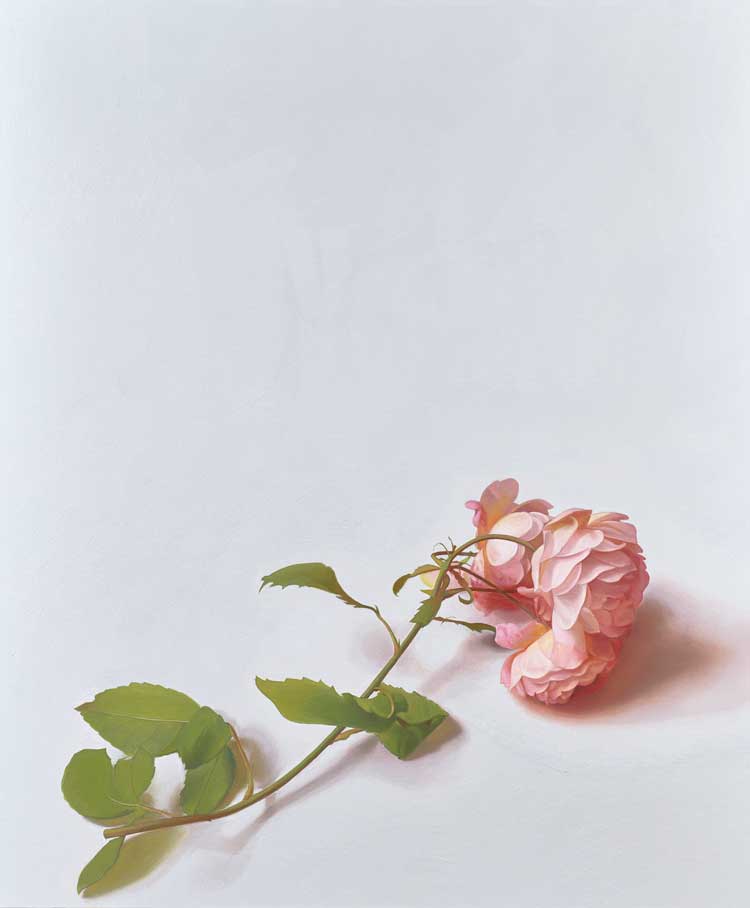
Alison Watt, Lying Down, 2025. Oil on canvas. © Alison Watt. Courtesy of Lévy Gorvy Dayan.
One of the most emotionally laden works in the exhibition is, I think, Alison Watt’s Lying Down (2025), a for-her typically pure white canvas with a single pink rose lying across the bottom half. While there is absolute realism – beyond even photorealism – there is also clearly emotion, and it makes my heart ache to look at the flower’s fading beauty. Watts doesn’t beat about the bush when she says: “As soon as a rose is picked, it’s dying.”
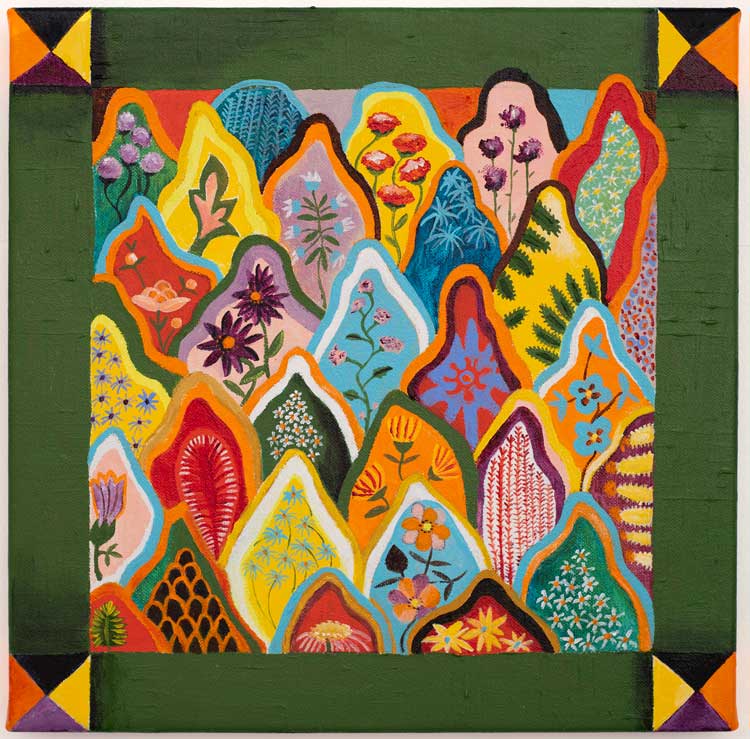
Lubaina Himid, These Are For You, 2026. Acrylic on canvas. Courtesy the artist, Hollybush Gardens, London and Greene Naftali, New York. Photo: Gavin Renshaw
© Lubaina Himid.
Hurvin Anderson and Lubaina Himid’s inclusions are examples of how they take motifs into their practices and recycle them. Anderson’s Untitled (2025) comprises a red, blue and silver floral wallpaper pattern – something prominently featuring in his work, in which he often depicts materials in domestic settings as a way of exploring his Afro-Caribbean heritage; similarly, in These Are for You (2025), Himid presents a pattern, inspired by East African kangas – fabrics with a large decorative border and a central motif painted in vivid colours.
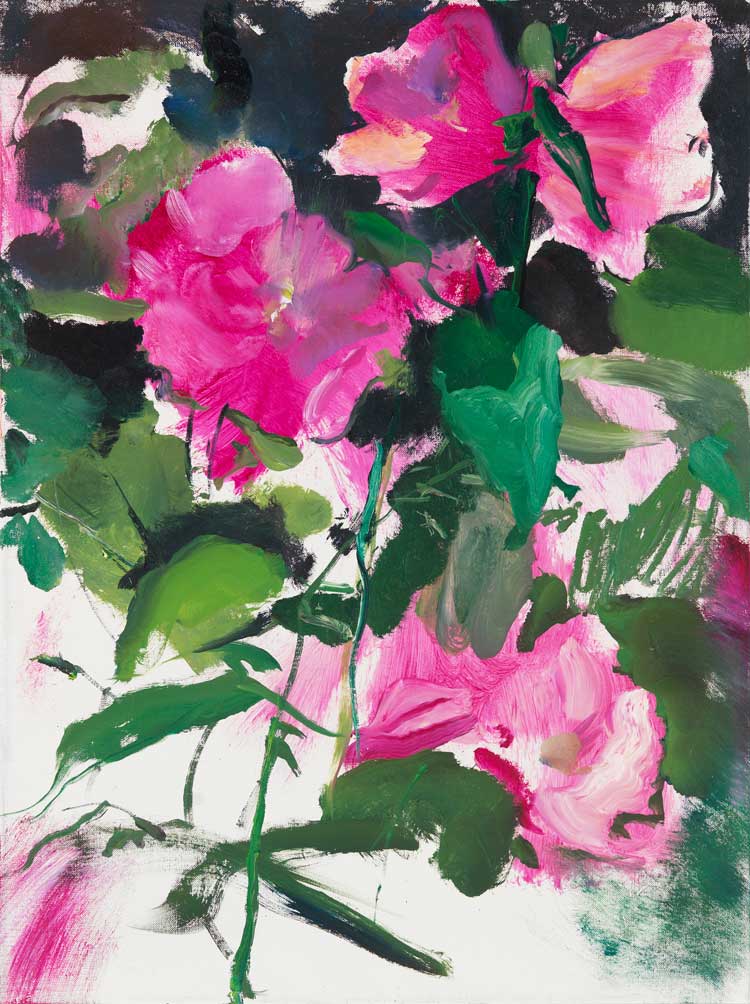
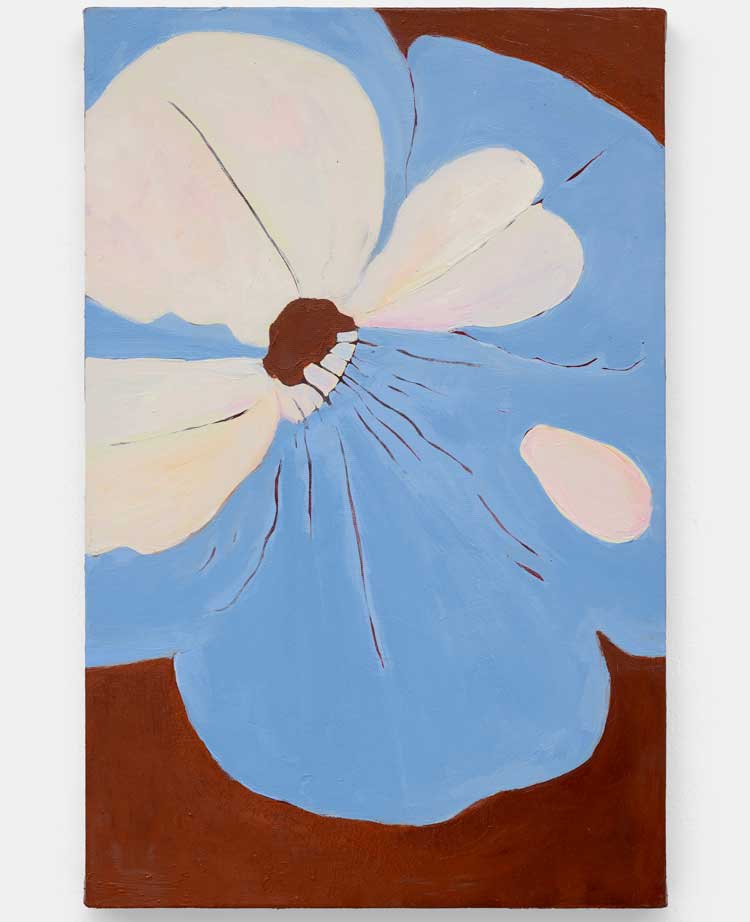
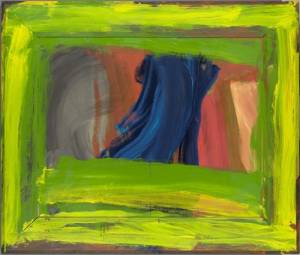
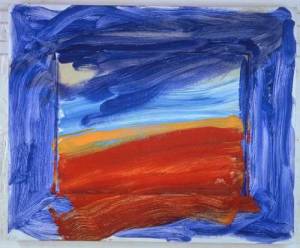
In closing, I would like to highlight my two favourite pieces in the exhibition. One is Louise Bourgeois’ La Fleur Bleue (2007), which comprises a charming blue flower form painted, in watercolour, over an etched background. Unlike Watt, Bourgeois oppositely but equally poignantly said: “Flowers mean new life; they let us forget about death.” My take-home work, though, would be Howard Hodgkin’s tiny little Red Flowers (2011-12), comprising his usual flourishing brushstrokes, here in red and green paint, sweeping across the wooden surface and its frame. This painting was inspired by his father, Eliot, who was a passionate gardener and plant collector. Hodgkin simply said: “My father loved small flowers – I was thinking about him.” And sometimes it really is just that simple.
References
1. All otherwise unspecified citations are taken from the wall texts of the exhibition.
2. The world famous Benton irises – bred by artist Cedric Morris – have an elegant colour palette and striking form. Here are the ones you should be planting by Dan Pearson, published online in Gardens Illustrated, 6 May 2025.
3. Essay by Celia Paul for the invitation to Celia Paul: Diaries, Hazlitt Holland-Hibbert, March 2025.
Click on the pictures below to enlarge

Copyright © 1893–2026 Studio International Foundation.
The title Studio International is the property of the Studio International Foundation and, together with the content, are bound by copyright. All rights reserved.
 |
 |
 |
|---|


-1000-300.jpg)
 Winifred Nicholson in Scotland
 Home and Garden: Paintings and Drawings of English Middle Class Urban Domestic Space 1914 to the present
 Howard Hodgkin
 Howard Hodgkin: Large Paintings 1984-2002
 Pierre Soulages