




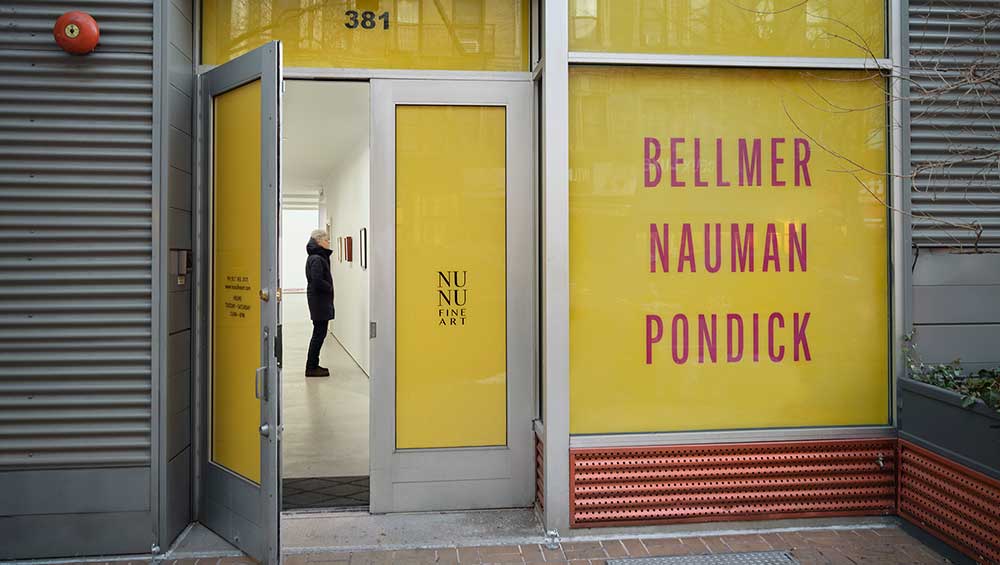
Installation view, Bellmer Nauman Pondick: Material Desire, a collaboration with Ubu Gallery, New York, Sonnabend, New York, and Nunu Fine Art, New York / Taipei. Photo: Martin Seck, courtesy Nunu Fine Art, New York / Taipei.
Nunu Fine Art, New York City
6 March – 30 May 2026
by YASMEEN M SIDDIQUI
Although he explicitly rejected the mantle of illustrator, insisting, against his father’s wishes, on being an artist, Hans Bellmer created six etchings for the 1940 edition of Georges Bataille’s novella, Histoire de l’Oeil (Story of the Eye). First published in 1928 under a pseudonym, then in a clandestine edition condemned by the French courts in 1951, the book was later published under Bataille’s true name by, fittingly, Jean-Jacques Pauvert, the publisher of works by the Marquis de Sade. Bellmer’s images take hold of Bataille’s story, its raw humiliations and violence tied up in a worshipful and an almost naive love among three adolescents that results in deaths by strangulation and suicide, and the defiling of a corpse. The voyeur and their relationship to the viewer and the viewed consumes Bataille and Bellmer. Bataille’s writings – Histoire de l’Oeil and L’Anus Solaire (the Solar Anus), another short work of fiction, written in 1927, which was evoked in 1988 by the Artforum critic Kirby Gookin in relation to sculptures by Rona Pondick – generate concepts and discourse around images of the emergence of the desirous body in ways that are amplified by the selection and arrangement of works that comprise this exhibition of photography, sculpture and video.
Pondick has selected the works for this show, bringing together three artists – herself, Bellmer and Bruce Naumann. In collaboration with the gallery owner, Nunu Hung, Pondick has boldly decided to narrate often unspoken bonds and lines of influence among artists, bringing to the mind’s eye recurring shapes, forms and treatments of the body, with emphasis on the corporeal, visual cues and tropes that can be found in work by many highly visible artists today.
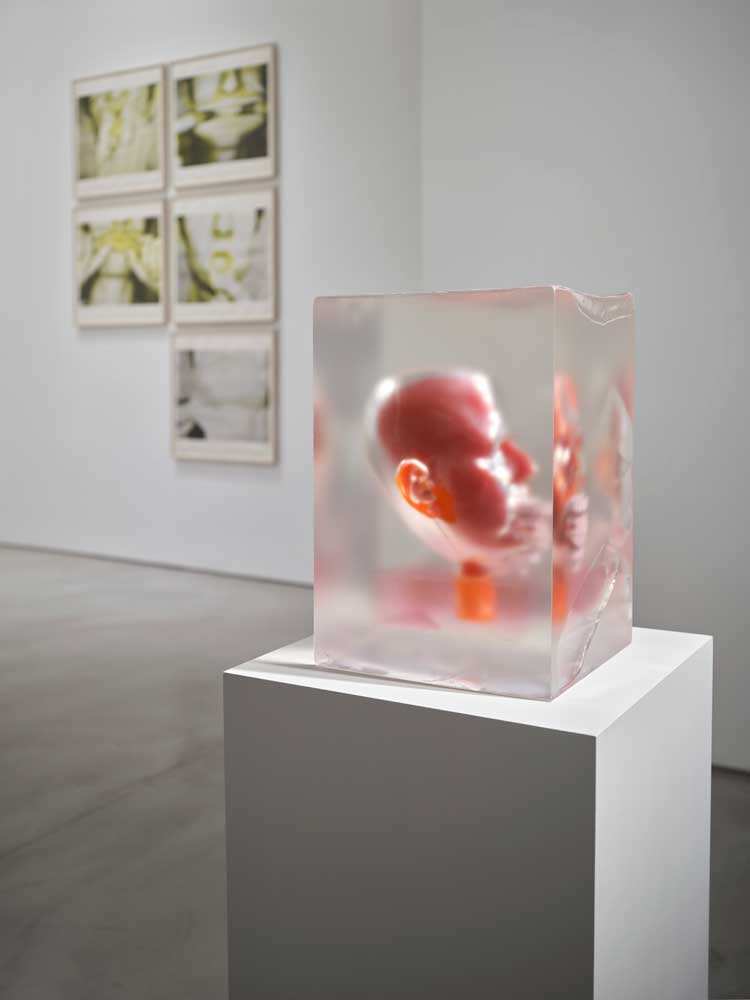
Foreground: Rona Pondick, Encased Orange with Pink Teeth, 2019-23. Background: Bruce Nauman, Studies for Holograms (a-e), 1970. Installation view, Bellmer Nauman Pondick: Material Desire, Nunu Fine Art, New York, 6 March – 30 May 2026. Photo: Martin Seck, courtesy Nunu Fine Art, New York / Taipei.
Centre stage in the lofty middle gallery is Pondick’s Encased Orange with Pink Teeth (2019-23). A cast of her head in acrylic and pigmented resin, the sculpture on a pedestal bears a likeness to many works by Nauman, whose screenprints Studies for Holograms (a-e) (1970) are hung high, stacked to the right. Like Nauman, Pondick has many other resin head sculptures that assume various postures – some also twist upside down. But it is her repeated use of gruesome teeth in the busts, the shape of the casts of her teeth, that resonate in uncanny ways, more visually abject than the bronze heads Nauman has cast, or the presence of his head in videos. Encased Orange with Pink Teeth elicits thoughts about the containment of female sexual power.
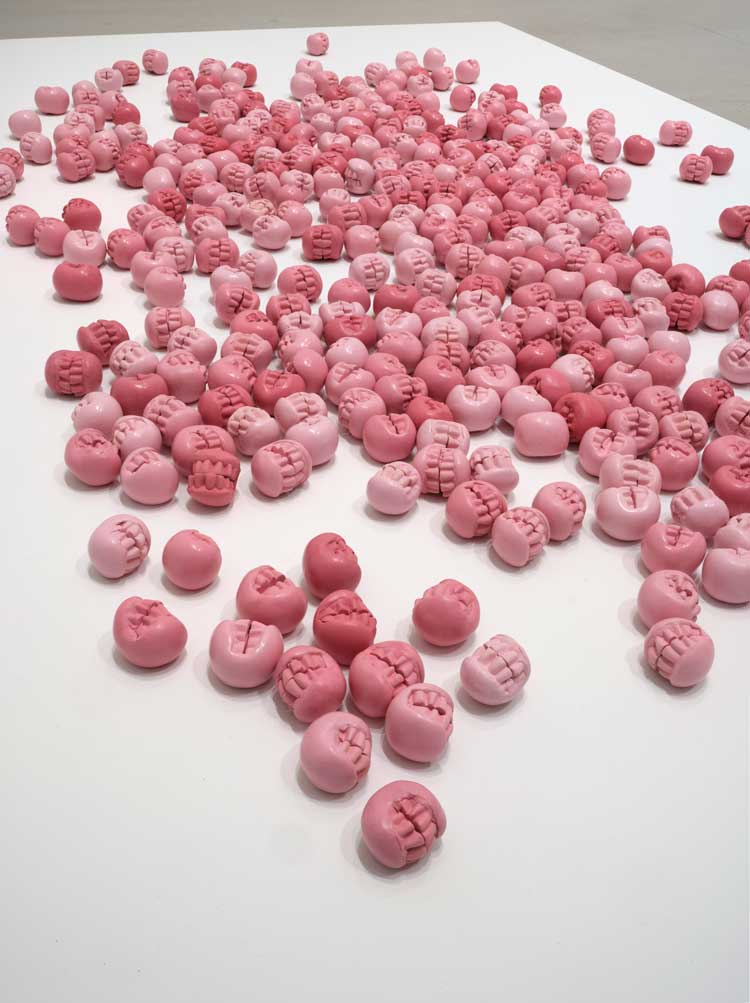
Rona Pondick, Small Pink Treats, 1992. Installation view, Bellmer Nauman Pondick: Material Desire, Nunu Fine Art, New York, 6 March – 30 May 2026. Photo: Martin Seck, courtesy Nunu Fine Art, New York / Taipei.
The gesture effected by this encased head is amplified by the placement of Small Pink Treats (1992), in which casts of Pondick’s teeth (made in collaboration with her dentist) are embedded in pink balls and strewn across the floor, looking like disembodied mouths, recalling the folkloric motif vagina dentata. Each of the 400 mouths edge us away from a one-to-one linkage to Nauman towards a different allegory, a darker premise. In his screenprints, he manipulates and contorts the flesh of his face with his hands. The playing with and modelling of flesh continues in the videos: Nauman’s absurdist Bouncing Balls (1969) and his relentless squeezing and pulling in Thighing (Blue) (1967). Bodily manipulation is a core precept in this show. Be it Pondick and Nauman using their bodies, or Bellmer using his La Poupée, dolls with womanly hips and thighs and curved breasts that he dressed in adolescent-style clothing and shoes and then arranged in tableaux and photographed.
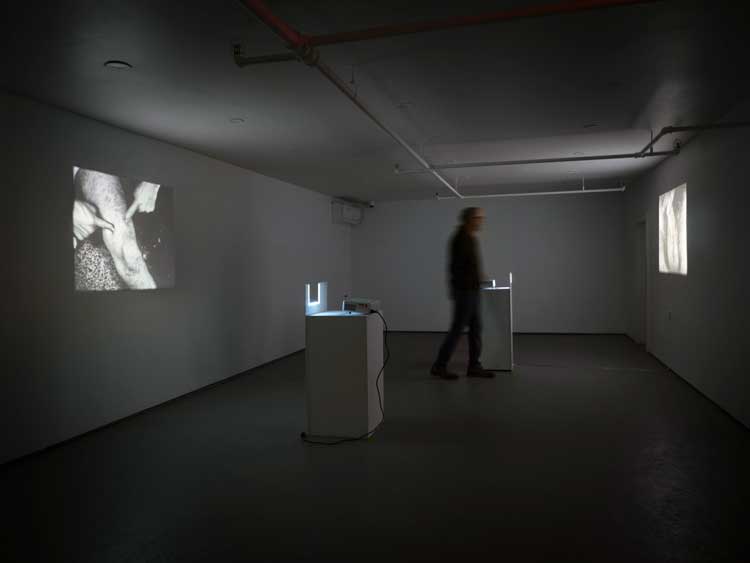
Bruce Nauman, Thighing (Blue),1967 and Bouncing Balls, 1969, courtesy Electronic Arts Intermix, (EAI), New York. Installation view, Bellmer Nauman Pondick: Material Desire, Nunu Fine Art, New York, 6 March – 30 May 2026. Photo: Martin Seck, courtesy Nunu Fine Art, New York / Taipei.
Are the contorted, sexually charged dolls in Bellmer’s photographs objects being observed or are they creatures created to arouse him and feed his fantasies. Made between 1934 and 1936, the nine photographs shown provoke this query in the context of fascist Europe. The glorification of an idealised Aryan body has been widely discussed as the subject Bellmer took on with La Poupée. He continued working until his death in 1975 and left much writing that charts his sexual imagination fuelled by his interest in themes of gender identity, as well as the dynamics of submission and dominance. His influence is broad among artists, and his work has inspired critical engagement among many writers, including the American art critic Rosalind Krauss and the art academic Sue Taylor. Later works, not on view in Material Desire – the etching from Bataille’s book and Bellmer’s collaboration with Unica Zürn, his lover of 16 years, open the door for speculation. He drew and drew again Bataille’s grisly image of a youth carving out the eye of a priest who died of asphyxiation while having sex with an adolescent. Bellmer and Zürn, who was psychologically fragile and experienced mental illness, explored BDSM, and she became his muse. Tied up like a side of beef at the butcher, stretched across a counter, the knobs of her thoracic spine indicated her humanness, string or rope digging into the flesh of her thighs and buttocks, the pallor of her skin showing she was fully alive.
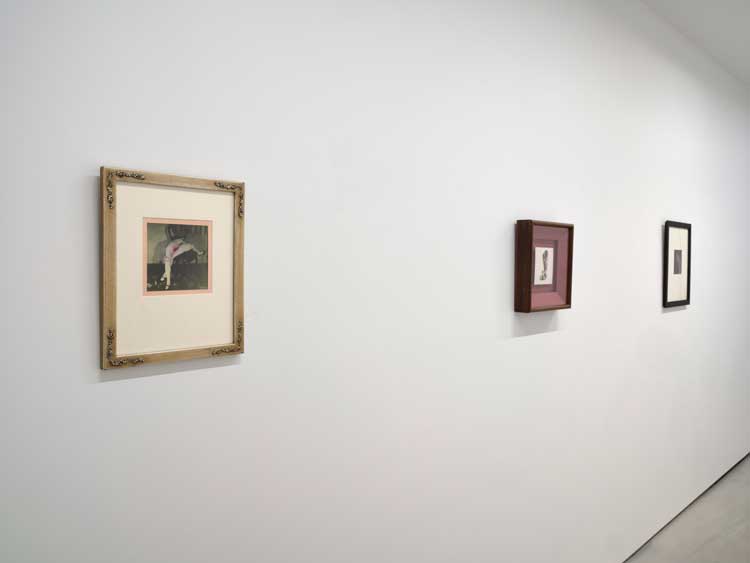
Hans Bellmer, La Poupée photographs, 1934-1935, courtesy of Ubu Gallery, New York. Installation view, Bellmer Nauman Pondick: Material Desire, Nunu Fine Art, New York, 6 March – 30 May 2026. Photo: Martin Seck, courtesy Nunu Fine Art, New York / Taipei.
Leaning on the research and theories of others to grasp the images made in 1930s Germany and France by Bellmer, both those in the show, La Poupée, and what came after these intimately scaled, yet alienating painted photographs, Making Monsters: The Uncanny Power of Dehumanization by David Livingstone Smith offers a useful theory. He surfaced in a most brilliantly tedious assemblage and telling of life in Berlin in the translation from German of Uwe Wittstock’s February 1933: The Winter of Literature. To precis, Smith argues that when we dehumanise others, we conceive of them as wholly human and subhuman at the same time.
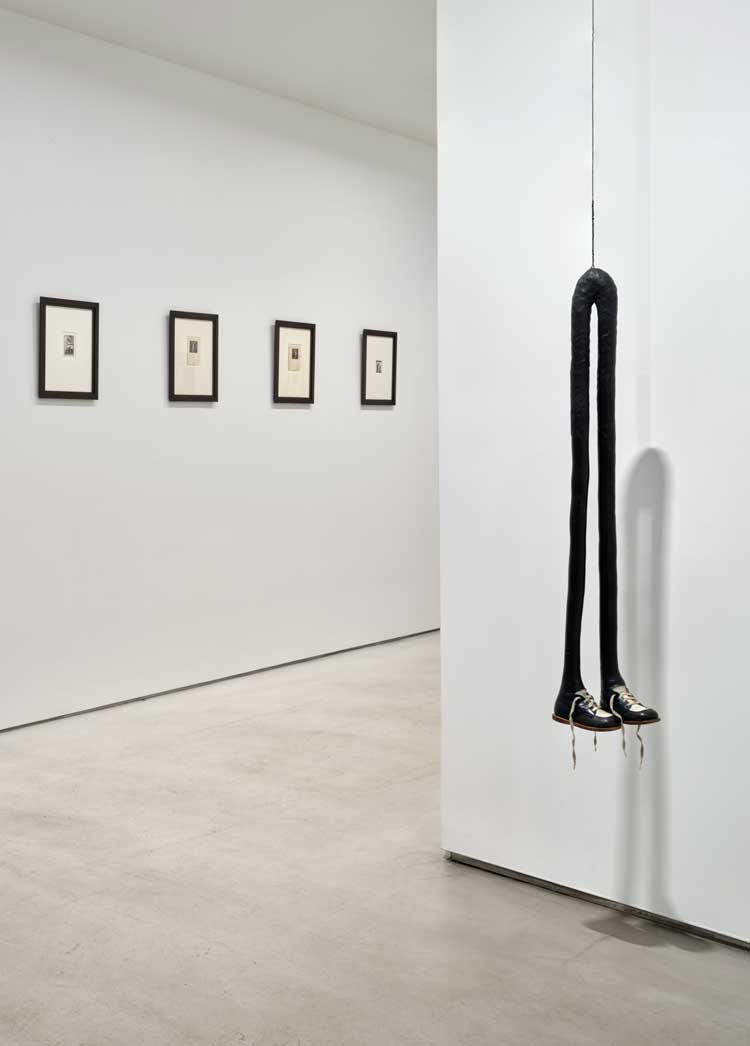
Hans Bellmer, La Poupée photographs, 1934-1935, courtesy of Ubu Gallery, New York; Rona Pondick, Baby Legs, 1990, Installation view, Bellmer Nauman Pondick: Material Desire, Nunu Fine Art, New York, 6 March – 30 May 2026. Photo: Martin Seck, courtesy Nunu Fine Art, New York / Taipei.
Oddly, after seeing Material Desire, Woody Allen’s 1985 film The Purple Rose of Cairo popped into my movie suggestion stream. I thought it the perfect stepping away. A tragicomedy, set in Depression-era New Jersey, with themes about the power of movies, the impact of decisions, opting for reality over fiction, or vice versa seemed like a mini-break from an intense show. And then, there it was. I didn’t remember this detail, but it rang loudly, Cecilia’s white ankle-length socks and black Mary Janes. Bellmer dressed La Poupée in such shoes. And Pondick uses them, too, in her sculptures. Mary Janes, usually for children, but in this movie worn by a woman, are meant to symbolise or signify what?
In the movie, Cecilia, played by Mia Farrow, obsesses over a film character, who falls off the screen into the room. She is offered one of them: the filmic version or the real guy. She chooses the Earthly version, and is, in the end, deserted. The delusion of the absurd, her rejection of an escape route through the movies, and more bizarrely, the blurring of fact or life with fiction is stark. It brings into high definition the import of Nauman digging into his flesh and Bellmer staging highly sexualised, asymmetric configurations of women’s bodies. The imagery is resituated when seen through Pondick’s assertive, critical lens. Fetish expressed by teeth that before and after Freud have loomed large across generations and developmental stages. When did I first dream of losing my teeth, having my teeth kicked in, biting someone or something, and then biting harder to rip flesh apart? I can’t recall.
Last night, I finally watched Kristen Stewart’s film from last year, The Chronology of Water, based on the novel by Lidia Yuknavitch. The colour palette is as specific as in The Purple Rose of Cairo but is sharp and bright, echoing the contrasting colour schemes in Pondick’s work compared with that of Nauman and Bellmer. In Stewart’s film, the reds and blues fracture and layer to amplify each segment; time splices to mirror or remind us of the flux and flow of memory that shortcircuits but is true. Concepts of power worked out in this movie: what we hold over others, how we hold it against ourselves, how we might narrate through an aesthetic lens the anguish of subjection and subjugation, have informed this navigation of the thought-provoking show Material Desire.
• Material Desire is being held in collaboration with Sonnabend, New York, and Ubu Gallery, New York.
Click on the pictures below to enlarge

Copyright © 1893–2026 Studio International Foundation.
The title Studio International is the property of the Studio International Foundation and, together with the content, are bound by copyright. All rights reserved.
 |
 |
 |
|---|

-1000-300.jpg)
 Drawing in Silver and Gold: Leonardo to Jasper Johns
 Dan Coombs: ‘Art is grounded in reaching for the real’
 Body & Void: Echoes of Moore in Contemporary Art
 Back to Eden: Contemporary Artists Wander the Garden
 David Lynch – Small Stories