




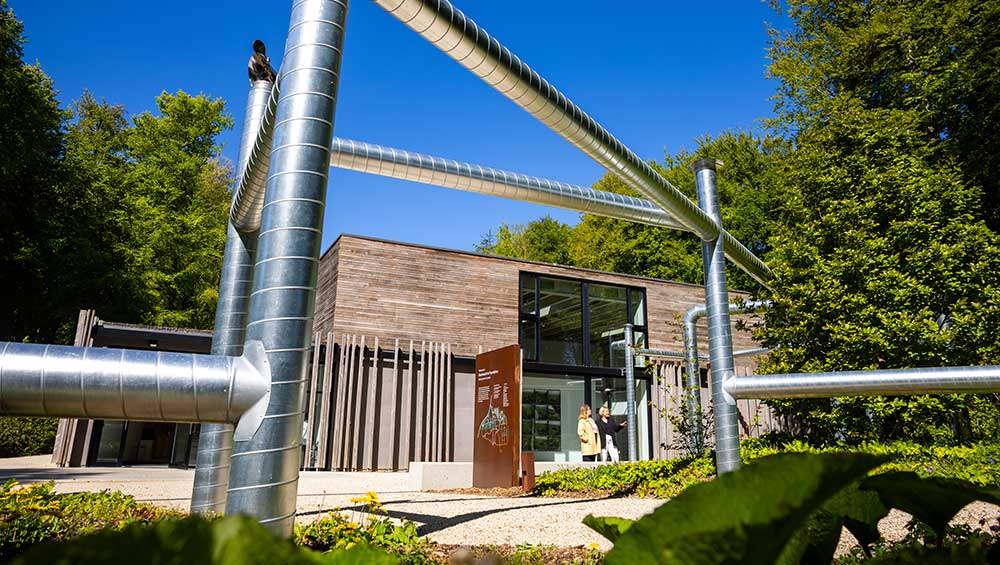
Nancy Holt, Ventilation Systems, 1985-92. Installation view, Nancy Holt, MoonSunStarEarthSkyWater, Goodwood Art Foundation, 2026. Artwork © Holt/Smithson Foundation / Licensed by Artists Rights Society, New York. Photo: Ciaran McCrickard / PA Media Assignments.
Goodwood Art Foundation, Sussex
2 May – 1 November 2026
by BETH WILLIAMSON
It is a little over a decade since the death of American artist Nancy Holt (1938-2014). Despite outliving her partner Robert Smithson (1938-73) by more than four decades, her creative practice seems to have languished under his shadow for far too long. There are other reasons, too, why an artist such as Holt, famous for her monumental site-specific work Sun Tunnels (1973-76) in the Great Basin Desert, Utah, would remain less exhibited than you might expect. Land art, Holt’s chosen term, is difficult to show in any meaningful way in the gallery and that doesn’t help. She distanced herself from ideas of earthworks and earth art, something she associated with a generation of male artists, many of whom were her peers. Carving this space for herself alongside but separate from those peers, Holt created a body of work that included concrete poetry, audio works, film and video, photography, drawing, room-sized installations, earthworks and public sculpture. It is a beguiling mix, but difficult to categorise.
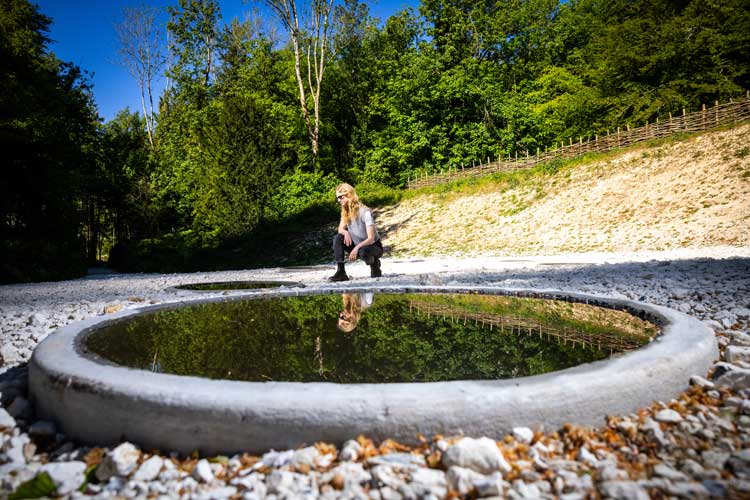
Nancy Holt, Hydra’s Head, 1974. Concrete, earth, water. Installation view: Goodwood Art Foundation, 2026. © Holt/Smithson Foundation / Licensed by Artists Rights Society, New York. Photo: Ciaran McCrickard / PA Media Assignments.
This exhibition at Goodwood Art Foundation is the first UK presentation of Holt’s work that includes a gallery-based show as well as works in the landscape. An earlier exhibition of her work at Parafin in London in 2020 shared the artist’s beginnings in concrete poetry, photography and video, as well as examples from the fabulous Locator series. More recently, in 2024 and 2025, her work was a significant part of Dartmoor: A Radical Landscape, at the Royal Albert Memorial Museum and Art Gallery (RAMM) in Exeter, when work made locally was displayed to great effect. Holt wanted to challenge and change our perception of the world around us. She was interested in language and perception and light and all these things are explored in one way or another in this exhibition, MoonSunStarEarthSkyWater.
.jpg "Nancy Holt, Sun Tunnels: Shifting Shadows, 1976, composite inkjet print on archival rag paper. Ventilation Systems, 1985-92 (detail), steel ducts, turbine ventilators, shanty caps, fans, air. Installation view, Nancy Holt, MoonSunStarEarthSkyWater, Goodwood Art Foundation, 2026. Artwork © Holt/Smithson Foundation / Licensed by Artists Rights Society, New York. Photo: Lucy Dawkins / Courtesy Goodwood Art Foundation.")
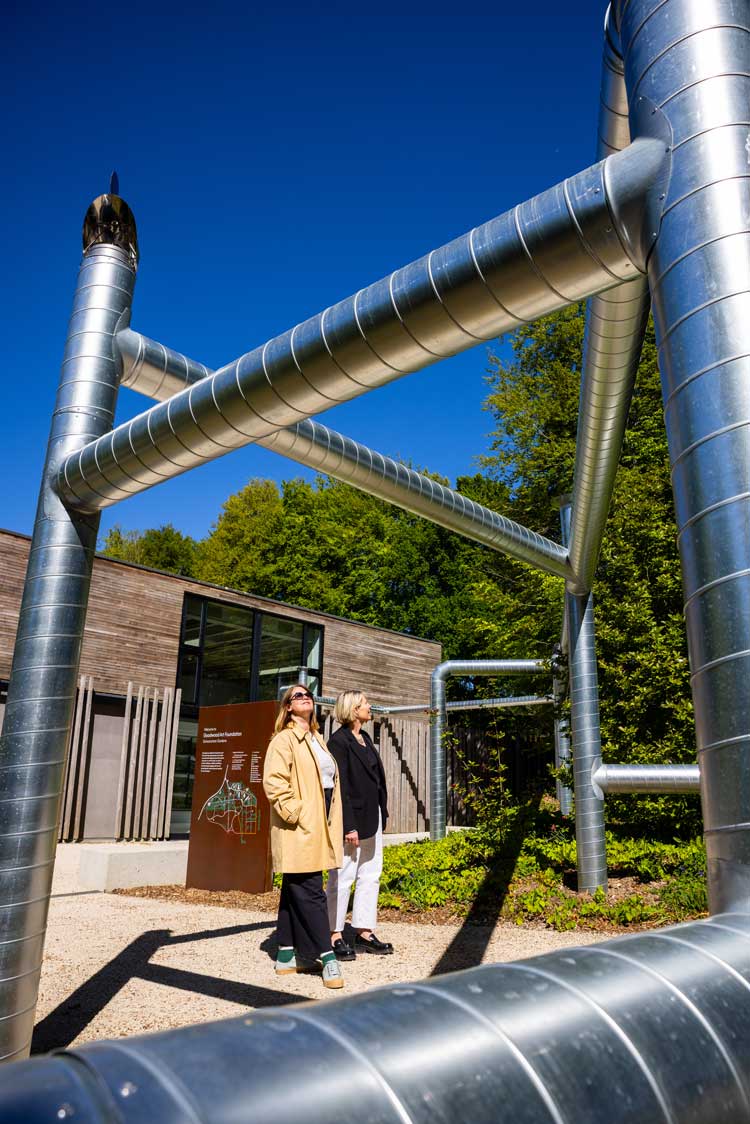
Nancy Holt, Sun Tunnels: Shifting Shadows, 1976, composite inkjet print on archival rag paper. Ventilation Systems, 1985-92 (detail), steel ducts, turbine ventilators, shanty caps, fans, air. Installation view, Nancy Holt, MoonSunStarEarthSkyWater, Goodwood Art Foundation, 2026. Artwork © Holt/Smithson Foundation / Licensed by Artists Rights Society, New York. Photo: Lucy Dawkins / Courtesy Goodwood Art Foundation.
A new iteration of the site-responsive work Ventilation System (1985-92) is the single work that makes greatest impact in this exhibition as it stretches inside and out, acting as a framing mechanism within the gallery and in the landscape immediately beyond. Made with local tradespeople and fabricated as they chose, the steel ducts, turbine ventilators, shanty caps and fans channel the air in new directions. Its inside/outside construction recalls its recent installation on a much larger scale in the exhibition Nancy Holt/ Inside Out at Bildmuseet, Umeä University in Sweden (2022-23) and MACBA in Barcelona (2023-24). In each instance, the usually unseen technological systems of the building are brought to our attention. It further echoes Holt’s ideas on shifting our perception as the unseen is foregrounded.
.jpg "Nancy Holt, Hydra’s Head, 1974. Installation view, Goodwood Art Foundation, 2026. Concrete, earth, water. Photo: Maria Bell / Courtesy Goodwood Art Foundation. © Holt/Smithson Foundation / Licensed by Artists Rights Society, New York.")
Nancy Holt, Hydra’s Head, 1974. Installation view, Goodwood Art Foundation, 2026. Concrete, earth, water. Photo: Maria Bell / Courtesy Goodwood Art Foundation. © Holt/Smithson Foundation / Licensed by Artists Rights Society, New York.
In another work, Hydra’s Head (1974), the sky and the stars are reflected in water-filled concrete pools. This is the first time this work has been created since its inception by Holt at Artpark in Lewiston, New York in 1974. Six concrete culverts of various dimensions are sunk into the ground, in this newest realisation, a chalk quarry in the grounds of Goodwood Art Foundation. The culverts are laid out in the pattern of the stars that form Hydra’s head, a grouping within the Hydra constellation. Each contains pools of water, each reflects the stars and sky above them. As Holt understood it: “Pools of water are the eyes of the Earth.” As photographs show, Holt’s 1974 installation was on a site alongside the Niagara River. She also wrote: “Eddies and whirlpools in the river below, fed by the mad waters of Niagara Falls seven miles upstream, keep up a loud rhythm – there’s always the sound of water. Hearing and seeing come together in a vaporous fusion.” She continued: “Falling water, rushing water, swirling water, still water, sound of water, color of water coalesce here in this place of water, not far from Niagara Falls – their proximity always felt, producing a continuous flow of liquid meditations.” It was something of a surprise, therefore, to experience this realisation of the work without the accompanying sound of water running nearby.
.jpg "Nancy Holt, Mirrors of Light II, 1974. Ten mirrors, 650 watt quartz light. Installation view, Nancy Holt: MoonSunStarEarthSkyWater, Goodwood Art Foundation, 2026. Artwork © Holt/Smithson Foundation / Licensed by Artists Rights Society, New York. Photo: Lucy Dawkins / Courtesy Goodwood Art Foundation.")
Nancy Holt, Mirrors of Light II, 1974. Ten mirrors, 650 watt quartz light. Installation view, Nancy Holt: MoonSunStarEarthSkyWater, Goodwood Art Foundation, 2026. Artwork © Holt/Smithson Foundation / Licensed by Artists Rights Society, New York. Photo: Lucy Dawkins / Courtesy Goodwood Art Foundation.
Inside the gallery, Mirrors of Light II (1974) and Ventilation System dominate the space. Three films, Pine Barrens (1975), Sun Tunnels (1978) and Niagara (1975), are screened sequentially in another space. Totalling about 80 minutes’ screen time, it is a lot to sit through to see it all and multiple screens would give the visitor more consideration. Wistman’s Wood and Trail Markers, both from 1969, make a captivating display, as always. However, having seen both works at RAMM in 2024, I have to say they benefited greatly from that context, rather than the more manicured landscapes of West Sussex. Similarly, Old Sarum Ruins (1969) made in Salisbury felt unrooted in the Goodwood estate. Many of the examples of drawings and concrete poetry are well chosen and exceedingly helpful in making more sense of the exhibition as a whole. For instance, it makes sense to have drawings for Hydra’s Head and Ventilation System. Photographs representing major works such as Sun Tunnels and Pine Barrens are helpful too. Holt’s focus on framing and the circle is engaged with in small scale in MoonSunStarEarthSkyWater (1969) and The World Through a Circle (1972). What the exhibition does not explain when it comes to Holt’s writing (poems, instructions, diagrams and lists) is that she found this mode of practice at a time when she was searching for a new form of making, questioning what art could be. We see examples such as Untitled (Disconsolate) (c1970) or Detach Here (1967), although the condition of their making is left without mention.
.jpg "Nancy Holt, Trail Markers, 1969. 20 inkjet prints on archival rag paper. Ventilation Systems 1985-92 (detail), steel ducts, turbine ventilators, shanty caps, fans, air. Artwork © Holt/Smithson Foundation / Licensed by Artists Rights Society, New York. Photo: Lucy Dawkins / Courtesy Goodwood Art Foundation.")
Nancy Holt, Trail Markers, 1969. 20 inkjet prints on archival rag paper. Ventilation Systems 1985-92 (detail), steel ducts, turbine ventilators, shanty caps, fans, air. Artwork © Holt/Smithson Foundation / Licensed by Artists Rights Society, New York. Photo: Lucy Dawkins / Courtesy Goodwood Art Foundation.
This exhibition is indeed a rare opportunity to see a solo exhibition of work by Holt in the UK. For me, it was worth visiting just to see Ventilation System. There is much potential in this exhibition, indoors and out, to tell a more engaging story, a more nuanced story of Holt and her work. As it is, so much is left unexplored. It has to be hoped that perhaps the learning programme will pick up on those missed opportunities.
Click on the pictures below to enlarge

Copyright © 1893–2026 Studio International Foundation.
The title Studio International is the property of the Studio International Foundation and, together with the content, are bound by copyright. All rights reserved.
 |
 |
 |
|---|


-1000-300.jpg)

 Dartmoor: A Radical Landscape
 Rafael Pérez Evans – interview: ‘Food contains a lot of emotion’
 Robert Smithson: Hypothetical Islands
 Nancy Holt: Points of View
 Light Show