




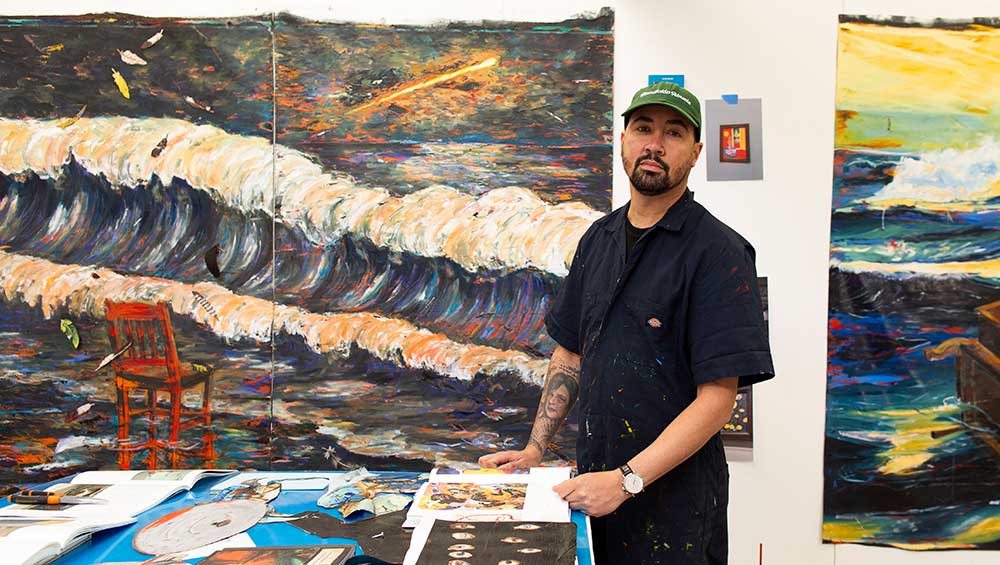
Angel Otero during his artist residency at Hauser & Wirth Somerset, 2026. Photo: Clare Walsh. Courtesy Angel Otero and Hauser & Wirth.
by DAVID TRIGG
In the oneiric paintings of Angel Otero (b1981, Santurce, Puerto Rico), domestic objects charged with personal significance collide with passages of painterly gesture to address themes of memory, place and identity. Foregrounding the materiality of his medium, Otero is known for his innovative approach: rather than painting directly on to canvas, he constructs his vibrant images from collaged layers of dried and peeled paint. Tinged with surrealism and nods to abstract expressionism, these fragmented and richly textured accumulations combine reminiscences from the artist’s youth with references to art history and large doses of magical realism. Studio International met with Otero in Bruton, Somerset, where he had temporarily moved his studio practice from New York and Puerto Rico to prepare for Agua Salada, his first UK solo exhibition, at Hauser & Wirth Somerset.
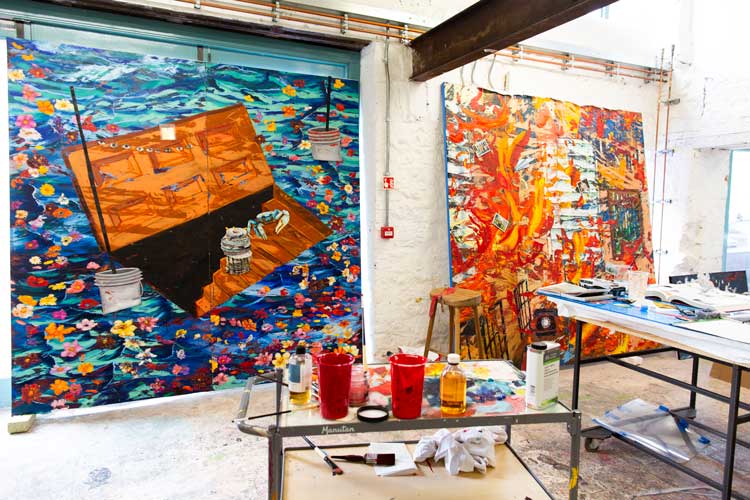
Angel Otero during his artist residency at Hauser & Wirth Somerset, 2026. Photo: Clare Walsh. Courtesy Angel Otero and Hauser & Wirth.
Although life in Somerset was far more genteel for Otero than the hustle and bustle of New York, his productivity showed no signs of ebbing during his residency. Indeed, considering that he was based in Bruton for just a month and a half, he completed a sizeable body of work, including several paintings, drawings, a sculpture and his first foray into moving image. “This residency has allowed me to resolve works that I actually started two years ago,” he explains, noting that several pieces in progress were shipped from his studios in New York and Puerto Rico to Somerset. “These new works encapsulate a kind of homecoming, a response to setting up my new studio in Puerto Rico, a transition that has been really inspiring for me.” The Caribbean island has been an enduring influence in Otero’s art ever since he left it in 2004 to study at the School of the Art Institute of Chicago. “I still consider Puerto Rico my real home,” he says. “It has a particular energy that I haven’t found in any other place I’ve travelled to: the light, the people, the food, the landscape.”
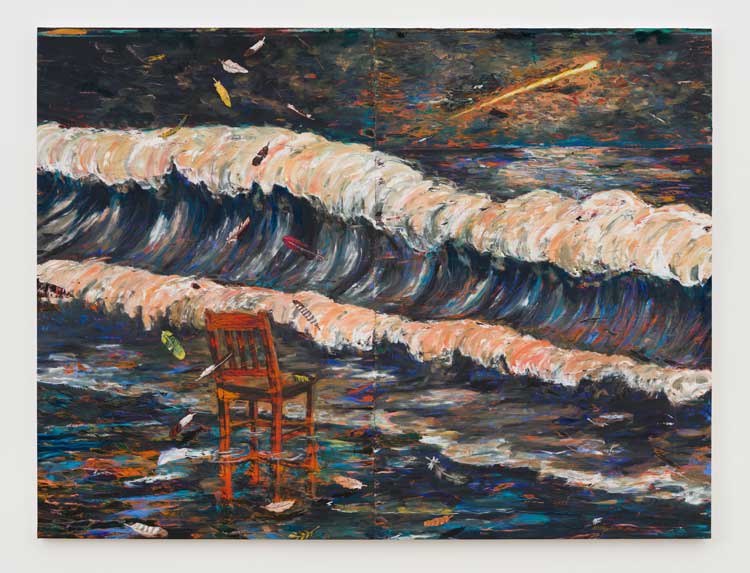
Angel Otero, Remains of the Shore, 2026. Oil paint and fabric collaged on canvas, 183 x 242 x 4 cm (72 x 95 1/4 x 1 5/8 in). Courtesy Angel Otero and Hauser & Wirth. Photo: Damian Griffiths.
Otero is best known for his innovative technique of applying layers of oil paint on to Plexiglas panels, leaving them to dry and then carefully scraping them off. The paint “skins” that are created by this process are then adhered to canvases, after which further painted and collaged elements are applied. To that end, Otero has to paint in reverse, first laying down the foreground before adding the mid and background layers on top. The process is far from precise and the finished paintings contain areas of damaged, seemingly degraded paint caused by the scraping and peeling process. “I never know exactly what the final results are going to be,” he says of the unpredictable approach, in which multiple fragments of previous layers are typically revealed, often to startling effect. For Otero, the results embody the indistinct and fragmentary nature of memory. “We might feel that memory is concrete, but as time passes it changes, taking different forms, shapes and perspectives.”
Chance and accidents play a large role in Otero’s oil skin technique, requiring him to give up a considerable amount of control over the finished image. “I like the challenge of having to respond to something that I wasn’t expecting,” he says. “But the element of chance is also connected to being human, it relates to how we navigate life in our encounters with the things that we haven’t planned for. Sometimes you have to respond in the moment and change your plan. That’s how it is in the studio too. Giving up control keeps me engaged and keeps me coming back day after day.”
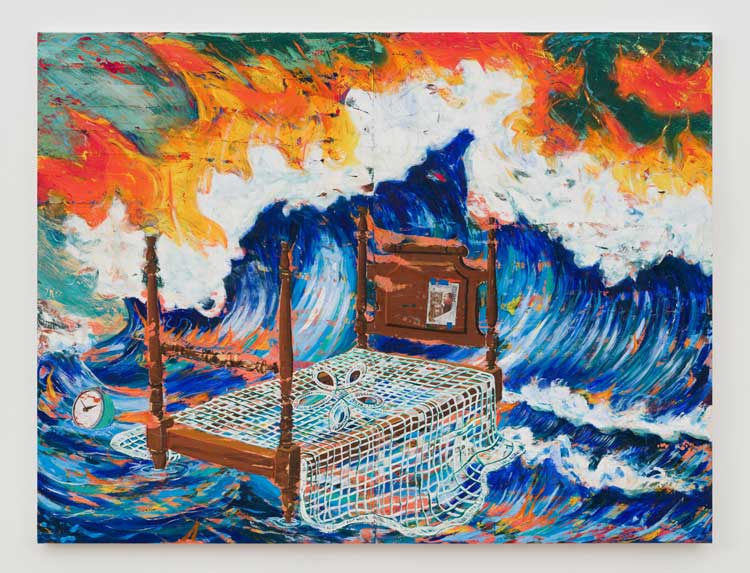
Angel Otero, Dreamcatcher, 2026. Oil paint and fabric collaged on canvas, 183.5 x 242 x 4 cm (72 1/4 x 95 1/4 x 1 5/8 in). Courtesy Angel Otero and Hauser & Wirth. Photo: Damian Griffiths.
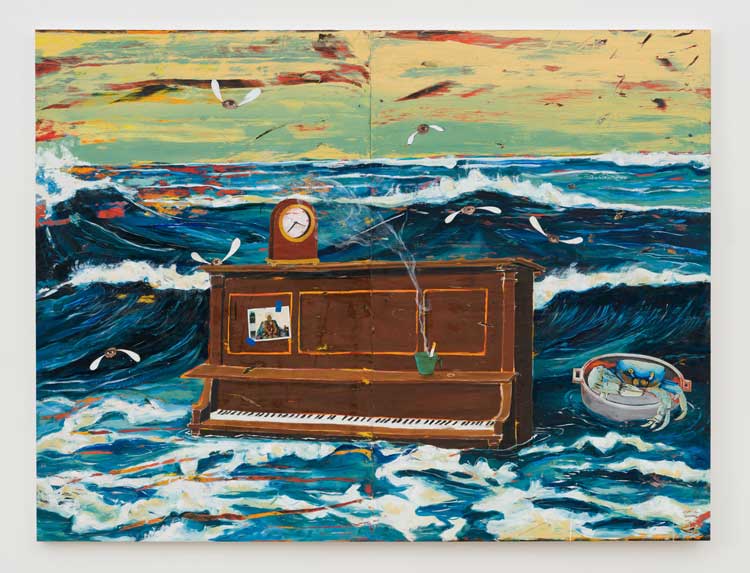
In recent years the ocean has become a significant leitmotif for Otero, appearing in his paintings as a dynamic force, with waves, tides and currents carrying away or threatening to engulf pianos, chairs, beds and other everyday objects. Intimately linked to his personal history and memories of growing up in Puerto Rico, it is increasingly embraced as a metaphor for connection, migration and the fluid contingencies of memory. “The first house I lived in with my grandma was right by the ocean,” he recalls. “As a child, the sea felt mysterious and dangerous. Later, we moved to a different town, further away from the ocean, but in my teenage years I would visit the beach as much as I could, to surf and hang out, but also to sit and reflect on things, which I am doing again because my studio in Puerto Rico is now just five minutes from the beach. For me, it’s very spiritual and helps me navigate my thoughts.” While the exhibition’s title, Agua Salada (salt water), refers to the ocean, it is ambiguous enough to carry multiple meanings. “Some people will think about the ocean for sure, but others will think about healing or ideas of preservation,” Otero says. This ambiguity plays an important role in the show, where water is seen both as life-giving but also destructive, familiar yet utterly other.
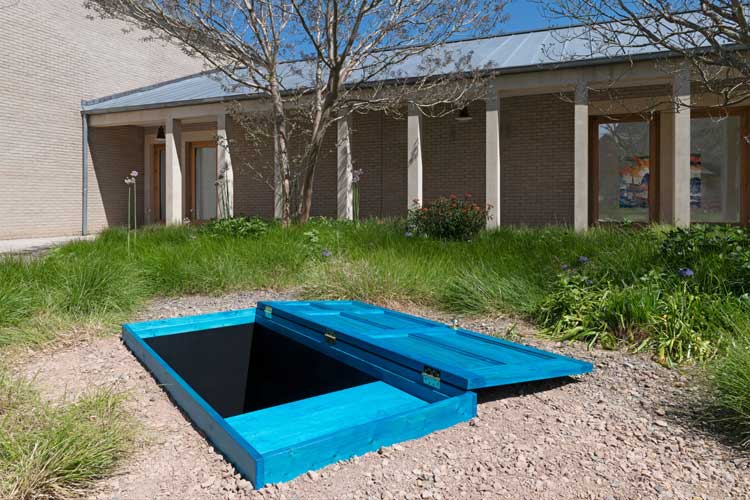
Angel Otero. Dreams and Salt, 2025/2026. Wood and metal, 10 x 168 x 210 cm (3 7/8 x 66 1/8 x 82 5/8 in).
Installation view, Agua Salada, Hauser & Wirth Somerset, 2026. © Angel Otero. Photo: Ken Adlard. Courtesy Angel Otero and Hauser & Wirth.
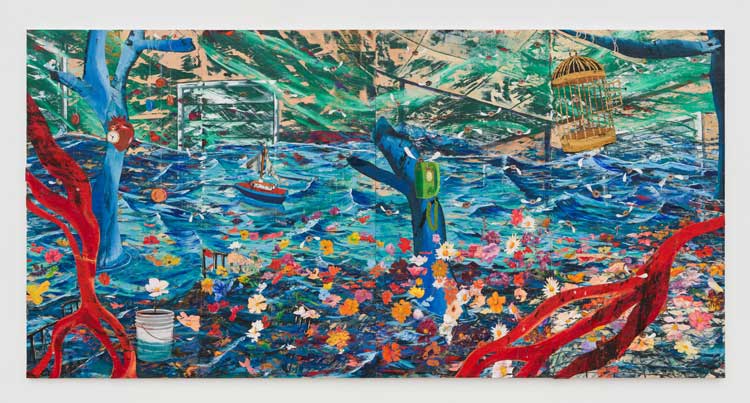
“There’s a lot of symbolism in these works. There are motifs that are familiar within my practice, such as telephones, birdcages, dentures, furniture, but also new ones such as crabs, eyes, buckets, cigarettes and windows,” says Otero, gesturing to the many canvases propped against the walls of Hauser & Wirth’s artist studios, which are housed in a historic brewery in the heart of Bruton. “The objects in these paintings are like stand-ins for people, family members or myself. They become these sort of protagonists,” he explains. Some are specific objects from his grandmother’s home, others are derived from his memories of objects. The combinations of these different elements result in surreal images such as Dreamcatcher (all works 2026), where a huge wave bears down on a pillar bed that simultaneously appears to have caught fire; or The Room that Learned to Breathe, a large diptych in which trees, flowers, yo-yos, windows and a birdcage float on the ocean as winged eyes fly around like insects. “I introduced the eye motif in my first Los Angeles exhibition,” Otero notes. “Because of my process of scraping, some of the paintings had these holes in their surfaces which reminded me of eyes. I drew a couple of eyes in those holes and then realised that they had so many meanings across different cultures. I grew up with ideas about the evil eye, protection and all these things, so then I started painting the eyes separately and collaging them on to the paintings.”
Searching for subject matter early on in his career, Otero drew inspiration from childhood memories of his grandmother and her home. Otero was evidently very close to his grandmother; her portrait is tattooed on his right forearm and he talks about her with great fondness. “It’s quite common in Latin America for grandmothers to take on a motherly role,” he explains. “My mum was working and so Grandma took me to school, made me lunch, and looked after me.” Objects from her home have inspired numerous works, as has its architectural features. “I’ve been dissecting her whole house through my work: the windows, the gate, the door, the stairs, the tiles, the furniture, the wind chimes. I’m not trying to reinterpret specific memories – I use them all as points of departure.”
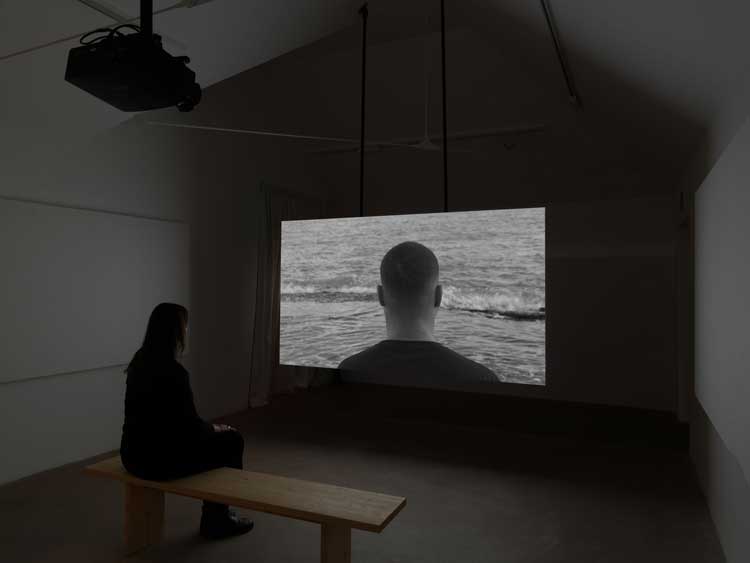
Angel Otero. Agua Salada, installation view, Hauser & Wirth Somerset, 2026. © Angel Otero. Photo: Ken Adlard. Courtesy Angel Otero and Hauser & Wirth.
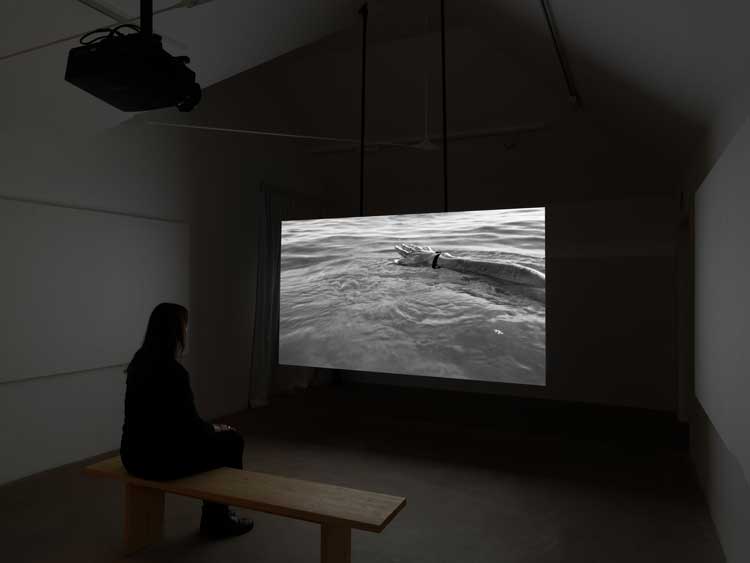
His grandmother’s house is also the subject of Otero’s first moving-image work, Agua Salada, although that had not always been his plan. “I had originally intended to make a film about a game I used to play as a kid, where me and my friends would race bottle caps in the gutters after it had been raining,” he explains. “Film-making usually involves a lot of pre-planning, from storyboards to lighting and sound, but I have a hard time with all that because I like to be spontaneous. We were in Puerto Rico, near my grandmother’s house and I thought: ‘Hey, we have the cameras, the house is here, let’s just shoot something around the house.’ So we went inside and started recording some of the objects that I’ve been painting for a long time. Suddenly, my whole idea about the film changed.”
As Otero explains, for many years the house has been kept almost like a time capsule. “My grandmother’s house is above my mom’s house. It’s a separate structure but when my grandmother died my mom decided to close its doors and said: ‘That’s it. It’s not for rent, you don’t open it, you don’t use it; it’s done, no one sleeps here.’” Yet despite this, Otero’s mother agreed to let him film inside the building, recognising its significance for him. The black-and-white film features two individuals; one is Otero playing himself in the present day, while the other is a younger version of the artist played by one of his studio assistants. “We’re both exploring the place, opening the windows, turning on lights, checking the furniture,” Otero says, describing the film. As it unfolds, we hear the sound of the ocean and his grandmother’s wind chimes, and we see the bed that Otero slept on as a child. In one scene recalling Otero’s recent paintings, a rocking chair from the house sits on the shore, lapped by waves. “For me, this is the most personal project I’ve ever done,” says Otero, whose poetic narration is heard throughout the film. “It’s about time, place and memory. It doesn’t have a linear narrative and is very dreamlike and ambiguous. You don’t know what’s past or present.”
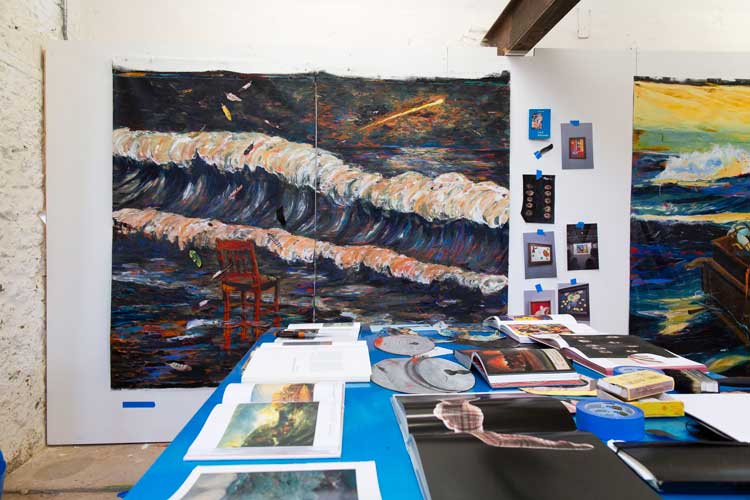
Angel Otero during his artist residency at Hauser & Wirth Somerset, 2026. Photo: Clare Walsh. Courtesy Angel Otero and Hauser & Wirth.
“Personal references are a kind of trampoline that allow me to leap beyond the purely autobiographical and representational to things that hopefully are more universal,” Otero elaborates. And while much of his imagery is inextricably linked to childhood memories of Puerto Rico, it is also infused with references to art history and his daily lived experiences. A table in the studio is strewn with art books on the work of painters such as JMW Turner and Winslow Homer, whose marine subjects have been a significant inspiration for the work in Agua Salada. “I like to go on a journey in my work and try to surprise myself. I’m thinking about art history, about Puerto Rico, about what happened yesterday or where I have to go next week, and everything collapses together. But the autobiographical aspect of my work – those references to my family and where I’m from – they act as an anchor that helps me to keep my feet on the ground.”
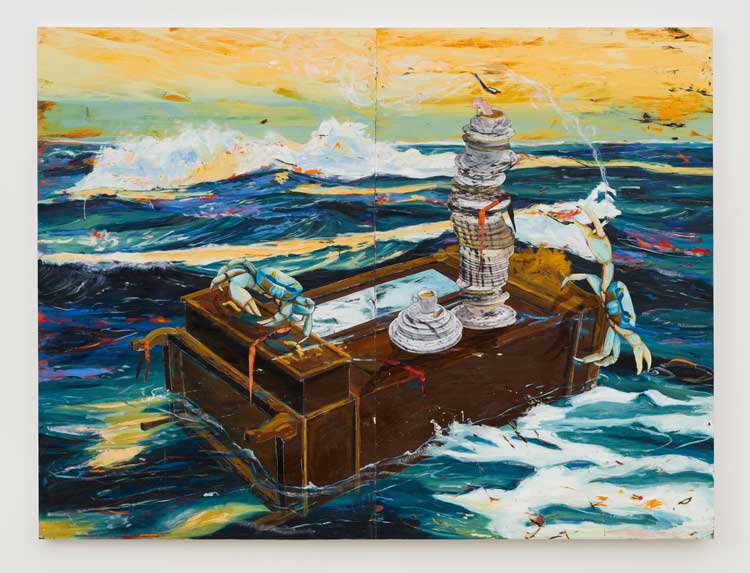
Angel Otero, A Two Man Island, 2026. Oil paint and fabric collaged on canvas, 182.5 x 242 x 4 cm (71 7/8 x 95 1/4 x 1 5/8 in). Courtesy Angel Otero and Hauser & Wirth. Photo: Damian Griffiths.
In another painting, titled Anchored, Otero returns to the ornamental wrought-iron gate that stands outside his grandmother’s house and which he explored in a body of metal and ceramic works in 2024. Here, the gate, with its intricate scrolling patterns, appears like an apparition, hovering amid rolling blue waves tinted with flashes of orange and yellow. Such structures are seen all over Puerto Rico, having been introduced during the centuries of Spanish rule (1493-1898) and while Otero has a very personal connection to this particular gate, his painting subtly speaks to the history and impact of colonialism in Puerto Rico. “I’ve always embraced this idea of dancing with the personal and the historical in my work,” he says. For Otero, the gate also stands as a portal: “a symbolic point of entry, of leaving, of arriving, of escaping.” Is the gate a portal into a world of happy memories? “That’s the way I feel about it, for sure,” he confirms.
The notion of portals connecting physical and metaphysical realms is explored further in the sculpture Dreams and Salt, a doorway installed on the ground that opens to reveal a staircase descending into darkness. The piece was created in 2025 for the third Grand Tropical Biennial, a one-day exhibition in Loíza, Puerto Rico, where it was installed on the beach. “This piece started life as a drawing, from which I made a painting. Then the idea grew and when I was invited to participate in the Tropical Biennial, I decided to accept the challenge of making the door a physical reality,” he recounts. “I went to the beach with my crew at 5am, we dug a large hole and installed the sculpture. Because it was a one-day event, we had to remove it in the evening, but at Hauser & Wirth I’m making it a lot more elaborate with drainage, so it can exist here for several months outdoors.” The sculpture evokes feelings of distance, detachment and the longing for return or even escape.
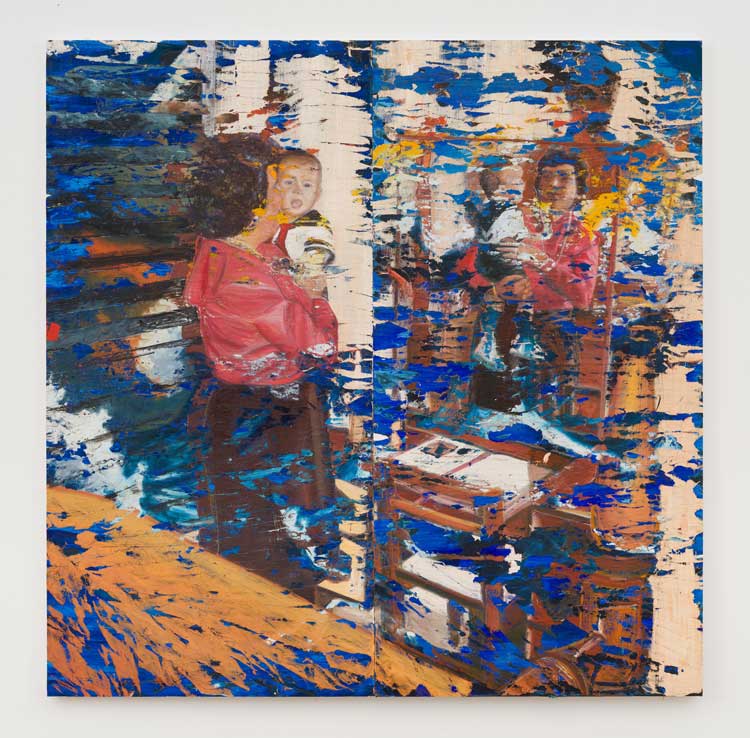
Angel Otero, A Sailor Before the Mirror, 2026. Oil paint and fabric collaged on canvas, 241.5 x 241.5 x 4 cm (95 1/8 x 95 1/8 x 1 5/8 in). Courtesy Angel Otero and Hauser & Wirth. Photo: Damian Griffiths.
Another major development for Agua Salada has been the inclusion of portraits of family members painted from photographs. The painting A Sailor Before the Mirror depicts Otero as an infant, held in the arms of his grandmother and surrounded by objects from her home. The figures face a mirror, in which we see them reflected through a fragmented sea of layered abstract marks, ranging from fiery oranges and yellows to watery blues. The composition has the feeling of a hazy memory, pulling in and out of focus. “I came across the photograph when I was editing my film,” says Otero. “It reminded me of some interiors I had painted – paintings I’ve never shown – and so I just wanted to paint it as an experiment, it wasn’t meant to express something, I was just exploring it for myself. It also reminded me of Las Meninas, with Velázquez looking out at the viewer.”
Having never exhibited portraits before, Otero was at first hesitant to include it in the exhibition. “I was a little intimidated by the thought of bringing something so personal, so I wasn’t planning on showing it anywhere,” he says. “But what started as an exploration began to feel more and more perfect for the purpose of this exhibition.” As with Otero’s other works, the composition was created using his oil skin technique. “I was never going to make a traditional kind of portrait; it had to have these gestural and distorted elements, which act like a filter between the personal subject matter and the viewer. I wanted it to be intimate to me, but also to be universal if possible. A painted replica of the photo wouldn’t challenge the motif, I need to have the process. It reminds me of the writing of Jeanette Winterson who has a unique way of navigating between reality and magic. She travels between different characters, genders and realities. My favourite of hers is Art and Lies: A Piece for Three Voices and a Bawd.”
Although Otero’s latest works don’t make explicit reference to his time in Somerset, he says the new context has indirectly influenced his approach. “Working here has given me a certain perspective on solitude and simplicity,” he explains, referring to the fact that for the first half of the residency he worked alone before being joined by two assistants. “I’m used to New York and Puerto Rico, both being very active and culturally diverse environments where I’m always on the run. In New York there’s so much noise and a lot of visual noise, but being here in such a serene and beautiful environment has helped me really appreciate the importance of a quieter pace of life. I feel I can hear my thoughts more clearly here and I’ve encountered a certain type of peace which has helped me connect with my work in a different way. As a result, I think some of the new works have this feeling of solitude but also intimacy. They are like portals to my emotions, to how I feel about place, about self, about being a son, a father and an artist.”
• Angel Otero: Agua Salada is at Hauser & Wirth Somerset, until 18 October 2026.
Click on the pictures below to enlarge

Copyright © 1893–2026 Studio International Foundation.
The title Studio International is the property of the Studio International Foundation and, together with the content, are bound by copyright. All rights reserved.

 |
 |
 |
|---|

-1000-300.jpg)



 David Smith: Field Work
 Louise Bourgeois: Turning Inwards