




-1000.jpg)
Angela de la Cruz, UPRIGHT, istallation view, Ikon Gallery, Birmingham, 2026. Image courtesy Ikon. Photo: Tom Bird.
Ikon Gallery, Birmingham
25 March – 6 September 2026
by DAVID TRIGG
The two works that open this solo exhibition by the London-based Spanish artist Angela de la Cruz resemble the kind of objects found lurking in art school skips at the end of term. In the first, Still Life with Table (2000), a rumpled black canvas is awkwardly wrapped around a broken stretcher and a collapsed table, the two remaining legs of which provide support for the unruly mess, which rests on the floor, forlorn and abject. Next to this is Limp (Brown) (2000), a freestanding monochrome painting that has suffered a violent injury – its bottom-left corner having apparently been ripped off and crudely stitched back with gaffer tape, along with the corner of another painting that forms a foot to support the precarious whole. They are ugly, outrageous and utterly compelling.
.jpg "Angela de la Cruz, Still Life with Table, 2000 (left), and Limp (Brown), 2000. Installation view, UPRIGHT, Ikon Gallery, Birmingham, 2026. Image courtesy Ikon. Photo: Tom Bird.")
Angela de la Cruz, Still Life with Table, 2000 (left), and Limp (Brown), 2000. Installation view, UPRIGHT, Ikon Gallery, Birmingham, 2026. Image courtesy Ikon. Photo: Tom Bird.
Such painting in the expanded field typifies the probing of the medium’s spatial and material boundaries that the Turner Prize-nominated artist has pursued since her student days at the Slade in the mid-1990s. This welcome exhibition at Birmingham’s Ikon gallery, though not the full-scale survey De la Cruz certainly deserves, presents rarely seen works from 1999 to today, demonstrating her enduring capacity to surprise and confound expectations of what art can and should look like.
Her canvas-based works generally begin in the traditional way: regularly proportioned stretchers and taut cotton duck provide a support for oil or acrylic paint, which is carefully applied with horizontal brushstrokes. But then her monochromes are made to buckle, bend or collapse altogether. Canvases are twisted, dislodged or sometimes entirely liberated from their supports. They lie on the floor or loiter in corners; you can’t help but feel slightly sorry for them. But humour is never far away. The violence is slapstick, à la Buster Keaton or Charlie Chaplin, though perhaps Jacques Tati’s critiques of modernity’s rigid structures and sterile aesthetics are more pertinent, in particular the restaurant scene from Playtime (1967), where a tightly controlled ultra-modern environment hilariously collapses into anarchy.
-2.jpg "Angela de la Cruz, Transfer (White) with Armchair, 2011 (foreground). Installation view, UPRIGHT, Ikon Gallery, Birmingham, 2026. Image courtesy Ikon. Photo: Tom Bird.")
Angela de la Cruz, Transfer (White) with Armchair, 2011 (foreground). Installation view, UPRIGHT, Ikon Gallery, Birmingham, 2026. Image courtesy Ikon. Photo: Tom Bird.
Whether she is making paintings that use the language of sculpture or sculptures that use the language of painting, each one reflects De la Cruz’s concern with the human body with all its frailties. For her, the stretcher is often an extension of the body, and several works in the exhibition use the artist’s own physical measurements for their dimensions. Bloated III (Blue) (2012) is one example, a curious wall-mounted work whose glistening, painted aluminium surface is covered with unsightly bulges created by hammering. Nearby, the all-white sculpture Transfer (White) with Armchair (2011) features a similarly proportioned rectangular cuboid. One end rests on a plush Florence Knoll lounge chair, the other on a rusty Robin Day Polyside chair – both modernist classics yet with very different applications. The use of chairs underscores the cuboid’s anthropomorphism: it is a reclining figure caught between comfort and utility, resting or – given the Polyside’s associations with hospital waiting rooms – suspended in an eternal moment of anticipation.
.jpg "Angela de la Cruz, Reach (Red & Black) Two Parts, 2002. Installation view, UPRIGHT, Ikon Gallery, Birmingham, 2026. Image courtesy Ikon. Photo: Tom Bird.")
Angela de la Cruz, Reach (Red & Black) Two Parts, 2002. Installation view, UPRIGHT, Ikon Gallery, Birmingham, 2026. Image courtesy Ikon. Photo: Tom Bird.
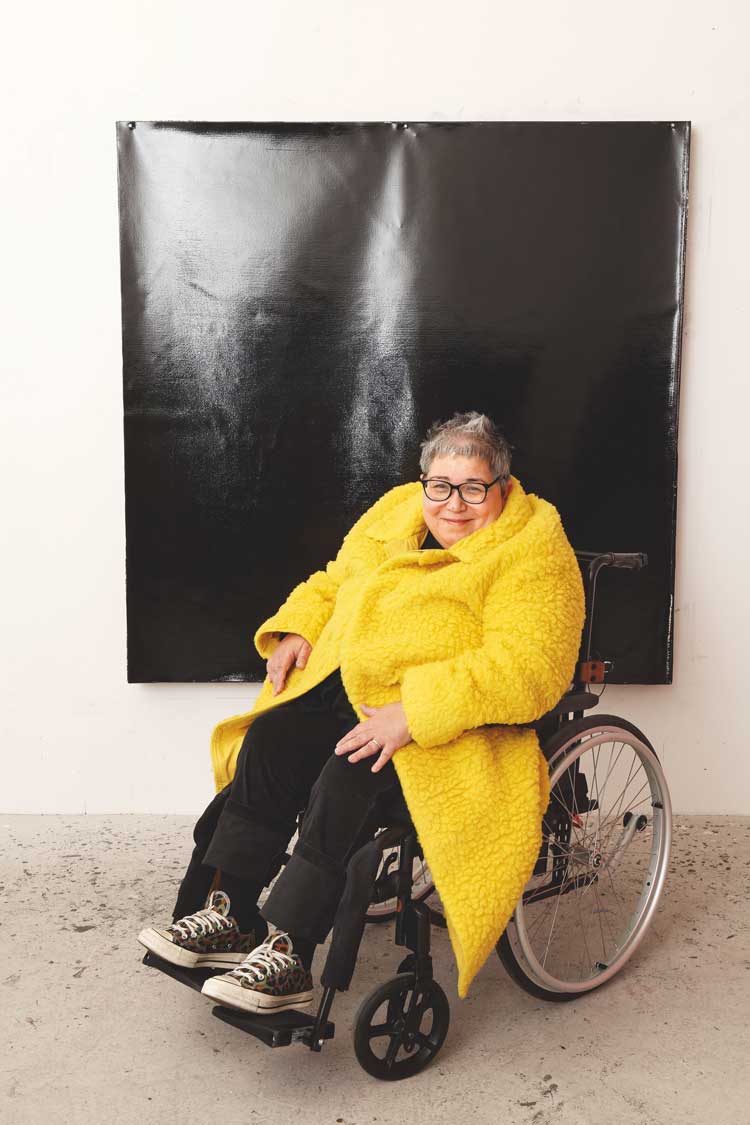
Themes of structural support and reliance on others continue in Reach (Red & Black) Two Parts (2002), a diptych in which one large red canvas rests on top of a crumpled black painting, which has apparently been crushed under the weight of the other. The show’s title, Upright, comes into view here, speaking to posture and moral integrity, but also to notions of loadbearing. The question this painting seems to ask is: who carries the weight? It is not autobiographical, but resonates differently when you learn that De la Cruz is disabled, becoming a wheelchair user after a brain haemorrhage while pregnant in 2005 left her in a coma for several months. As a result, her work is made with the aid of assistants and while it has always alluded to the human condition, it is now inextricably linked with the artist’s personal experience of fragility, vulnerability and fortitude in the face of adversity.
.jpg "Angela de la Cruz, Shutter (Red), 2017. Installation view, UPRIGHT, Ikon Gallery, Birmingham, 2026. Image courtesy Ikon. Photo: Tom Bird.")
Angela de la Cruz, Shutter (Red), 2017. Installation view, UPRIGHT, Ikon Gallery, Birmingham, 2026. Image courtesy Ikon. Photo: Tom Bird.
The language of minimalism is regularly subverted in De la Cruz’s works. A notable example here is Shutter (Red) (2017), a bright-red aluminium work that looks like the result of someone dropping a Donald Judd sculpture, causing it irreparable damage. Once uniform strips of horizontal metal are now bent and deformed, slipping downward like broken slat blinds. The feeling is one of collapse and instability but, interestingly, the kinked components appear to have been carefully painted after their trauma, which evokes a sense of care, even redemption.
The outlier here is Upright Piano (1999), in which two upright pianos are joined together, one on top of the other, to form an instrument that can be played only while standing. An intriguing musical proposition, it is activated by pianists throughout the exhibition run. But as a sculpture it falls flat, more a novelty or curio than anything else, remaining mute for most of the time.
,-image-courtesy-Ikon-Photo-Tom-Bird.jpg "Angela de la Cruz, Upright Piano, 1999. Installation view, UPRIGHT, Ikon Gallery, Birmingham, 2026. Image courtesy Ikon. Photo: Tom Bird.")
Angela de la Cruz, Upright Piano, 1999. Installation view, UPRIGHT, Ikon Gallery, Birmingham, 2026. Image courtesy Ikon. Photo: Tom Bird.
In 2001, one of De la Cruz’s pieces featured in a performance by Ballet Rambert, choreographed by Rafael Bonachela. Returning to the world of dance, the most recent work in the exhibition was developed with the Birmingham Royal Ballet as they worked on Sir Peter Wright’s production of The Nutcracker. Titled Blister (2026), and far from balletic, this large wall-mounted painted metal object is reminiscent of a Claes Oldenburg burger – a crumpled, flesh-coloured sheet of aluminium sandwiched between two red squares, one of which has been deformed, bulging from the wall like a large welt or angry blister. It reflects the tension between the graceful movement of the dancers and the punishing realties of their physically demanding art, which often results in pain and injury.
It is not hard to see why the Nutcracker ballet, in which a doll is broken and fixed, would appeal to De la Cruz. Her works consistently allude to the resilience and adaptability of the human body, whatever life throws at it. Moreover, they also seem to express a yearning to see this broken and unstable world brought back into balance.
Click on the pictures below to enlarge
.jpg)
,-image-courtesy-Ikon-Photo-Tom-Bird.jpg)
.jpg)
.jpg)
.jpg)
.jpg)

Copyright © 1893–2026 Studio International Foundation.
The title Studio International is the property of the Studio International Foundation and, together with the content, are bound by copyright. All rights reserved.
 |
 |
 |
|---|




-1000-300.jpg)
 Meryl McMaster – interview: ‘I explore complex questions around one’s sense of self and belonging to two heritages’
 Hew Locke – interview: ‘A lot of my work has to do with the burden of history and … how history affects us today’
 Langlands & Bell – video interview: ‘We like to be catapulted into the unknown; we like a challenge’
 After White: Michaela Zimmer and Peter Welz
 Edmund Clark: ‘The intervention, the control, the censorship is part of what I do’