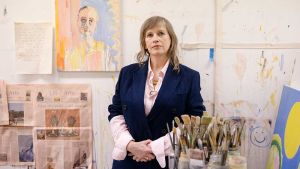

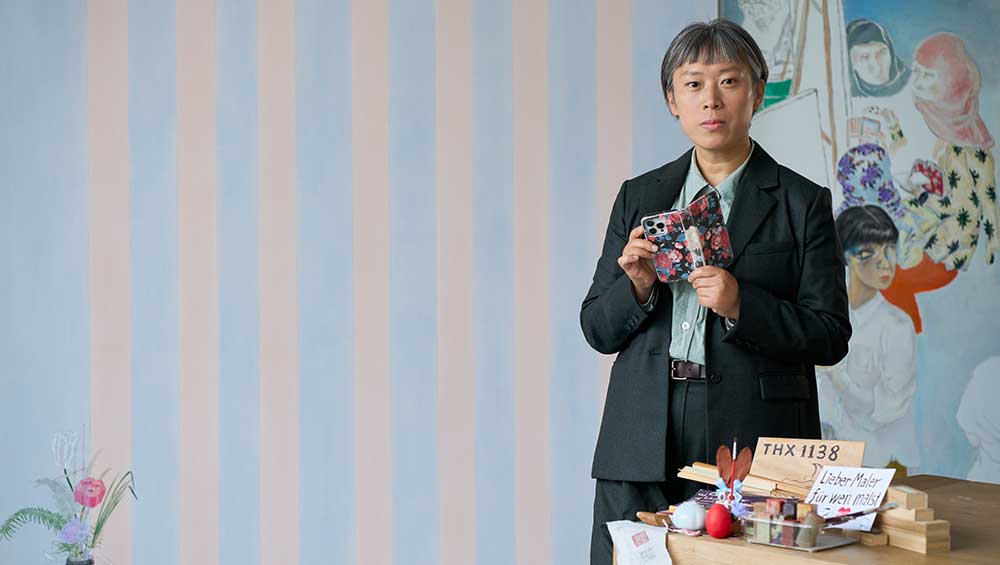
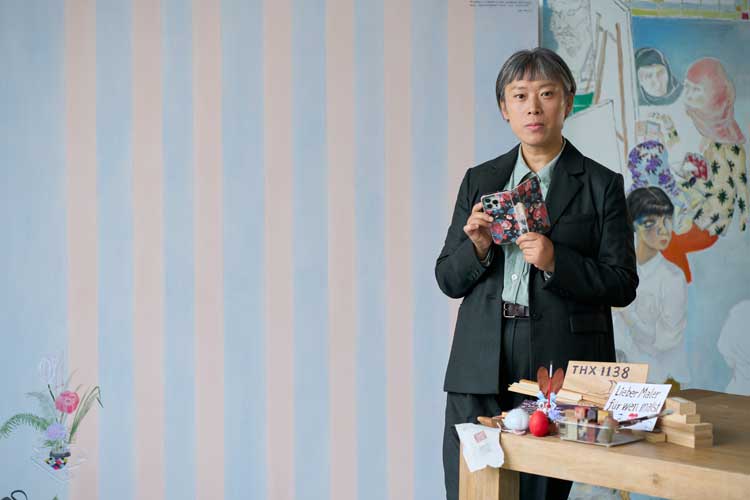
Portrait of Evelyn Taocheng Wang. Photo: Sol Archer. © Evelyn Taocheng Wang.
by JOE LLOYD
It is an unexpectedly clement spring morning in the Italian city of Bolzano for the opening of Evelyn Taocheng Wang’s exhibition at Museion. A vast window behind the galleries opens on to the emerald hills of an Alpine valley, strewn with vineyards and castles. “Before I share more,” says Wang, “I would like you to close your eyes, forget about what we are doing, what you have seen, and what you want me to answer. And don’t think about what’s next. We’ll just take a minute for a little bit of meditation. So, please close your eyes, and if you see something or you think something, try to cut it off.” It might seem a curious idea for an artist to push focus away from her own work. Yet in the context – surrounded by an overwhelming landscape and artworks that deftly flicker between Chinese and European motifs, art historical reverence and subversion, image and text – it makes sense to go in with a cleansed mind.
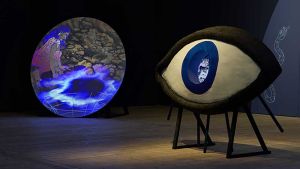
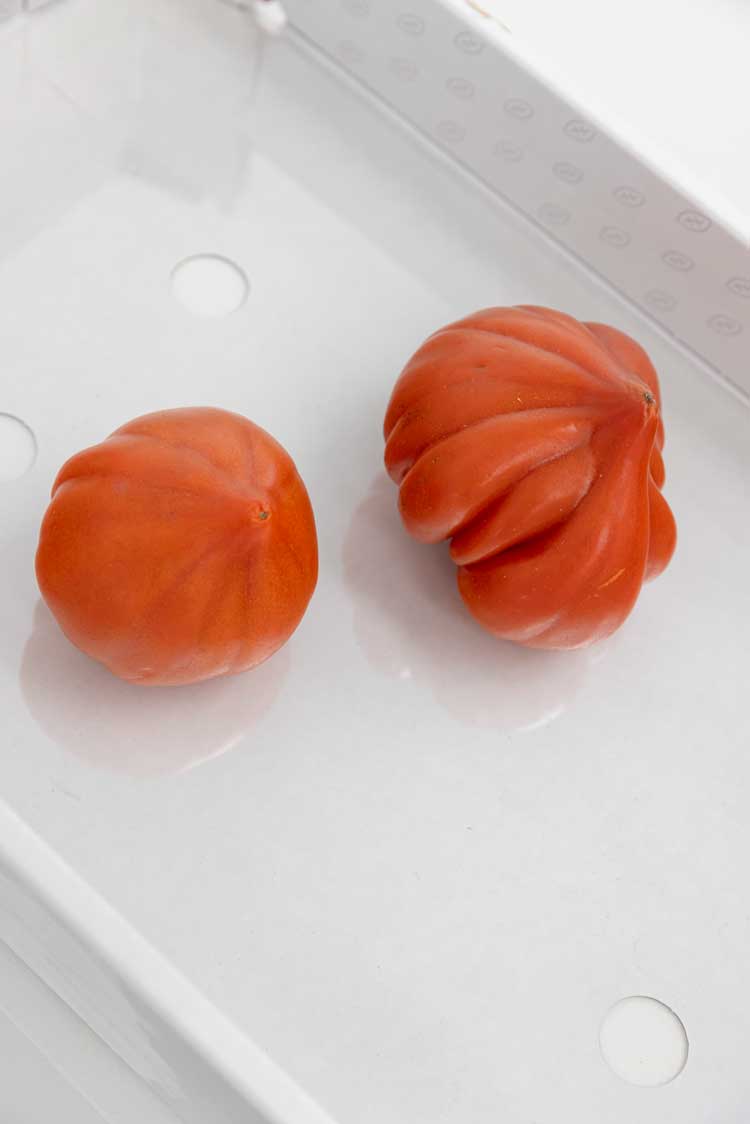
Wang’s exhibition at Museion, Sweet Landscape, takes inspiration from Bolzano’s Alpine surroundings. “When I first visited Bolzano, I was really impressed by the landscape around the mountains – because Holland has no mountains, only sea,” she says. The Alpine setting invoked Wang’s memories of her mountainous hometown in China. It also aligned with her earlier understanding of the continent, learned through studying catalogues of western art history. “All of our vision is almost like secondhand, because we see landscapes in art before we see them with our own eyes,” she says. “Our experience is always twisted. Where is the boundary between the landscape we know and the landscape we see?” The sweet in the exhibition’s title refers to the sensation, after years of greenhouse-grown Dutch produce, of biting into a flavoursome Italian tomato. Wang’s sculpture Ancient Roman Bust for Sale (2025) is a crate of these pungent fruits, bought from a local market – for the opening, two livid red specimens.
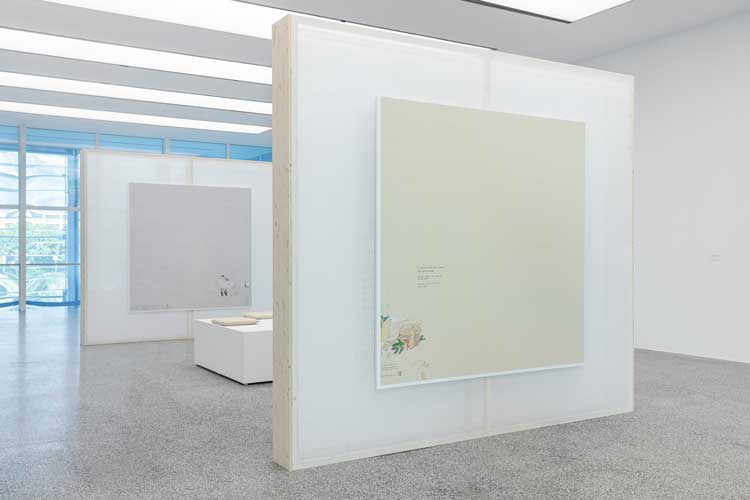
Evelyn Taocheng Wang. Sweet Landscape, exhibition view, 2026, Museion. © Evelyn Taocheng Wang 2026, courtesy the artist; Antenna Space, Shanghai; Carlos / Ishikawa, London. Photo: Luca Guadagnini.
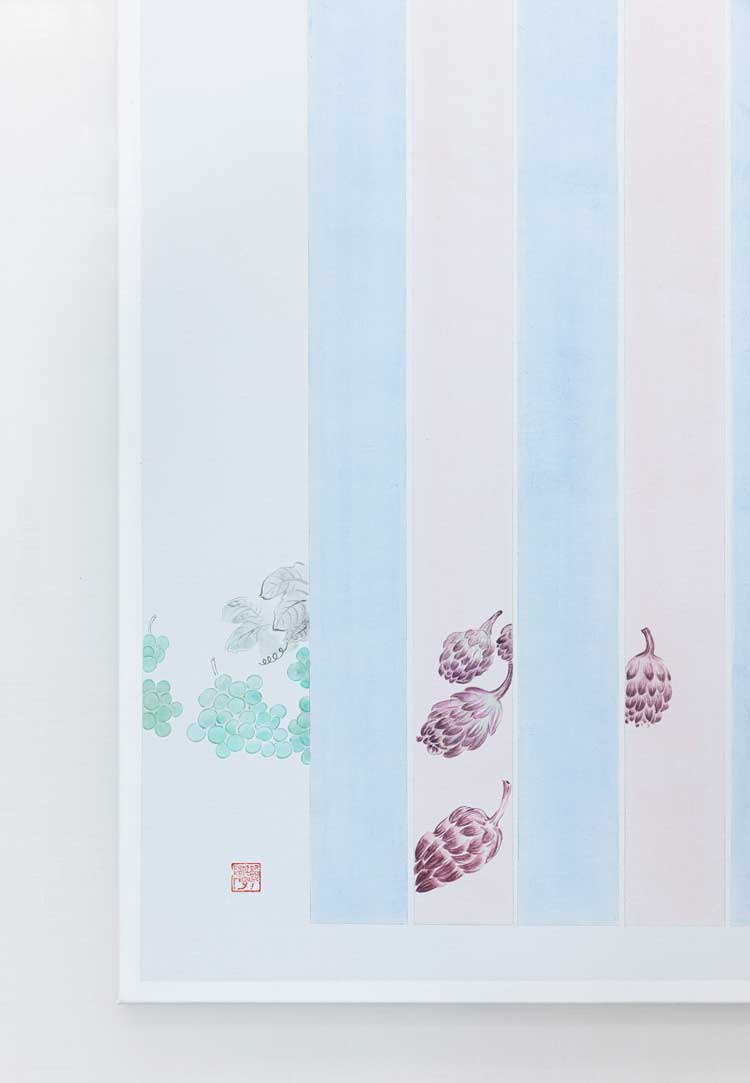
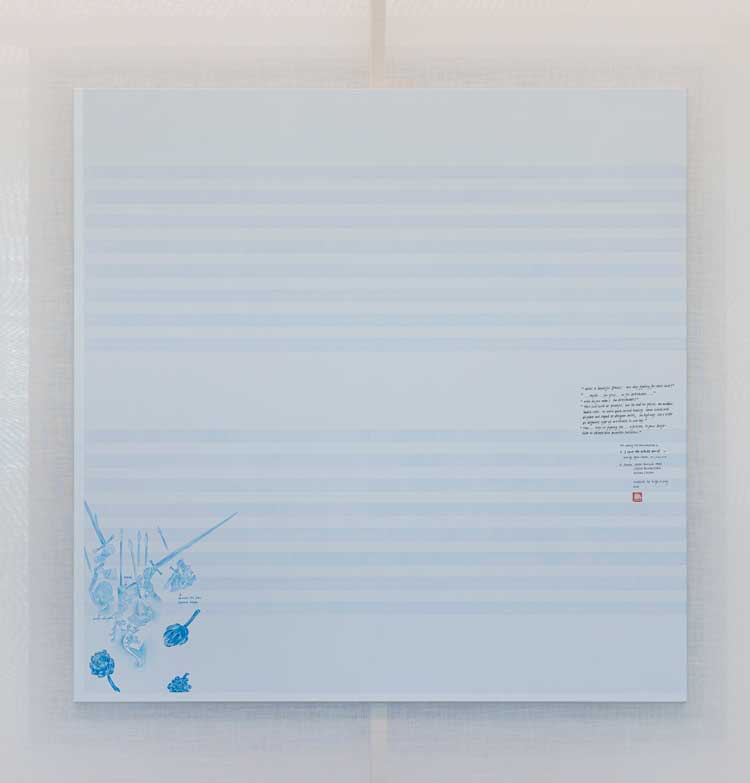
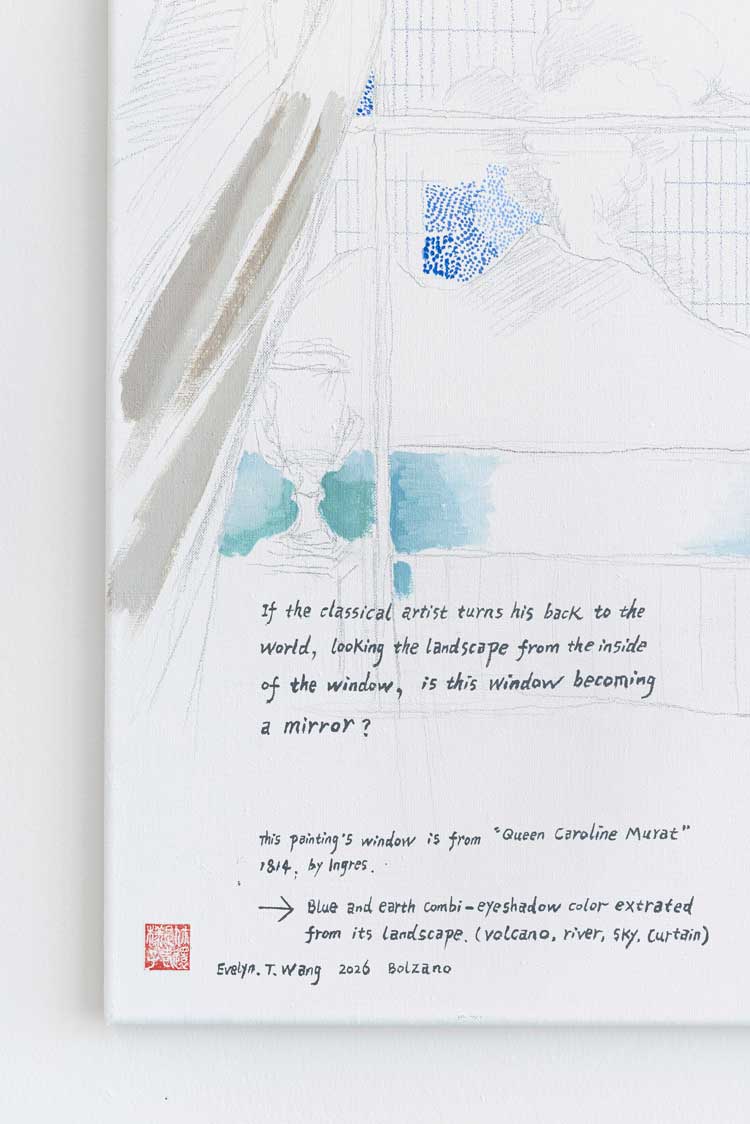
Sweet Landscape, the result of two years of planning, extends several of Wang’s existing bodies of work, most prominently Do Not Agree with Agnes Martin All the Time (2022-). Exhibited at the 2024 Venice Biennale and her 2025 Museum Ludwig exhibition to celebrate her Wolfgang Hahn Prize, this series recreates the meditative grid paintings of the minimalist Martin, with delicately painted original images and text. Martin’s works – abstract, though often with titles suggestive of the natural world and the weather – come to serve almost as backgrounds to Wang’s diaristic imagines. At Museion, these image borrow from painted frescos in Bolzano’s Chapel of Santa Caterina and Castel Roncolo, but also panettone and strawberries. Sometimes her new images float translucently atop the Martin backgrounds, while on other occasions they poke out from them, as if Martin’s stripes have become blinds or walls. There are numerous witty pairings: Mary Magdalene is placed next to a shampoo that bears her image, while a fragment of a painting by Giuseppe Castiglione – a Jesuit missionary and painter with a particular specialism in horses – is paired with a gelato sundae. “I was thinking,” Wang explains, “that his horse could have travelled through the mountain and entered Bolzano, and afterwards they might want a Bolzano ice-cream.”
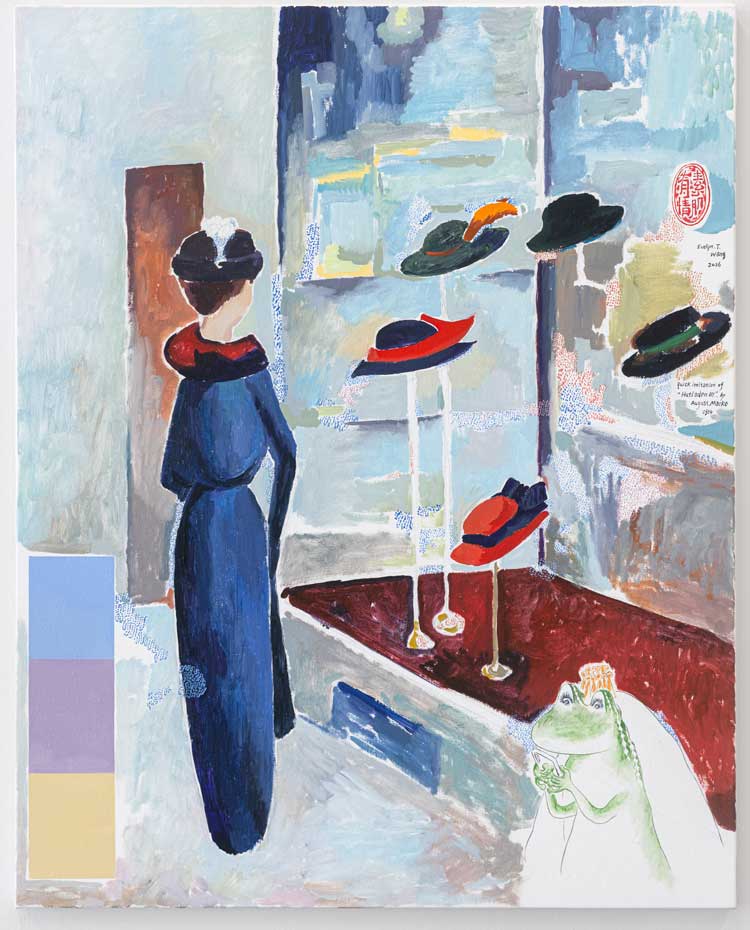
Evelyn Taocheng Wang, Frog Princess Checks her Smartphone in front of Window of August Macke's Hat Shop, 2026. Oil colour, pencil on canvas, 100 x 80 x 2,5 cm. © Evelyn Taocheng Wang, courtesy the artist; Antenna Space, Shanghai; Carlos/Ishikawa, London. Exhibition view, Evelyn Taocheng Wang. Sweet Landscape, Museion, 2026. Photo: Luca Guadagnini.
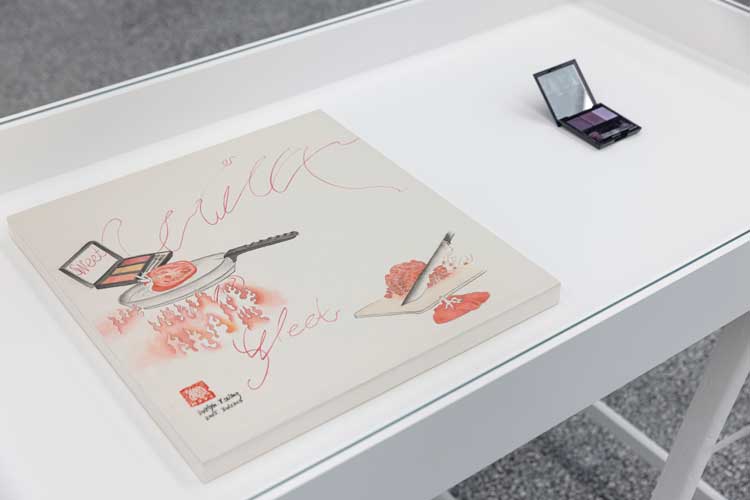
Castiglione collaborated with court artists in Beijing and came to be both influenced by Chinese painting and an influence on a generation of Qing painters. Wang’s work is at the confluence between Chinese and European styles. She initially trained in traditional Chinese art. “In old Chinese painting, you don’t see the concept of light because there is no shadow,” she explains. “Painting about landscape is more like an abstract construction of how we think about a landscape which we belong to.” It also shaped an interest in mediums other than oil on canvas. Traditional Chinese painting preferred silk and paper over the canvas, and watercolour and ink over oil. A series of smaller works at Museion are crafted from mineral colour and calligraphy ink over silk and xuan paper, creating diaphanous images that seem to float gently over a grey ground. They also feature portable cosmetics. “The transparent way of applying the colour always reminds me of using cosmetics on one’s body,” says Wang.
The artist moved to Frankfurt to study at the HBK Städelschule, graduating in 2012. “Frankfurt was a difficult time for me,” recounts Wang, “first because of routine. Because training in this traditional technique of painting in China requires a lot of routine, a lot of self-discipline. You are not allowed to do too many other things. In Frankfurt, it was tough for me to find the meaning of freedom.” Her tutor introduced her to the American and European conceptual art of the 1960s and 70s, theories of image generation and repetition, and body culture. The latter helped to inspire a series of works that sheathe canvases in garments of Wang’s own, at Bolzano a leather jacket and a cashmere coat. The coat encompasses a canvas showing the Dolomites, Alpine fruit and vegetables and abstract swatches of colour, but also a powder-compact mirror showing Wang’s face and broken male genitalia. Clothes both enclose and reveal. Both garments are from the characteristically Italian brand Max Mara and visualise the way clothes have their own connotations for national identity.
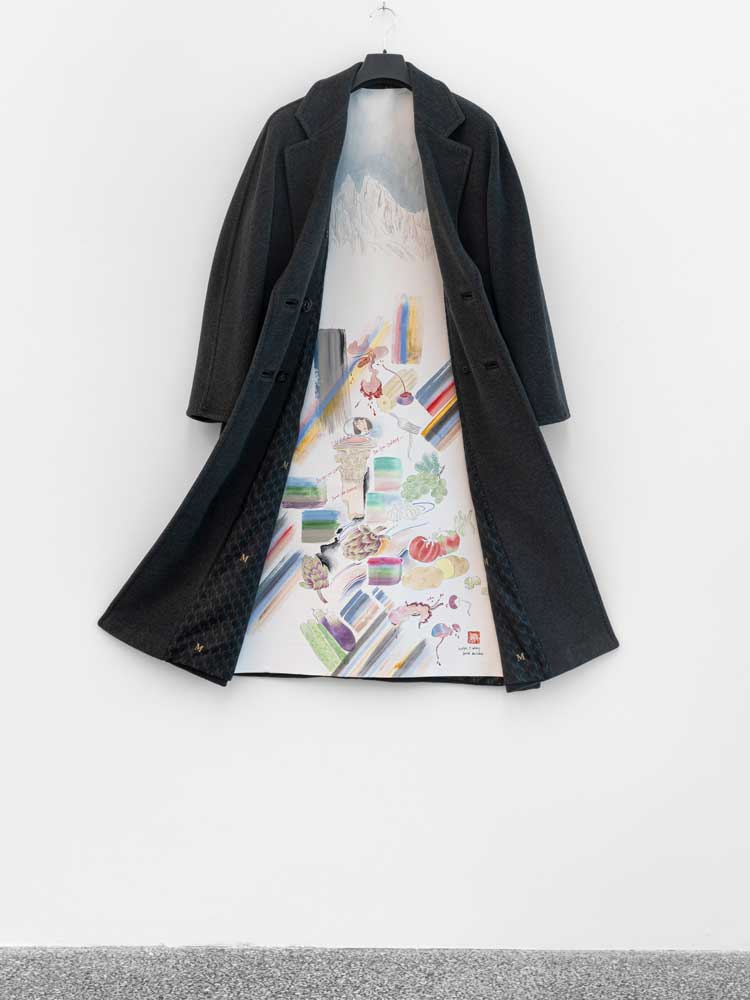
Evelyn Taocheng Wang, Lining Painting of Bolzano Veggie and Snow Mountains, 2026. Max Mara 101801 Icon Coat, size about Women M, 85% wool 15% cashmere; acrylic colour, pencil, gesso on canvas, cotton threads. Height, 160 cm. © Evelyn Taocheng Wang, courtesy the artist; Antenna Space, Shanghai; Carlos / Ishikawa, London. Exhibition view, Evelyn Taocheng Wang. Sweet Landscape, Museion, 2026. Photo: Luca Guadagnini.
Wang’s experiences in Europe made her interested in her sense of belonging, caught between two continents: “I began to think about how I could replant myself somewhere else as a migrant artist, and to understand where I was, and where I could continue dealing with what I learned in China.” She has since created work that recreates and morphs western classics. One new work in the show, Frog Princess Checks her Smartphone in Front of Window of August Macke’s Hat Shop (2026), recreates the German expressionist’s 1914 painting in oil colours, then adds a gender-switched version of the fairytale character to the front of the scene. “Everyone thinks about the Frog Prince, but I think there must also be a princess, and we might just have forgotten about her,” says Wang. It alludes to an alternative folklore, but also to the contemporary age of image generation, where digital technology can edit, compound and fake. “With social media and the new process of image consumption, we have to know what is real, the question of authenticity,” she says.
Although she had encountered Martin’s work before, Wang’s intense engagement with her blossomed during the pandemic. “During Covid, I was facing some difficulty with my works on paper. I started to do some meditation by myself to find the way, as the crisis globally expanded. As an artist, I could only jump into art history to find something I could do.” The British artist Rory Pilgrim brought Wang some images and told her she would love them in real life. “I said: ‘Why?’,” Wang continues. “My work has never been minimalistic because I always represent paperwork generated by ink-wash painting, which is not totally abstract.” But the more Wang read into Martin’s work, the deeper the affinities seemed. “She worked with paper wash and she completely removed the boundaries between drawing and painting because she used pencils for the grids.”
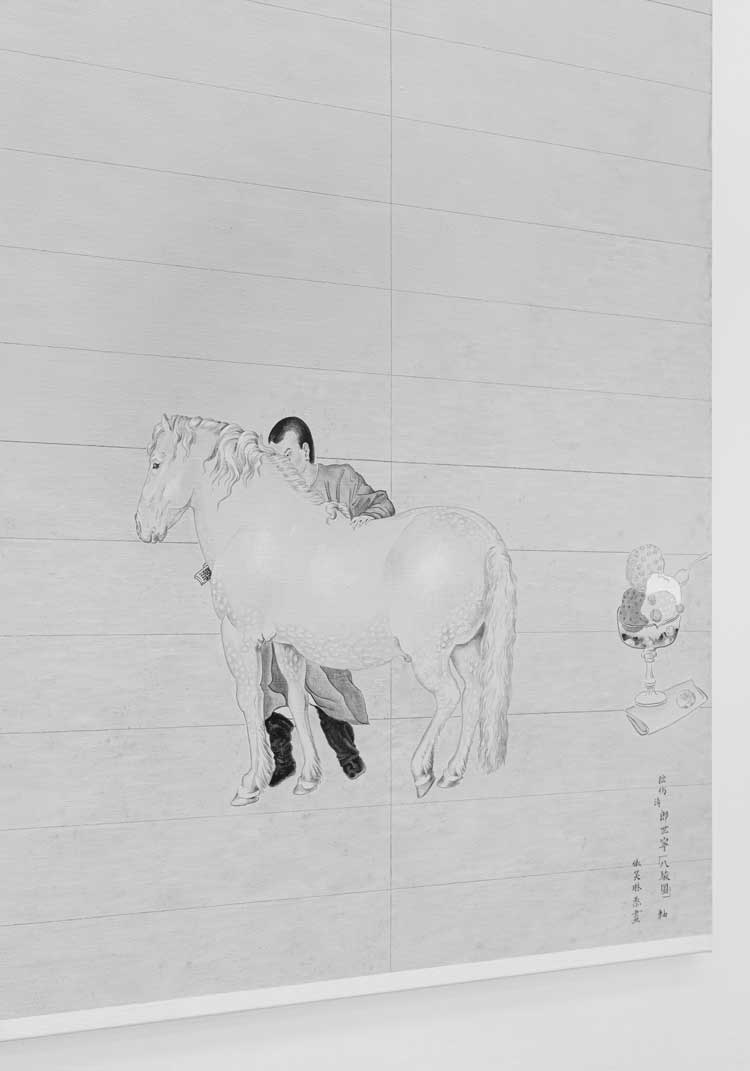
Evelyn Taocheng Wang, Giuseppe Castiglione's White Horse with Bolzano Ice-cream and Imitation of Agnes Martin, 2026 (detail). Acrylic colour, pencil, pencil fixation medium, gesso on canvas. 185 x 185 x 2,5 cm. © Evelyn Taocheng Wang, courtesy the artist; Antenna Space, Shanghai; Carlos/Ishikawa, London. Exhibition view, Evelyn Taocheng Wang. Sweet Landscape, Museion, 2026. Photo: Luca Guadagnini.
Martin also proved a compellingly many-sided model, a Calvinist Christian who researched Taoism and Zen Buddhism, who seems to combine the two worlds in her works. “I think her personal life is interesting,” says Wang. “She was always trying to deny something. She would openly talk about something, but then deny what she had talked about.” There is a tension in her works between the apparently perfect grids and the proof of the human hand that made them. “Although they look really peaceful and minimal,” says Wang, “there are so many imperfections, so many struggles inside.” To create her Martin series, Wang studies a catalogue to try to memorialise Martin’s grids, meditates for half an hour, then plucks an image from her head. She then adds the figurative elements and snatches of text, often witty, whimsical conversations. “I see the background as like paper,” says Wang, “so I can write a story.” Sweet Landscape is like a well-constructed short story collection, where each vignette artfully ties together into a multifaceted whole.
• Evelyn Taocheng Wang: Sweet Landscape is at Museion, Bolzano, Italy, until 8 November 2026.
Click on the pictures below to enlarge

Copyright © 1893–2026 Studio International Foundation.
The title Studio International is the property of the Studio International Foundation and, together with the content, are bound by copyright. All rights reserved.
 |
 |
 |
|---|
-1000-300.jpg)