




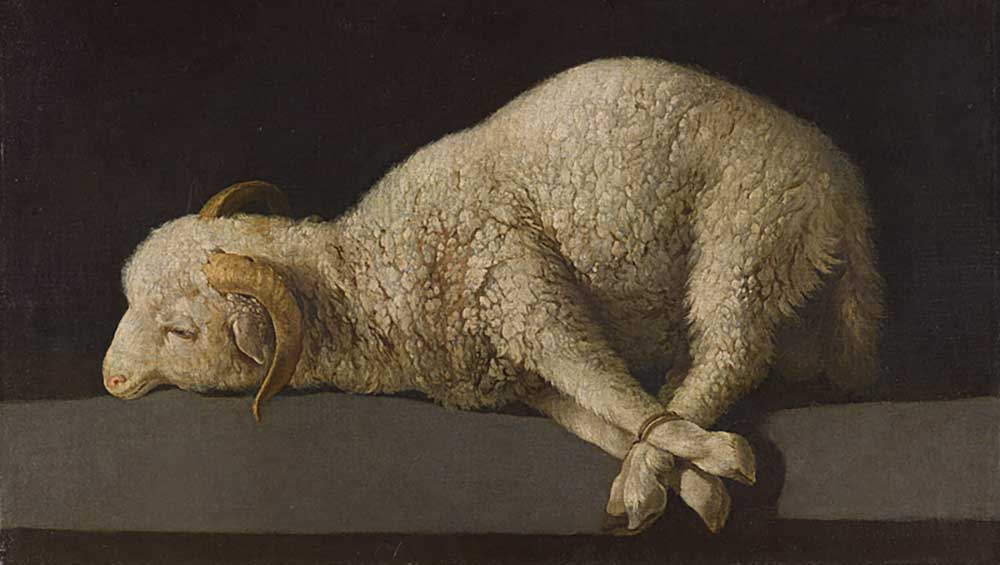
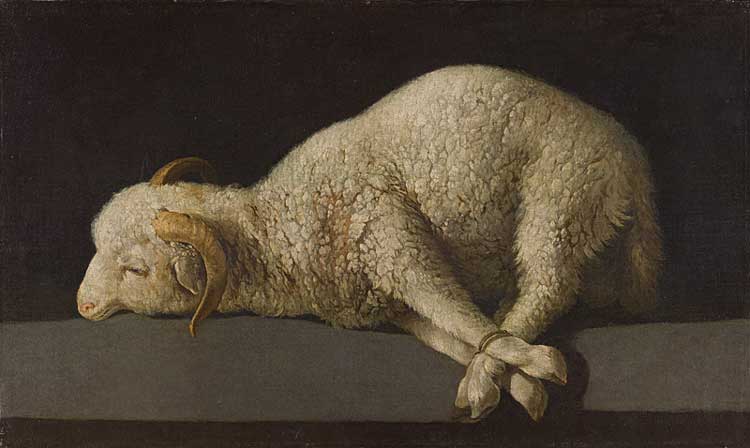
Francisco de Zurbarán, Agnus Dei, 1635-1640. Oil on canvas, 37.3 x 62 cm. Museo Nacional del Prado, Madrid © Photographic Archive Museo Nacional del Prado .
National Gallery, London
2 May – 23 August 2026
by JOE LLOYD
My heart started racing the moment I entered the National Gallery’s retrospective of Francisco de Zurbarán (1598-1664). High on the wall opposite the entrance hangs a towering Crucifixion (1627), loaned from the Art Institute of Chicago. Christ’s pale flesh and fluttering white loincloth appear out of an impenetrable gloom, less Golgotha than an imagined plane of darkness. When this masterpiece was displayed behind a grille in the sacristy of a Dominican monastery, worshippers would mistake it for a sculpture. This was Zurbarán’s first signed work – his signature appears on a tattered piece of paper beneath Christ’s bleeding feet, a scrap that shows the painter’s capabilities for capturing minutely observed detail. It sealed his reputation so completely that, in 1629, the Elders of Seville invited him to move to their city, waiving the examinations usually required for up-and-coming artists.
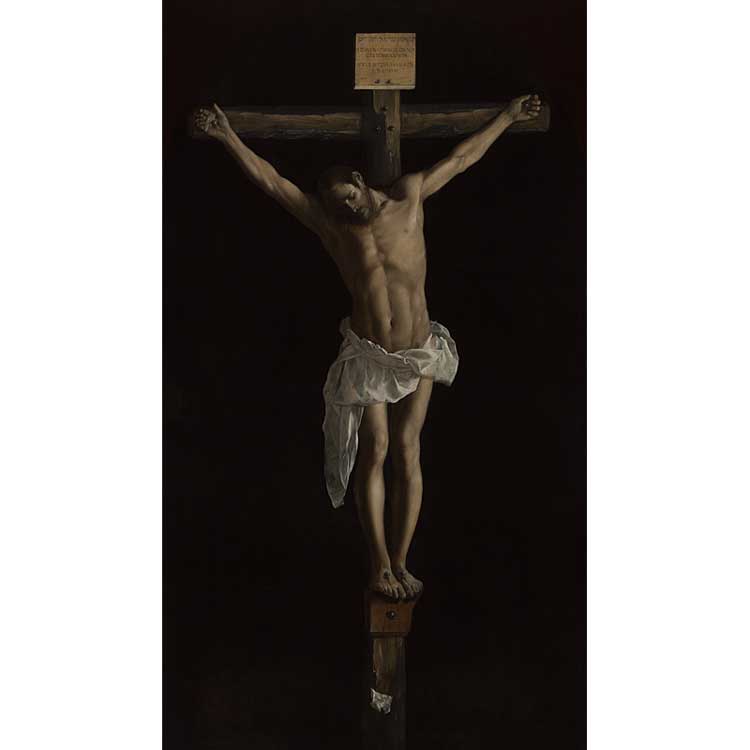
Francisco de Zurbarán, The Crucifixion, 1627. Oil on canvas, 290.3 × 165.5 cm. The Art Institute of Chicago, Robert A. Waller Memorial Fund, 1954.15 © The Art Institute of Chicago.
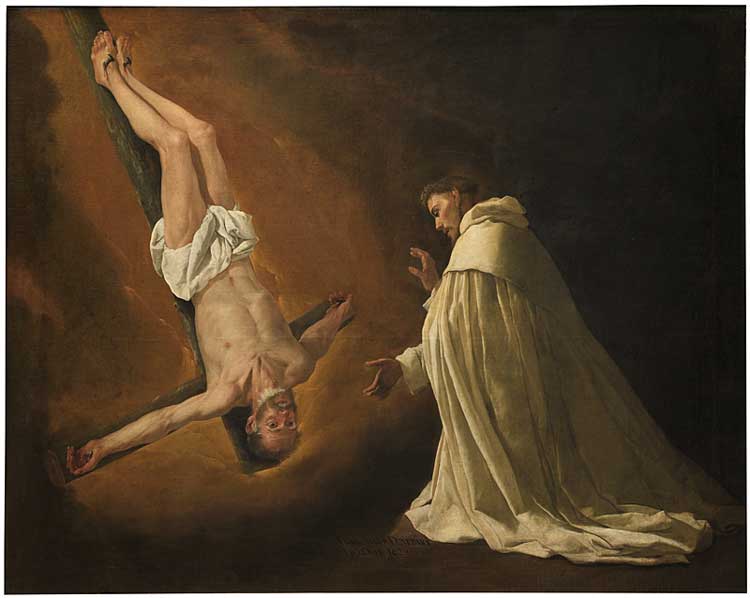
The National Gallery’s curators have juxtaposed this work with two other astounding loans. On the right, from the Wadsworth Atheneum, is a larger-than-life portrait of Saint Serapion (1628), who was dismembered by English pirates. Zurbarán’s rendition, which has Caravaggio’s delicate handling of light and dark, is serene despite the saint’s bound hands. His white robes have the physicality of classical sculpture. Opposite, from the Prado, is The Apparition of Saint Peter to Saint Peter Nolasco (1629). The latter saint kneels in contemplation, also in white robes, as the apostle appears to him on an inverted crucifix, bathed in heavenly light. Few paintings so effectively demonstrate the Counter Reformation preoccupation with mysticism and a personal relationship with the divine. Zurbarán elides the distance between the visionary and the vision. In a work in the next room, The Vision of Saint Alonso Rodriguez (1630), paradise appears as if in thought bubbles above the saint’s head.
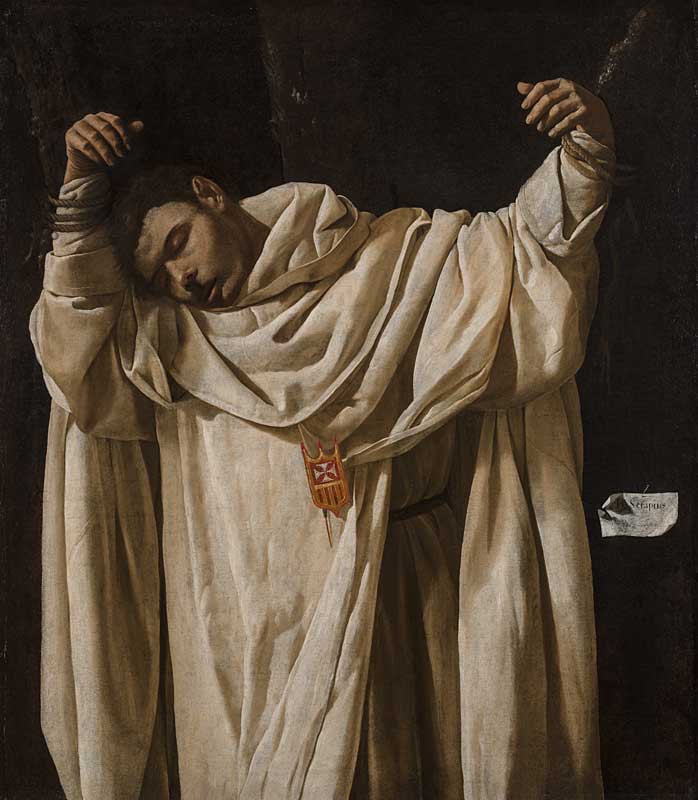
Francisco de Zurbarán, Saint Serapion, 1628. Oil on canvas, 120.7 × 104.1 cm. Wadsworth Atheneum Museum of Art, Hartford, CT. The Ella Gallup Sumner and Mary Catlin Sumner Collection Fund © Wadsworth Atheneum Museum of Art, Hartford, Connecticut.
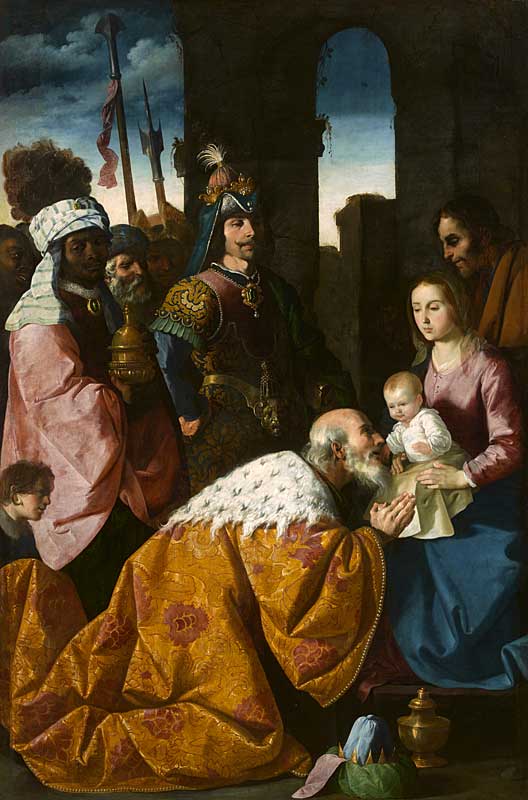
Zurbarán’s output was almost entirely religious, though there are exceptions, such as his panels of the Labours of Hercules (1634). Even works depicting historical scenes – such as The Surrender of Seville (1629), where the defeated Muslim governor hands the keys of the city to the Christian monarch Ferdinand III of Castile – are freighted with religious significance. Zurbarán’s Seville had a monopoly on trade with the Spanish Americas. Andalucía’s monastic orders embarked on a commissioning spree, each trying to outdo their rivals with the most gleaming altarpieces. The National Gallery has reassembled three paintings that once formed a row of a gargantuan multi-tiered structure in the charterhouse of Jerez de la Frontera (c1638-9). The outer works tell a story – the Visitation and the Circumcision – with pinpoint focus. Landscape and architecture are relegated to the background. The most human emotional moments of these religious dramas are heightened: a king leans close to gaze on the Christ child like a grandfather meeting his grandson. The centre painting of The Virgin of the Rosary features four Carthusian monks kneeling below the symbolic scene, as if encouraging their real-life brethren to do the same.
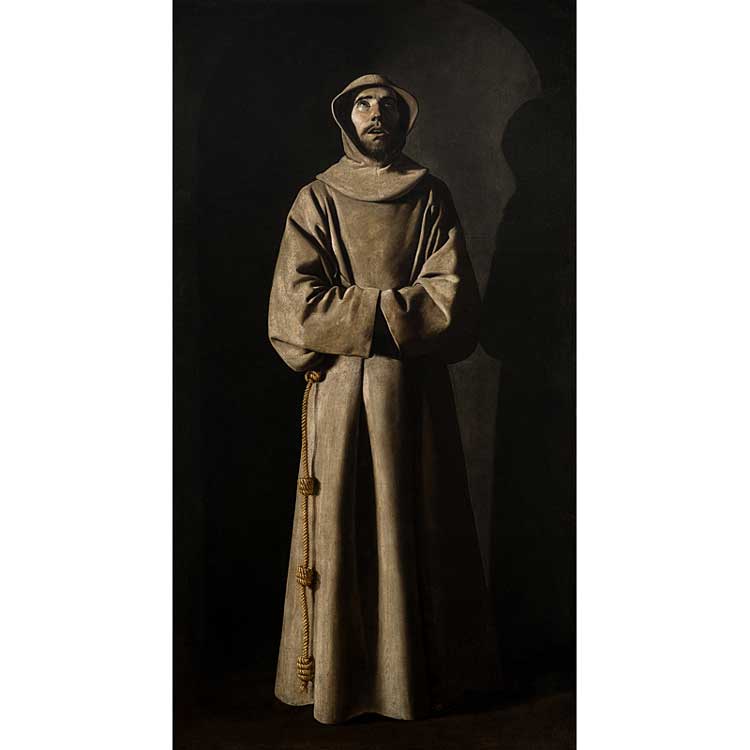
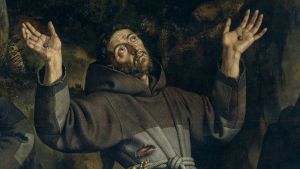
Francisco du Zurbarán, Saint Francis of Assisi, 1636. Oil on canvas, 200 × 110.5 cm. Musée des Beaux-Arts, Lyon © Lyon MBA - Photo Martial Couderette
Zurbarán is perhaps best-known today for his depictions of anguished monks and apostles, rendered in a severe chiaroscuro. But the new exhibition aims to capture the breadth of his work. For every austere tenebrist scene there are several with vivid colours. There are clouds of putti, which often serve as unhappy footstools for Christ and the Virgin. In the aforementioned Vision of Saint Alonso Rodriguez, the holy pair clutch soft pink hearts, squeezing them to squirt out rays of divine light. There are only a handful of those monks, and they are hardly anguished at all. A Francis of Assisi (1636) from Musée des Beaux-Arts de Lyon has the monastic pioneer gazing to the heavens in ecstasy. It hangs next to one of the National Gallery’s own two Francises (1635-9), this one clasping a skull. When it was acquired in 1853, an MP wrote to the Times describing it as a “small, black, repulsive picture”, which seems to deliberately miss the point of this humane capturing of devotion.
For all Zurbarán’s range, like most painters of his time he was commissioned to depict the same scenes over and over again. He painted at least 12 Crucifixions, four of which are present in the present exhibition. On their evidence, they show a painter who saw the chance to create variance with these repetitions. A Crucified Christ (1635) from Seville has the same impervious darkness as the earlier Chicago version, but is distinguished by the expression of spiritual torment on Christ’s face, as well as the exquisitely folded fabric of his loincloth. A 1655 version instead homes in on the physical agony. It takes place against a brooding brown sky, and gains much of its effect from the trio of tearstained mourners standing beneath the cross, earthly and immediate figures in which worshippers might have seen themselves.
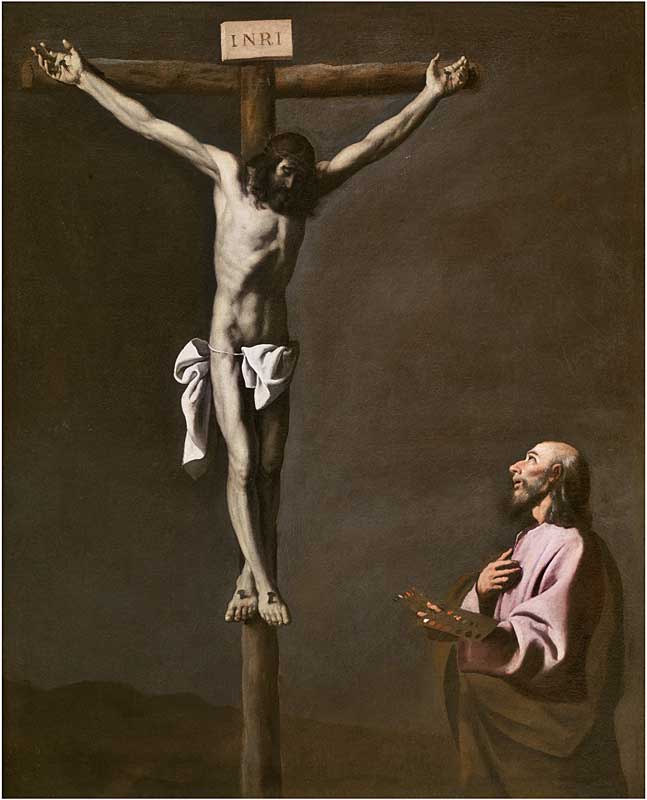
Francisco de Zurbarán, The Crucified Christ with a Painter, about 1650. Oil on canvas, 105 x 84 cm. Museo Nacional del Prado, Madrid © Photographic Archive Museo Nacional del Prado.
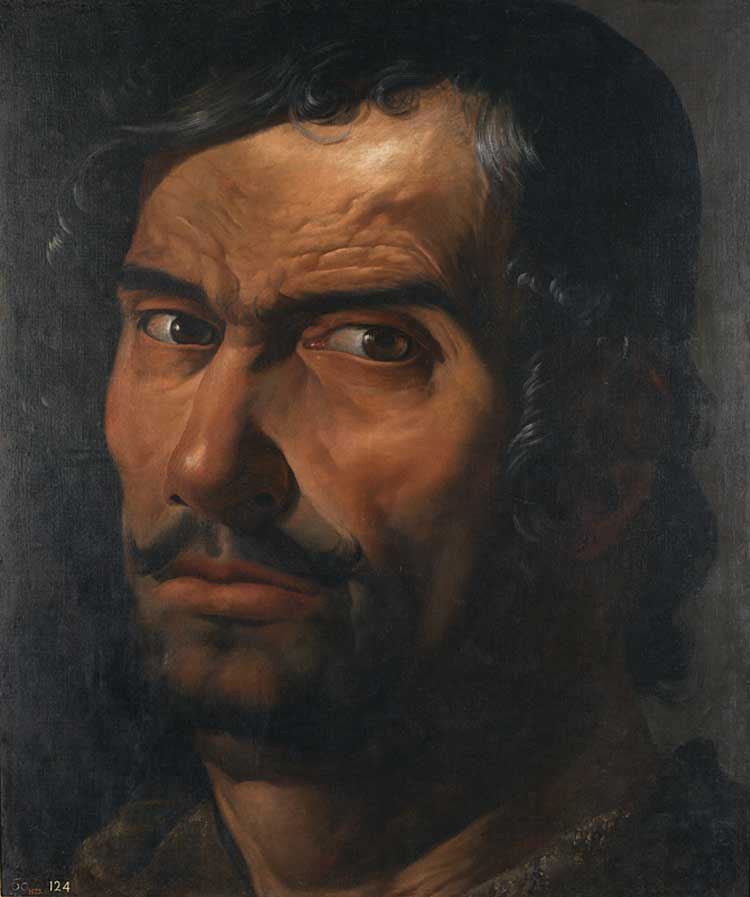
Strangest is another late work (c1650), where a palette-wielding Saint Luke gazes up at the crucified saviour as if pleased with his creation. There is nothing else quite like it. Elsewhere Zurbarán regularly painted retrato a lo divino, portraits of real people in the guise of saints; perhaps this is the artist’s own self-portrait as a painter of the divine. Zurbarán’s work holds several other mysteries. The Colossal Head (c1635), recently attributed to Zurbarán after its restoration, is another sui generis work for its century: a 2-metre-tall portrait of an enormous head. It may have been a theatrical background, or a folly intended to scare visitors to the Buen Retiro Palace in Madrid.
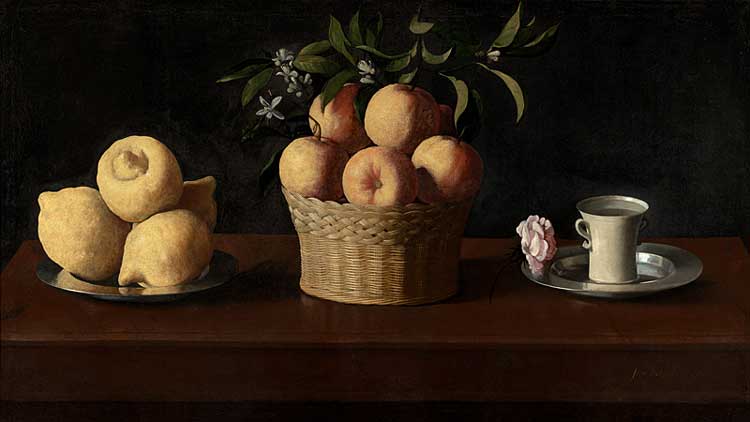
Francisco de Zurbarán, Still Life with Lemons, Oranges and a Rose, 1633. Oil on canvas, 62.2 × 109.5 cm. The Norton Simon Foundation, Pasadena, California.
© The Norton Simon Foundation.
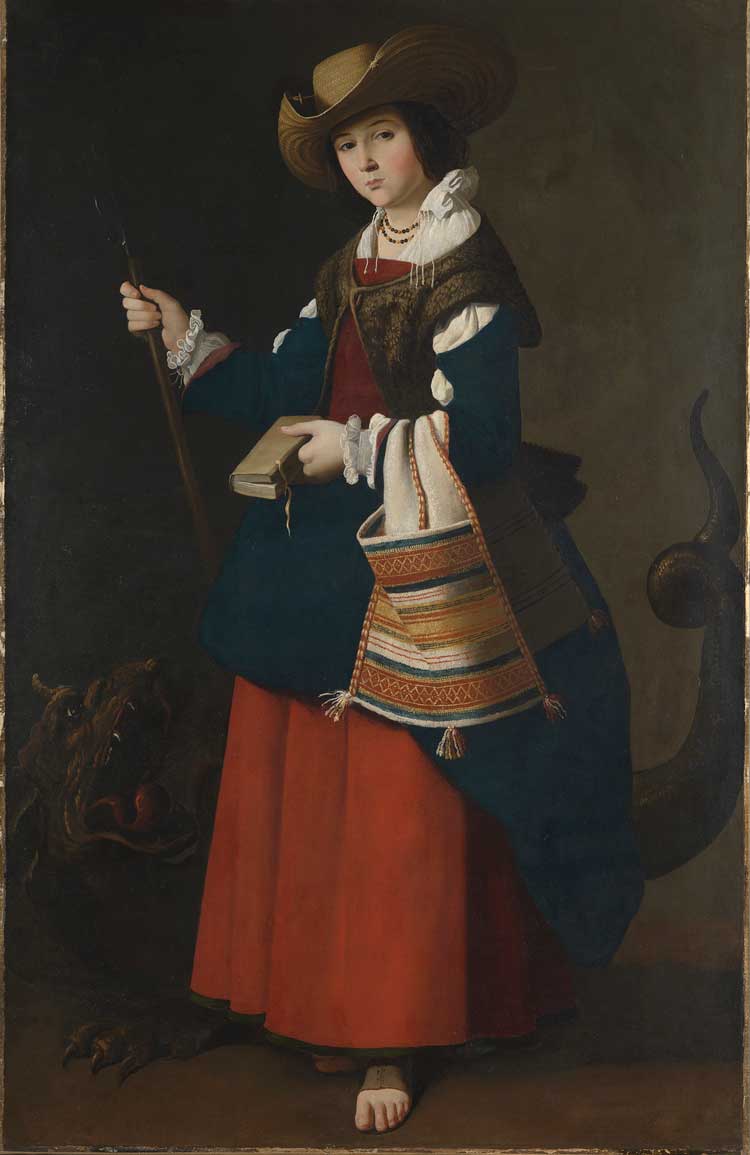
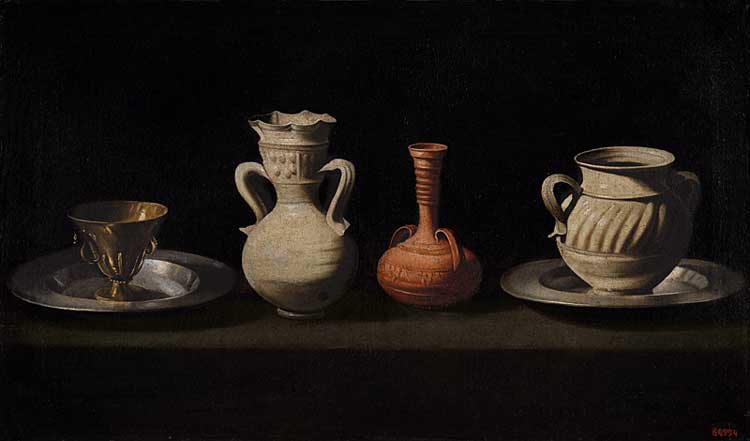
Throughout his oeuvre, Zurbarán is especially distinguished by his attention to minute details. This is particularly manifest in his textiles and clothing, which might be a legacy of his haberdasher father. Saint Margaret (c1630-34) holds a rough-hewn woven saddlebag whose grain is remarkably true to life, while Saint Bonaventure (c1629) lies on a rich, heavy brocade whose creases perfectly capture the light. This care for representation is also there in his few signed still lives. Still Life with Lemons, Oranges and a Rose (1633) has the three subjects – the rose is paired with a cup of water, both Marian symbols – separated at equal distance. It is an almost unequalled rendering of the objects in light and space, a realism so acute that the works almost become mystic. A set of works by his son Juan, himself a talented painter of still life, feel artificial by comparison.
The final room of the exhibition, focused on private devotion, features a pair of late works that bear the influence of Raphael, with a softness far removed from the dynamical contrasts of his prime. It also features a painting of such unutterable beauty as to silence the air around it: the Prado’s Agnus Dei (c1635-40), a lamb lying tied up. It has a symbolic dimension as the Lamb of God, John the Baptist’s prophetic name for Jesus, but it is also a real animal, bound up as a gift, alive but on the inevitable path towards its end. It is down-to-earth and palpable – the curls of its wool look as if they could flutter in a breeze – while also possessing a sacredness that few painters have equalled. For all the grandeur of his altarpieces, Zurbarán is a master of small things.
Click on the pictures below to enlarge

Copyright © 1893–2026 Studio International Foundation.
The title Studio International is the property of the Studio International Foundation and, together with the content, are bound by copyright. All rights reserved.
 |
 |
 |
|---|

-1000-300.jpg)



 Saint Francis of Assisi
 A Backward Glance: Giorgio Morandi and the Old Masters
 Zurbarán: Master of Spain's Golden Age
 Murillo: The Self-Portraits