




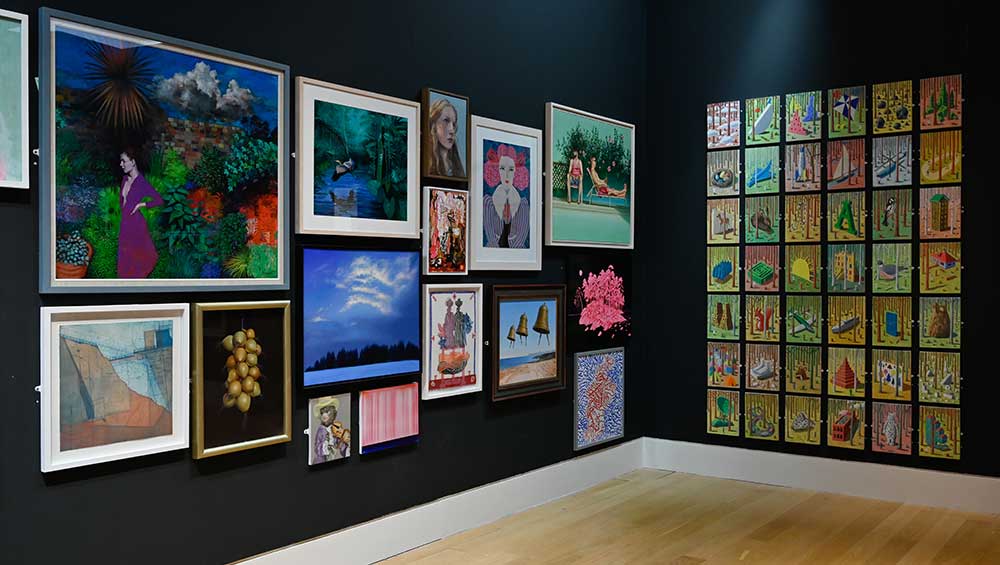
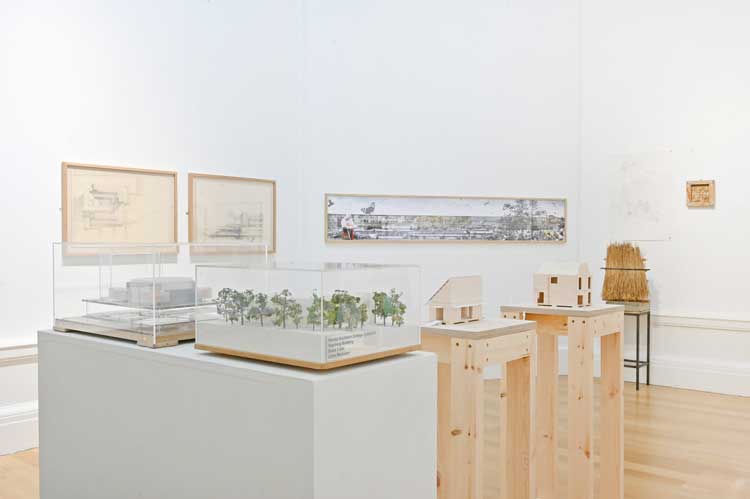
RSA200 Annual Exhibition, 2026, installation view. Photo: Julie Howden.
Royal Scottish Academy,
9 May – 14 June 2026
by BETH WILLIAMSON
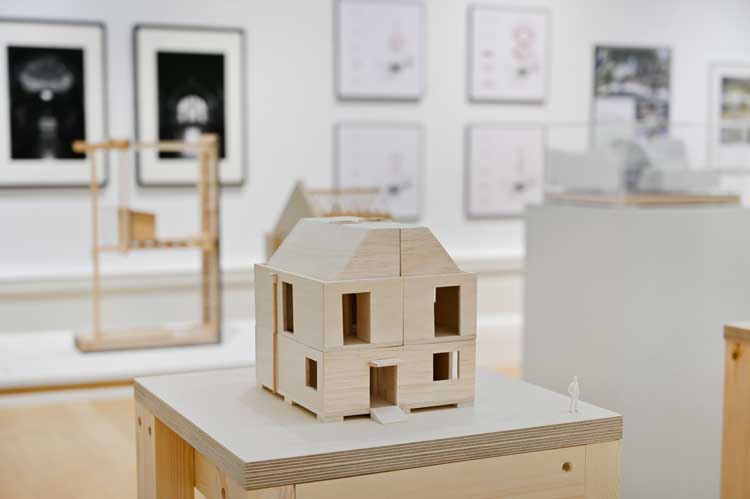
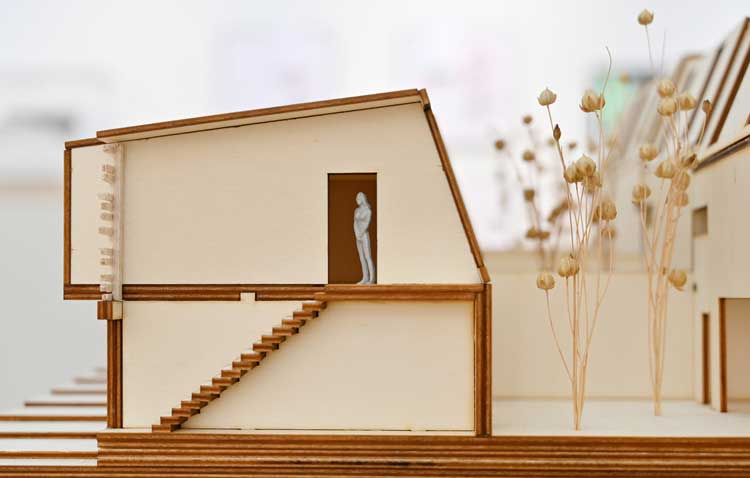
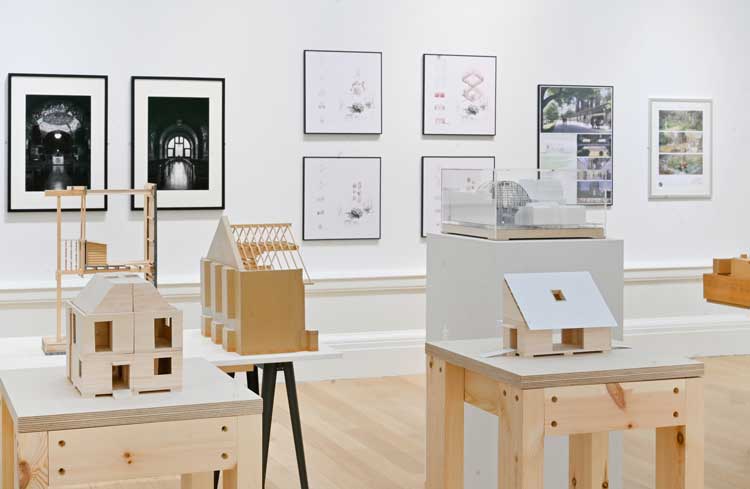
For 200 years the Royal Scottish Academy (RSA) has strived to sustain best practice in contemporary Scottish art and architecture. It maintains a collection, an archive and a library. It informs national debate in visual, cultural and educational matters. Above all, it encourages and supports emerging artists and architects. Every year, the RSA holds its annual exhibition. It is a showcase for its members and an opportunity for less well-known artists to exhibit work too. This year, the exhibition is particularly special. Led by the exhibition convenor, Annie Cattrell, and the architecture convenor, Fergus Purdie, the RSA’s bicentenary year coincides with the tercentenary of James Hutton, known as the father of modern geology. While I don’t intend to comment on the architectural element of the exhibition, it is worth mentioning that Purdie’s themes are “Beginning(s)” and “Unbuilt”, with Academicians being invited to design an imagined, alternative Academy building. What an exciting opportunity. Cattrell’s theme is “In Time” and she has invited artists interested broadly in ideas of geology and the passage of time, linking to Hutton. While this theme is evident in the exhibition, it is worn lightly throughout the various spaces, allowing for a wide interpretation by artists.
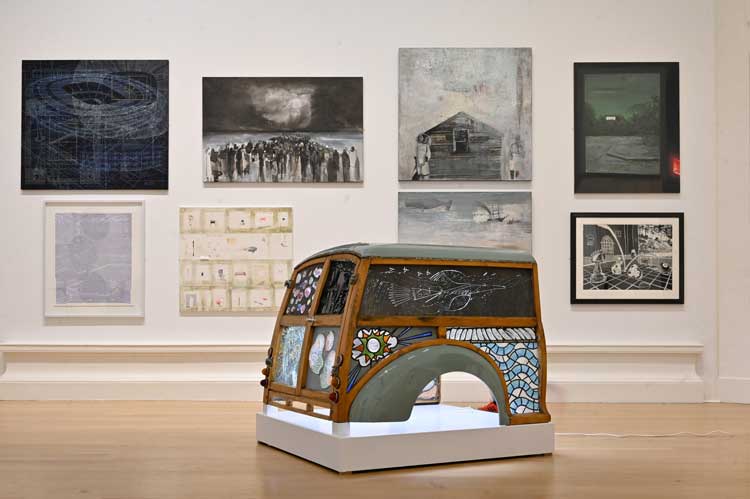
RSA200 Annual Exhibition, 2026, installation view. Photo: Julie Howden.
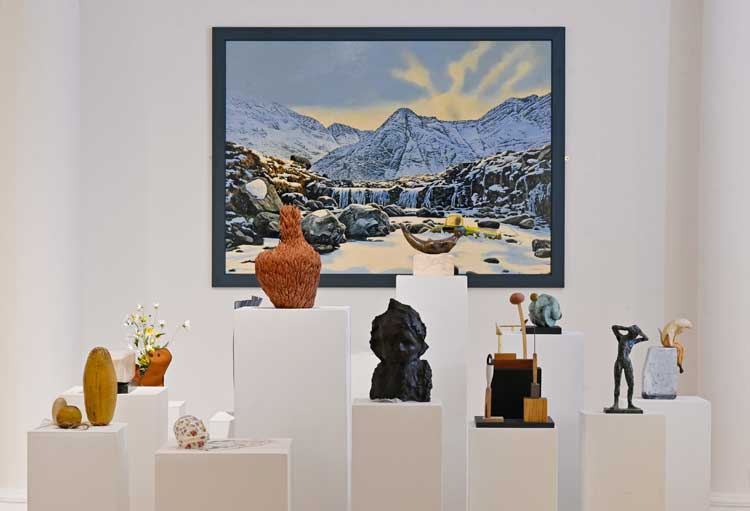
It is difficult to know where to begin with such a large show, but Cattrell and the selection and hanging committee (Anne Bevan, Matthew Dalziel, Graham Fagen, Helen Flockhart, Ilana Halperin, Norman McBeath, Louise Scullion and Edward Summerton) have done an incredible job. Outside the building, visitors are welcomed by banners designed by Sam Ainsley, sedimentary layers within the rock but in Ainsley’s signature colours and hand. Inside, each wall is filled from floor to ceiling, with floor space occupied by sculpture, vitrines and more. The catalogue lists 560 works in total, a huge number by any standard, but it doesn’t seem crowded. Walking through the galleries feels like an intimate conversation among friends, a convivial environment in which to encounter old friends and discover new ones. Nothing is fixed here and fresh perspectives pop up just when you least expect them.
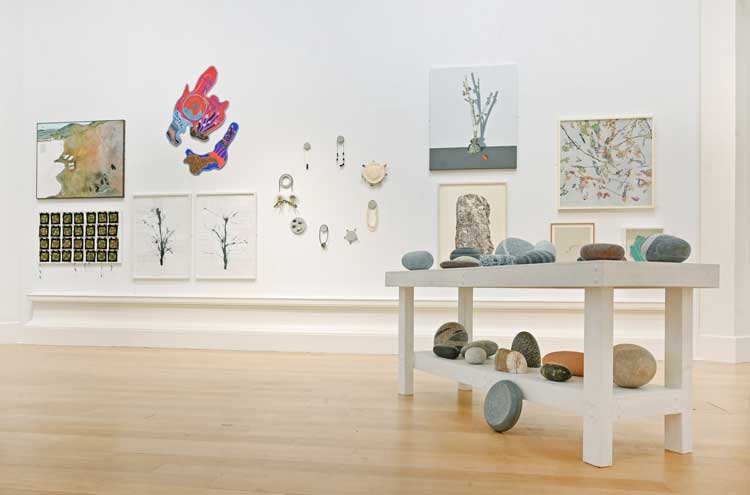
RSA200 Annual Exhibition, 2026, installation view, including works by Annie Cattrell. Photo: Julie Howden.
In Cattrell’s own works in Gallery 1, delicate lines of ink on paper increasingly branch outward and seem to hold time and breath. Her work pays attention to structures and patterns, whether that be in the landscape or weather, or the human body or brain. It is an interdisciplinary practice, located somewhere between art and science, such that the macrocosm and microcosm take on equal significance. As is often the case in Cattrell’s work, it is as if a moment in time is frozen in these images, transformed from a living, multidimensional flow or construction to something set on a page, still mobile and contingent but now more grounded and poetic in its aesthetic form. Julie Brook’s work stands out in this gallery too. I saw Brook’s paintings, drawings and film in Making Waves – Breaking Ground at Bowhouse last year. In the present exhibition it is photographs of her Firestacks works made in the Outer Hebrides that impress with their powerful elemental effect.
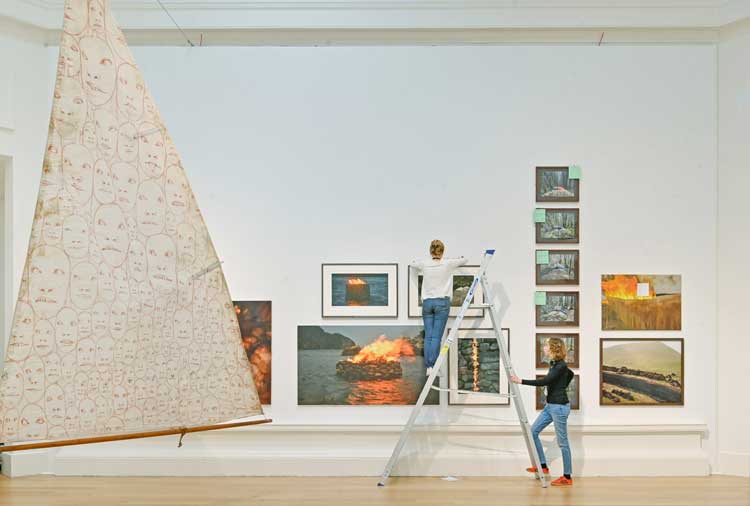
RSA200 Annual Exhibition, 2026, installation view, including works by Julie Brooks. Photo: Julie Howden.
Over in Gallery 4, another artist from the Bowhouse exhibition, Samantha Clark, is showing the incredible work Confluence (2025). Made in Scotland and during a residence in Japan, Confluence stretches to many metres. I’ve previously seen photographs of this work lying flat on a table while being made, but seeing it hung from ceiling to floor, and spilling out close to our feet, is a completely different experience. Close by, in Gallery 2, is one of those fresh perspectives I mentioned earlier. Two works by Marian Leven, Layers of Time 2 and Layers of Time 4 (each a sort of sedimentary mixed media sketch), are hung close to one another and to a jesmonite sculpture Fumi (The White Swan) (2025) by Andrian Melka. It makes for a perfect juxtaposition. Similarly in Gallery 3, Allan Ramsay’s HEID (2026) and Zuzanna Salamon’s I hope you stay II (2025) create another curatorial sweet spot.
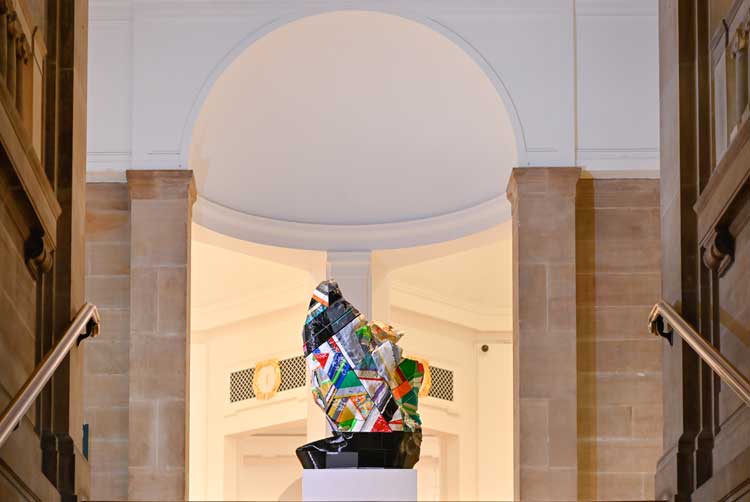
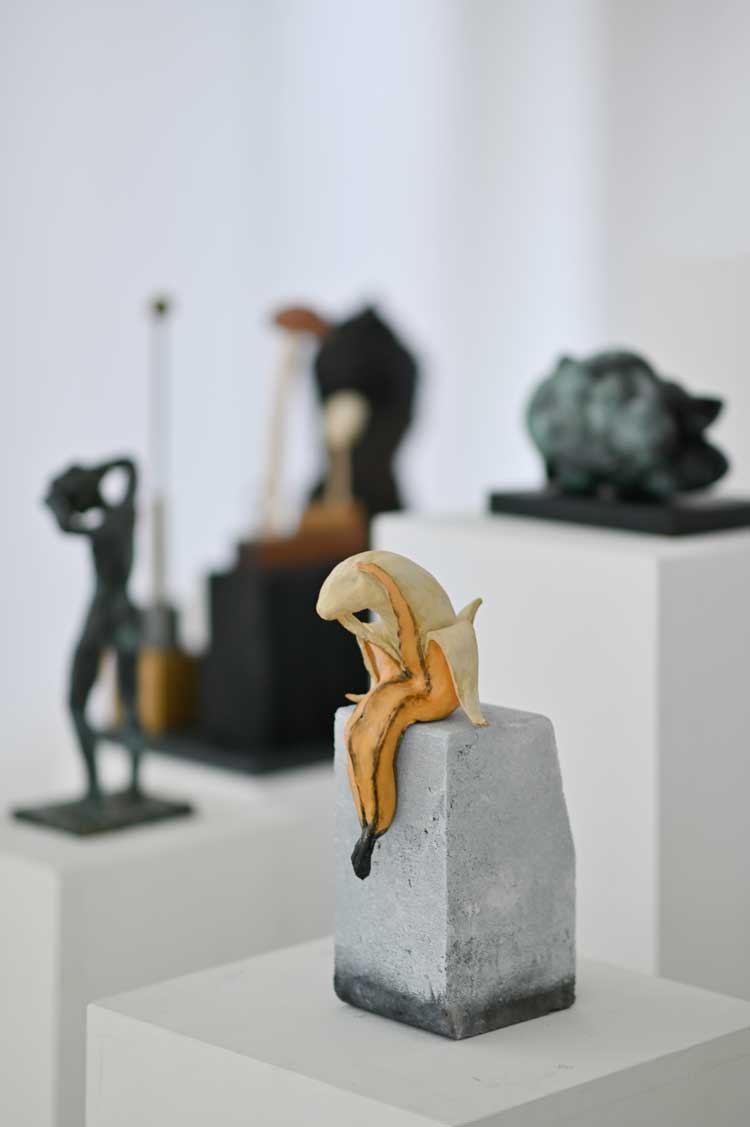
It was good to see Louise Gibson’s Atrophy “The Shark” (2025) too. I spoke to Gibson as part of Edinburgh Art Festival last year so it is great to see her contemporary sculpture included in this prestigious exhibition. Other sculpture of note is that by Jake Harvey. Harvey’s long engagement with the ideas of James Hutton makes his work crucial in the context of this exhibition. Two large works in Gallery 1 – Raised Beach (2026) and In the Footsteps of James Hutton (2026) – make those connections explicitly. Downstairs in the members’ lobby, two further small works by Harvey are shown close to Helen Douglas’s beautiful handscroll Lewisian I (2024). Douglas and Harvey have worked in parallel for a few years now, each evolving a separate but related seam of work deeply invested in the landscapes and ideas that interested Hutton. It is essential viewing.
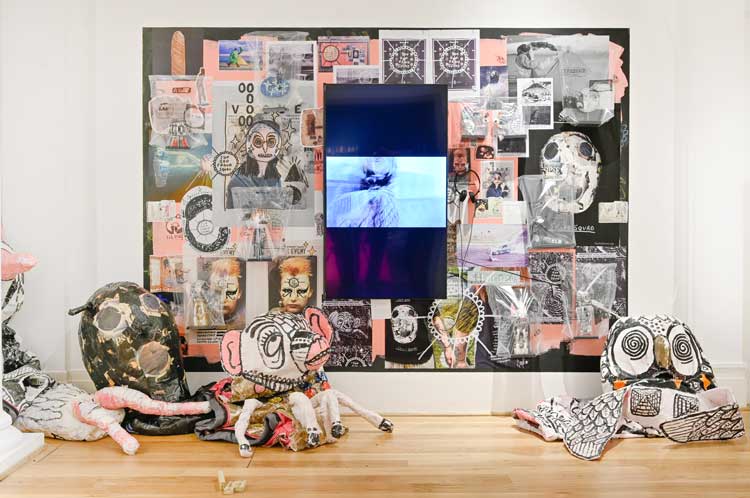
RSA200 Annual Exhibition, 2026, installation view. Photo: Julie Howden.
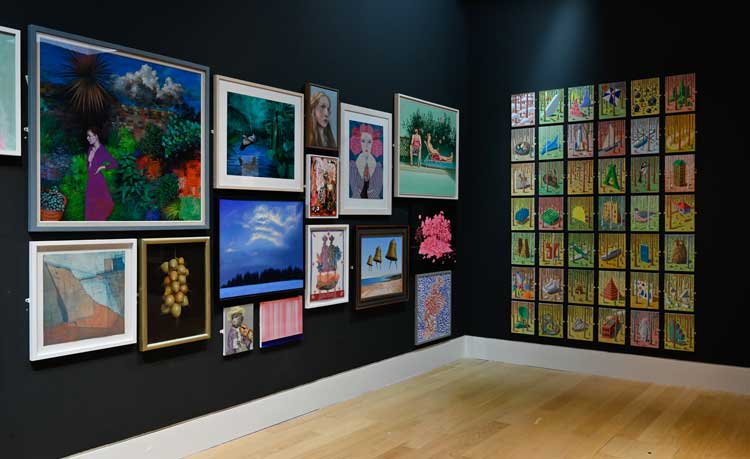
The Finlay Room in the lower galleries, hung by Flockhart and McBeath, is, to my mind, one of the most exciting spaces in the exhibition. McBeath’s own work is upstairs where three black-and-white editioned photographs entitled Redemption I, II and III show architectural detail and shadow from unusual perspectives. Their interest is in being able to deduce this much from their pleasing lines, but no more, and wondering about their intriguing title. Back in the Finlay Room itself, McBeath and Flockhart have created an opulent tapestry of colour and texture that fills every inch of the space with such voluptuousness it makes you want to weep with joy. Flockhart’s own works included here, Tulip Head (2024) and Prima Pandora and Fruiting Body, both from this year, are exquisite examples of contemporary surrealist work by a Scottish artist. And while we might think of Flockhart in the tradition of surrealism, here there are myths and legends and Renaissance connections too. Ultimately, of course, Flockhart has developed her own unique approach, richly painted and technically accomplished. She creates living worlds within her paintings that have a captivating intensity to them and characters that focus entirely on what they are doing in the picture. Often in a reflective mode, and sometimes including elements of the grotesque, Flockhart’s pictures are not fairytales. Rather, they seem to unearth our deepest fears and most intimate emotions and yet remain pleasing. Other works that caught my attention in this room include Jane Gardiner’s Suspended (2026), Rowan-Flora Strachan’s Fonn Adhar (2026) and Jodi Le Bigre’s Annotated Landscape (2025).
As I mentioned at the outset, this exhibition felt like meeting old friends and new, artists I’ve long been familiar with and those I want to know better. It was a joy to visit and to feel part of the conversation around the RSA’s long tradition of supporting art and artists in Scotland. We are not yet halfway through 2026 and there is much more to come in this bicentenary year.
Click on the pictures below to enlarge

Copyright © 1893–2026 Studio International Foundation.
The title Studio International is the property of the Studio International Foundation and, together with the content, are bound by copyright. All rights reserved.
 |
 |
 |
|---|
-1000-300.jpg)
 Helen Flockhart: ‘Art doesn’t have to be large to be powerful’
 Ron Mueck: Sculptures at the National Galleries of Scotland
 Frances Walker: Works on Paper
 Festival Connections - 179th RSA Annual Exhibition
 RSA 181st Annual Exhibition