




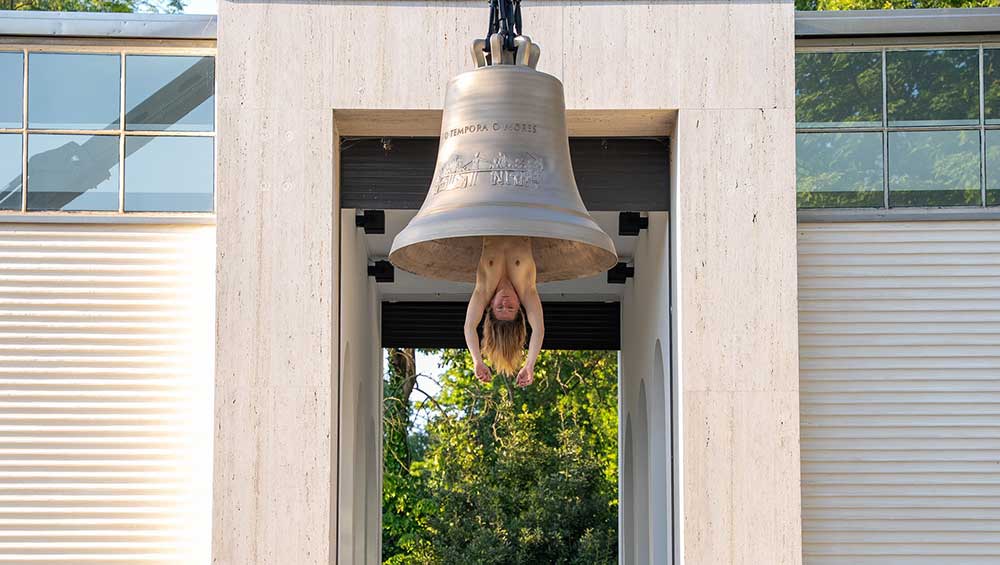
Austrian Pavilion, Venice Biennale 2026, Florentina Holzinger: Seaworld Venice, 2026. © Nicole Marianna Wytyczak.
Various locations, Venice
9 May – 22 November 2026
by AMIE CORRY
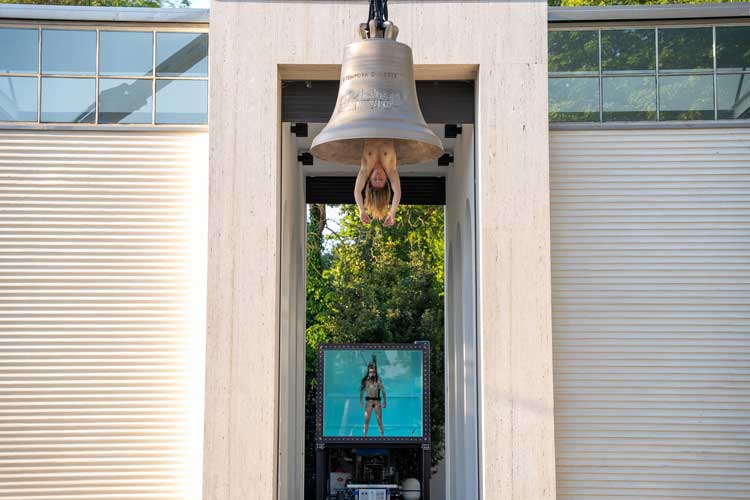
Inscribed on the giant bell that serves as unofficial centrepiece of this year’s Giardini is the Latin phrase “O tempora o mores”, meaning “Oh, the times! Oh, the customs!” The bell is strung from a crane over the entrance to the Austrian Pavilion, which is hosting performance artist Florentina Holzinger’s Seaworld Venice. Every hour, supposedly throughout the biennale’s run, a naked performer will scale the rope beneath the bell, invert themselves and swing violently from side-to-side, causing a peal of tightly choreographed, arhythmic chimes.
It is an ambitious feat, not only in terms of performance, but in funding and logistics. And it works because it reflects as well as troubles: the refined landscape of the Giardini falls silent as a sea of phones records a portentous symbol of time accelerating, time running out, time as luxury denied to millions the world over. “Oh, the times!” Holzinger’s bell sounds, and here we are, wandering around this sinking – literally – ode to soft power, resilience and wild, human creativity. It is a heavy nod to the conflicted premise of the biennale.
While every biennale is a product of, and testament to, its moment, the 61st commenced under deeper and more complex shadows than its recent antecedents. Foremost among these was the devastating death of the Swiss-Cameroonian curator Koyo Kouoh in May 2025, a year before the opening of the biennial, which she was to appointed to preside over. Her theme, In Minor Keys, forefronts “enchantment, seeding, commoning and generative practices that invite collectivities”.
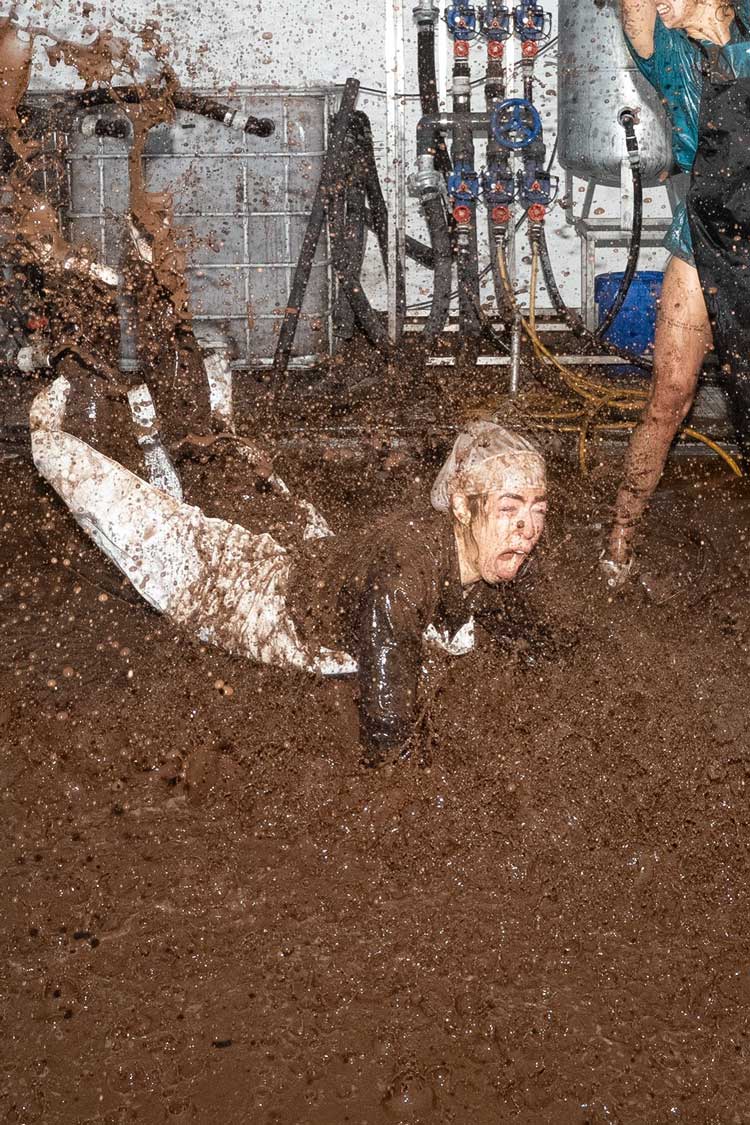
Austrian Pavilion, Venice Biennale 2026, Florentina Holzinger: Seaworld Venice, 2026. © Nicole Marianna Wytyczak.
At a geopolitical level; in April, the international jury resigned over Russia and Israel’s inclusion, hence the lack of official awards. Many artists have now withdrawn from the proposed Visitors’ Lions, which are this year replacing the usual Golden Lions for Best Artist and Best National Pavilion. During opening week, the activist group Pussy Riot staged protests against Russia, and on 8 May, a 24-hour strike organised by Art Not Genocide Alliance shut down much of the biennial in support of Palestine.
Then there are the results of the dramatic, politicised cuts to art funding and freedom of expression occurring the world over; the context for the US Pavilion and Alma Allen’s embarrassing state-sponsored sculptural offerings. South Africa, which was excluded from the biennial from 1968 to 1993 during apartheid, cancelled its own 2026 pavilion over Gabrielle Goliath’s Elegy, which is a tribute to murdered women, including the Palestinian poet Hiba Abu Nada, who was killed in an Israeli strike in Gaza in 2023 (the reason for the pavilion’s cancellation); the South African teenager Ipeleng Christine Moholane, killed in 2015; and Nama victims of Germany’s colonisation of Namibia in the early 20th century. Now on independent display at Chiesa di Sant’Antonin, Goliath’s ongoing video installation is an exquisite and moving lament, entirely in keeping with Kouoh’s invocation: “Though often lost in the anxious cacophony of the present chaos raging through the world, the music continues.” Elegy is a Venice highlight, making something of a mockery of the biennale’s nation-state premise and the power invested in countries to sanction their pavilions.
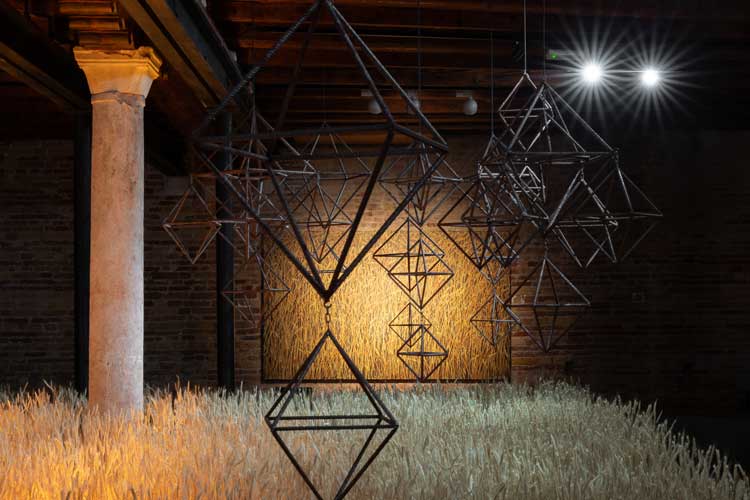
Installation view: Official. Unofficial. Belarus. at La Chiesa di San Giovanni Evangelista, a Collateral Event of the 61st International Art Exhibition – La Biennale di Venezia. Courtesy of Belarus Free Theatre. Photo: Dasha Trofimova.
Similarly, Official. Unofficial. Belarus. is a collateral event rather than a national pavilion, because the dictator-run country would never grant that privilege to the exiled Belarus Free Theatre, founded in 2005 as a direct challenge to the absolute censorship in the country. The centrepiece of the exhibition at Chiesa di San Giovanni Evangelista is an eerie field of wheat, each stalk cut from Polish fields by former political prisoners and positioned at unnatural, uniform intervals. Suspended above it are Vladimir Tsesler’s geometric metal shapes based on straw spiders; delicate straw structures traditionally hung from ceilings in Belarusian homes to maintain balance. Natalia Kaliada, the curator, and co-founder of Belarus Free Theatre, tells me they have just been banned for their unChristian connotations – a horrible coincidence for the exhibition. Kaliada was surveilled and jailed before being forced into exile. Her husband has also been jailed, as has her grandfather. Official. Unofficial. Belarus.is co-curated with Natalia’s daughter, Daniella Kaliada, who was first interrogated by state police aged eight. A repurposed wooden confessional box presents a complex series of surveillance methods, including facial recognition software prompting fictional data. The voices of famous British actors read prisoner testimonies. The voices feel incongruous, but they avoid the authors identifying themselves. Frankly, anything that calls attention to this powerful show is a worthy addition.
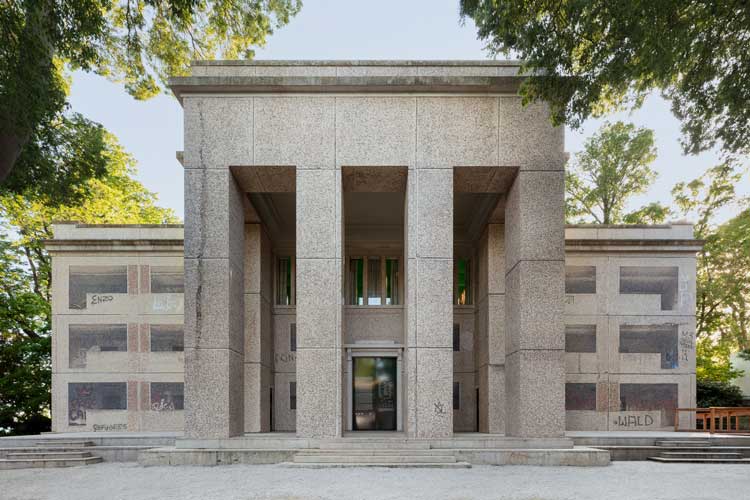
German Pavilion, Sung Tieu, Human Dignity Shall Be Inviolable, 2026. Courtesy the Artist. Photo: Andrea Rossetti.
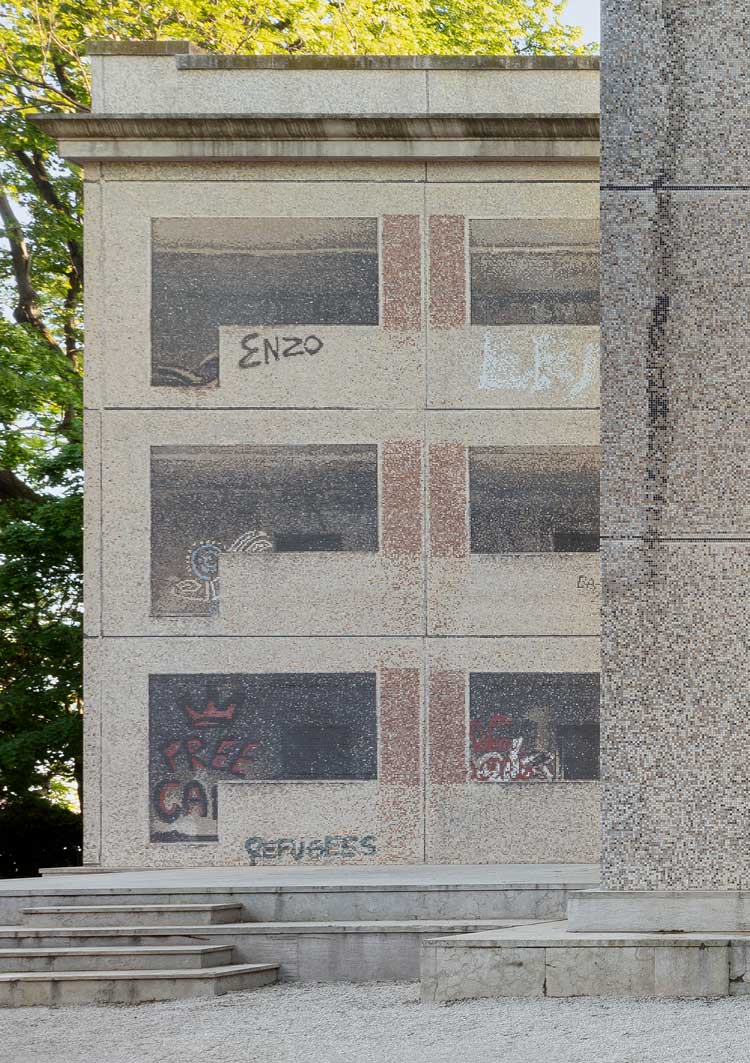
German Pavilion, Sung Tieu, Human Dignity Shall Be Inviolable, 2026. Courtesy the Artist. Photo: Andrea Rossetti.
Back at the Giardini, Sung Tieu and Henrike Naumann’s Ruin at the German Pavilion is a compelling tussle with nationalism and one of the strongest pavilions. Sung Tieu continues a long tradition of artists intervening in the pavilion’s Nazi-era architecture, this time by covering the facade with graffitied mosaic; a reconstruction of the East Berlin housing complex in which she grew up. The prefab building, now slated for demolition, housed many Vietnamese contract workers and asylum seekers in the 1990s, most of whom lost their jobs with the fall of the German Democratic Republic. Since then, the building has been publicly portrayed as a crime-riddled ghetto.
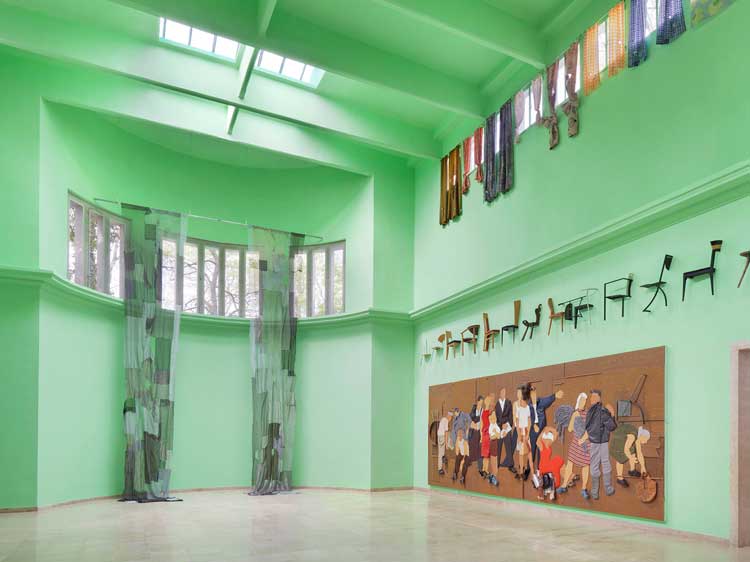
German Pavilion, Henrike Naumann, The Home Front, 2026. Courtesy the Artist. Photo: Jens Ziehe, Berlin.
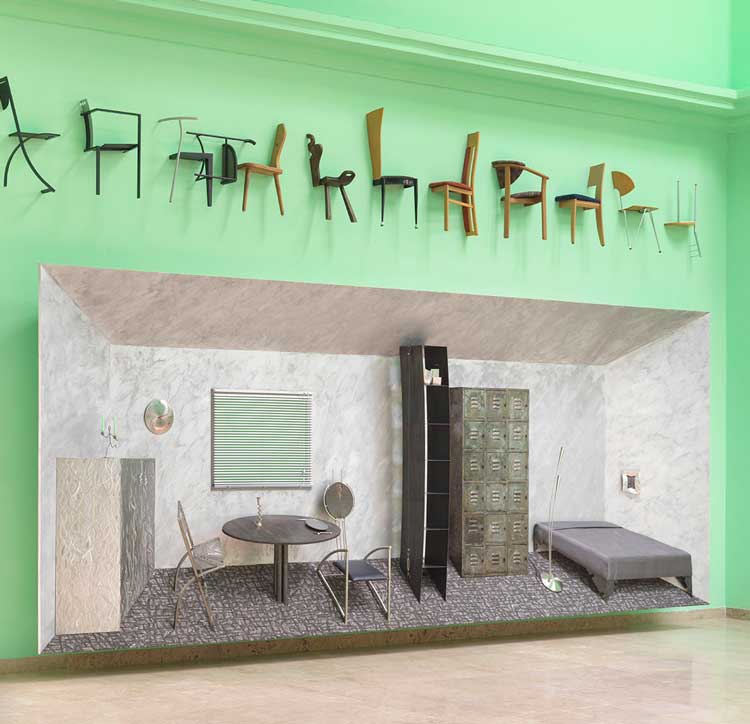
German Pavilion, Henrike Naumann, The Home Front, 2026. Courtesy the Artist. Photo: Jens Ziehe, Berlin.
Inside the pavilion, Naumann (who died in February at 41) excavates the myths and memories of East Germany through objects and interiors. Installed in relief, including an entire semi-flattened room, and against the mint-green shade of Soviet army barracks, The Home Front suggests the curious reality and aesthetic aftermath of an ideology crumbling overnight. Occasional performances by the Venetian vertical dance group Il Posto see a pair in traditionally gendered costume, faces entirely impassive, drop haltingly from the ceiling-height windows to the floor. The presentation is utterly specific yet indelibly relevant. It is also formally exquisite.
Brazil’s Comigo ninguém pode is a dialogue between artists Rosana Paulino and Adriana Varejão, curated by Diane Lima, the first Black woman to helm Brazil’s curation. Named after a toxic plant, a symbol of spiritual protection and ancestral resilience that is often planted in the entryways of homes in Brazil, the project pitches nature and mysticism against the weight of cyclical, colonial violence. Varejão’s visceral ceramic installations forge seams and wounds in the newly restored pavilion, while hybrid clay creatures hatch from pods and skitter up the walls. With reference to Indigenous cosmologies and Paulino’s paintings, drawings and collages that often present Black women as life-forces and weavers, the exhibition proposes modes of repair and regeneration. Given Brazil is at risk of returning to a fascist government this October, the artists urgently remind of the unending need for both.
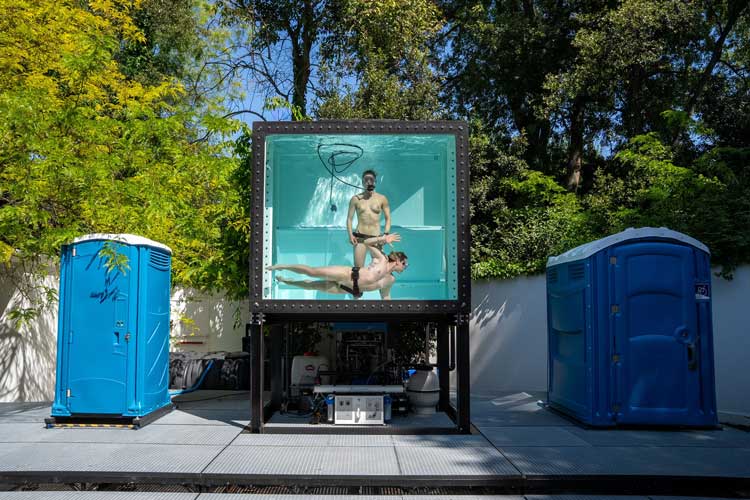
Austrian Pavilion, Venice Biennale 2026, Florentina Holzinger: Seaworld Venice, 2026. © Nicole Marianna Wytyczak.
With Seaworld, Holzinger and her performers have created an epoch. There is the bell and the jetski, its rider gaining speed with each turn of the cramped enclosure. Both speak to accelerationism, ecological disaster and the curious passage of time – where humanity is constantly moving, yet stuck. Many seem to have overlooked Seaworld’s humour, as well as its class commentary; one installation involves cleaners drily observing a broken pump, a fault caused by biennale attendees shitting against instruction in the pavilion’s dedicated Portaloos. The system proceeds to attack the workers in a sustained, physically startling and brilliantly slapstick episode. Seaworld could have done without the performer submerged in a vitrine of piss, which serves to explicate the filtration of visitors’ urine into safe water, but is too blunt in its symbolism. Still, revelling in the absurd and the abject, Seaworld is exhilarating – a large collective of female-identifying artists portraying human failure in all its drama and decadence.

Austrian Pavilion, Venice Biennale 2026, Florentina Holzinger: Seaworld Venice, 2026. © Nicole Marianna Wytyczak.
Seaworld has prompted a frenzy reserved for performance-based work during biennales of the last decade. This is in itself an unstraightforward sign of the times, given that performance speaks to a desire for visceral, bodily intervention, and visitors’ hunt for “content”, but is also hard to commercialise and thus decently fund. (It should be noted that phones are banned from Dries Verhoeven’s The Fortress at the Dutch Pavilion, and Holzinger had originally intended to do likewise.) In any case, funds have been raised. Belgium and Japan, and offsite pavilions Iceland and Scotland also all incorporate performance. Though wildly different in sensibility, each is well conceived and contributes to the energy of this year’s biennale and, I’m sure, the 10% increase from 2024 in visitors on opening day.
-by-Bugarin-+-Castle.jpg "Bugarin + Castle, Nocturnal Amusements, part of the exhibition Shame Parade curated by Mount Stuart Trust for Scotland + Venice at La Biennale di Venezia in 2026. Image by Dimitri D’Ippolito. Courtesy of the artists and Scotland + Venice.")
Bugarin + Castle, Nocturnal Amusements, part of the exhibition Shame Parade curated by Mount Stuart Trust for Scotland + Venice at La Biennale di Venezia in 2026. Image by Dimitri D’Ippolito. Courtesy of the artists and Scotland + Venice.
Scotland’s Bugarin + Castle: Shame Parade reimagines historic shaming rituals to consider how sound and costume shape social control. The artists, Davide Bugarin and Angel Cohn Castle, have created an expansive installation incorporating 14th-century court transcripts, 18th-century satire, karaoke, voice feminisation exercises, medieval armour and Filipino vehicle art. Shame Parade doesn’t wave a Pride-style flag, but instead offers a researched and smart testament to non-normativity as an engine of richness, complexity and liberatory politics, however viciously it is policed.
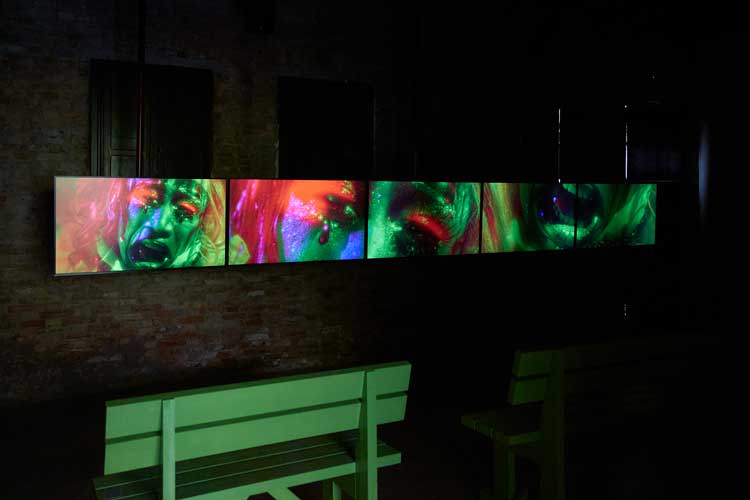
Bugarin + Castle, Submit to Sound, part of the exhibition Shame Parade curated by Mount Stuart Trust for Scotland + Venice at La Biennale di Venezia in 2026. Film curated by Mount Stuart and produced by Forma. Image by Dimitri D’Ippolito. Courtesy of the artists and Scotland + Venice.
There is inevitably an elegiac quality to the Arsenale and Giardini main exhibition, with attention paid to Kouoh’s formative influence on the art world. The Giardini’s main exhibition is a testament to Kouoh’s undogmatic mission statement, and replete with exceptional, often overlooked, artists. But it is just too full, with work struggling to compete.
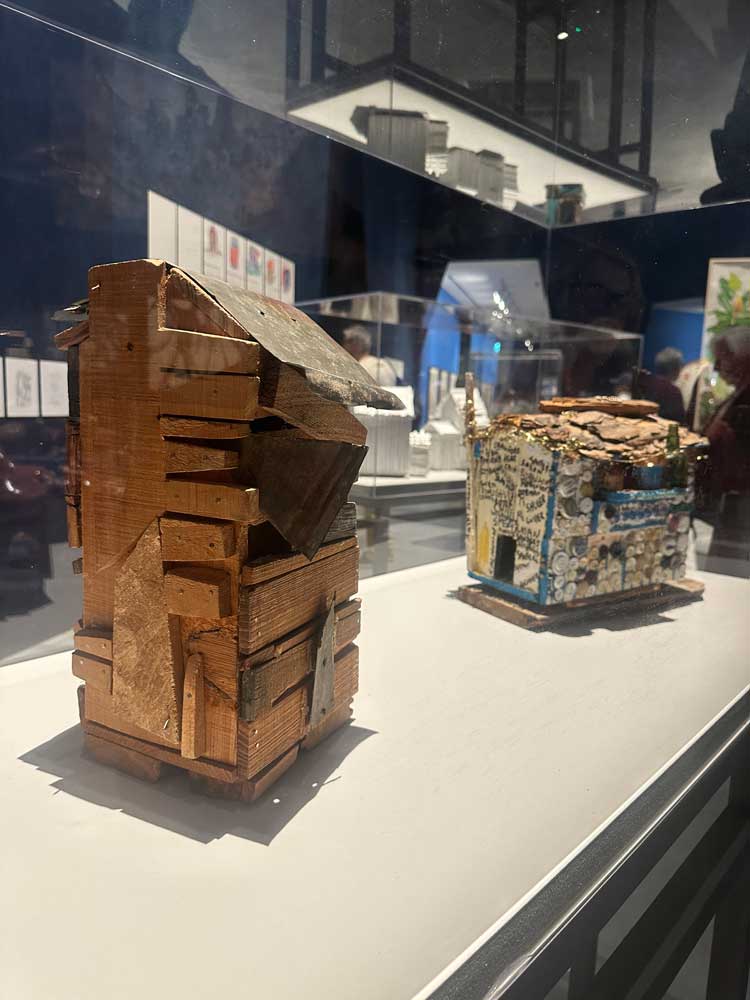
Beverly Buchanan, installation view, Arsenale, Venice Biennale, 2026. Photo: Amie Corry.
A display of Beverly Buchanan’s (1940-2015) Shacks – wooden models, drawings and stories based on small, often hand-built homes from the Black American South – is a rare opportunity to view this significant exploration of the magic, as well as the racialised material economy, of the region and its vernaculars. It is dismaying, then, to find it edged into a crowded room, when it could command twice or three times the space.
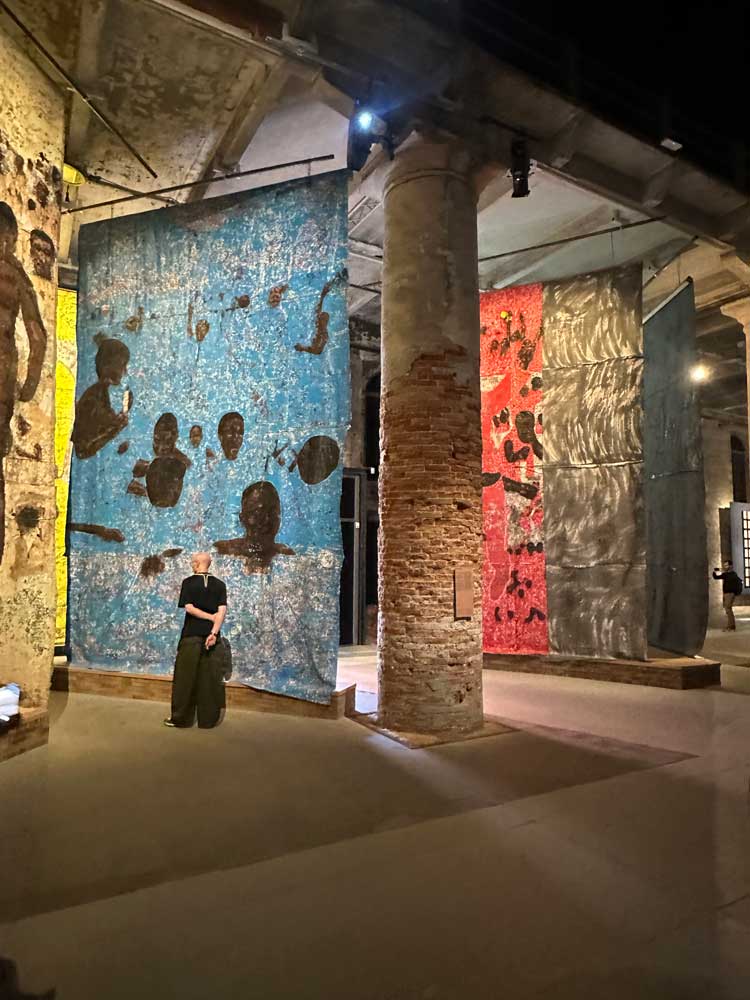
Kaloki Nyamai, installation view, Arsenale, Venice Biennale, 2026. Photo: Amie Corry.
At the Arsenale, there is much to applaud, enjoy and take strength from. Kaloki Nyamai’s exquisite paintings extend from the ceiling to the floor of the old armament building, where they graze raw corrugated card plinths. (Cardboard is used throughout the Arsenale to brilliant effect.) Nyamai’s works complicate any assumed relationship between spectacle and scale. Comprising a mercurial combination of rope, sisal, newspaper, fabric, photographic transfer and yarn, the hangings are moving, undeniable, and the opposite of bombastic, despite their gargantuan size. Nyamai alludes to the cycles of rupture and repair that neo-colonial Kenya, and specifically his home region of Kitui, undergo. His figures are emerging, embracing, working, perhaps dreaming.
Conversely, Alfredo Jaar’s The End of the World leans too far towards spectacle. Jaar’s 4cm cube of the most critical minerals in the world today – crucial for our so-called “advancement” but the reason for ceaseless abuses of human rights – communicates its message without its vast, red “cathedral-like” home.
Kader Attia’s complex installation, Whisper of Traces – splintered projections, hanging ropes, fractured mirrors, art history nods – does something new with ideas of memory, the metaphysical and fragmentary knowledge. Attia plays with the notion, expounded by a Vietnamese shaman, that computer viruses are spiritual entities.
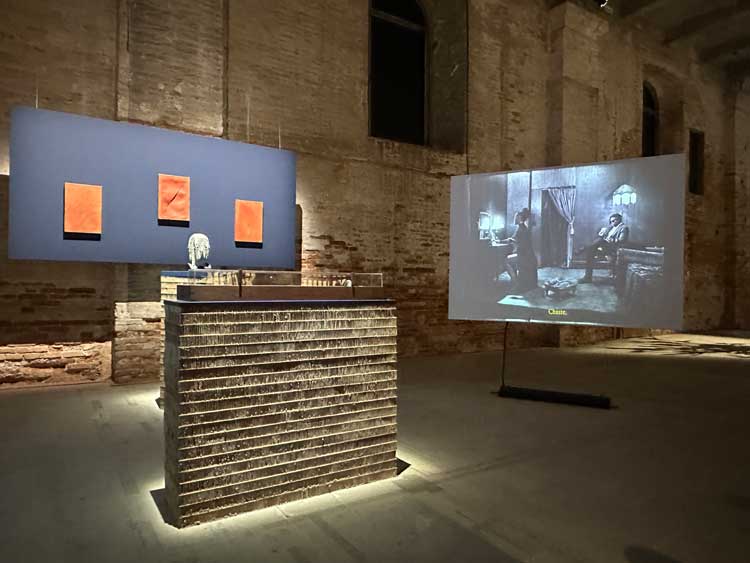
Tiona Nekkia McClodden, installation view, Arsenale, Venice Biennale, 2026. Photo: Amie Corry.
Tiona Nekkia McClodden’s installation of film and sculpture – slashed leather panels and a vintage épée mask – leans into narrative as a means of investigating Black queer interiority, and the boundaries of pleasure and pain. Ruinoustells the story of an artist – played by McClodden – teetering on the brink of destroying their own work, while straying into the worlds of BDSM and fencing.
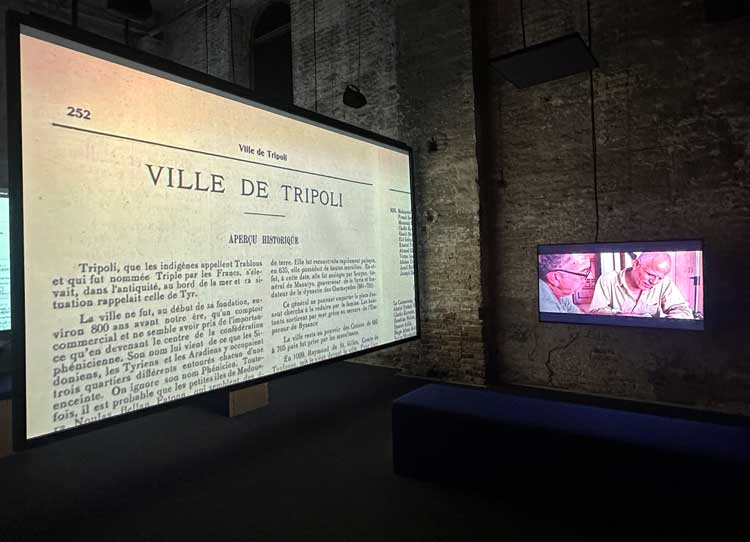
Avi Mograbi, installation view, Arsenale, Venice Biennale, 2026. Photo: Amie Corry.
Despite Kouoh’s emphasis on the quieter, minor keys, some of the strongest work is explicitly political. Avi Mograbi’s film installation Between a River and a Sea tells the heartrending story of 78 years of displacement through two diverging family histories, as well as business directories – one for Lebanon, Palestine and Syria from 1938, one from Gaza in 2023. Both reveal Israel’s ongoing and sustained decimation of lives and livelihoods in the regions.
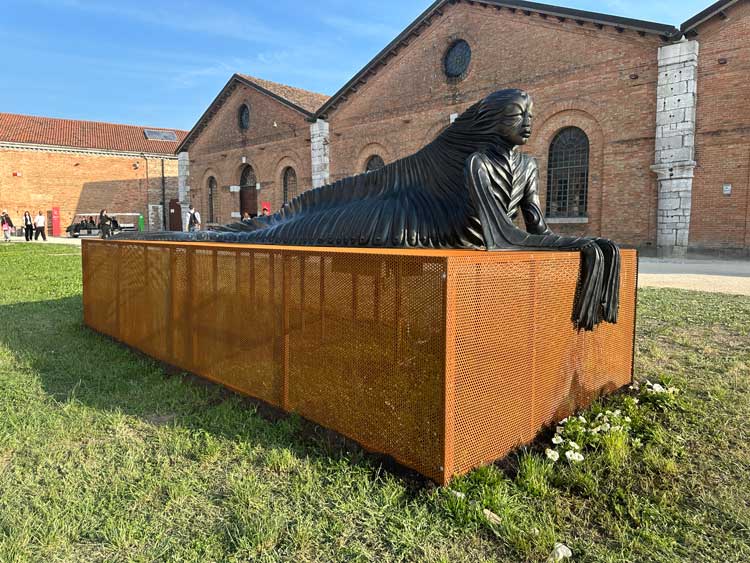
Wangechi Mutu, SimbiSiren, installation view, Venice Biennale, 2026. Photo: Amie Corry.
At the furthest reach of the Arsenale’s exterior, Wangechi Mutu’s speculative aquatic being, SimbiSiren, stretches out on the shores of the lagoon, her fins watering a delicate tangle of white flowers on the ground beneath. It’s a touching end to the vast, volatile project that is the Venice Biennale, which, while undoubtedly struggling to hold the contemporary moment, at least makes spaces for a cacophony of responses to it.
Click on the pictures below to enlarge

Copyright © 1893–2026 Studio International Foundation.
The title Studio International is the property of the Studio International Foundation and, together with the content, are bound by copyright. All rights reserved.
 |
 |
 |
|---|
-1000-300.jpg)
 Stay of life in Venice
 Outside In: 55th Venice Biennale
 Richard Long: Walking and Marking
 Daniel Buren and his Invention Trajectory
 A Runaway Girl at Home in New York: Louise Bourgeois at the Guggenheim