




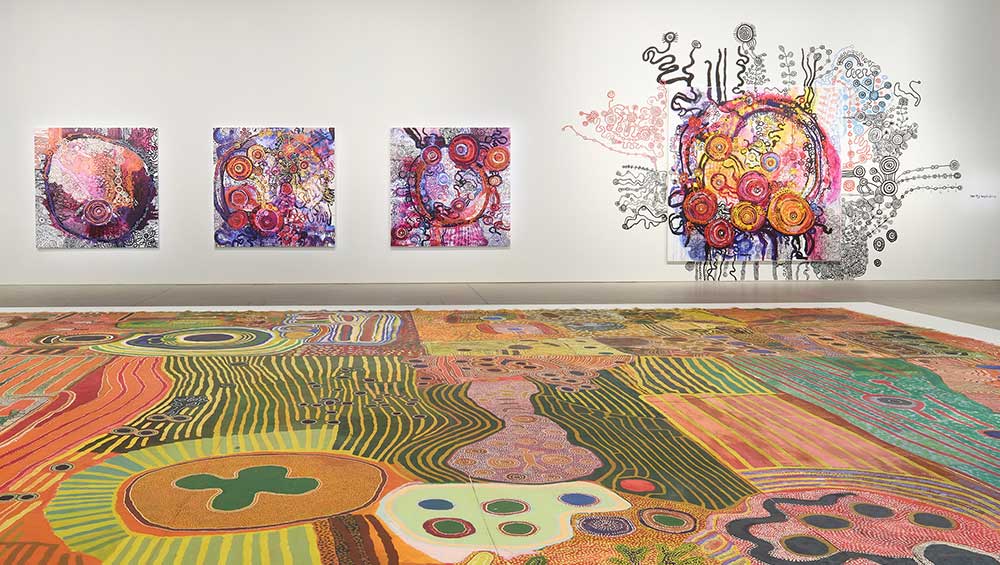
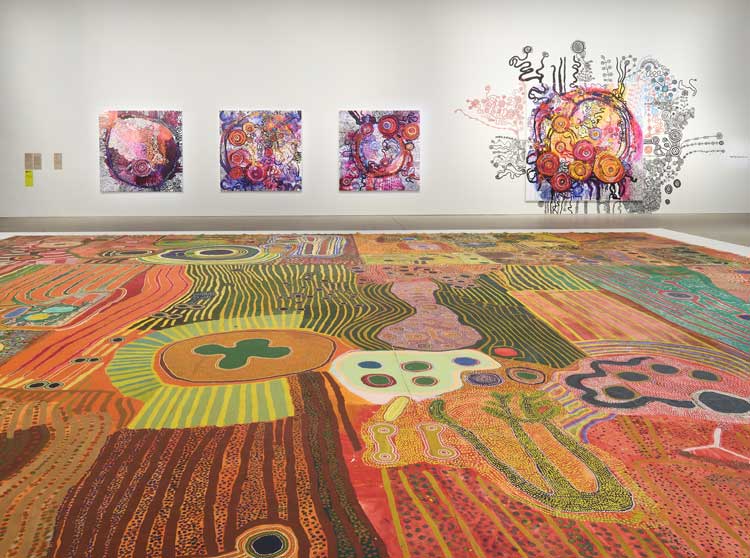
Foreground: Ngurrara Artists, Ngurrara Canvas II, 1997. Courtesy of the artists and the Ngurrara Canvas Management Group (NCMG) © Ngurrara Artists. Background: Yaritji Young, Tjala Tjukurpa III, 2025; Tjala Tjukurpa II, 2025; Tjala Tjukurpa IV, 2025; Tjala Tjukurpa I, 2025; Tjala Tjukurpa, 2026., 2026. Courtesy of the artist and Tjala Arts © Yaritji Young. Installation view, 25th Biennale of Sydney, Rememory, 2026, Art Gallery of New South Wales. Photo © Art Gallery of New South Wales, Felicity Jenkins.
14 March – 14 June 2026
Various venues
by JANET McKENZIE
The 25th Biennale of Sydney explores the concept and the reality of rememory. The artistic director, Hoor Al Qasimi, took her cue from Toni Morrison’s Pulitzer Prize-winning 1987 novel Beloved, asserting: “Abandoning typical and linear storytelling, in which history and memories are presented through objectification, rememory is how we become subjects and storytellers of our collective present through events of the past.”
The audience is urged to rethink not only the manner in which we address the past, but how we engage with memory in the present and how the visualisation of memory can impact the future on a personal level and in a broader context of community and the wider world. In Beloved, Morrison viewed rememory as a way of “putting the authority back into the hands of the slaves, rather than the slaveholder”. The Sydney Biennale features more than 143 artworks by 83 artists and collectives from 37 countries and territories, alongside an extensive public programme across the city.
Al Qasimi has long championed non-western and Indigenous artists, drawing on political themes to decentralise art and make it less elitist, more readily accessible. Hence, this iteration’s wider than conventional choice of venues within and on the edge of the city’s main circle – including White Bay Power Station, Chau Chak Wing Museum, the Sydney Opera House and the Art Gallery of New South Wales. The biennale this year also extends into the multicultural suburbs of West Sydney through the inclusion of Campbelltown Arts Centre and Lewers: Penrith Regional Gallery.
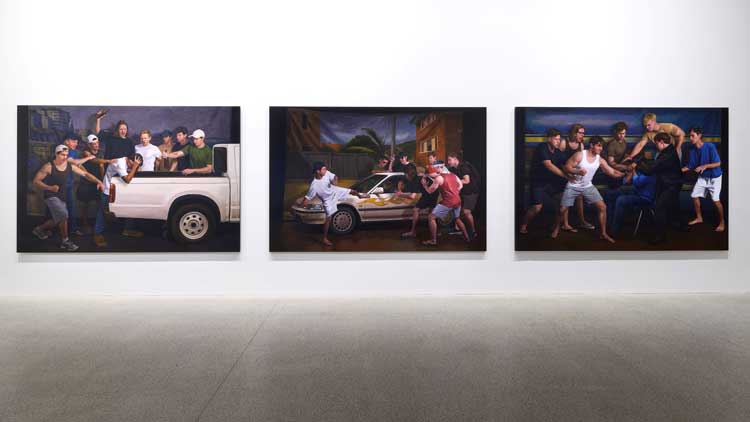
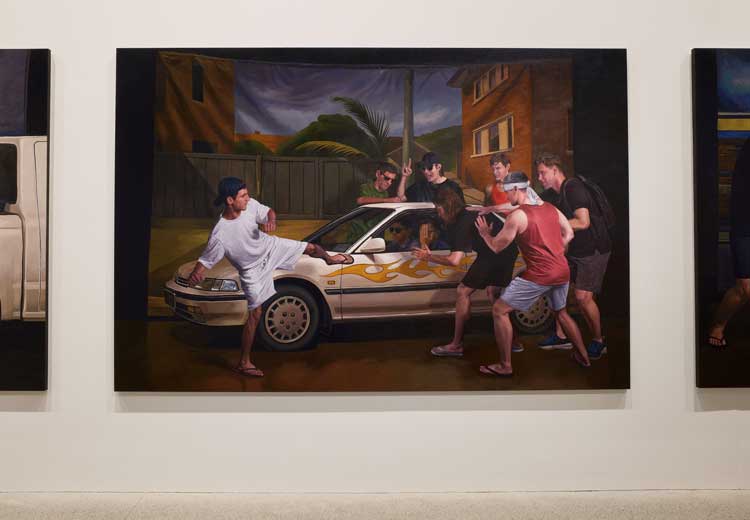
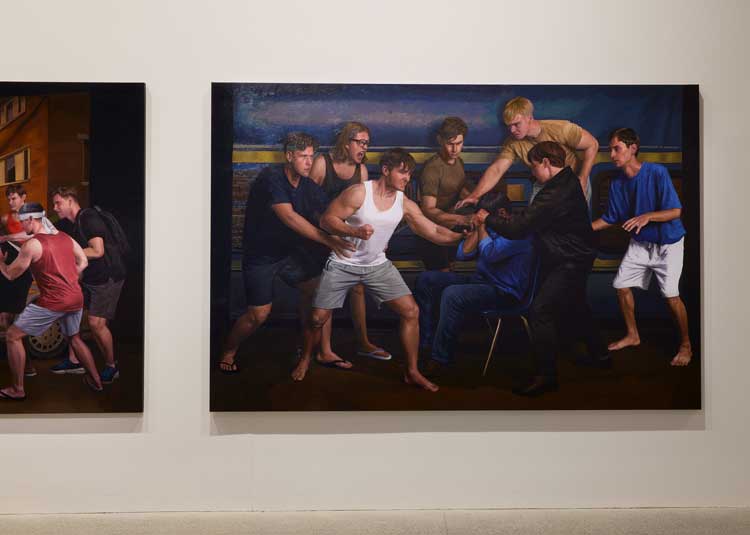
Left to right: Abdul Abdullah, North Cronulla Beach car park approx 1:45pm, 2025; Mitchell Road approx 2:40pm, 2025; Cronulla Railway Station approx 3:00pm, 2025. Courtesy of the artist and Ames Yavuz © Abdul Abdullah. Installation view, 25th Biennale of Sydney, Rememory, 2026, Art Gallery of New South Wales. Photo © Art Gallery of New South Wales, Felicity Jenkins.
Based on Al Qasimi’s opposition to the war in Gaza, some biennale donors and board members have been critical of her appointment. The biennale opened two weeks after the beginning of the Iran war, amid travel suspension and chaos affecting its curator and several artists. The biennale’s longstanding reputation for the politics of artist integrity and solidarity is evident and yet there is a sense, too, that the strength and focus of the event has been reduced. Australia’s distance from the current Middle Eastern war zones (a sense of being geographically safe and possibly marginal), the nation’s racist history and intolerance toward refugees and, most recently, the government’s failure to stop events such as the recent Bondi shooting, mean the politically engaged biennale is seen as anything but representative of mainstream Australia.
The best works this year call on Australian citizens to interrogate their own past, including Aboriginal land rights and the racist-fuelled Cronulla riots of 2005. Al Qasimi asserts the significance of this year’s iteration of the biennale: “Rememory has been shaped by artists whose practices are grounded in lived experience, cultural knowledge and community. Many of the works in this edition draw on personal, familial and collective histories to reflect on how memory is carried across generations, and how histories that have been fragmented or suppressed can be revisited and reassembled through art.”
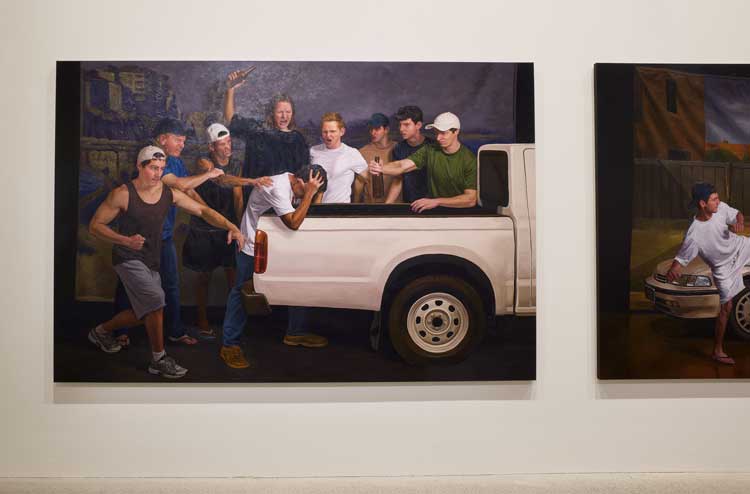
Abdul Abdullah, North Cronulla Beach car park approx 1:45pm, 2025. Courtesy of the artist and Ames Yavuz © Abdul Abdullah. Installation view, 25th Biennale of Sydney, Rememory, 2026, Art Gallery of New South Wales. Photo © Art Gallery of New South Wales, Felicity Jenkins.
The biennale draws together a range of local and global issues and events, through newly commissioned and presented artworks that engage with contemporary ideas and the world we live in, inspiring and challenging perspectives and in turn fostering a shared sense of community and belonging. One of the most impactful commissioned works is that of Abdul Abdullah, Cronulla Railway Station, approx 3.00pm (2025). His series of large canvases confronts Australia’s collective memory of the 2005 riots. Two decades on from the event, it is possible to reappraise the riots that shocked the nation, as well as their impact on, and the involvement of, individuals who live locally in Sydney’s south. Unprecedented in recent history, more than 5,000, mostly white, Australians gathered in Cronulla for a day-long assault on non-white individuals or anybody perceived to be of Middle Eastern descent. The drama is re-enacted to great theatrical effect by the use of Renaissance contrivance, establishing an artificiality and dramatic illusion to depict scenes that were reported extensively in the media at the time. With photographic realism and amplified scale from media footage, theatrical apparatus highlights the question of whether the racist mob emerged from a genuine concern for national identity, or whether a vigilante group was responsible.
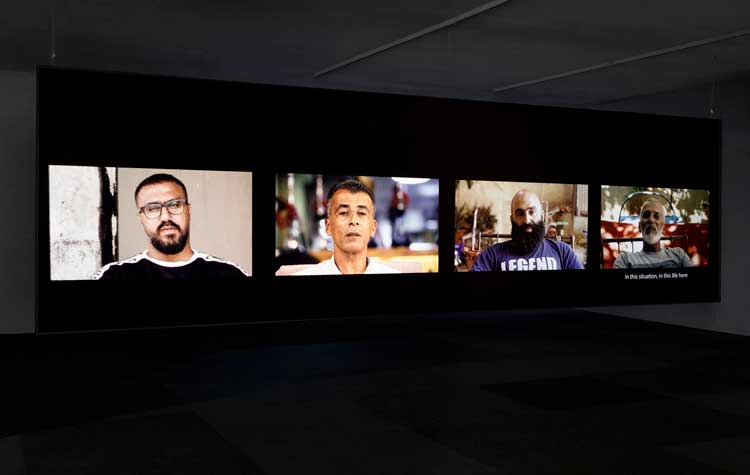
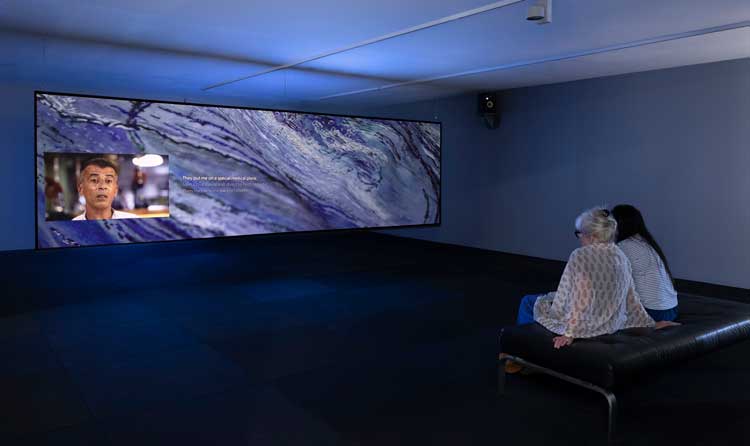
Joana Hadjithomas and Khalil Joreige, Asylum of our Dreams, 2026. Courtesy of the artists, In Situ – fabienne leclerc, Paris and The Third Line, Dubai © Joana Hadjithomas and Khalil Joreige. Installation view, 25th Biennale of Sydney, Rememory, 2026, Campbelltown Arts Centre. Photo: Silversalt Photography.
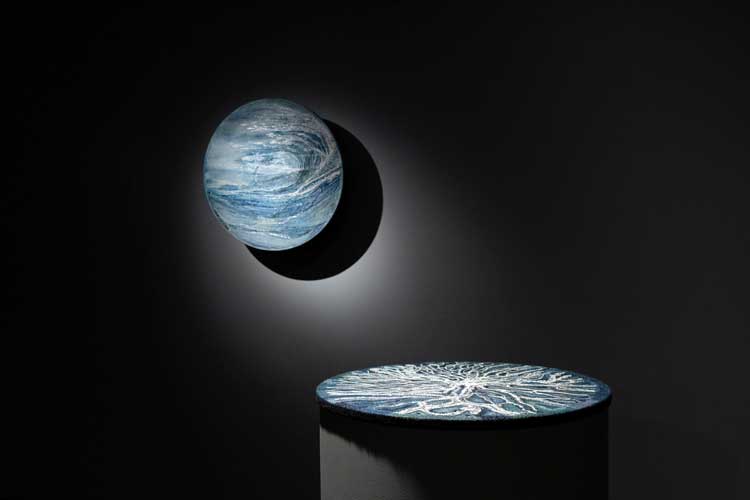
At Campbelltown Arts Centre, the Lebanese artist and film-making duo Joana Hadjithomas and Khalil Joreige present the film Asylum of Our Dreams (2026), a story of incarceration and despair, based on the escape story of a group who had planned to enter Australia via a dangerous sea crossing but one (a friend of the film-makers) decided to stay in Lebanon. The group were arrested and sent to a high-security asylum-processing centre on Christmas Island. Asylum of our Dreams and the accompanying wall text conjure the misery of their detention described by the detainees as, “time stretched into endless waiting”. Working closely with five women to recreate circular embroideries of the sea, Hadjithomas and Joreige created a sense of “suspended temporality”.
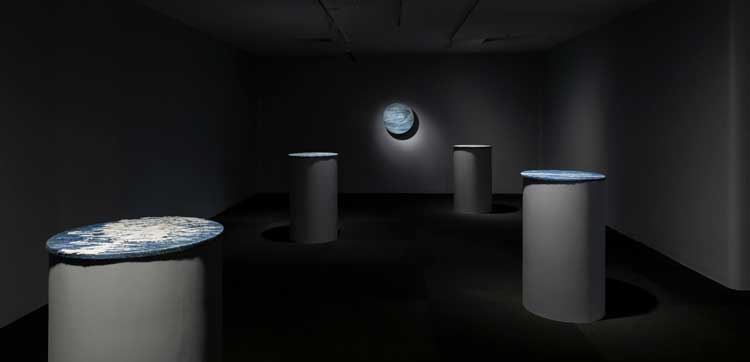
Joana Hadjithomas and Khalil Joreige, Asylum of our Dreams, 2026. Embroideries commissioned to Le Temps Brodé. Courtesy of the artists, In Situ – fabienne leclerc, Paris and The Third Line, Dubai © Joana Hadjithomas and Khalil Joreige. Installation view, 25th Biennale of Sydney, Rememory, 2026, Campbelltown Arts Centre. Photo: Silversalt Photography.
Rememory calls on the audiences to engage more thoughtfully and to question what we encounter, to avoid simple explanations and resolutions. The wide range of exhibitions engages audiences to trace entangled histories of land, migration and incarceration across local and global contexts. As a visionary partner, Fondation Cartier pour l’Art Contemporain has worked with the biennale to commission 15 First Nations artists to produce new work. The ongoing collaboration, says Bruce Johnson McLean, the Fondation First Nations curatorial fellow, “offers a unique platform to interrogate and expand curatorial frameworks in dialogue with First Nations artists, creating spaces where ancestral knowledge, contemporary practice and experimental approaches intersect. Through these commissions, we explore the entanglements of history, memory and identity, amplifying voices that challenge conventional narratives and invite audiences into nuanced dynamic encounters.”
Rememory encourages participating artists from Australia and around the world to examine their own cultural roots while also engaging with Sydney’s communities and histories, addressing shared global questions of identity and belonging, marginalised perspectives and untold stories, highlighting how memory shapes identity and collective experience. First Nations voices and the diverse diasporas that shape contemporary Australia are central to the exhibition’s narrative.
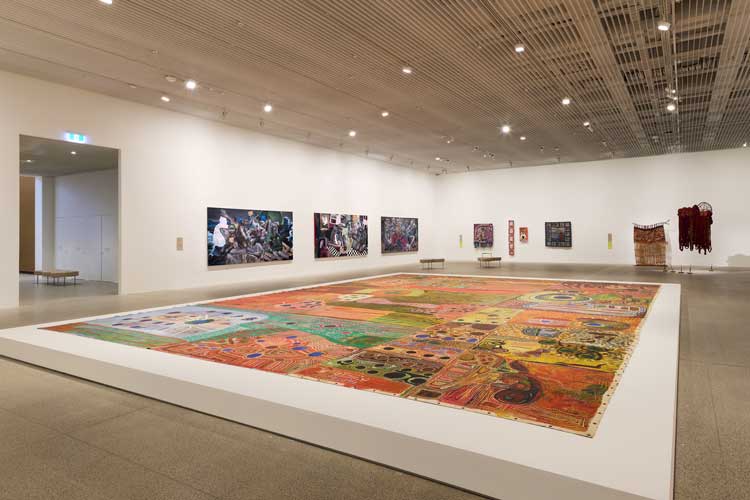
Foreground: Ngurrara Artists, Ngurrara Canvas II, 1997. Courtesy of the artists and the Ngurrara Canvas Management Group (NCMG) © Ngurrara Artists. Installation view, 25th Biennale of Sydney, Rememory, 2026, Art Gallery of New South Wales. Photo © Art Gallery of New South Wales, Felicity Jenkins.
The high point of the biennale for me is Ngurrara Canvas II, created by the Ngurrara artists of the Great Sandy Desert in Western Australia. A spectacular artwork that dominates a large space at the Art Gallery of New South Wales, it alone is worth travelling to the other side of the world to see. An artwork of great beauty and spiritual importance, Ngurrara Canvas II is also of pivotal legal significance – it represents the first and only time that a work of art has been used as proof of historical land tenure. One of the largest Aboriginal paintings ever produced, the 8 x 10 metre (26 x 33ft) artwork is on show in Sydney for the first time. The canvas was presented to the National Native Title Tribunal in 1996 to demonstrate the Ngurrara people’s connection to Country during native title proceedings. (A smaller iteration had been created but was deemed too small.)
The Ngurrara artists had been inspired by the landmark MMabo decision of 1992, a high court ruling credited for overturning terra nullius, a Latin phrase meaning “nobody’s land” that was used at the time of Australia’s settlement by the British in 1788. Britain claimed there was no legal system of land ownership, and land was given and sold to farmers and miners, with many Aborigines forced to leave or to live in missions. The law played a key role in racial discrimination against First Nations people: Aborigines had no land rights under colonial rule.
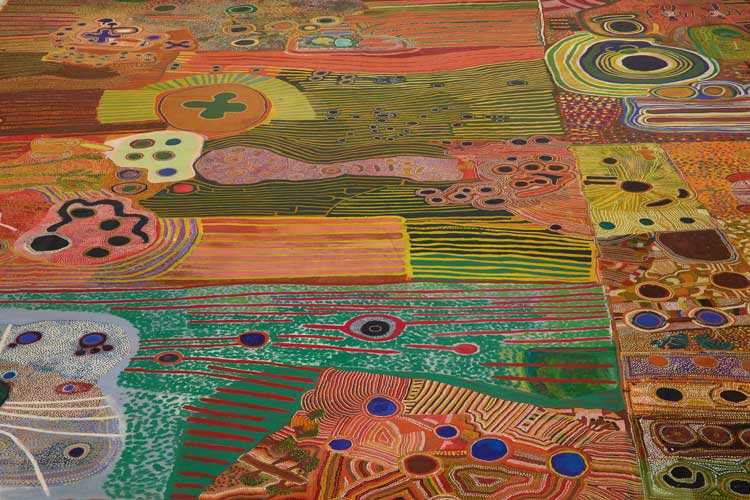
Foreground: Ngurrara Artists, Ngurrara Canvas II, 1997 (detail). Courtesy of the artists and the Ngurrara Canvas Management Group (NCMG) © Ngurrara Artists. Installation view, 25th Biennale of Sydney, Rememory, 2026, Art Gallery of New South Wales. Photo © Art Gallery of New South Wales, Felicity Jenkins.
About 40 artists set about creating Ngurrara Canvas II to support their legal claim to their land: they painted it in its complex entirety, including the sacred jila (waterholes), places that support ceremony and hold powerful ancestral beings. In the laying down of the vast canvas across the red soil of the Pirnini claypan, close to the town of Fitzroy Crossing, the Ngurrara artists created a visual account of an area larger than Tasmania; an area that is home to five different language groups. It is a deeply felt creation and a powerful embodiment of a living country. It is the epitome of an act of decolonial storytelling, of belonging, of ownership.
In about 1997, Ngarralja Tommy May (c1935-2022), explained: “[We] were wondering how to tell the court about our country. I said then: ‘If kartiya [white people] can’t believe our word, they can look at our painting. It all says the same thing.’ We got the idea of using our paintings in the court as evidence.”
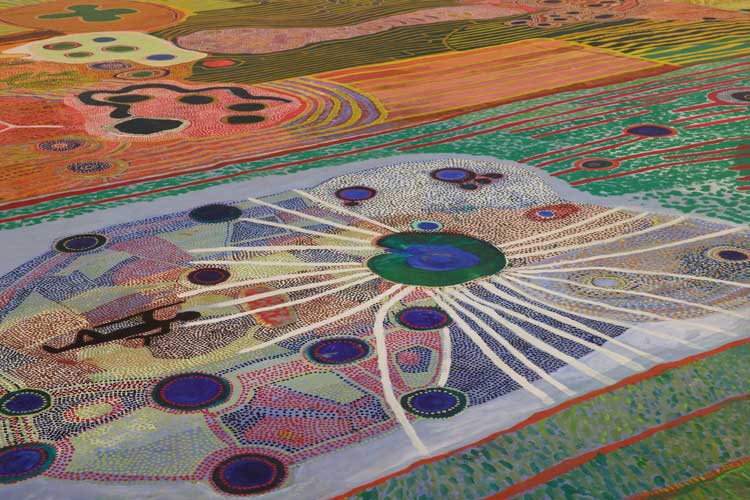
Foreground: Ngurrara Artists, Ngurrara Canvas II, 1997 (detail). Courtesy of the artists and the Ngurrara Canvas Management Group (NCMG) © Ngurrara Artists. Installation view, 25th Biennale of Sydney, Rememory, 2026, Art Gallery of New South Wales. Photo © Art Gallery of New South Wales, Felicity Jenkins.
It worked and the land was returned to the Ngurrara people in 2007 and 2012.
Murungkurr Terry Murray, a Ngurrara artist and the co-ordinator of the Ngurrara Canvas Management Group, was the youngest artist to work on the Ngurrara Canvas. He explains its importance to First Nation people: “We want to look after this canvas properly and for all the artists to be recognised. The senior artists told us the stories and we mapped it out and started to paint. I learned about the journey of my family. Ngurrara Canvas II is a map. It shows Ngurrara people where we came from, what story we can tell, what we can sing, and what we can dance. When we were planning how to manage the canvas, some people were thinking of money, but it is more important than that. It is our turlpu, our heart, and pirlurr, our spirit.”
Click on the pictures below to enlarge

Copyright © 1893–2026 Studio International Foundation.
The title Studio International is the property of the Studio International Foundation and, together with the content, are bound by copyright. All rights reserved.
 |
 |
 |
|---|
-1000-300.jpg)
 Charles Conder: Retrospective
 Mediators and Messengers: Contemporary Art in the Landscape
 Book review: The Formalesque: A Guide to Modern Art and its History