
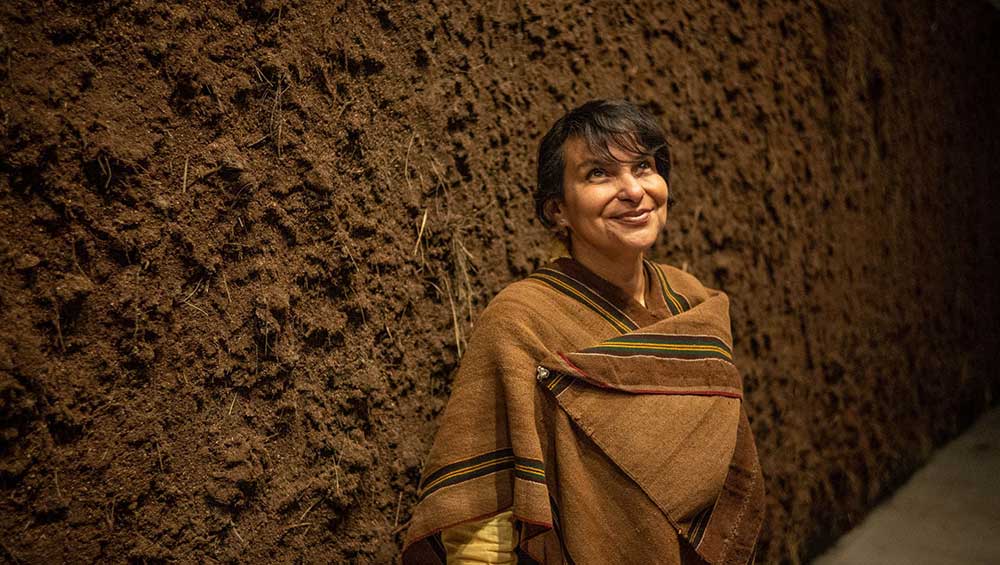
Delcy Morelos. Photo: Julian Bongiovanni.
by VERONICA SIMPSON
In preparation for a meeting with the artist Delcy Morelos (b1967, Tierralta, Colombia), I went to see her new work, her first in London. Origo, an enormous earthen ring, a “void” as she later referred to it, squats on the sculpture court at the Barbican Centre, the first sculpture to occupy the space in a decade. Placed in geometric balance between the curve of Frobisher Crescent, and the orthogonal blocks of the Barbican’s main building, it is accessed on the same floor level as the gallery, which is filled with vibrant, witty and deeply political art by Morelos’ Colombian compatriot Beatriz González. Origo is Morelos’ first monumental work in Europe to be sited outdoors, so that makes it special, as does the fact that there is no admission fee – people can see and experience it multiple times, in all weathers.
Measuring 24 metres wide and nearly four metres high, it took a month to install and required 30 tonnes of soil and clay. Morelos and her team of – mostly Mexican – makers have been kneading, slapping and scraping mud on to every nook and cranny of the semi-permeable sculpture’s framework. You can walk a certain way along each of four dark, fragrant tunnels that comprise the oval “ring”, before hitting a pile of earth in a cave-like endpoint. These ends coincide with four entrances/exits, placed at the four cardinal points.
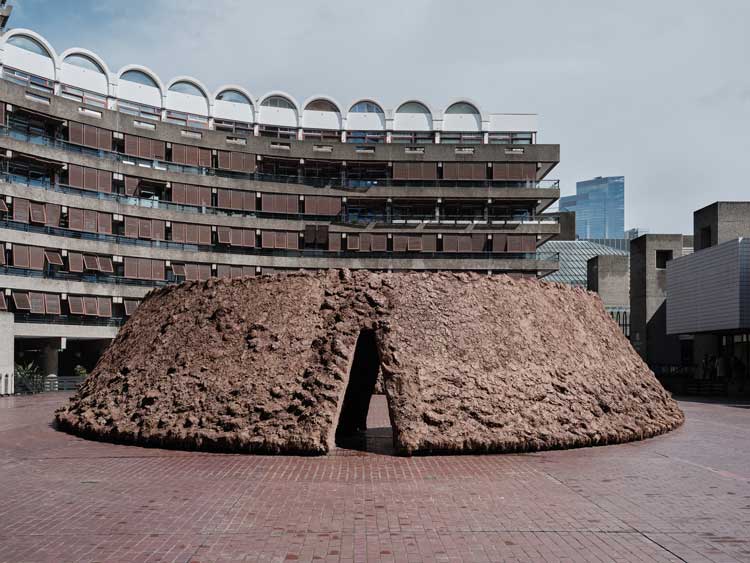
Delcy Morelos: Origo, installation view, Barbican, London, 15 May – 31 July 2026. Photo: Barbican
Art Gallery / Thomas Adank. © Delcy Morelos.
As I entered the inner circle, I noticed a woman standing with her back to one of the craggy, clay walls, her face raised to the sun, arms outstretched. With eyes closed, she dropped her arms and held her forearms out in front of her, making repetitive, pulsing gestures with fingers and thumbs, as if conducting some kind of silent incantation. I suspect a lot more of these personal ritual moments will be experienced – maybe even generated – during the sculpture’s residence here.
Morelos’ profile has risen in the last decade, since the definition of who the art world considers worthy of consideration has exploded to incorporate more gender positive, Indigenous and global south orientations – and since the paintings and drawings of her early years gave way to a series of ambitious earthworks and installations. The one that put her seriously on the art world map was Earthly Paradise (2022), at the 59th Venice Biennale, an earthen maze filling a whole section of the Arsenale with its visceral sensuality and monumental scale. In the guide to the biennale, the curator Manuela Hansen gave as good a summary then as I’ve heard of the essence and appeal of Morelos’ work: “Morelos’ use of earth is informed by Andean and Amazonian Amerindian cosmologies and conveys the notion that nature is not something inert that we access and control at our will from an outside and exceptional position, but that we are earthly beings; we become, live, die and decompose with and as the earth. As the soil penetrates and affects our body and senses, our human becoming takes a new shape: we apprehend we are always becoming humus, as the Latin etymology of the very word ‘human’ recalls.”
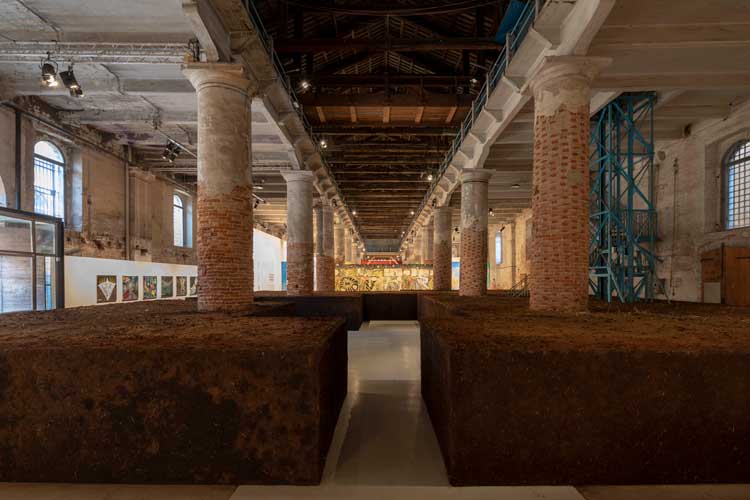
Delcy Morelos, Earthly Paradise, Biennale di Venezia, 2022. Photo: Roberto Marossi. © Courtesy of the artist and Marian Goodman Gallery.
But Morelos’ work is about so much more than piling mounds of earth in white cube galleries or historic spaces to remind us of our roots. Her work is also in dialogue with the whole lineage of land artists (Walter de Maria’s The New York Earth Room from 1977 is often cited) and is infused with her particular take on what the site requires, in form and in materials. She composes her installations carefully to enrich the storytelling (postcolonial, anti-extractivist), drawing components from her now trademark palette of earth, clay, water, cinnamon, cloves, cacao, cassava flour, tobacco, metal, jute, hay, buckwheat, chia seeds and honey. For example, Profundis (2024), the earthwork she created for the former monastery turned art space the Centro Andaluz de Arte Contemporáneo in Seville, included many of the same plants that Christopher Columbus transported from Spain to the Americas for cultivation, this time shipped from Colombia, in a gesture of reverse colonisation.
The work Cielo Terrenal (Earthly Heaven, 2023), for her 2023 show at Dia Chelsea in New York, involved Morelos painting the floors and lower third of the gallery walls – up to the level of flooding that the city’s buildings suffered after Hurricane Sandy in 2012 – with water and acrylic binder mixed with black soil from Goshen, in the Hudson valley (known as the Black Dirt Region). Its companion work, El Abrazo (The Embrace, 2023), featured a towering mound of earth taken from a Manhattan roof garden, plus clay, grass seed and ground coconut husks, creating a tactile skin that was then perforated with millions of stalks of hay from the Hudson Valley. This bristling, live, animal quality was mesmerising and meant to be touched. She wants us to take care of this Earth, this planet, as much as we would take care of ourselves, she says. Interviewed for Artnet at the time, she said: “I am a witch – a witch is a woman of wisdom who learns from nature and its secrets. I come from a lineage of ancestral knowledge, and I understand that soil is nourishment.”
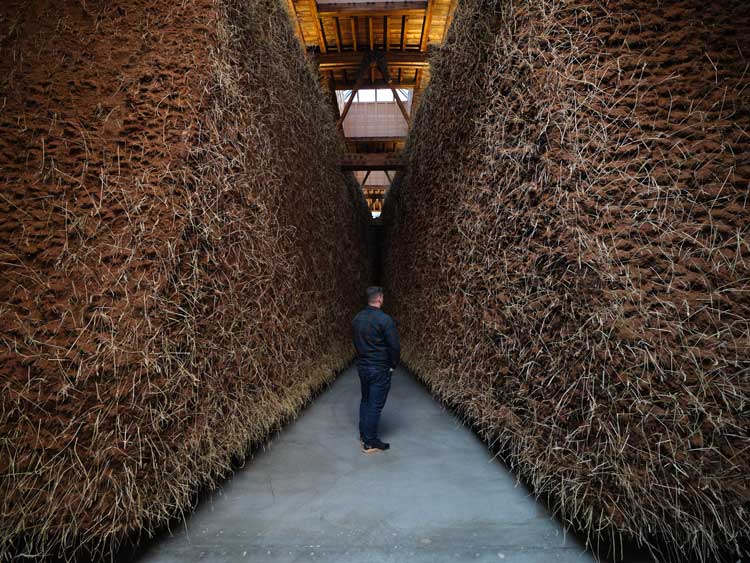
Delcy Morelos, El Abrazo (The Embrace), [detail], installation view, Dia Chelsea, New York, 2023. Photo: Don Stahl. © Courtesy of the artist and Marian Goodman Gallery.
Part of the allure – and a crucial part of the ethos – of Morelos’ work is that it is ephemeral. Earth will be returned to the earth – enriched, not impoverished, by the additional seeds, organic material and scents; a kind of artistic compost. It leaves little in the way of a footprint, and nothing in the way of monetary or collectible artefacts – though some “market friendly” earlier works, in textiles and on paper, were included in the show that her gallerist, Marian Goodman, staged in Paris in 2023.
Over the last year Morelos’ monumental talents have been highly visible across Europe. Berlin’s Hamburger Bahnhof hosted a massive earthwork, Madre (July 2025 to January 2026), and as well as Origo at the Barbican there will be a trapezoidal indoor structure, 14 metres long and 9 metres wide, made of mud, timber, wattle and daub, in Bozar, Brussels, in the summer. As is now her regular practice, Morelos commissioned professional fragrance company Givaudan, to create a bespoke scent for the Brussels commission, described as evoking humid soil, wood, cinnamon and natural oils. Visitors will be encouraged to enter the earthwork barefoot.
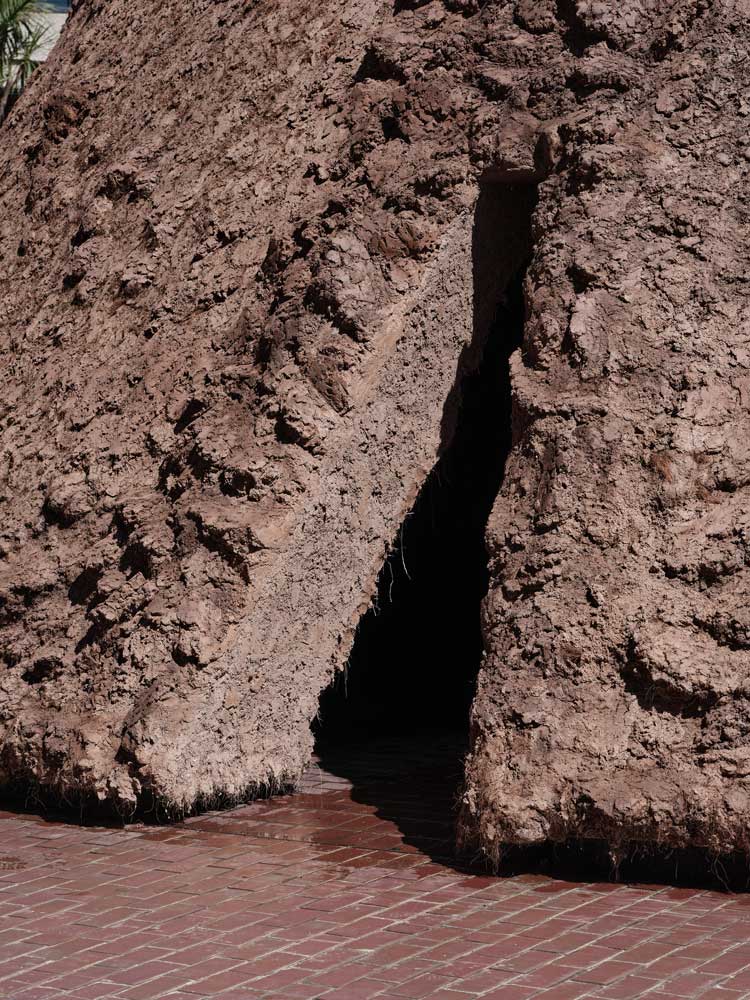
Delcy Morelos: Origo, installation view, Barbican, London, 15 May – 31 July 2026. Photo: Barbican
Art Gallery / Thomas Adank. © Delcy Morelos.
Her presence at the Barbican is part of a season celebrating Colombian culture. I had been excited about meeting her, but two hours before our scheduled conversation I was told she was not going to make it. I was offered a place at the talk scheduled that evening with the curator, Diego Chocano. I accepted. Any lingering pique at her last-minute “no show” evaporated when I sat in the auditorium and heard Chocano explain somewhat sheepishly that they had been celebrating rather too enthusiastically at the official launch party for Origo the night before and were all feeling rather fragile. One has to admire that rock’n’roll spirit.
Morelos sat between Chocano and her translator, looking radiant and timeless, in a tailored, felted cape and a billowing blue dress; the “Andean-style queen” look completed by dapper white leather brogues. Her long black hair was loosely tied, the glowing red frames of her glasses in the stage spotlights obscured her eyes, but it seemed as if they were often closed as she spoke in that halting, almost incantatory rhythm that arises when questions posed in English are translated to Spanish, responded to in Spanish and then translated back to English. Her often-gnomic utterances and aphorisms intensified the impression of interview as ritual, albeit disrupted with frequent laughter. She and Chocano have obviously established a warm rapport over the work’s two-year gestation, and his questions and digressions did much to contextualise the work and the processes of an artist who clearly doesn’t feel the need to over explain. The following is a combination of questions and insights from Chocano, additional questions from the studio audience (including myself) and her edited replies.
Chocano asked Morelos what happened, in about 2012, when she started incorporating quantities of soil into her work: what prompted that shift? She said: “At that time I went to Morocco for an artist residency. It was shocking: I had never seen a desert before. The soil was … desert but was still producing life. Olive trees were there. And yet the soil was naked.” She felt from that point on she could allow the soil to speak for itself more.
Chocano says he initially thought her response to the Barbican would be to create a dialogue between soil and cement. Instead, he says: “She created this dwelling, this installation, this little home, as a space where the human becomes decentred, isn’t necessarily the privileged subject. When you enter, you become on an equal footing with the soil and the plants - almost like this rebuttal or gentle critique of … the concept that underpins the Barbican. It’s equally political and socially engaged. She really thinks about the context that she is working in.”
Morelos apparently arrived at the form of Origo within 24 hours of her first visit to look around the Barbican. Chocano tells us that the artist lay down (on a chilly October day) in the sculpture court and then joined him by the lakeside terrace. There she saw the fountains spouting watery arcs, and the idea for a rounded structure, with a void in the middle emerged. By the next morning, she had already drafted her first ideas – which are apparently very similar to what we now see in the Barbican.
Why the name Origo? “Origo is origin in Latin,” says Morelos. “I gave it that name because there was a Roman settlement here. The word Origo starts with an ‘o’ and ends with an ‘o’. An oval. Like the form of Origo. Origo is an encounter in many dimensions. We encounter modernity and utopia in the Barbican. It is made out of culture, made out of soil. They used ancestral techniques for construction. The oval is encountered in cycles. Origo is the encounter in multiple dimensions. The Barbican embraces Origo.”
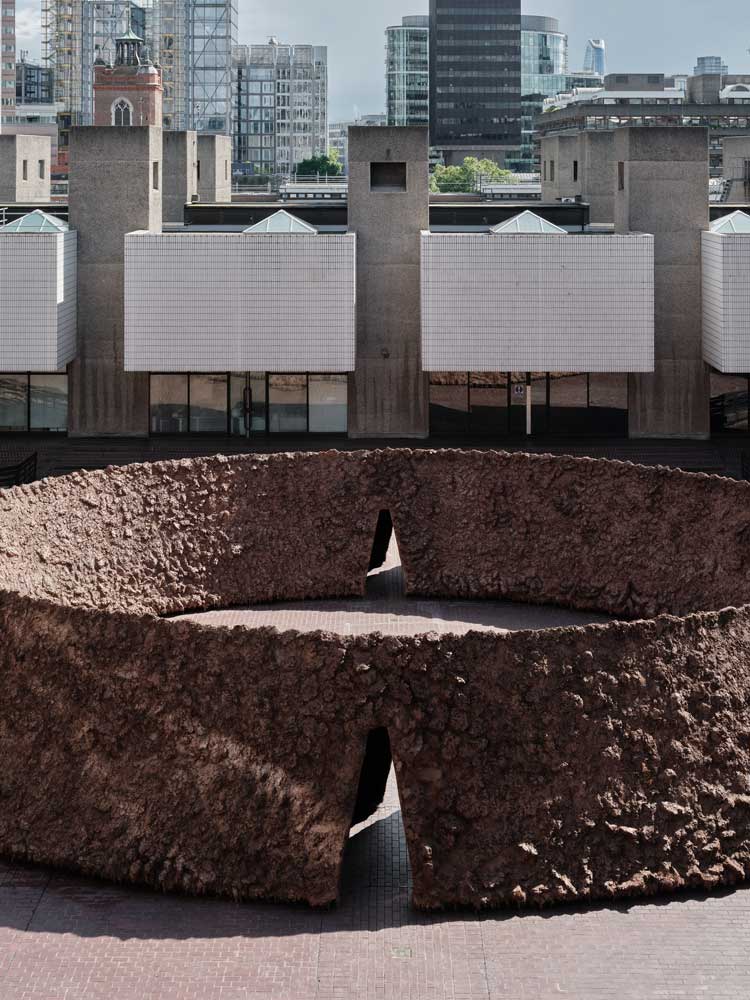
Delcy Morelos: Origo, installation view, Barbican, London, 15 May – 31 July 2026. Photo: Barbican
Art Gallery / Thomas Adank. © Delcy Morelos.
She is a fan of the Barbican’s brutalist aesthetic and monumental presence. “When I came to the Barbican, I felt a very big emotion. I love modernist and brutalist architecture. And the Barbican is a great example. When they showed me the place where my sculpture was being placed, I was scared. It was so beautiful. And I always say that the void is beautiful, and that what I make at that void has to be a little bit better than the void. What I did was the void within the void. Because the void is where we develop – in the empty, warm and dark void that is the womb of our mother. I wanted to talk about our origin.”
Chocano shares with the audience photographs of the team hard at work, in mud-splattered overalls. The earth apparently came from a farm near Newcastle – Morelos wanted an earth tone that would sit between the gnarled grey of the concrete and the Barbican’s russet-toned paving.
Morelos tells us that she fell while working on Origo and nearly lost a tooth. Her team joked that it was a “brutalist kiss”. But she adds: “I would have done even more just to make this work here. Here we gave it all, even our souls – the team just like myself. It’s important for people to have a place, even if it’s for a limited time … to have an experience with soil. The origin of this matter that they are made of, their bodies. I don’t know what their souls are made of, maybe of emotions and thoughts. And when these thoughts are sweet and harmonious, we can make something out of this world even better.”
What will Origo bring to Londoners? “Londoners are going to have an experience that if they want is going to be very profound,” says Morelos. “Silence is needed, and time, because they are always going somewhere, there is always a message on your cellphone to be sent. But to have an experience not just in Origo but in life, genuine solitude and introspection are needed … to enjoy the flavour.”
Chocano says: “Delcy says to work with the soil, you need to speak its language, and it’s a language that not everyone speaks and it’s a language that’s not easy to teach. And through the two-year process we have worked together she has insisted on speaking this language to me. It’s a language that very productively challenges our sometimes rigidly institutional processes and forces us to adapt and grow. Making something alive on such a big scale is not something that a lot of institutions do. But I wanted to highlight this: it feels like a very important part of her practice, this challenging of institutions, and this complete conviction in her voice and her language as an artist. It’s really important and we really felt it - the entire Barbican team. It was challenging at times, but extremely worthwhile. Delcy and her team also brought a very joyous and courageous spirit to the installation. Where they go, the circus arrives. We were on display for the whole of the build (all the flats on the Frobisher crescent had front-row seats).”
I asked Morelos what combination of scents she chose to add to her Barbican soil recipe. She replies: “When I conceive a work of art or design an experience, the scent is one of the strongest elements. The smell is like a time machine – memory connects our very cells. So, when we smell, our memory gets activated. Origo’s smell is a forest smell – a mixture of cinnamon and cloves … When you are in darkness your other senses get sharper. Your ears are sharper and your sense of smell.” She wanted Londoners to have memories of a time in childhood, of the magical space that nature represents to our pre-adult selves.
One of her favourite London discoveries in the month-long construction she says has been her up close encounters with the urban fox. “When we were planning Origo, they told me we need to block the doors so foxes can’t enter the place. I thought: ‘Oh, that’s absurd. All the foxes of London are waiting for me to make a sculpture?’ (laughter). I don’t laugh any more. We hadn’t even finished the sculpture and the foxes were already there. We felt the foxes were pushing us for the work to be finished. And to do it better. They were regular visitors, eating leftovers, finding places to sleep inside the caves. We had fences to block the doors. They climbed over them. We knew that they would keep coming and we lived with them. Because before human beings were here in this territory, they were here already. So, the foxes’ territory was filled up with concrete. Now we have given them soil and they are happy.”
She hopes that Londoners will really spend time in and around Origo, getting close to it. “Soil likes to be touched. This soil was massaged and hydrated, perfumed. Even spoiled.” When Origo’s time in the sculpture court is over, the earth will be returned to earth – albeit perhaps not to the farm site from where it was sourced.
To the question of what art can do to counteract colonialism and extractivism, Morelos suggests we take comfort from the Earth, which has suffered so much abuse from humans, from mining to wars, for centuries. She said: “I have been dismissed - not valued, as a woman, for having Indigenous ancestry. What I have felt is that that makes us stronger, and each situation you can overcome better than before. This is something I have learned from the Earth: we always can be better and continue to grow.”
• Delcy Morelos: Origo is at the Barbican until 31 July 2006. Her installation Monumental will be in the Horta Hall at Bozar, Brussels, from 28 June to 30 August 2026.
Click on the pictures below to enlarge

Copyright © 1893–2026 Studio International Foundation.
The title Studio International is the property of the Studio International Foundation and, together with the content, are bound by copyright. All rights reserved.

 |
 |
 |
|---|

-1000-300.jpg)