




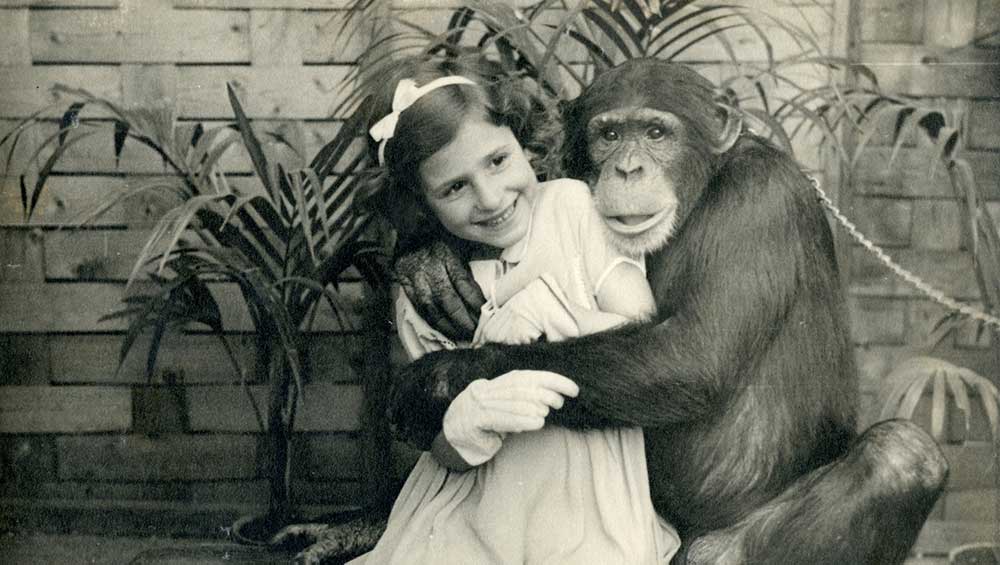
Postcard from the collection of Tom Phillips. Image © Bodleian Libraries, University of Oxford.
Weston Library, Bodleian Libraries, Oxford
11 March – 27 September 2026
by ANNA McNAY
When my support dog, Parsley, received an invitation to review an exhibition addressed first to him, and only by association to me, I knew we had to accept. The exhibition at hand was Pets and their People at the Bodleian Library, Oxford.
On entering the gallery, Parsley began to growl. Following the direction of his dissent, the cause became clear: a black-and-white cat was reclining on a bench, purring contentedly. But this was no real cat, but rather a toy of the kind often used with dementia patients. Evidently it was real enough, however. As its purr turned to a miaow, Parsley’s growl crescendoed to a bark. It took a good while to convince him of his mistake. I found the cat a little creepy – as, indeed, he probably did – although I think as a child I would have loved it.
What was evident going around the gallery was the desire on the part of the curator, Charles Foster, to elicit discussion. The exhibition texts raise a lot of questions, the main one being: who has the control in the relationship – pet or human? The exhibition title perhaps hints at an answer, putting “pets” first as it does, but the artefacts on display, and their associated stories, ask us to consider whether this is as it should be. You might expect that the curator of such an exhibition would be a strong supporter of the primacy of pets; Foster is, in fact, at the very least an agnostic. (The staff responsible for selecting the accompanying merchandise were certainly more pet aficionados, however.)
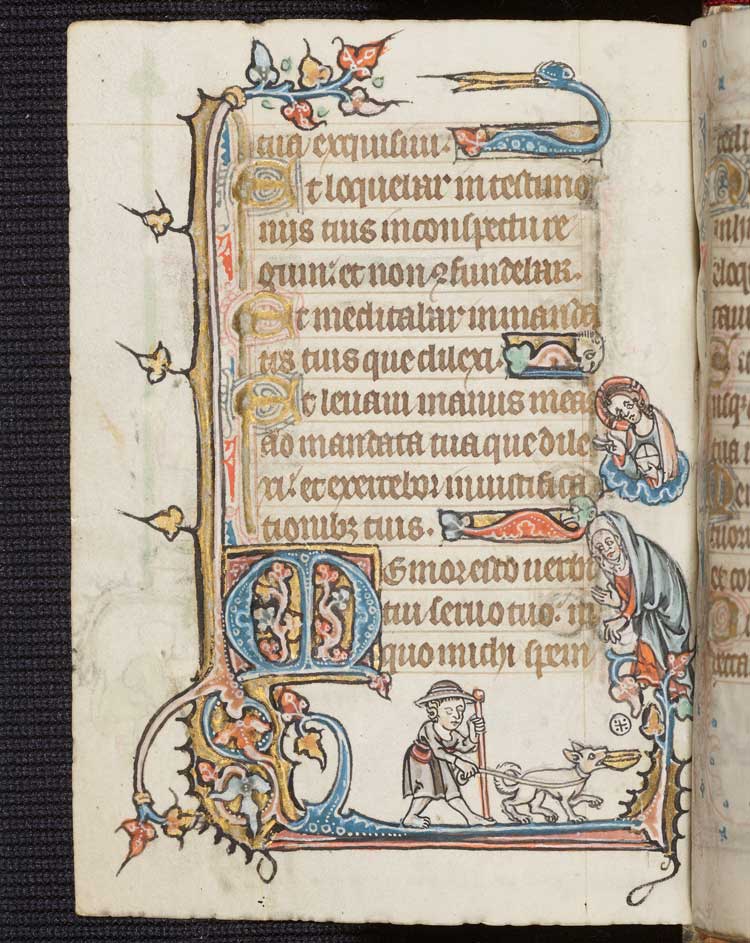
Portable Psalter, MS. Douce 6, fol. 98v, © Bodleian Libraries, University of Oxford.
Parsley and I were particularly drawn to the illumination of a medieval assistance dog shown, in a 14th-century Flemish psalter, holding the alms bowl for its blind-beggar owner. Other beautiful manuscripts include one from the 17th- to 18th-century depicting a woman of the Persian Qajar dynasty along with her courtly cat and an exquisite 16th-century Italian Book of Hours showing the birth of John the Baptist, with a well-fed cat being used to warm his cradle.
-Bodleian-Libraries,-University-of-Oxford-2.jpg "Portable Psalter, MS. Douce 6, fol. 98v, (detail) © Bodleian Libraries, University of Oxford.")
Portable Psalter, MS. Douce 6, fol. 98v, (detail) © Bodleian Libraries, University of Oxford.
Another of our favourite pieces was the painting, Portrait of a Young Man holding a Dog and a Cat (attributed to Dosso Dossi, c1508-10), in which the man is shown with a dog in one arm and a cat in the other. The two animals were thought to highlight the two sides to his character. Oxford author Philip Pullman picked up on this notion of our personality being represented in animal form as our “daemon” in His Dark Materials trilogy. Indeed, Parsley has often been called my daemon, and, as one of the wall texts suggests: “It can be hard to know where the human ends and the animal begins.” (A photograph of a chimp possessively hugging a small girl further emphasises this point.) There is a manuscript by Pullman (Lyra’s Oxford, 2003) on show from the library’s collection, open on a page mentioning its protagonist’s daemon, Pantalaimon. Another Oxfordian author to be included is JRR Tolkien, who wrote a novella, Roverandom (of which the first typescript, from the early 1930s, is on display), about the adventures of his son’s lost toy dog. This is accompanied by a drawing in the author’s hand, as well. From my childhood, there are also examples from Beatrix Potter, Kenneth Grahame, Lewis Carroll and Shirley Hughes (whose Dogger was my first ever favourite book).
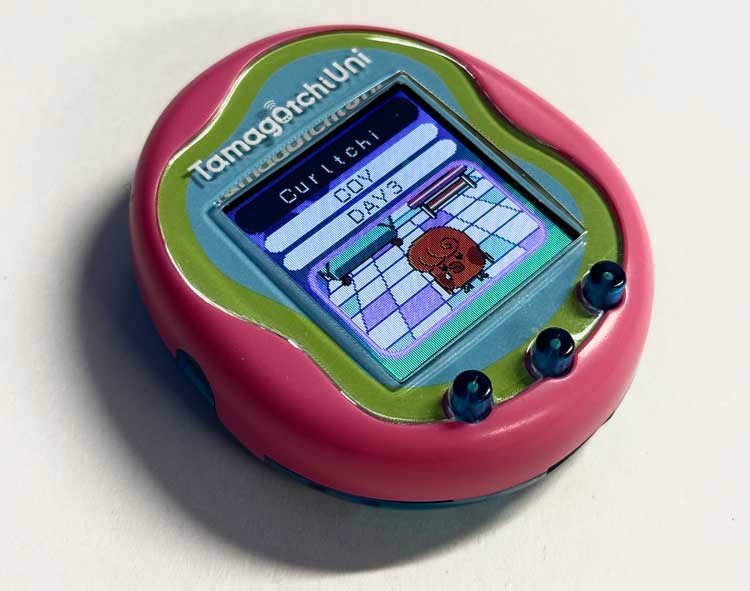
Tamagotchi, © Bodleian Libraries, University of Oxford.
Then there is a “replacement pets” section, including the hit of the late 90s, the Tamagotchi – a small, hand-held, egg-shaped computerised creature, which demands TLC, food, cleaning and so on, in order to stay alive. I received one as a gift while in hospital and had nothing to do but lavish it with all the attention it required. It died the day I was discharged. Clearly, I would have been better off with the alternative on display – a pet rock. (I should add that Parsley receives the utmost attention at all times, apart from when I am hyperfocused on work, but he is – luckily – more than adept at reminding me of his existence.)
There is also a section dedicated to the death of our pets, with everything from funerary traditions (an excellent mummified cat, from 664BCE – 200CE, is on loan from the World Museum Liverpool, alongside the information that whole Egyptian households would shave their eyebrows to mourn a dead cat) to making photograms (Julia Schlosser, Alex (Alex’s Body), 2018) or having their skins turned into a coat.
-Daniel-Meadows.jpg "John Payne, aged 12, with friends and his pigeon Chequer. Portsmouth, 1974. © Daniel Meadows. Courtesy the artist and Bodleian Libraries, University of Oxford.")
John Payne, aged 12, with friends and his pigeon Chequer. Portsmouth, 1974. © Daniel Meadows. Courtesy the artist and Bodleian Libraries, University of Oxford.
There are lots of photographs of pets and their people, including a series of self-portraits of children from Handsworth, Birmingham, with their pets, which were taken as part of a project, led by the professional photographers Brian Homer, Derek Bishton and John Reardon, who wanted to dispel the negative image attached to the area by the police and the media in the late 1970s. There are also photos from the collection of the artist Tom Phillips, showing people with their pets, accompanied by the question of whether people look like their animal sidekicks. No conclusion is reached, but I think the evidence in favour is compelling.
One wall is dedicated to a collection of breathtaking facts about the numbers of different animals currently owned as pets in the UK and how much we spend on them. The final section includes poems written by children about their pets – and the invitation to write one of your own (we passed on this).
Across the exhibition, there is everything ranging from dogs and cats to tortoises, pigeons and otters. College pets are also given a small section (but where is Tabitha, who lived in St Hilda’s lodge when I was a student? Doubtless that is far too long ago to mention!) Showing how animals of all kinds have long been at the heart of the family, an “inventory” written by the 17-year-old Maria Madan in 1745 numbers “in all 82”, with the human relatives being followed in the list by cattle, dogs and puppies – all individually named; then, among others, by pigs, a cat, kittens, guinea “piglins”, geese, ducks, chickens, starlings, a blackbird, goldfinches, a greenfinch, an ass, an “ass-colt” and an owl.
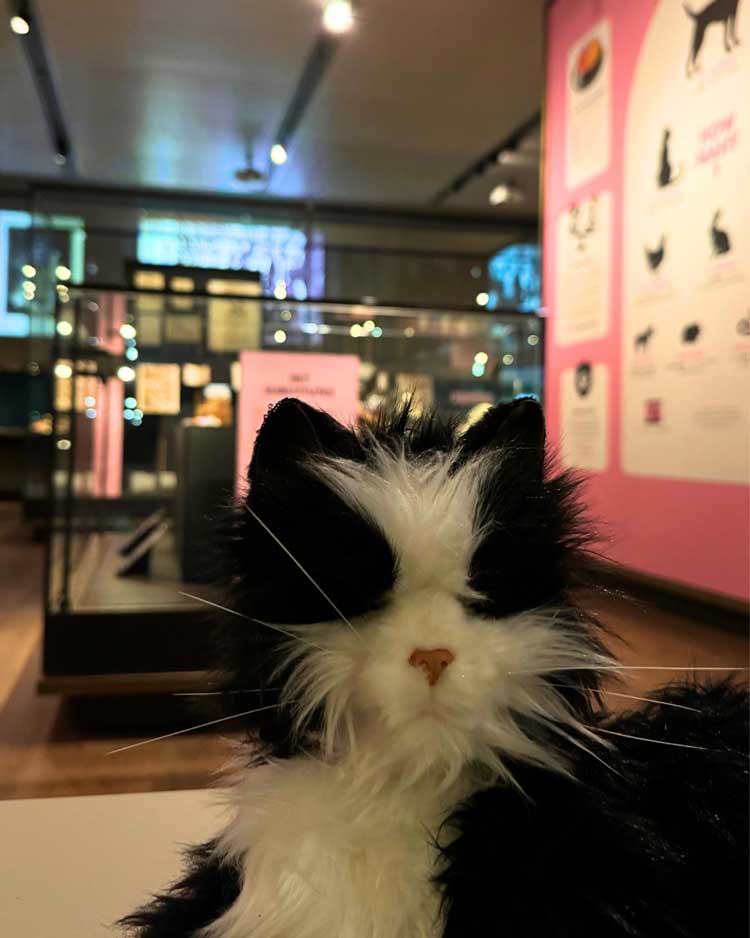
Pets and Their People, installation view, Weston Library, Bodleian Libraries, Oxford, 11 March – 27 September 2026.
The poster for the exhibition is a 19th-century confection showing a cat wearing a bonnet. This, along with other examples of the anthropomorphised dressing up of animals (for example, the pop-up book The Robins at Home, published in 1895), I also find somewhat creepy (mind you, no more so than Anne Geddes’ cloying babies – and, of course, I have to confess that Parsley does have a winter jumper and jacket collection that outnumbers my own. Ahem). Other posters on display include a Conservative party one from 1958, implying that a proper home needs a cat (and hence that pets can bind families – and societies – together), and there is also a photograph of Churchill with his pet poodle, Rufus II (and there was me thinking he owned, as well as being associated with, a British bulldog).
Despite not liking the cat, Parsley’s attention span lasted the duration of our visit, and I didn’t need to scoop him up into his sling (the manner in which he is used to frequenting exhibitions as he remains calm – and, doing his job, comforting – in this way). In fact, towards the end, he sat up and raised a paw to the glass vitrine containing the assistance apparatus for a lame dog (Parsley’s posture is copied by a very sweet little bronze dog dating back to somewhere between 27BCE and 395CE, on loan from the Ashmolean). He genuinely seemed interested. From my point of view, the exhibition brought back lots of happy memories. So, cat notwithstanding, it’s a thumbs up from us.
Click on the pictures below to enlarge

Copyright © 1893–2026 Studio International Foundation.
The title Studio International is the property of the Studio International Foundation and, together with the content, are bound by copyright. All rights reserved.
 |
 |
 |
|---|

-1000-300.jpg)



 David Remfry – interview: ‘It’s unprecedented that there were no arguments whatsoever this year’
 Hormazd Narielwalla – interview: ‘True, he’s physically not here, but Bowie, the god, is still with us’
 Alex Da Corte: As Long as the Sun Lasts
 Christine and Jennifer Binnie – interview
 Royal Academy Summer Exhibition 2017