



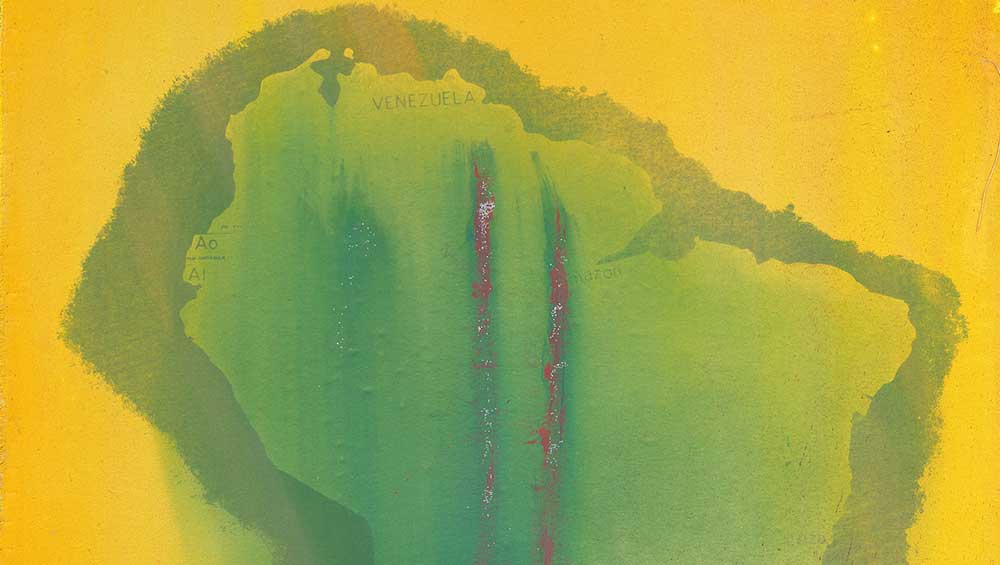
Frank Bowling, Yellow Map, 2025 (detail). Acrylic on canvas with marouflage, 161.5 x 107.3 x 4.5 cm. Courtesy the artist. Photo: Anna Arca. © Frank Bowling. All rights reserved, DACS 2025.
The Fitzwilliam Museum, Cambridge
27 March 2026 –17 January 2027
by ROCHELLE ROBERTS
Spanning almost seven decades, this show highlights key moments in Frank Bowling’s oeuvre, tracing his evolution from figuration to abstraction, including early paintings from the 1960s, when he was still a student at the Royal College of Art in London, through to his newest work. Although it is a small display with only 10 works on show, the exhibition offers an intimate and engaged look at Bowling’s dynamic body of work, with some paintings being shown for the first time.
Born in 1934 in British Guiana (now Guyana), Bowling came to London in 1953. He hoped to become a writer or poet but, while on national service in the Royal Air Force, he met the artist Keith Critchlow, who introduced him to institutions such as the National Portrait Gallery and Tate. Bowling became obsessed with the old masters as well as the giants of 20th-century art including Francis Bacon and Frank Auerbach. These encounters were highly influential and set him on the road to becoming an artist.
One of the first paintings in the display is Beggar No 5 (1962-63). In this, Bowling depicts a scene from his childhood in New Amsterdam, Guyana. A ragged-looking man in a blue-and-white striped T-shirt stands outside a shop – Bowling’s Variety Store, which belonged to Bowling’s mother, Chrissie. When Bowling was a child, his mother would offer food and shelter to homeless people, tasking Bowling with washing their feet – an activity that he remembers as traumatic. In this expressively painted work – where it is easy to see the influence of Francis Bacon – the figure seems at ease in his environment, which is perhaps at odds with Bowling’s less-than-positive recollection of events. Still, the figure of the beggar became a recurring theme in Bowling’s work of the early 60s, which perhaps shows him trying to work through past trauma.
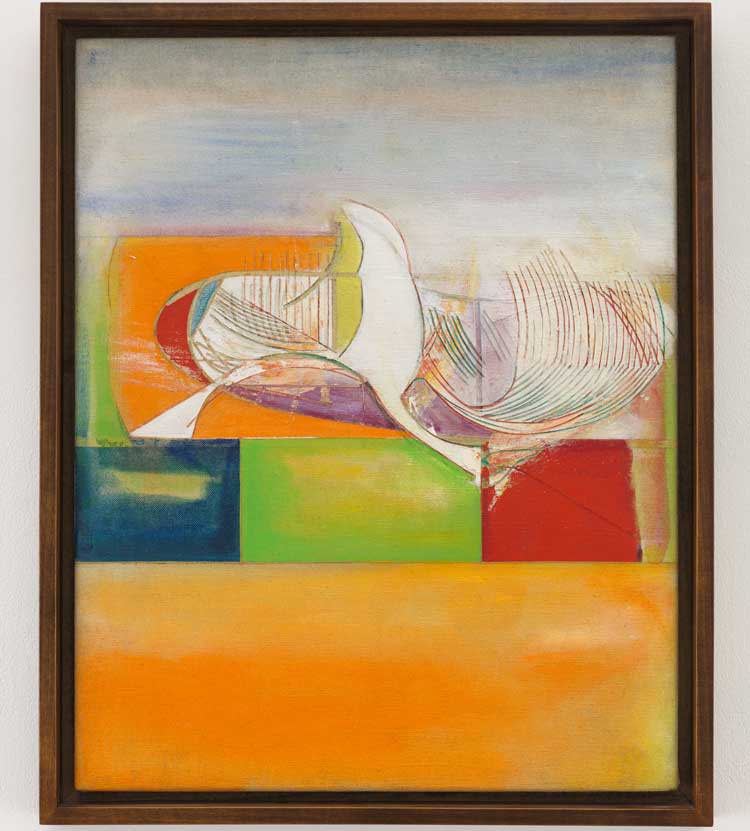
Frank Bowling, Swan, 1964. Oil on canvas, 50.5 x 40.4 x 1.1 cm. Courtesy the artist. Photo: Anna Arca. © Frank Bowling. All rights reserved, DACS 2025.
Bowling’s move towards abstraction emerges in his three swan works shown here– two from the 60s and one from the 2020s. The painting Swan (1964) shows a white swan against a background of red, blue, green and orange blocks. The swan, itself rendered in a simple form, appears to be writhing on the ground, its wings depicted using green and red lines, the upward motion indicating quick movement. Despite the bright colours, there is a feeling of tension in the painting, the isolated swan sprawled out, drawing the viewer’s gaze. At the time of the painting, Bowling was exploring his interest in colour theory, which can be seen clearly in the coloured blocks that form the background of the painting, as well as the influence of artists such as Piet Mondrian, who is known for his abstract paintings of geometric grids using primary colours.
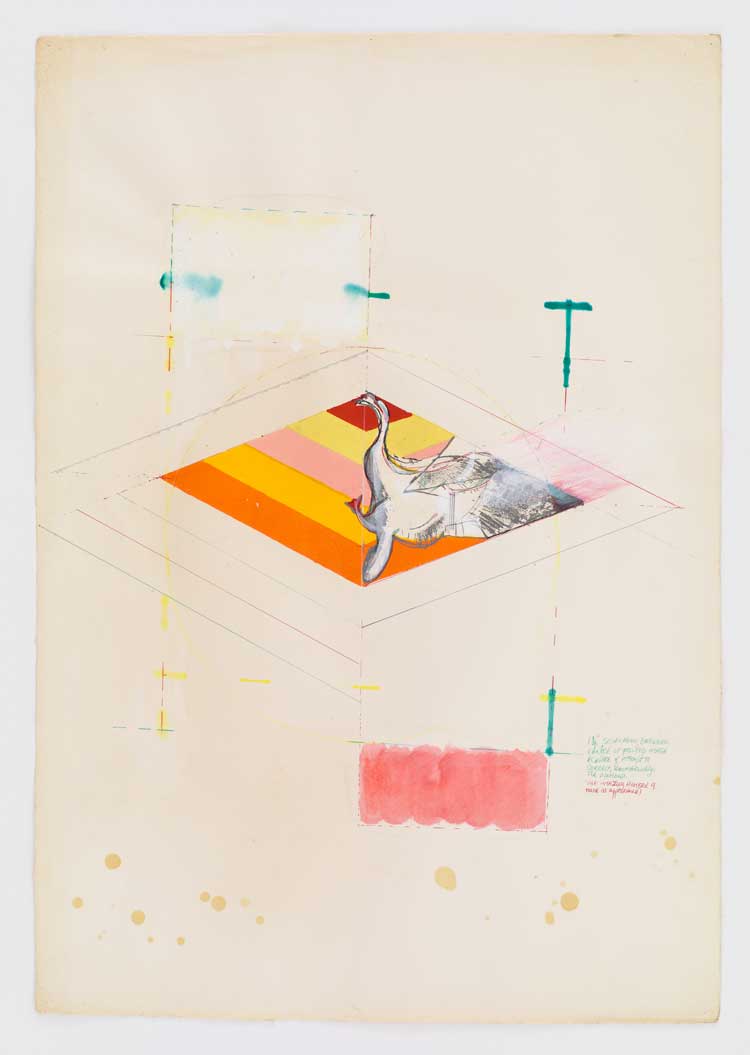
Frank Bowling, Swan Geometric Observation 1, 1965, Oil medium, pen, and pastel on paper, 57.1 x 40 cm. Courtesy the artist. Photo: Anna Arca. © Frank Bowling. All rights reserved, DACS 2025.
Swan: Geometric Observation 1 (1965) also shows a white swan against a coloured background. This time, Bowling uses the shape of a rhombus, or diamond, as a background element, echoing the shape of the swan. Bands of red, yellow, pink and orange fill the diamond, giving it the illusion of being in 3D. The work is part of a series of prints Bowling made on the subject of swans that include annotations revealing his thought process and observations while making them. Here, towards the bottom right of the print, Bowling notes: “1¼" separation between centre of printed image & centre of attempt to correct, geometrically, the diamond. The amazing number 9 made its appearance!”
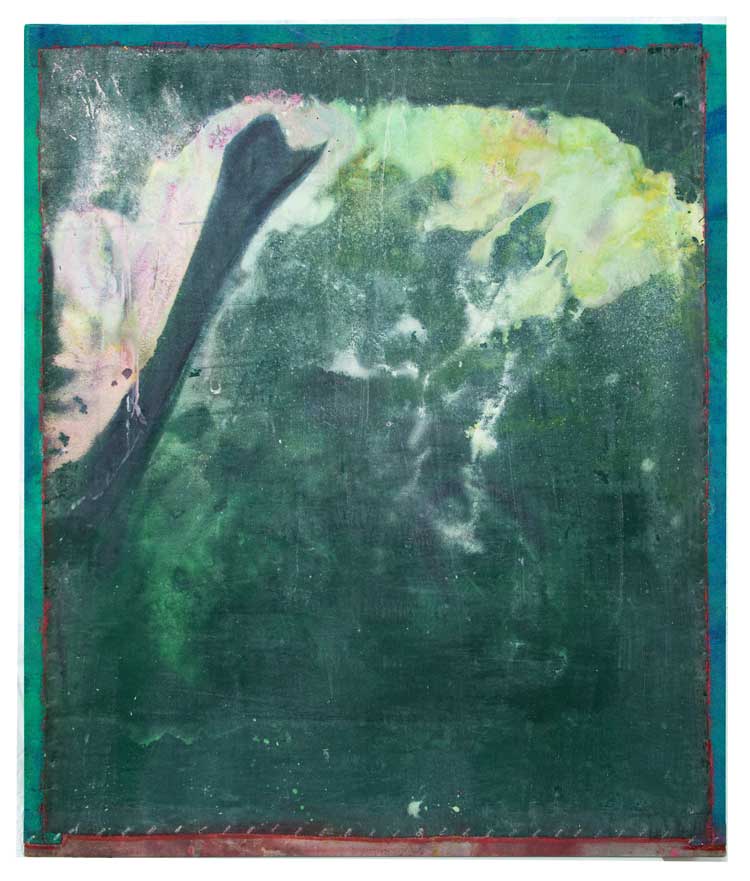
Frank Bowling, Swan Upping, 2020. Acrylic on canvas, 114.3 x 96.5 cm. Courtesy the artist. Photo: Sacha Bowling. © Frank Bowling. All rights reserved, DACS 2025.
In Swan Upping (2020), Bowling abstracts the figure of the swan even further. Shown for the first time, this painting renders the head and neck of the swan in dark green, which seeps and bleeds over the canvas, creating a mottled and watery texture. Areas of lighter green, yellow and pink give contrast and add to the experimental quality of the paint application.
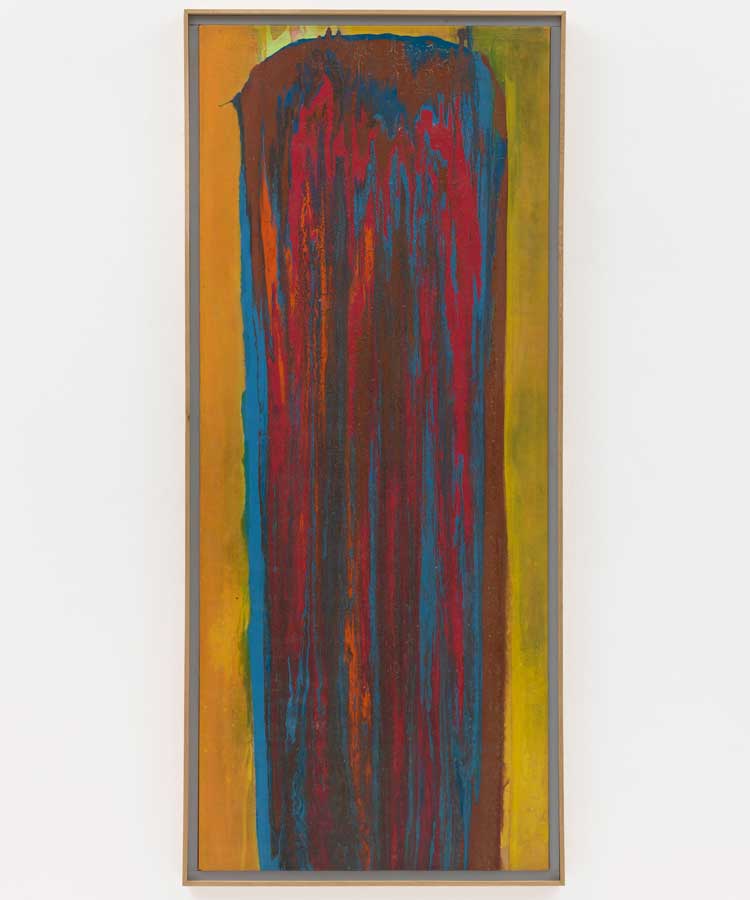
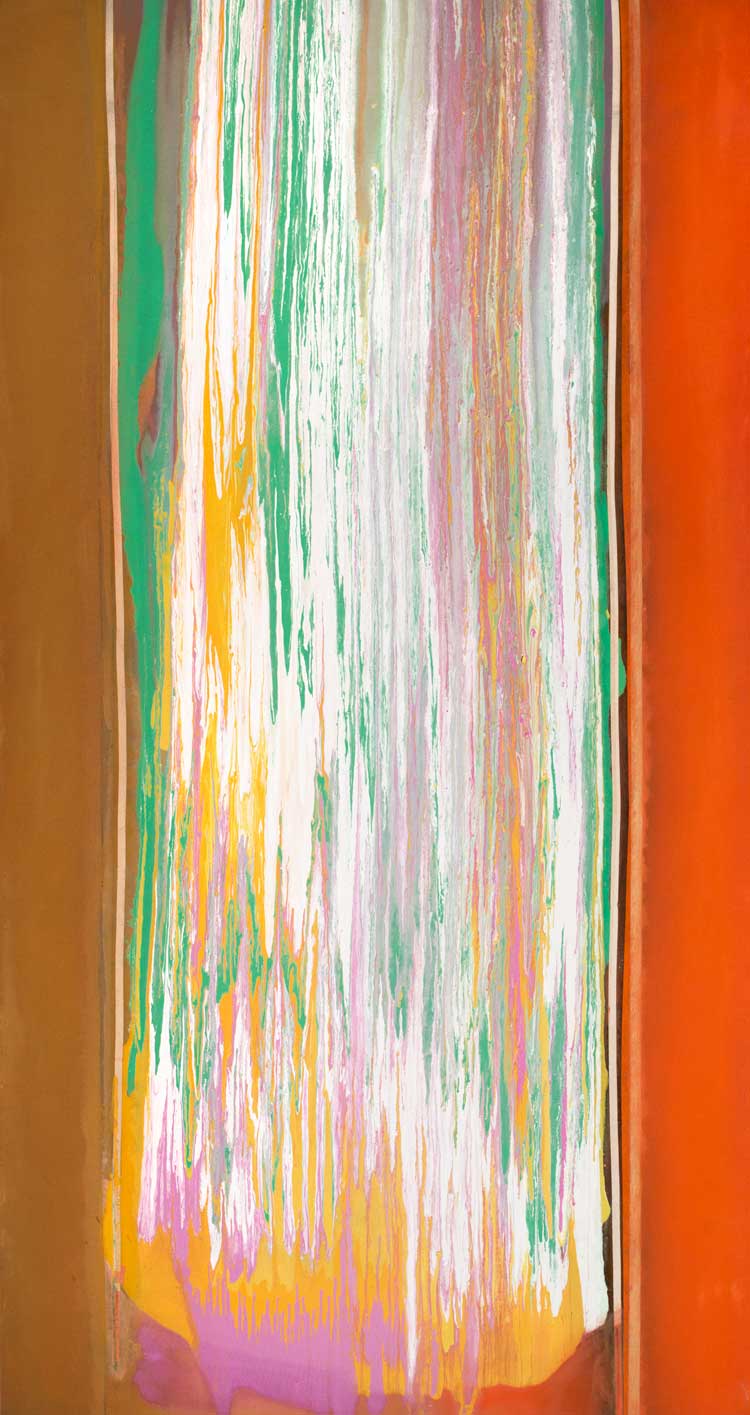
Frank Bowling, Sentinel, 1976. Acrylic on canvas, 173.2 x 71.2 cm. Courtesy the artist. Photo: Anna Arca. © Frank Bowling. All rights reserved, DACS 2025.
Bowling’s expansive approach to painting and his exploration of the many possibilities of paint through interventions and experiments can also be seen in earlier works. Influenced by his time in New York and the abstract expressionist painters of the 50s, Bowling started to make drip paintings – pouring paint on to a canvas, letting it sit for a while, then pouring more paint on top before the underlayer had dried. He calls this technique “wet into wet”. The exhibition includes two examples of Bowling’s drip painting – Lenoraseas (1976) and Sentinel (1976). In each, strong colours run down the canvas in an evocation of flowing water, marbling on the surface of the canvas to create beautiful textures and patterns.
,-2007,-Courtesy-the-artist-and-Hauser-and-Wirth.jpg "Frank Bowling, Pondlife (After Millais), 2007. Acrylic, acrylic gel and found objects on canvas with marouflage, 239.5 x 135.8 x 4.5 cm. Courtesy the artist and Hauser and Wirth. Photo: Damian Griffiths. © Frank Bowling. All rights reserved, DACS 2025.")
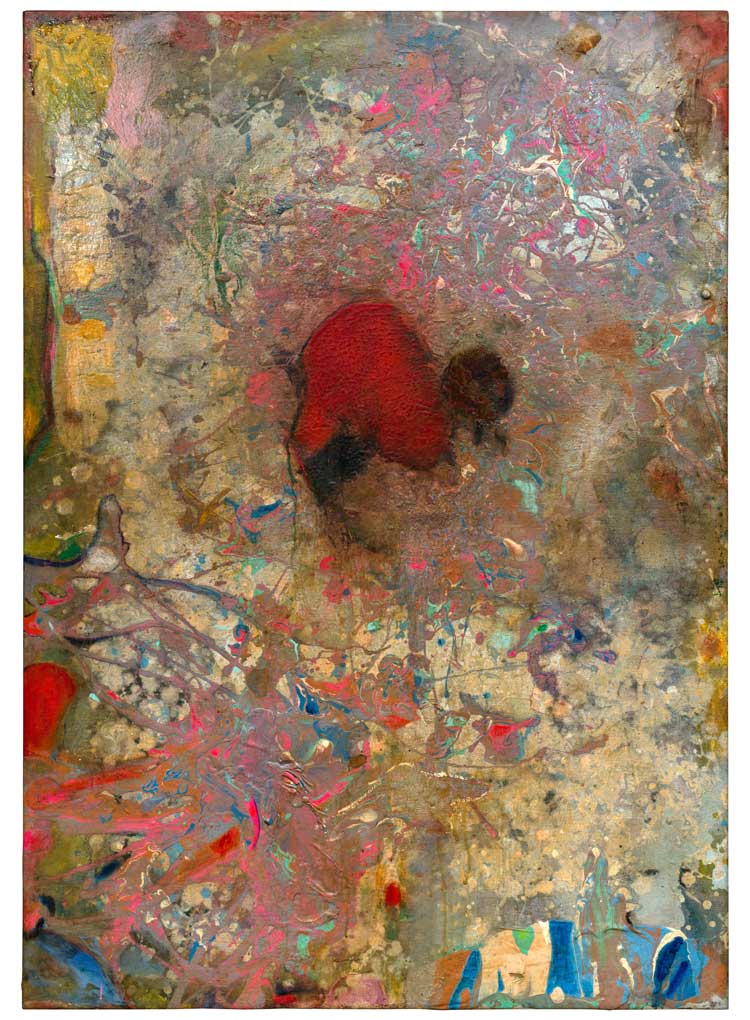
Frank Bowling, Pondlife (After Millais), 2007. Acrylic, acrylic gel and found objects on canvas with marouflage, 239.5 x 135.8 x 4.5 cm. Courtesy the artist and Hauser and Wirth. Photo: Damian Griffiths. © Frank Bowling. All rights reserved, DACS 2025.
Bowling further explores the quality and texture of paint in Pondlife (After Millais) (2007), a response to Millais’ painting Ophelia (1851-52), which depicted Shakespeare’s tragic heroine floating in a river surrounded by flowers. In Bowling’s abstract version, he uses found objects and a top layer of thinly applied, watery paint to create a murky and atmospheric waterscape. In the top right, thickly applied yellow paint drips down the length of the canvas, seemingly offering a sense of hope through the darkness.
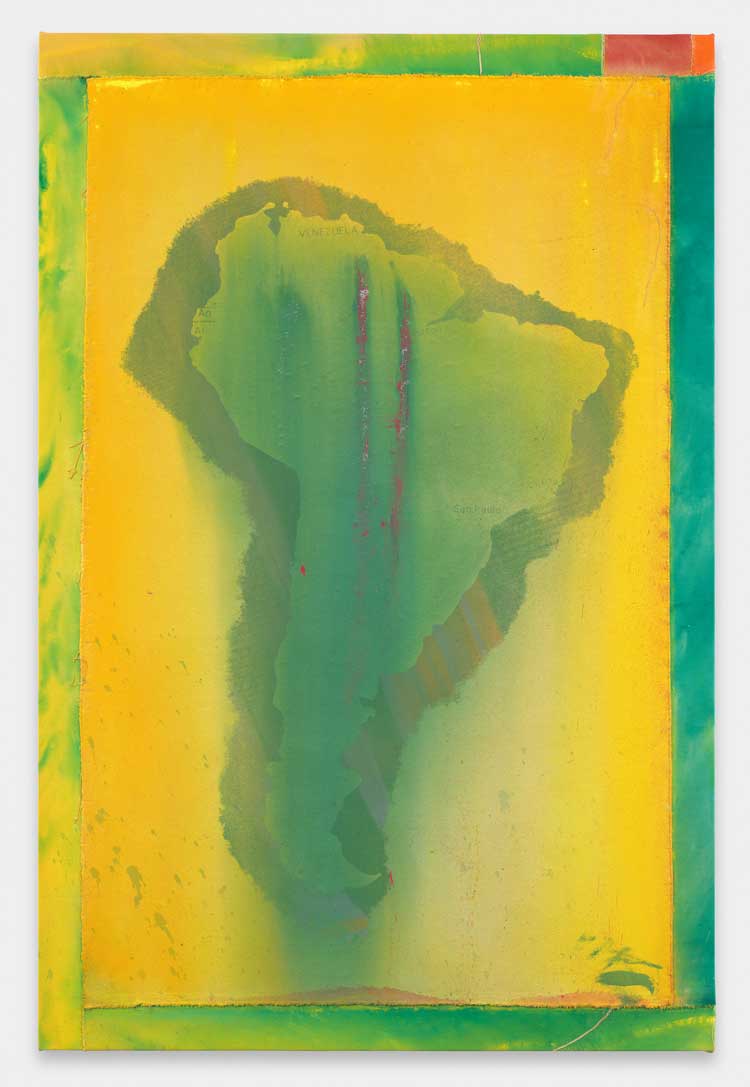
Frank Bowling, Yellow Map, 2025. Acrylic on canvas with marouflage, 161.5 x 107.3 x 4.5 cm. Courtesy the artist. Photo: Anna Arca. © Frank Bowling. All rights reserved, DACS 2025.
The last painting in the show is Yellow Map (2025), a stencilled outline of South America – which includes the country of his birth – in green against a bright yellow background. Bowling started making his map paintings while living in New York in the 60s. Often monumental in scale, this smaller iteration still holds great visual impact. Bowling has always rejected the necessity to make political art or, what some might term “Black art” – something he felt the pressure of in his early career. Instead, he was always more interested in the exploration of his medium, working almost daily in his studio. His map paintings are clear examples of this. Although Yellow Map has autobiographical elements, it also highlights Bowling’s interest in form, shape and colour, in the properties of paint and the new way it can be applied – in this painting, the quality of yellow was achieved by spraying water on to the canvas and letting the paint run and dilute.
Click on the pictures below to enlarge
,-2011,-Acrylic,-acrylic-gel-on-collaged-canvas-with-marouflage-Courtesy-the-artist-Front.jpg)

Copyright © 1893–2026 Studio International Foundation.
The title Studio International is the property of the Studio International Foundation and, together with the content, are bound by copyright. All rights reserved.
 |
 |
 |
|---|

-1000-300.jpg)
 Frank Bowling and Sculpture
 Life Between Islands: Caribbean-British Art 1950s – Now
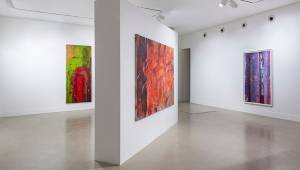 Modal Painting
 Royal Academy of Arts Summer Exhibition 2020
 The Artist in Time: A Generation of Great British Creatives – book review