




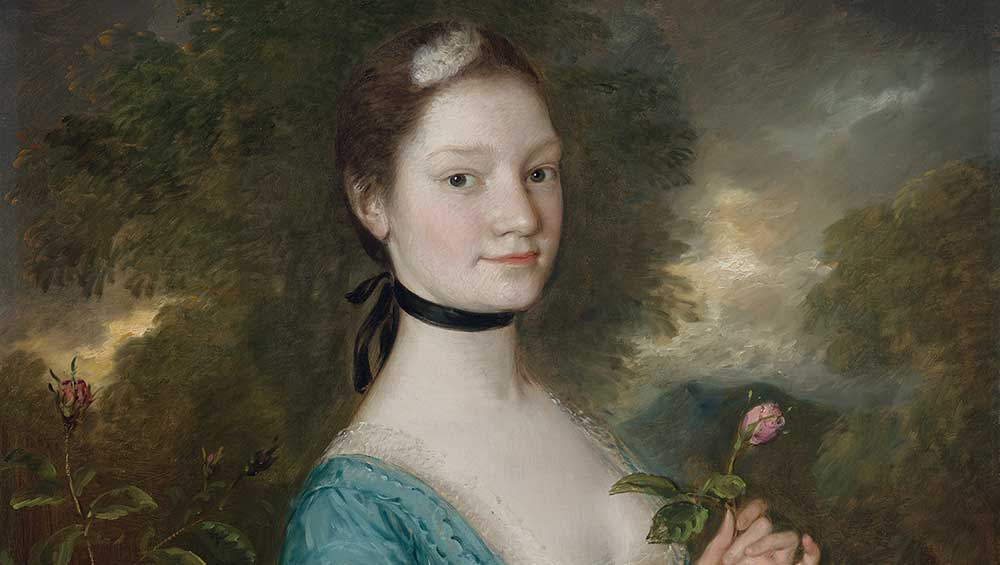
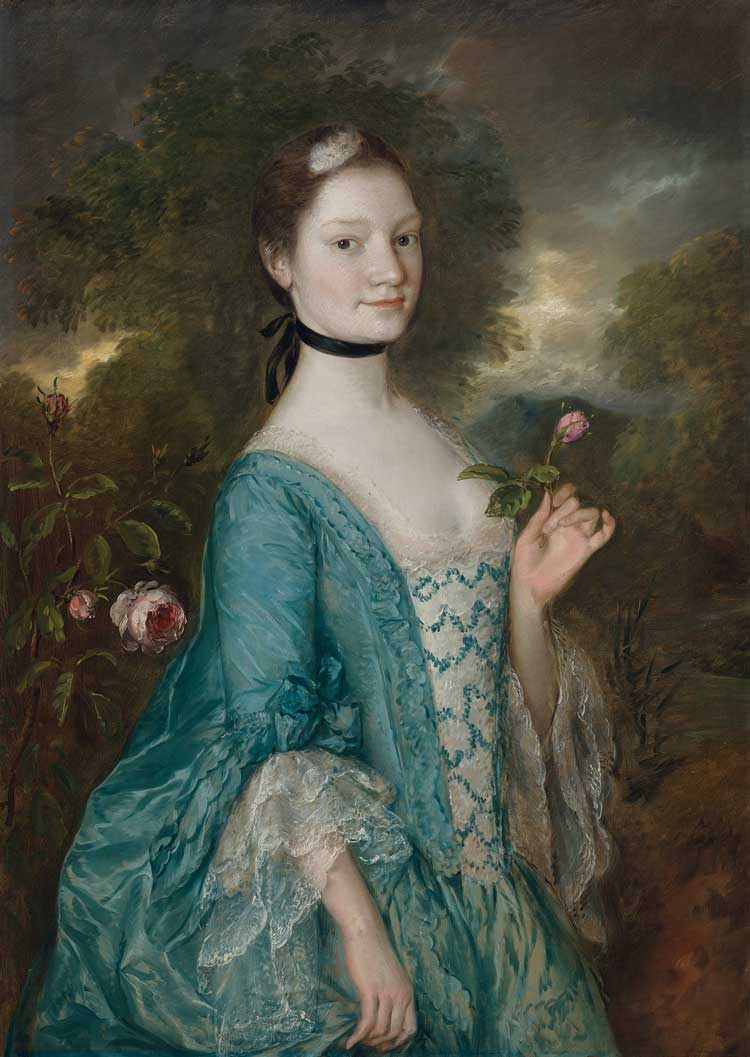
Thomas Gainsborough. Sarah Hodges, Later Lady Innes, c1759 (detail). Oil on canvas, 40 × 28 5/8 in (101.6 × 72.7 cm). The Frick Collection, New York. Photo: Michael Bodycomb.
The Frick Collection, New York
12 February – 25 May 2026
by LILLY WEI
While I haven’t been thinking much (if at all) about Thomas Gainsborough (nor have you, I suspect), Aimee Ng, the Frick Collection’s chief curator, has. The results? Gainsborough: The Fashion of Portraiture. It’s the first New York exhibition dedicated to the English artist’s superb, supple, subtly confected portraits, and it is delightful. It is especially welcome as an antidote to the daily barrage of increasingly alarming, near-apocalyptic news, part of the current escapist tilt toward period offerings that are reassuring, providing a glimpse of an (at least imagined) less tumultuous world.
Gainsborough, too, offers reassurance – although, possibly, with a sly dash of resistance to entrenched social hierarchies. For the most part, though, his glamorised vision of mid-18th century England is devoid of the intrusive realities lurking outside the charmed circle of the affluent elites he served, the revolt of the American colonies yet to occur, the inhumanity of the slave trade that underpinned the fortune of many of his sitters swept under their expensive carpets, and the rumblings of what would erupt as the French Revolution barely audible – reckonings that were still decades in the future. The lushly green and pleasant land that characteristically appears in his paintings reminds us that Gainsborough preferred landscape to portraiture (famously stating he was “sick of portraits”.)
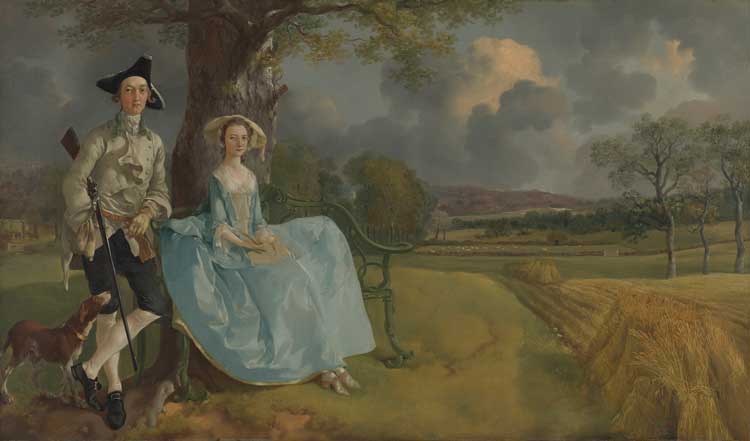
Thomas Gainsborough. Mr and Mrs Andrews, c1750. Oil on canvas, 27 1/2 × 47 in (69.8 × 119.4 cm). © The National Gallery, London.
Pastorals did not make demands and recalled the pleasurably verdant surroundings of his childhood. One of his best-known early works is here: Mr and Mrs Andrews (c1750), a serene portrait of the couple and their extensive holdings that was then considered radical for its emphasis on the landscape as well as the accuracy of its depiction. Gainsborough was instrumental in establishing landscape as an essential English genre, his vision beguilingly natural, mood-setting, the romantic English garden in contrast to the symmetrical formality of French landscapes.
He was an ardent player of the viola da gamba, which he also preferred to painting portraits, he claimed. Be that as it may, it was the portraits that made him not only famous in his lifetime, but also beloved, and earned him his place in art history. They also paid his bills and, although he did well, he never made a fortune despite his prominence; it seems that he was not always politic, not the consummate courtier.
Gainsborough would, at times, update previously commissioned paintings as circumstances and fashion cycled, the ornate replaced by a studied simplicity and back again, adding a uniform or insignias as requested, adapting a hairstyle – powdered wigs in, then out, loading up or eliminating jewels, and so on. A promised gift to the Frick, Frances, Mrs Alexander Champion, is a case in point; the first version was painted in around 1767, and then reworked in 1775, raising her hair into a powdered pouf and removing the ornate choker she wore, her dress, a soufflé of quicksilver, impressionistic strokes, also simplified to reflect the style of the day. This might not have been astute in terms of business, but his (astute) accommodation no doubt earned him good will.
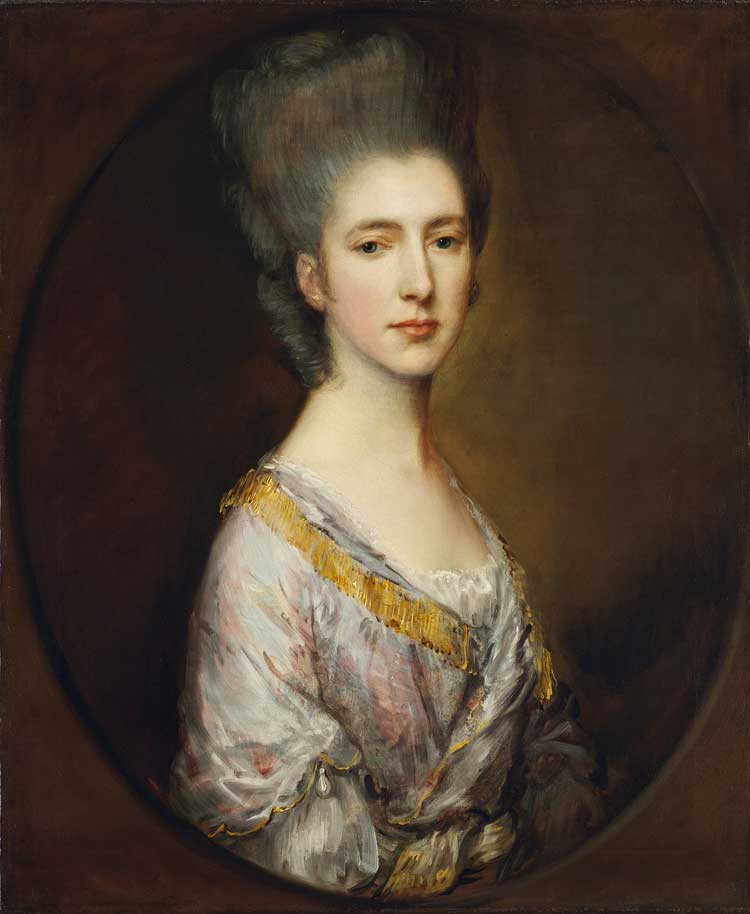
Thomas Gainsborough. Mrs Alexander Champion, 1767 and c1775. Oil on canvas, 29 1/2 × 24 3/4 in (74.9 × 62.9 cm). Promised gift to The Frick Collection. Photo: Joseph Coscia Jr.
Gainsborough was born in 1727 in Sudbury, Suffolk and moved to Ipswich for a time, where he lived for about eight years. He relocated to Bath in 1759 to cultivate a more aristocratic, more prominent clientele and was successful enough to try his luck in London in 1774 where he remained until his death in 1788.
He became one of the most sought-after portraitists of his day, rivalled only by Sir Joshua Reynolds, both founding members of the Royal Academy of Arts. Gainsborough was a favourite of King George III, painting the royal family on multiple occasions. His work also found favour with Henry Clay Frick, who acquired eight works by the artist. Looking at the approximately two dozen paintings in the exhibition, it is easy to see why. If you like painting at all, they are irresistible.
Fashion plays a major role in this show, the emphasis, however, not only on styles –imported from France which has always claimed sovereignty, then and now, in matters of haute couture – but also on the semiotics of dress to signify rank, riches and in his male sitters, their profession. Always fascinating as a reflection of the times and how we interpret it, it is another variation on how clothing defines us – the turn of a sleeve, the sweep of a train, the width of a pannier, all major events. It also dwells on the function of portraits themselves, another fascinating topic.
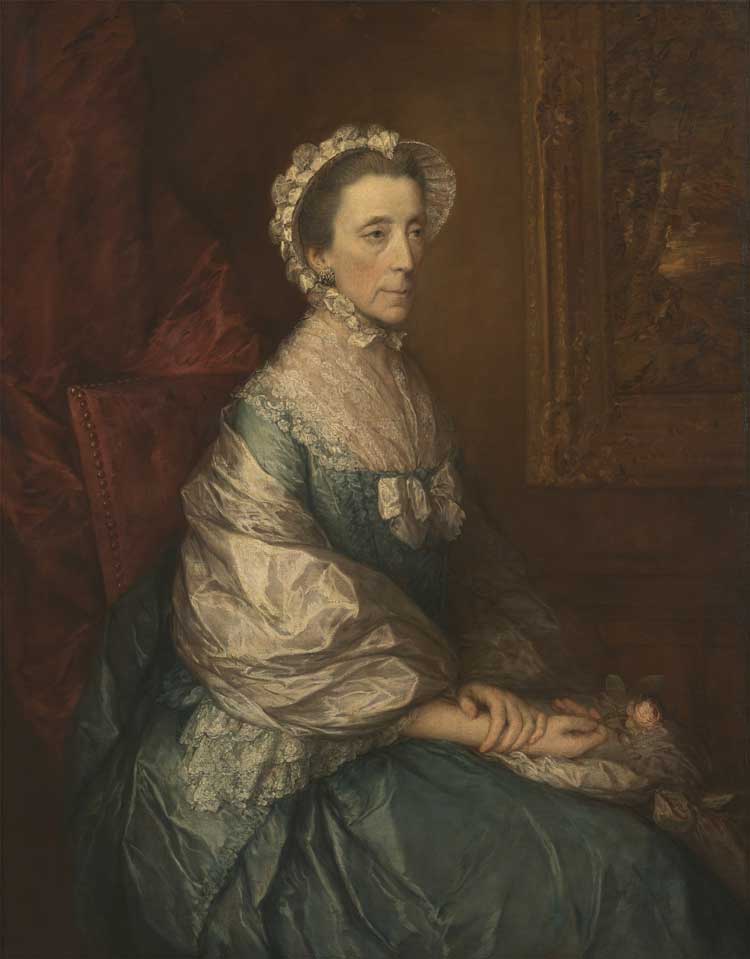
Thomas Gainsborough. Mary, Duchess of Montagu, c1768. Oil on canvas, 49 1/4 × 39 1/2 in (125.1 × 100.3 cm). Duke of Buccleuch, Bowhill House, Scottish Borders. Photo courtesy The Buccleuch Living Heritage Trust.
Gainsborough, taking cues from Anthony van Dyck, an admired portraitist from a century earlier, draped his own sitters – the (mostly) primped, powdered, and furbelowed 1% – in brushwork so dazzling that it could not help but flatter them. He deftly captured the gossamer lightness of fabrics as well as their richness, of sparkling gems and strands of glowing pearls, of the glint of gold in chains, weapons and medals, the tips of silk and satin slippers flirtatiously, seductively peeking out from beneath the women’s gowns. His eye, ultimately, is sympathetic, generous, investing his subjects not only with elegance but with personality, psychological nuance. (I think of Goya, who was far more candid in outlook, although the peerless beauty of his brushwork, as in his portraits of the unprepossessing Charles IV and his family, is so bewitching that we hardly notice. Evidently his royal patron also did not notice or did not mind.)
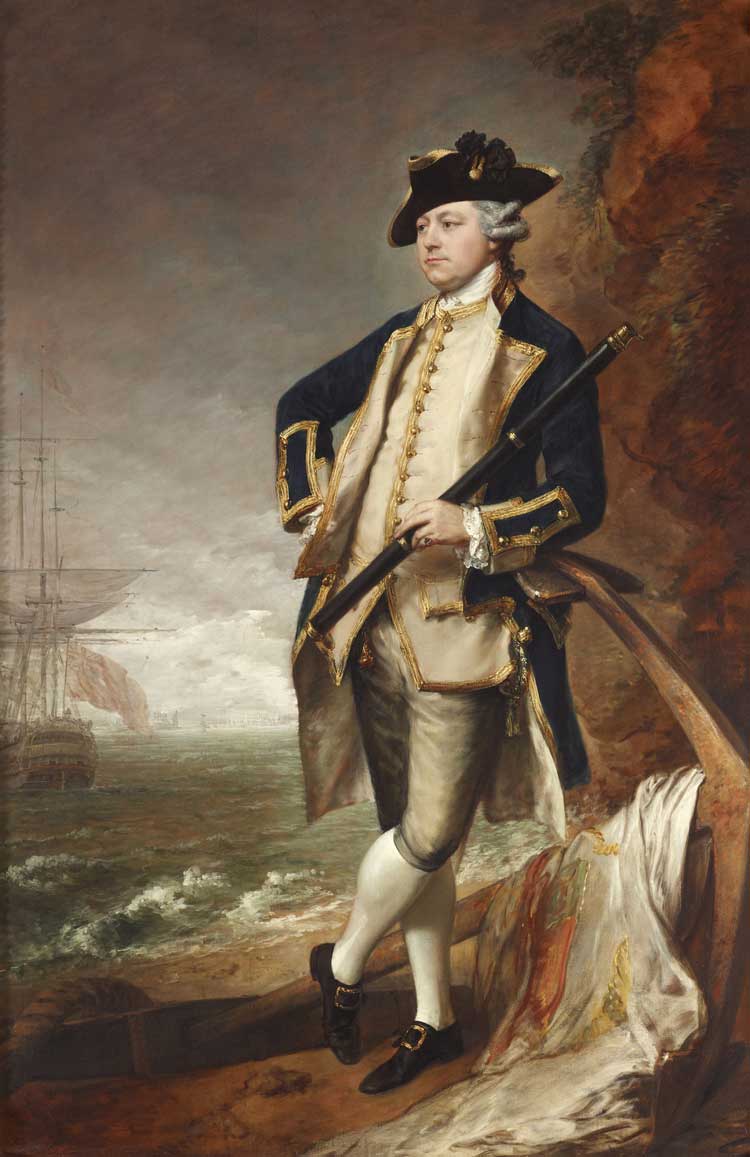
Thomas Gainsborough. Captain Augustus John Hervey, Later 3rd Earl of Bristol, c1768. Oil on canvas, 91 5/16 × 60 1/16 in (232 × 152.5 cm). Ickworth House, Suffolk © National Trust Images.
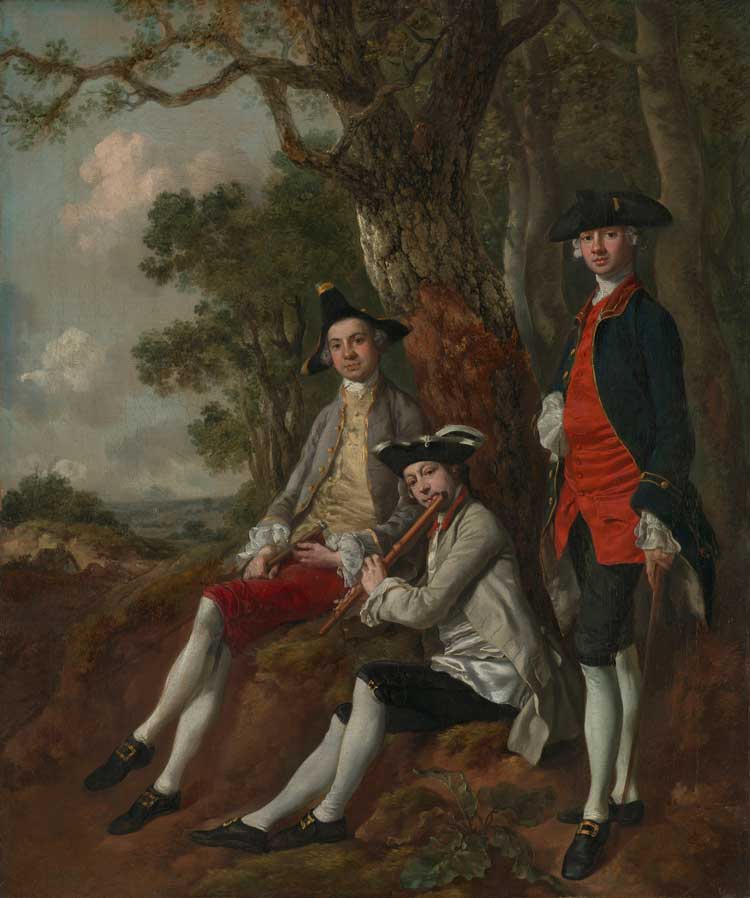
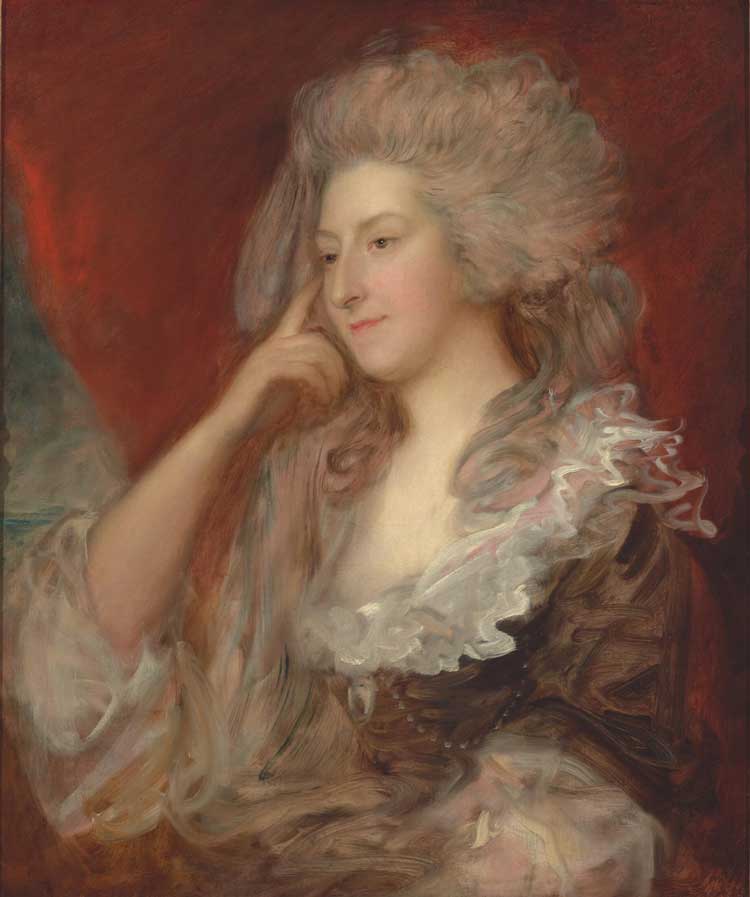
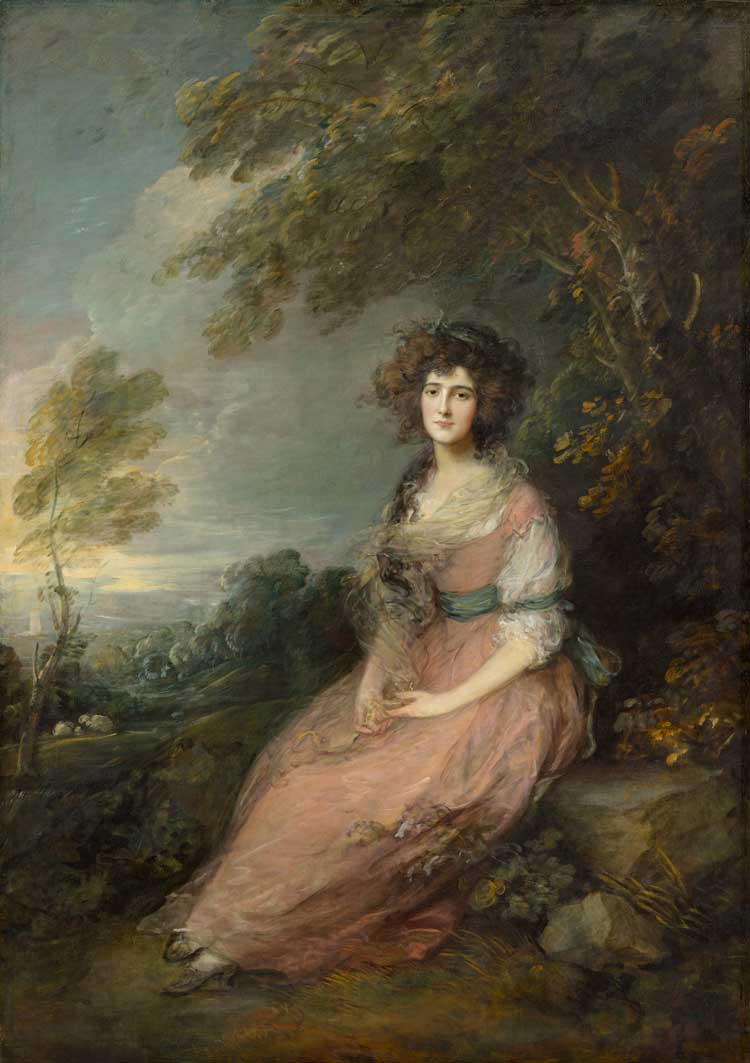
In his range of portraits – heads, busts, full-length – Gainsborough was unusually egalitarian, painting not only the cream of society, such as Mary, Duchess of Montagu (c1768) or Captain Augustus John Hervey, later 3rd Earl of Bristol (c1768), but also those of less exalted standing, such as the celebrated actress Mrs Sheridan (Elizabeth Linley of the eminent musical family) as well as the scandalous, such as the demi-mondaine Grace Dalrymple Elliott (there are two likenesses of her in the show, one full-length and exquisite, the gleaming yellow-gold gown she is garbed in far more alluring than anything seen on Oscar night. There is also a portrait of Mrs Fitzherbert (c1784), the mistress and for a time, the morganatic wife of George IV, then the Prince of Wales, a closeup, intimate, en déshabillé, gazing pensively into the distance. Musicians and artists also figure in his repertoire, such as his friend, Samuel Linley or an early conversation piece that curiously portrays a musician seated between two wealthy gentlemen. Another portrait of special note is of Ignatius Sancho, the only Black subject he ever painted. Gainsborough presents him as a gentleman in pose and apparel, his hand tucked into his scarlet, gold-trimmed waistcoat. He may have given the painting to Sancho, a talented musician, in exchange for lessons, Ng said.
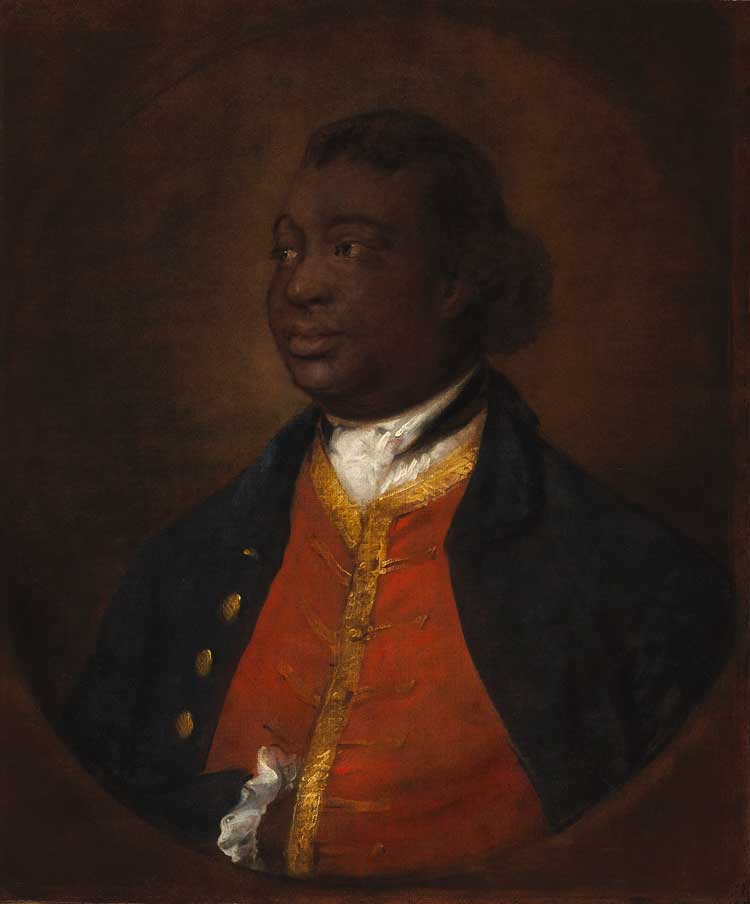
Thomas Gainsborough, Ignatius Sancho, 1768. Oil on canvas, 29 × 24 1/2 in (73.7 × 62.2 cm). National Gallery of Canada, Ottawa.
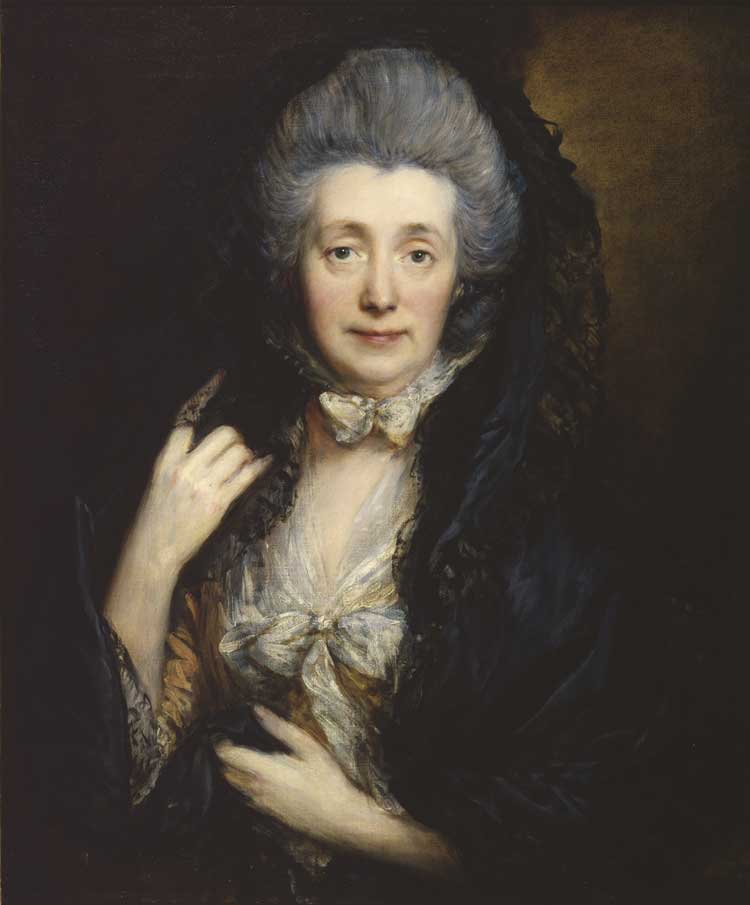
Thomas Gainsborough. Margaret Gainsborough, c1778. Oil on canvas, 30 3/16 × 25 1/8 in (76.6 × 73.8 cm). The Courtauld, London © The Courtauld / Bridgeman Images.
Family is a constant in his work. Included is a remarkable portrait of his wife, Margaret, the daughter of a duke, but illegitimate. Sensitively rendered, she regards us with an independence of spirit and scepticism that is extraordinarily contemporary. She is dressed in lace and a sumptuous black cloak. When criticised for the fineness of her robes as inappropriate to her station, Margaret was reported to have responded – tartly, dismissively, I imagine – that her blood was the blood of princes (although not quite the killing riposte it might have once been.) In Gainsborough’s many self-portraits, as with the one here, he similarly portrays himself as a gentleman, an artist, not as an artisan, his perspective on his and his family’s social status inevitably complex. While Gainsborough was a man of his times, he seemed chafed by the inequities of the status quo, by the darker story, challenging them obliquely, quixotically. At the same time, he created the standard for the representation of its splendours.
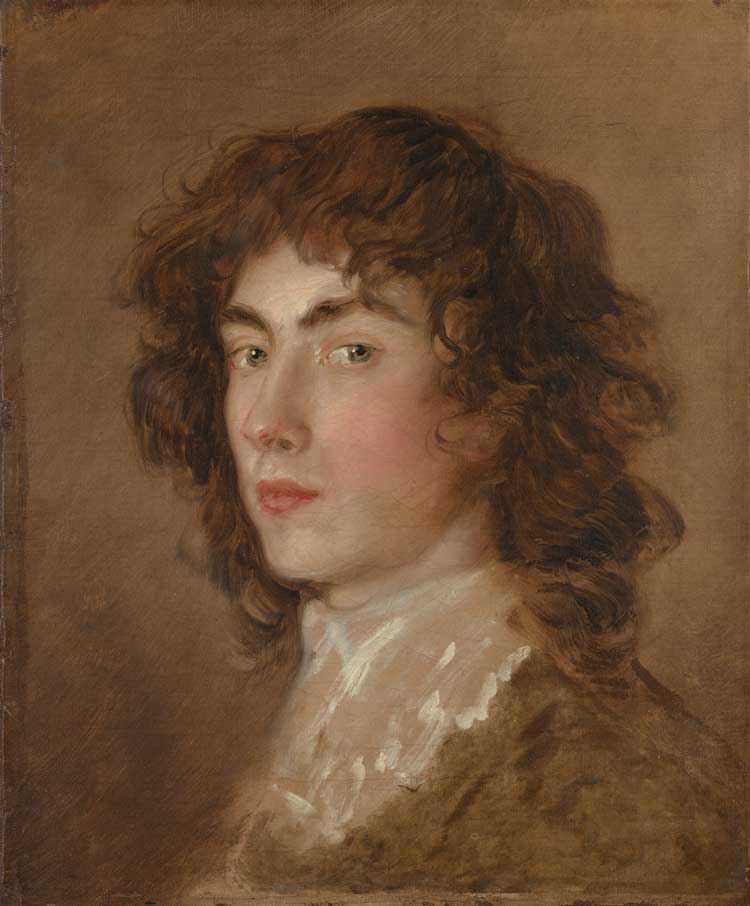
Thomas Gainsborough. Gainsborough Dupont, c1770–72. Oil on canvas, 17 15/16 × 14 3/4 in (45.5 × 37.5 cm). Tate, London.
There is also the handsome portrait of his nephew, Gainsborough Dupont, his studio assistant, frequent model and artist, that is dated c1770-72. The painting, that of his head, and nearly monochromatic, is pared down in size, the brushwork rapid, sketchy, the hair a tousled mop, the filigree of his lace collar conjured by a few expertly squiggled strokes of white, the tone warmed-earth. Based on Van Dyck, it might also serve as a precursor to the more soulful portraits of the Romantic era and was perhaps the painting that was placed by the artist’s bedside as he lay dying, as he requested.
Click on the pictures below to enlarge

Copyright © 1893–2026 Studio International Foundation.
The title Studio International is the property of the Studio International Foundation and, together with the content, are bound by copyright. All rights reserved.
 |
 |
 |
|---|
-1000-300.jpg)
 Charles I: King and Collector
 Painters’ Paintings: from Freud to Van Dyck
![Moses Harris. The Natural System of Colours Wherein is displayed the regular and beautiful Order and Arrangement, Arising from the Three Premitives [sic], Red, Blue and Yellow, The manner in which each colour is formed, and its Composition, 1769/1776. Royal Academy of Arts, London.](/images/articles/m/making-colour-2014/smallpix/X8384-300.jpg) Making Colour
Making Colour Alex Katz: 70s/80s/90s
 A Dialogue with Nature: Romantic Landscapes from Britain and Germany