




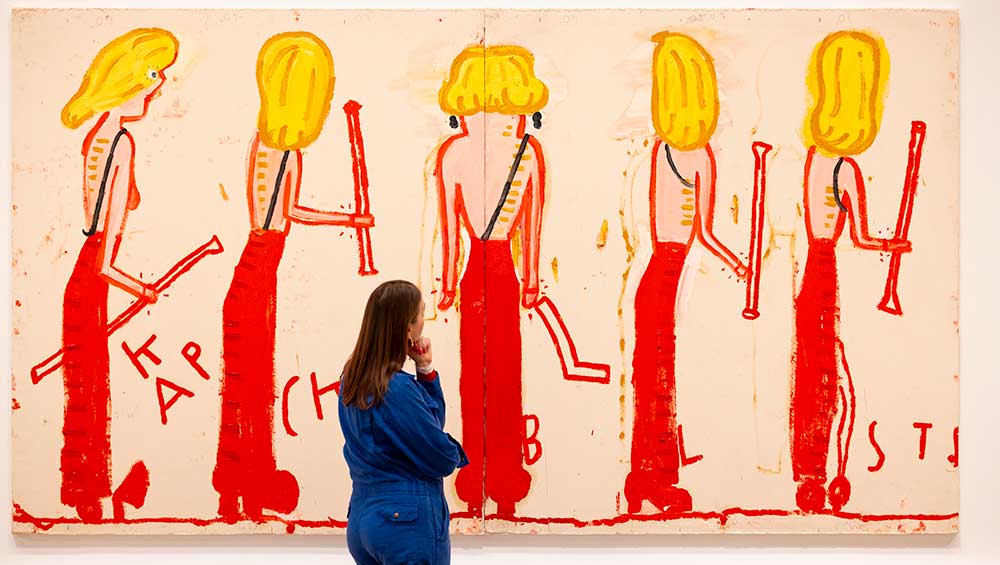
Rose Wylie, NK (Syracuse Line-up), 2014. Courtesy private collection, Choi&Choi Gallery and Jarilager Gallery. Installation view, Rose Wylie: the Picture Comes First, Royal Academy of Arts, London, 28 February - 19 April 2026. Photo © Royal Academy of Arts, London / David Parry. © Rose Wylie.
Royal Academy of Arts, London
28 February – 19 April 2026
by TOM DENMAN
In the fairytale Rumpelstiltskin, an imp kidnaps a girl. Only if the mother can guess his name will he return her. A point of reference for the self-empowerment we feel when we name things – from diseases to animals to tastes in the mouth – the fable came to mind as I wandered through this grand showcase of Rose Wylie’s painting from about 1990 onwards. The atrium is said to explore the English nonagenarian’s memories of air raids during the second world war. A recurring word – appearing in the title of three paintings and on the canvas of one of these – is “doodlebug”, the British nickname for the German V-1 missile. This is the Rumpelstiltskin principle in action: give it a silly-sounding name and it becomes less threatening, an ethos Wylie’s cartoonish figures on raw, unstretched canvas seem to mirror. In three images, the flying bomb appears almost as a child might outline it: instead of foreshortening it, she puts the far wing on the vertical, as if making a cutout. Still, a hint of trauma – historical, if not personal – is inevitable, even if made light of, especially in Black Doodlebug (2022) with its swastika.
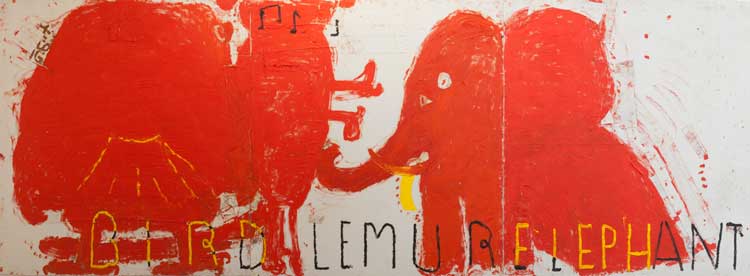
Rose Wylie, Bird, Lemur and Elephant, 2016. Oil on canvas, 183 × 499 cm (overall). Courtesy private collection and JariLager Gallery
Photo courtesy Jari Lager. Photo: Soon-Hak Kwon. © Rose Wylie.
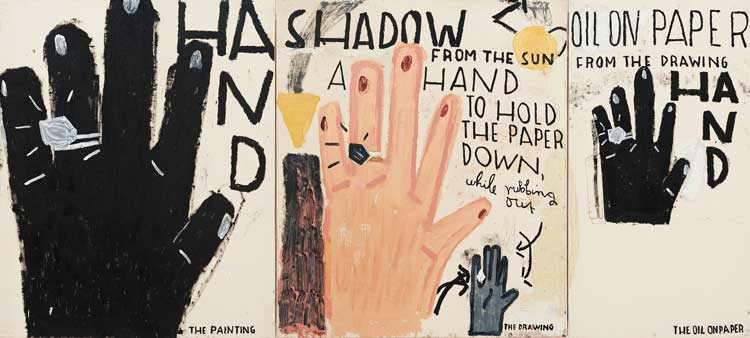
Whether such light-heartedness celebrates the (unfounded) feeling that historical distance affords safety from far-right extremism or offsets the reality of its resurgence is a debate Wylie invites, even if the show’s title signals adherence to the anti-interpretation school of response. In any case, most of Wylie’s paintings seem innocent enough. She depicts cats and birds and leaves, as well as more ambiguous subjects such as people in the media, art openings and consumer goods, always in a point-blank style that disguises her mastery – note how the propellers spin, how a plane flies over our heads, in Park Dogs & Air Raid (2017) – often graffitiing captions of varying clarity beside them. One room presents four massive paintings of animals (2015-16), messily blocked out in black, blood-orange, burgundy and sky blue, the names of each animal loosely written beneath them, a bird, a lemur, an elephant, a horse. That magic mix of mind and image whereby a motley arrangement of shapes, lines and colours becomes something, a bit like shadow puppets – “Wow, a lemur!”
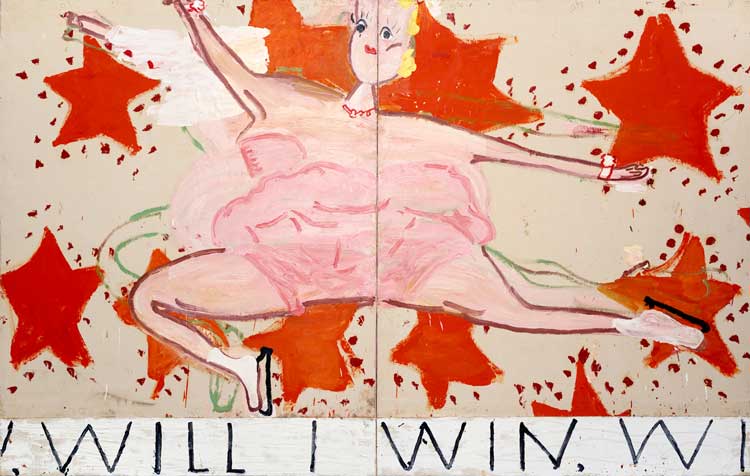
Rose Wylie, Pink Skater (Will I Win, Will I Win), 2015. Oil on canvas, 208 × 329 cm (overall). Courtesy private collection and JariLager Gallery
Photograph courtesy Jari Lager. Photo: Soon-Hak Kwon
© Rose Wylie
Wylie studied painting at Folkstone and Dover School of Art in the 1950s, then put it aside to raise a family, resumed her practice in the 1980s and rose to fame at the beginning of this century. Judging by the exhibitions she has had post-efflorescence, it is mainly the work from about 2000 that the public is allowed to see, with a smattering of canvases from the previous decade. This show is no exception to the rule: the earliest painting is The Well-Cooked Omelette of 1989. Though relatively realistic – with the egg bunching up against the inner curvature of the blue-and-white bowl, whose dragonfly motif Wylie has lovingly delineated –it may at first strike as an abstraction. It has much of the messiness of what would follow, as Wylie gets bolder and bolder in finding new ways of thoughtfully hiding her pictorial intelligence. The woman’s candyfloss dress in Pink Skater (Will I Win, Will I Win) (2015) may seem a failure in delineation – we can almost hear Wylie swearing as she accumulates mistakes. But there is a method to the madness: we get a sense of the dancer’s leap, her ambition – the prawn-like bulge under her armpits could be her breasts in motion, round and round. Hilariously, Wylie’s apparent (performed or otherwise) struggle to get it right resonates with the dancer’s desperate hankering for stardom.
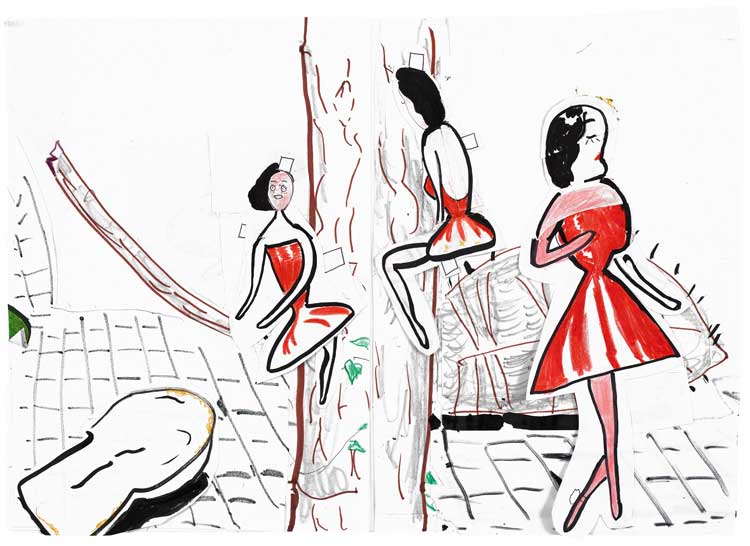
Rose Wylie, Study for Red Twink, 2002. Graphite and coloured pencil on paper, 31 × 42.5 cm (overall). Courtesy the artist and David Zwirner. © Rose Wylie. Photo: Jack Hems.
The show’s non-linear approach and restricted timeframe withhold biographical contextualisation when it doesn’t pertain directly to the work, possibly in order to present the artist as live and kicking rather than historicise her, and to keep us from losing sight of the works. In them, there is a richness and sophistication of surface that sustains the attention, taking us beyond the moment of recognition and creating tension between seeing and seeing in. In the candyfloss skater, I see a childish need – more than modernist “naivety”, a word the artist disdains – to be centre stage lingering into adulthood. Girl in Lights (2015) is also very funny: a naked woman, outlined in brown and filled bright pink, lies – or flies, given the faint sky-blue brushstrokes in the background – with her back to us, multicoloured fairy lights caught in her hair (drunken calamity or a dream?). Wylie has written the work’s title in capitals along the bottom: the matter-of-factness, of word and image, pushes back at any temptation to interpret, challenges us not to think about Velázquez’s Rokeby Venus (and derive a feminist interpretation from the association), which I find myself doing anyway because the challenge is also a dare.
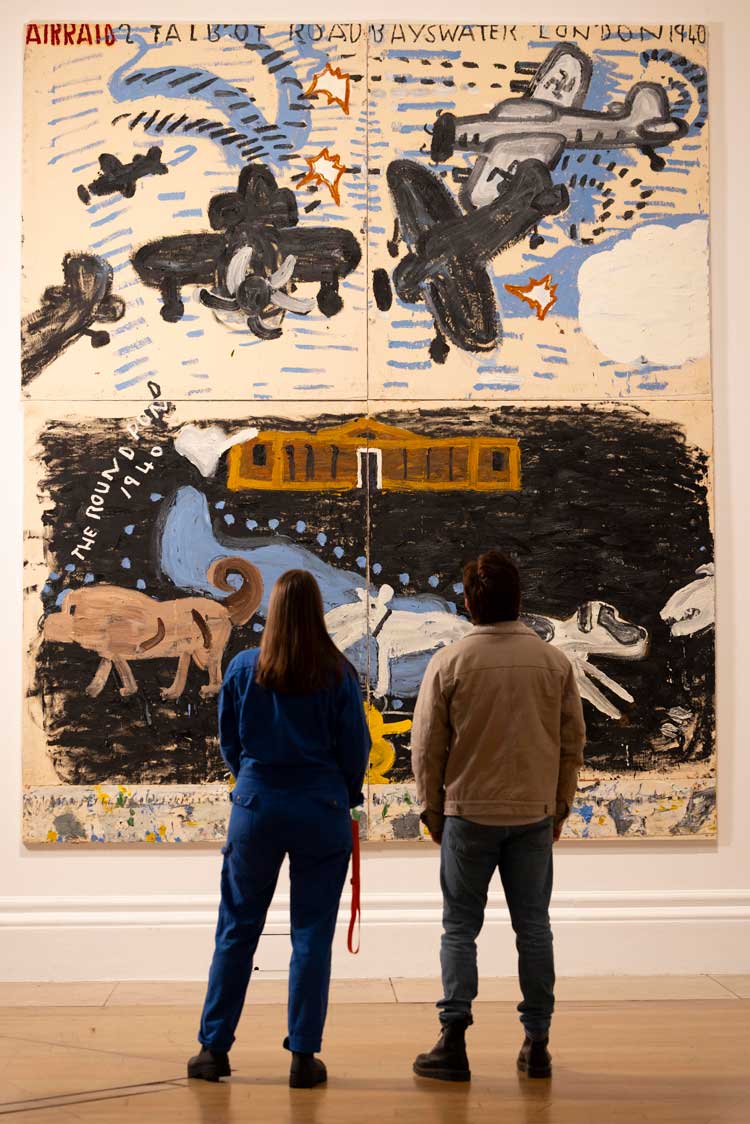
Rose Wylie, Park Dogs & Air Raid, 2017. Oil on canvas, 393 × 331 cm. Private collection. Installation view, Rose Wylie: the Picture Comes First, Royal Academy of Arts, London (28 February - 19 April 2026). Photo © Royal Academy of Arts, London / David Parry. © Rose Wylie.
It often takes the form of awkward juxtapositions, sometimes with wordplay thrown in: dogfighting airplanes and dogs in a park in Park Dogs & Air Raid (2017); in Ack Ack (2003), a bird’s head rendered as a brown furry circle with a reddish dot for the eye and a triangle on the circumference for a beak, with the letters “A.A.FLA” on one side and “CK” on the other and stellular blasts above. In this latter work, the letters could refer to “flak” – which in the second world war became a generic term for anti-aircraft fire, as did the words of the title which, phonically, also sounds like the noise some birds make. Sometimes memory makes associations, it doesn’t have to have meaning, and painting is an excellent medium for relishing this tendency. The perspective this celebrates is cushy and quaint – there are people for whom being bombed is neither a distant memory nor anything to laugh about, but still, it would be trite to criticise Wylie for being from Kent.
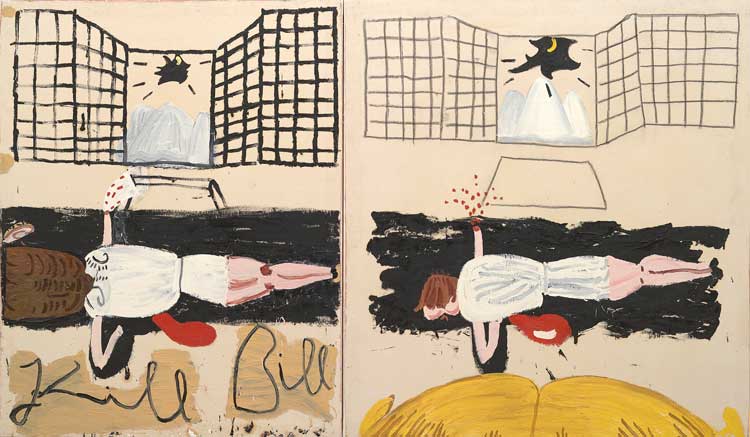
Rose Wylie, Kill Bill (Film Notes), 2007. Oil on canvas, 180 × 308 cm (overall). Courtesy private collection and JariLager Gallery. Photo courtesy Jari Lager. Photo: Soon-Hak Kwon. © Rose Wylie.
Wylie seems to be preoccupied with violence, or the image of it, and how to paint it without painting about it. The show dedicates a room to large paintings inspired by films, most of them ultraviolent such as Quentin Tarantino’s Inglourious Basterds and Kill Bill and Oliver Stone’s Natural Born Killers. It is perhaps no surprise that these films are like many of Wylie’s paintings in that they constitute a pastiche of violence, always with tongue in cheek. Wylie’s two-panel Kill Bill (Film Notes) (2007) presents, in one frame, a dead or dying body lying in the middle distance, blood spurting in red dots from their severed wrist, with the film’s title below – extra reassurance that this is meant to be a joke, especially for those who are familiar with the film – while the next frame repeats the scene except with the top of the protagonist’s blond head where the title was, first-person perspective playfully inviting us into the action. Much like the invention of a nickname for them, such humour arms us against our deep-seated fears (although it is a mark of privilege, of course, when they are deep-seated and not a part of lived reality). No wonder, then, that in these films Wylie finds a kindred spirit.
Click on the pictures below to enlarge

Copyright © 1893–2026 Studio International Foundation.
The title Studio International is the property of the Studio International Foundation and, together with the content, are bound by copyright. All rights reserved.
 |
 |
 |
|---|
-300.jpg)

-300.jpg)
 Sophie Barber: Mackerel sky, mackerel sky, never long wet, never long dry
 Luchita Hurtado: I Live I Die I Will Be Reborn
 Women Can’t Paint: Part 1
 Rose Wylie: Quack Quack
 Mirrors to Windows: The Artist as Woman