
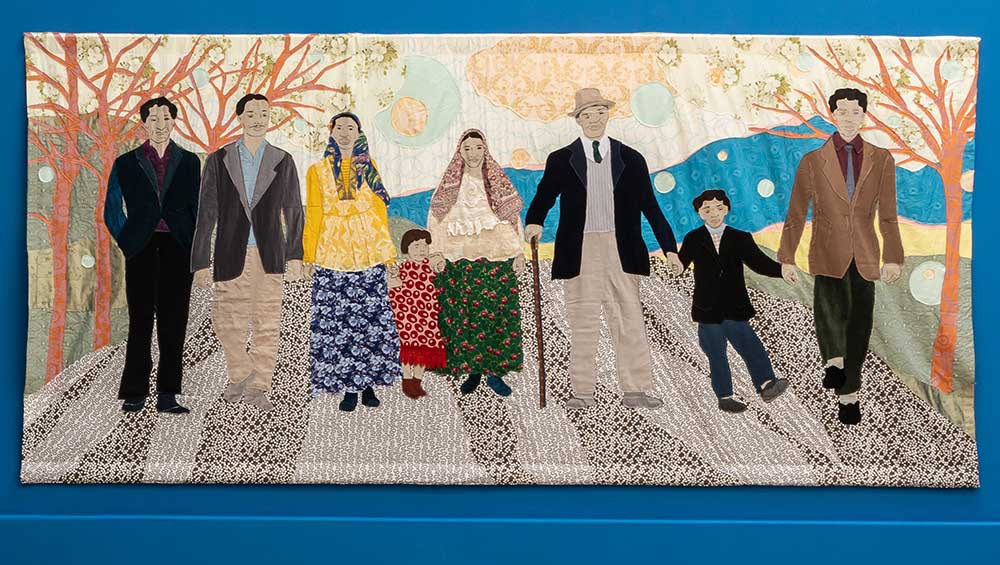
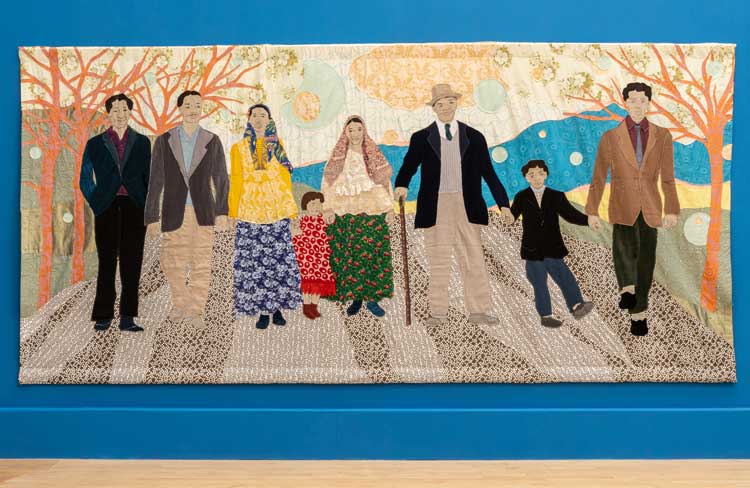
Małgorzata Mirga-Tas, Maria’s Romani Family, 2022. We won’t stay silent any longer. Part of The Dead Don’t Go Until We Do, 2026. Exhibition view, Talbot Rice Gallery, the University of Edinburgh. Photo: Sally Jubb
Talbot Rice Gallery, Edinburgh
7 March – 30 May 2026
by VERONICA SIMPSON
Over the past year, there have been many profound shifts in what felt like the old, post-1945 world order, and as these seismic shocks were really registering, a year ago, I found some comfort in reading Peter Frankopan’s historical epic The Silk Roads, charting the cyclical nature of wars, land grabs, colonisation and volatile transactional relationships across continents over 2,000 years of human history. None of this is new, it seems. And though that history has been there for all of us to see, should we have cared to look, it feels timely and welcome to discover the work of many artists and activists who are digging deep into the past, and highlighting older traditions and rituals of value and care for each other and our environments; a crucial counterpoint to the prevailing chaos.
Talbot Rice Gallery – never wary of tackling big topics or epic themes – has gathered four artists/collectives to commune with us and each other on the subject of memory and legacy; re-representing, memorialising and celebrating communities, places and practices that have been ignored, overlooked or annihilated, stretching from central Europe to Africa, Asia and back to Edinburgh.
The curator, James Clegg, had been planning on making four solo shows around these mostly well-established artists – all have been celebrated at the Venice Biennale or Documenta. However, the threads that weave between each of the artists’ works and sensibilities makes for a far richer and stronger collective exposition of Clegg’s underlying theme: how honouring and remembering our ancestors, those who came before us, can give us “the strength to celebrate our own lives and those around us”, as he says in his introduction to a generous, detailed exhibition booklet.
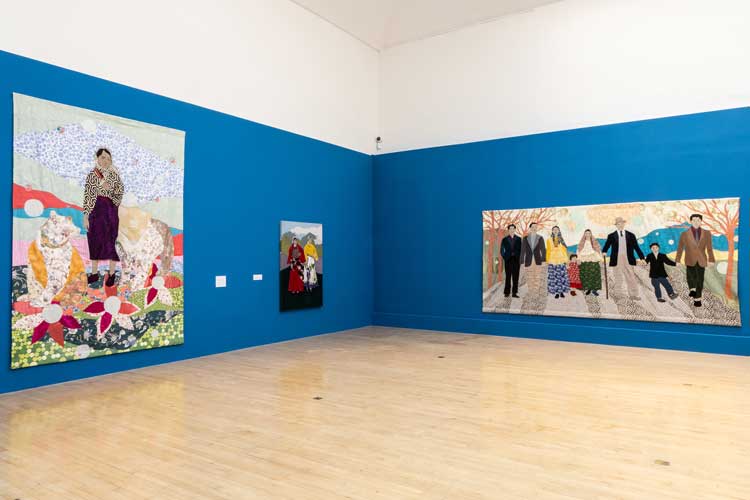
Małgorzata Mirga-Tas, We won’t stay silent any longer, 2026. Part of The Dead Don’t Go Until We Do, 2026. Exhibition view, Talbot Rice Gallery, the University of Edinburgh. Photo: Sally Jubb
You get a wonderful sense of scale as well as the full beam of daylight on Małgorzata Mirga-Tas’s resonant and richly patterned textile works, offset against deep-blue-painted walls, in the main, double-height, contemporary gallery. Mirga-Tas was one of the “discoveries” of the 59th Venice Biennale in 2022 – the first artist of Romani origin to be showcased in a national pavilion. She was born and educated in Poland and her textile pieces appeared inside and outside the Polish Pavilion in the Giardini. The interior hall was lined with 12 panels of large-format textiles, titled Re-Enchanting the World, inspired by the Hall of the Months frescoes in the Renaissance Palazzo Schifanoia in Italy. Mirga-Tas combined figures from her family, her community and history with landscapes of her Czarna Góra home, and astrological and cosmological symbols, stitching into being a new mythological setting for the frequently misunderstood and demonised Roma people, Europe’s largest ethnic minority.
The scale of the works in Edinburgh is smaller and more intimate. But the same technique prevails: of collaging the distinctive patterns and prints of clothes donated by Mirga-Tas’s family, friends and community, as well as curtains, bedding, carpets and rugs. An overwhelming atmosphere of domesticity, creativity, craft and care is expressed in every stitch.
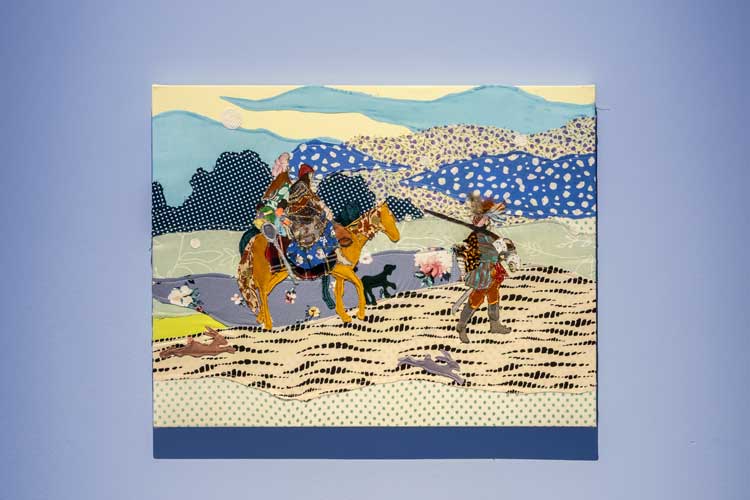
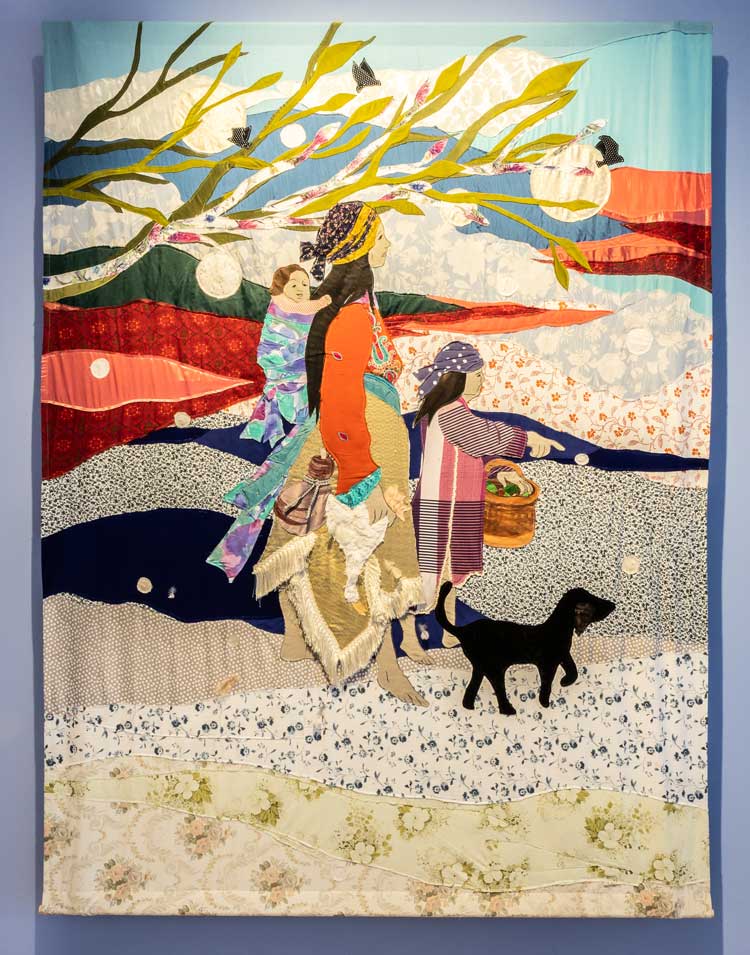
Małgorzata Mirga-Tas, We won’t stay silent any longer, 2026. Part of The Dead Don’t Go Until We Do, 2026. Exhibition view, Talbot Rice Gallery, the University of Edinburgh. Photo: Sally Jubb
Titled We Won’t Stay Silent Any Longer, her presentation offers portraits – singly and in groups – of members of her family and the wider Roma community. Often inspired by archive or family photographs, Mirga-Tas takes her original source material and enriches it with narratives that subvert the negative stereotypes disseminated around Roma people.
While never shying away from traumatic histories – such as the brutal incarceration and annihilation of Roma people under Nazi rule – her trademark colourful palette and the domestic intimacy of these collaged prints somehow infuse these portraits with joy; the painful backstories are shared in the captions. I often ask myself whether a work of art that needs a caption or publication to explain its political or humanitarian significance is a less successful work. But I can see that foregrounding the pain and trauma of her subjects within these portraits would risk perpetuating that misunderstanding and trauma, whereas Mirga-Tas is trying to free them. And she does, in a kind of textile transubstantiation.
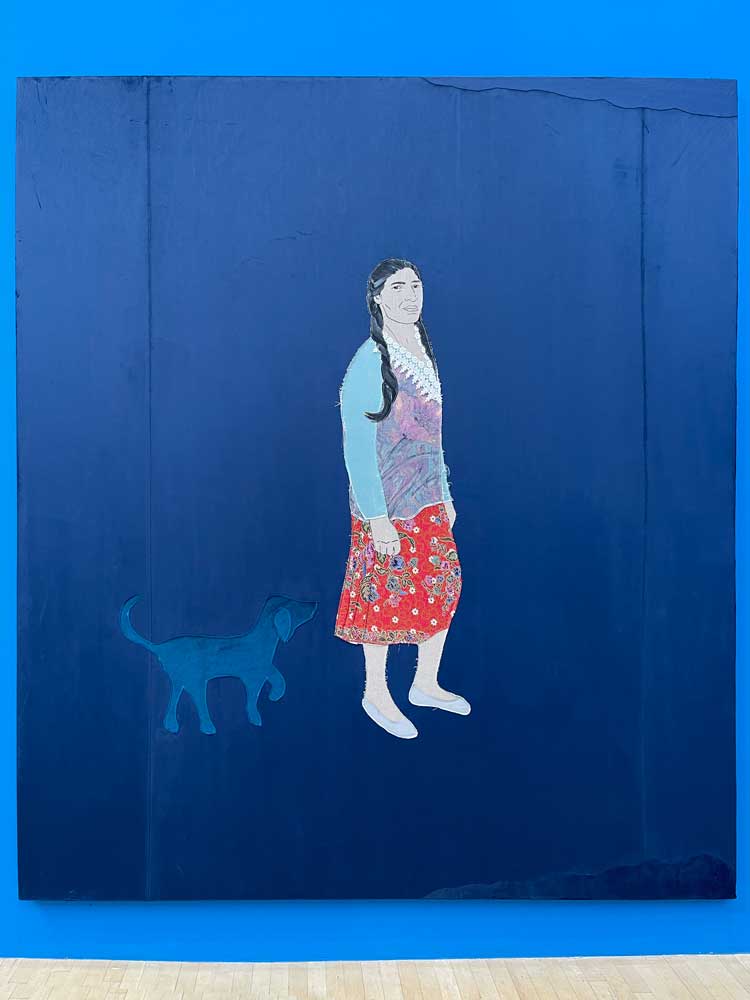
Małgorzata Mirga-Tas, Wanda Siwak, 2022. Part of The Dead Don’t Go Until We Do, 2026. Exhibition view, Talbot Rice Gallery, the University of Edinburgh. Photo: Veronica Simpson.
Take, for example, Wanda Siwak, whom we meet in an eponymous work from 2022, part of a series called Siukar Manusia (meaning “wonderful people”; this group populated the last room of her 2024-25 Tate St Ives solo show). Siwak survived her time in a concentration camp but spent the rest of her life looking for the daughter she had given to neighbours to hide and keep safe. On her death, the mission passed to her nephew, who eventually tracked down the daughter’s descendants in Ukraine. This luminous figure turns a serene gaze towards us, all the intensity and pattern concentrated on her figure and clothes, against a plain background of midnight blue; a small blue dog follows at her heels – a symbol of fidelity, constancy?
Another tender portrait here is Vera Lacková With Daughter (2026). Lacková is a film-maker and friend of Mirga-Tas. She also dedicates her work to overcoming the stereotypes and misunderstanding that prevail around Roma communities. Her documentaries include a commemoration of survivors of the Holocaust. In this portrait, she and her daughter exude towards the viewer a warmth and ease, as they relax against a landscape of vibrant floral and leaf prints, beneath a bright, fabric sun. It is as if Mirga-Tas is wishing for her friend and daughter these endless fields of flowers – the friendship itself is monumentalised in the fabric.
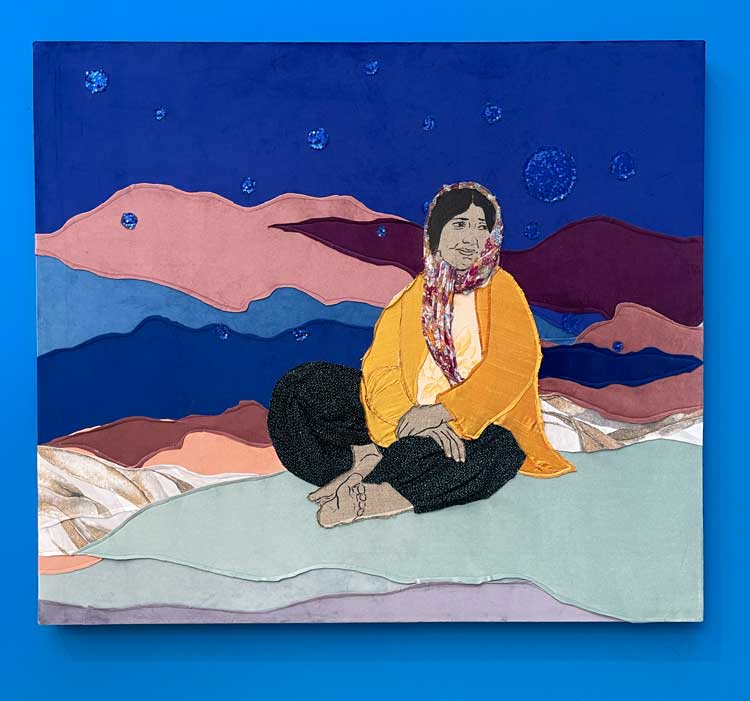
Małgorzata Mirga-Tas, The Blacksmith’s Daughter, 2025. Part of The Dead Don’t Go Until We Do, 2026. Exhibition view, Talbot Rice Gallery, the University of Edinburgh. Photo: Veronica Simpson.
The belittling or degrading of Roma people and their traditions in archive photographs, in which they usually remain nameless – indicating that their categorisation is more important than the individual – is weaponised by Mirga-Tas in portraits that transform those moments of dismissal or worse into ones of transcendence. For example, in Kovaciskri Ćhajori/The Blacksmith’s Daughter (2025), Mirga-Tas takes as inspiration a stock photograph titled “antique travel photographs of Constantinople (Istanbul) Gypsy camp”. The original photo depicts a Roma blacksmith working with the help of his family, but Mirga-Tas singles out the figure of his daughter. She is depicted here, seated and calm beneath a starry sky (the stars representing ancestral connections).
A caption tells us that, in Romani culture, “blacksmiths are alchemists, poets and artists, who transform matter and bring new things into the world”. Mirga-Tas’s grandfather was a blacksmith, and he pops up nearby, in a textile titled My Grandfather (2026). The image, taken from a family photo, shows her grandfather with his youngest daughter, Renata, and his first grandson, Marcin, representing three surviving generations. The faces in Mirga-Tas’s portraits are painted skilfully on to canvas, with just a few bold and expressive lines, so that the real people who inspired them emerge, vivid and distinctive.
Bears are a prevalent feature in Roma histories and communities, we learn, with one group of Roma people called the Ursari, meaning “bear handlers”. There are two bears and a female bear handler in the textile Romani Ćhaj Peskreja Ryćhinoha/Romani Girl With a Bear (2026). The caption tells us that bears are seen as “special beings that cross between human and non-human worlds”. They are apparently a common sight in the Tatra mountains near Mirga-Tas’s home. The two bears in the picture are represented in a patchwork of pale, floral prints, somehow transforming these lumbering creatures into beings of playfulness and light.
The caption also tells us that this portrait was inspired by one of a female bear trainer, taken in Berlin in the 1920s, initially part of a project to document individuals within the community, but later found in an archive used by the Nazis to flag up people for deportation, or worse.
Some are more straightforward celebrations of survivors and community, such as the group portrait Maria’s Romani Family (2022), inspired by Maria Dimitri, one of a thriving group of Roma women whom Mirga-Tas met while working in Gothenburg.
The eclectic nature of these salvaged fabrics is crucial to Mirga-Tas’s aesthetic, and integral to the power of her works as memorials to everyday life and ordinary people. In this way, they remind me of the Gee’s Bend quilts, for example those combining denim that has been worn soft or faded with usage, irregularly patched together out of economy and necessity. Speaking with Mirga-Tas in the gallery, just before the show’s opening she says: “From the beginning, all the textiles are from my family.” She says she tells her sisters never to throw away anything from their wardrobes because she will use them. “It’s important for them and for me,” she says. “I always ask them to give me their own clothes. I think … the clothes remember the situations. The clothes are full of history, spirituality.”
As demand for her works has grown, other sources of salvaged material have had to be found. But she points out: “The old fabrics are sometimes stronger than new ones. Also, when I use them from secondhand, I give them a second life. It’s beautiful. I cannot imagine throwing them away. Even the small pieces. My assistant, the girls from my studio, they laugh because they throw away the small pieces and I go to the bin and take them out. I can use them.”
Transitioning through the ground floor spaces towards the grand Georgian gallery at the back is a journey from light to dark – a deliberate scenography, as Clegg tells me: “Rebecca Solnit talks about darkness being important: that’s where hope lies. The uncertainty of other possibilities. These spaces have always been built around light and dark.”
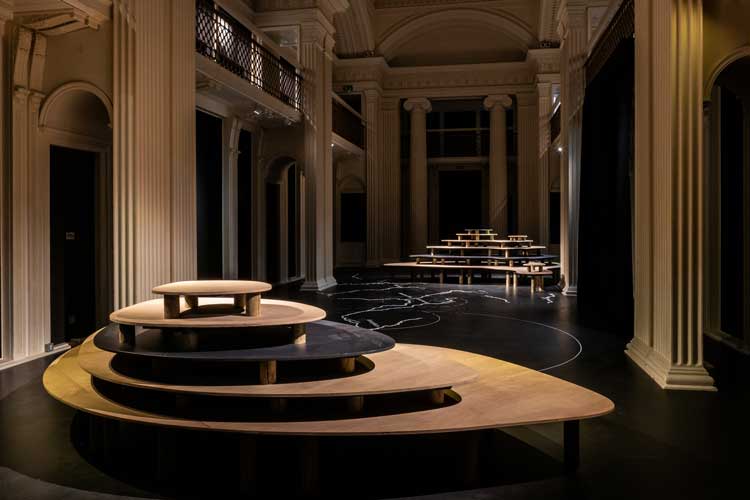
Madeyoulook, Mafolofolo, 2022 – ongoing. Part of The Dead Don’t Go Until We Do, 2026. Exhibition view, Talbot Rice Gallery, the University of Edinburgh. Photo: Sally Jubb.
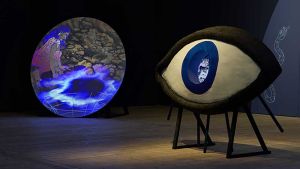
This darkened space – black walls, predominantly black floor, blacked-out ceiling – is resonant with the sound of birdsong when I enter. The call and response of South African birds blends over the soundscape’s 20-minute duration, which includes historic songs of survival and remembering, the sound of storms rising and abating, and oral histories gathered in the field. This work is called Mafolofolo, by Madeyoulook, South African artist duo Molemo Moiloa and Nare Mokgotho, and named after a settlement created by the Koni people (Bakoni) in 1873. They were gifted at food cultivation, and the shapes of curving platforms that fill the room echo the terraced earth mounds and stone structures on which they lived and thrived. But this agricultural knack made their land valuable, and they were constantly being displaced. This work was first presented at Documenta 15 (2022). Madeyoulook spent five years researching extensive earthworks left behind by the Koni, the memory of which has been kept alive entirely by their descendants – now all scattered. One of these descendants, Joseph Mothupi, shares stories on the soundtrack. While the lighter layers of curving board stand out, the darker ones offer additional enrichment, decorated with observations from the artists’ field notes. The map on the floor, says Moiloa, is “mapping sites of removal and return, and some of the towns and rivers where they’ve settled. Some have more contemporary names.” But the artists have deliberately left areas dark, unnamed, allowing parts of the territory to be hidden, as an alternative to the colonial project of naming things to stake a claim on them.
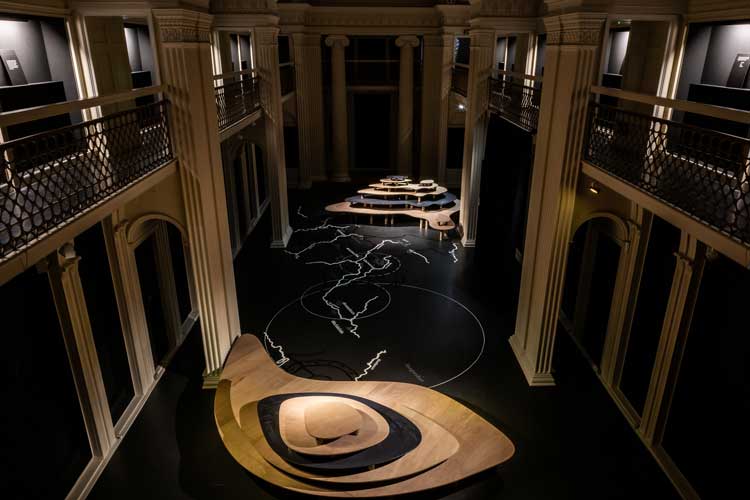
Madeyoulook, Mafolofolo, 2022 – ongoing. Part of The Dead Don’t Go Until We Do, 2026. Exhibition view, Talbot Rice Gallery, the University of Edinburgh. Photo: Sally Jubb.
At the preview, Moiloa told me: “What intrigued us was their ability to be quite violently pushed out, and to rebuild themselves again, the cyclical narrative of facing hardship and collapse and then rebuilding, through the land, through their relationship with nature, their intimate knowledge of the landscape and growing. We think this is quite an interesting way to think about our own current phase, whether it’s economic or political collapse. We can look to our ancestors to consider what it means when things fall apart, and that things can fall apart and we can rebuild.”
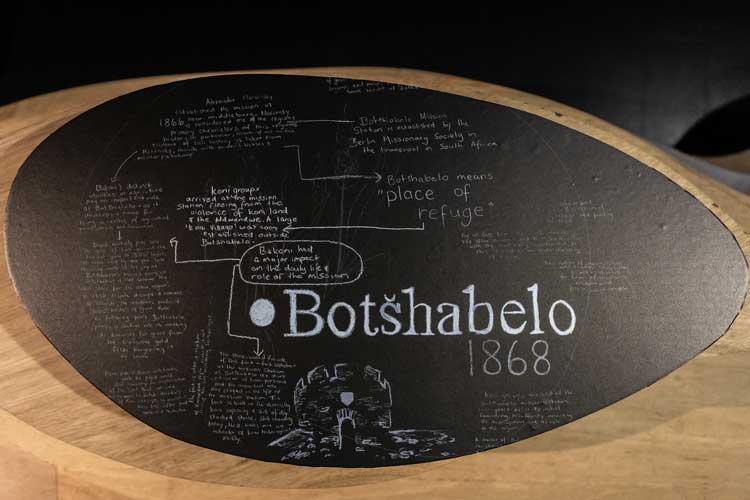
Madeyoulook, Mafolofolo, 2022 – ongoing. Part of The Dead Don’t Go Until We Do, 2026. Exhibition view, Talbot Rice Gallery, the University of Edinburgh. Photo: Sally Jubb.
The soundtrack swells and fades powerfully as you move around these spaces. Mokgotho says: “You get a sense of the call and response. It’s also a call and response between the human and the non-human, typically through biomimicry and quite a few cyclical things happening back and forth, and then there’s obviously a lot of atmospherics, nature sounds, recordings we did in this Koni area.”
Along the upstairs balcony gallery – in which Dutch landscape paintings have previously been displayed – each alcove features questions the artists evolved for a publication they produced for Documenta, looking at the ways in which landscape has been depleted through naming, claiming and mapping, and trying to find alternative ways to represent and value the land. Clegg feels the combination of these quotes on the wall with the artwork below and around is particularly potent: “Surveying, as an act of making hypervisible in order to take ownership, is replaced with a black landscape aesthetic concerned with keeping secrets from evolving; a safeguarding. These questions take us on a kind of journey, with gender and race and whether they are related to nature and asking: ‘Should we try to overturn this or do we lean into it and make it our own?’”
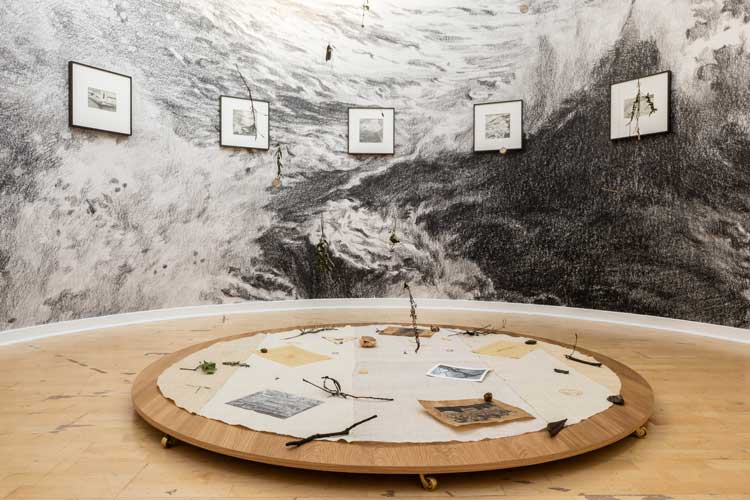
Kang Seung Lee, Erasure held like a fierce lantern, 2026. Part of The Dead Don’t Go Until We Do, 2026. Exhibition view, Talbot Rice Gallery, the University of Edinburgh. Photo: Sally Jubb.
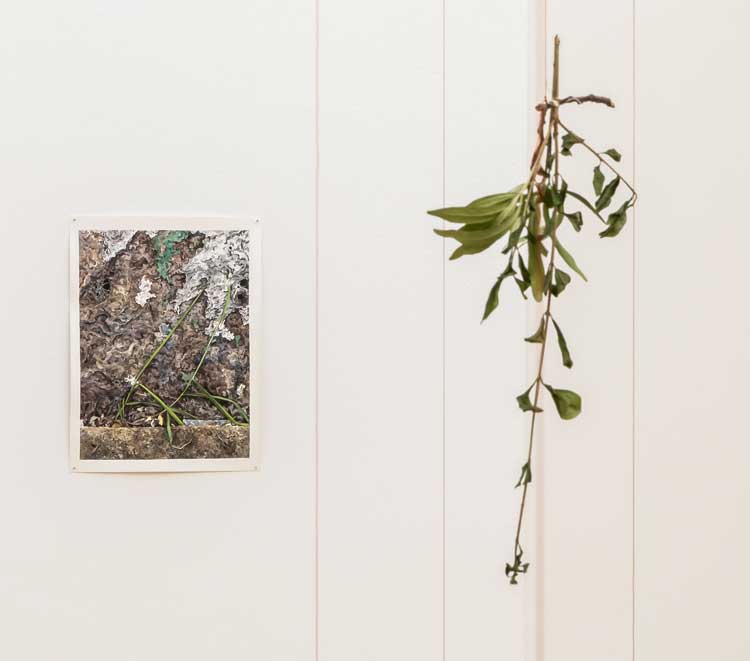
A reading room in the corner offers books that have informed the artists’ approach, as well as the original Documenta publication. Pushing open the door from this quiet, dark, space of contemplation, we are blinded by natural light coming from the spectacular circular rooflight, blazing down on Kang Seung Lee’s appropriately named installation, Erasure Held Like a Fierce Lantern. Lee, who was born in South Korea in 1978 and grew up there, endured cultural and institutional homophobia along with the paranoia and devastation of the HIV-Aids epidemic. The title of the show comes from California poet Meredith Stricker’s poem, The Rewilding, which describes the demilitarised zone between South and North Korea. For Lee, this has rich associations of resistance: resisting fixed notions of sexuality and identity. Wild plants become part of his narrative of rewilding, and for this show he has gathered plants from the streets of Edinburgh and strung some up in the centre of the room but laid others on linen cloth embellished in gold thread, to evoke the funeral cloths of traditional South Korean ritual. Clegg says: “The plants are witnesses of human life.”
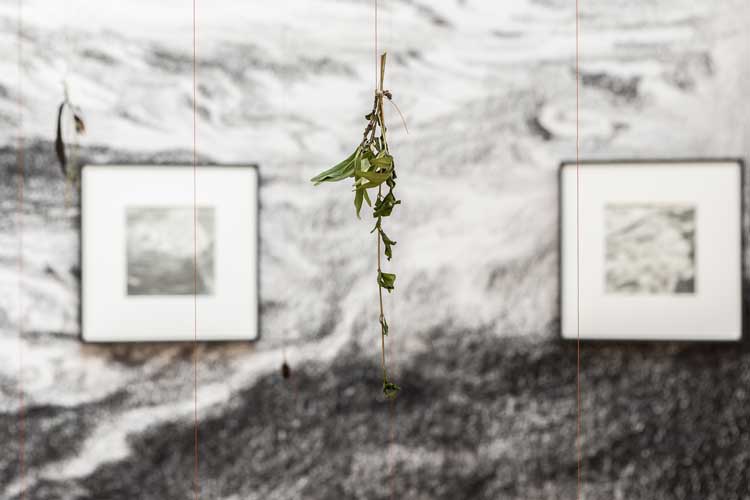
Kang Seung Lee, Erasure held like a fierce lantern, 2026. Part of The Dead Don’t Go Until We Do, 2026. Exhibition view, Talbot Rice Gallery, the University of Edinburgh. Photo: Sally Jubb.
These plants were gathered from a sort of pilgrimage Lee made to sites of queer history around Edinburgh, including the Aids memorial Life Tribute (with an inscription declaring: Grief is not forever but love is), and some steps down to the men’s toilets at the entrance to Princes Street Gardens West. (The toilets, now very mundane, were once a magnificently appointed Victorian public convenience, featuring a circle of wooden cubicles. In an era when gay men could only meet in secret, it was known as the Wheel of Fortune and was part of the route of the first Pride Scotland march in 1995). These sites also appear around the walls in delicate pencil drawings and watercolours by Lee, along with his drawings of photographs taken by key figures of queer photography such as Peter Hujar, Alvin Baltrop and Tseng Kwong Chi.
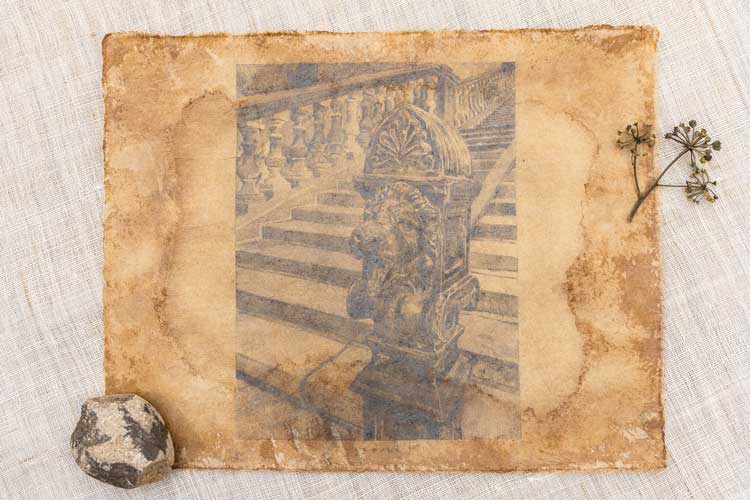
Kang Seung Lee, Erasure held like a fierce lantern, 2026. Part of The Dead Don’t Go Until We Do, 2026. Exhibition view, Talbot Rice Gallery, the University of Edinburgh. Photo: Sally Jubb.
In one drawing, of Baltrop’s photograph of Hudson Piers’ queer community, Lee has blurred the figures who died into swirling vapour. Clegg says: “I suppose these are all anti-portraits. Lee is someone who thinks about death in the sense of fluid space. Nothing is ever lost completely: our particles are still in the world. He almost developed this photorealistic style of painting and drawing as a way of filling in the gaps, recreating magazine covers with artists who he thought should be celebrated. Then it became more stylised in thinking about erasure and people who have been removed.”
As we walk towards the final gallery, on the first floor, we are plunged again into darkness to experience the world of Amol K Patil, whose work Clegg first experienced at Amsterdam’s Rijksakademie.
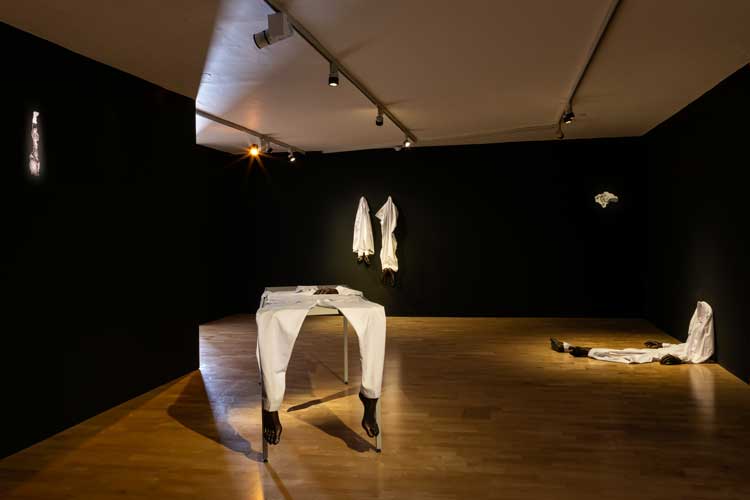
Amol K Patil, Who is invited to the city?, 2026. Part of The Dead Don’t Go Until We Do, 2026. Exhibition view, Talbot Rice Gallery, the University of Edinburgh. Photo: Sally Jubb.
Clegg says: “His grandfather was a performer who adopted the Powada tradition [storytellers of the Marathi culture] and his father wrote, produced and acted in social theatre and activism. The whole family came from the Dalit caste – the lowest of the five orders [of castes on the Indian subcontinent] – who were often given the most horrendous work to do. He talks about fatigue and the struggles but also the joy of finding within his grandfather and late father’s work the courage to speak out against these systems.”
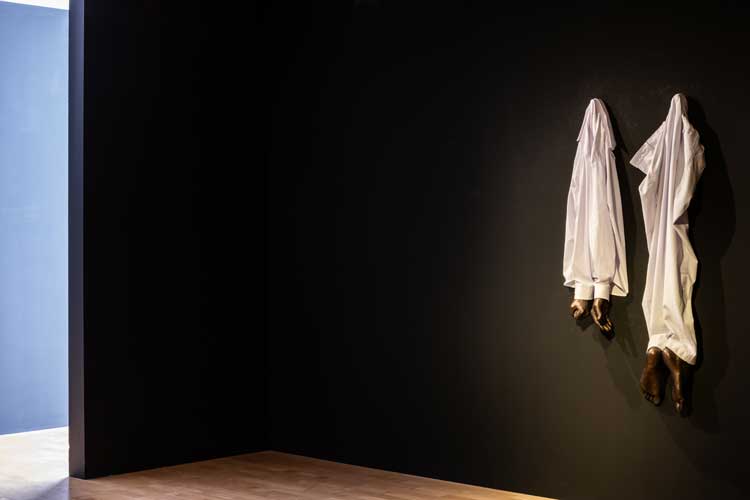
Sculptural displays of white work clothes – their pristine quality contrasting with the filthy and dark spaces in which they often had to work, in mines or sewers – glow in the corners, while a film, Who Is Invited to the City? reveals a predominantly black screen, with torchlight playing across what could be a watery landscape. The script is infused with poems from Namdeo Dhasal (his quotes are in blue), who founded the Dalit Panthers, inspired by America’s Black Panthers. Patil himself narrates the passages in English, but the only other sound on the film is the night chirruping of insects.
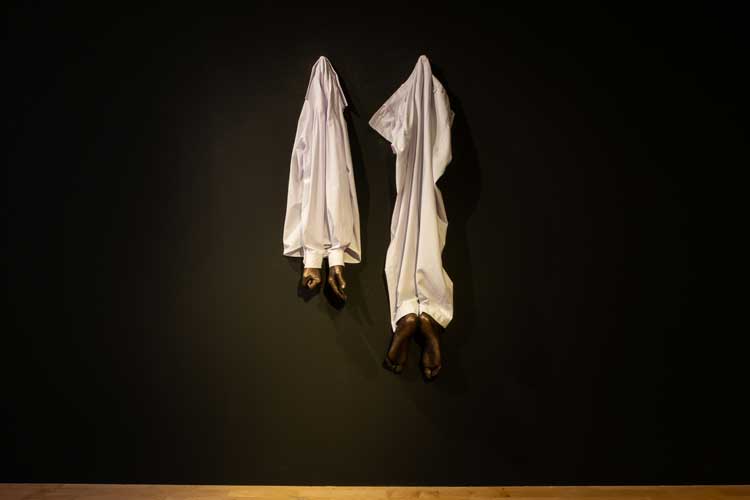
Amol K Patil, Who is invited to the city?, 2026. Part of The Dead Don’t Go Until We Do, 2026. Exhibition view, Talbot Rice Gallery, the University of Edinburgh. Photo: Sally Jubb.
Clegg says: “He’s telling the real historical story of people moving from the countryside to Mumbai in the hope of a better future and then finding themselves trapped in the city with no means of return and cast into these subterranean spaces to work. And that’s reflected through sculptures we have in here. These are actual workers’ clothes. And Amol says the white represents purity of being and spirit somehow.”
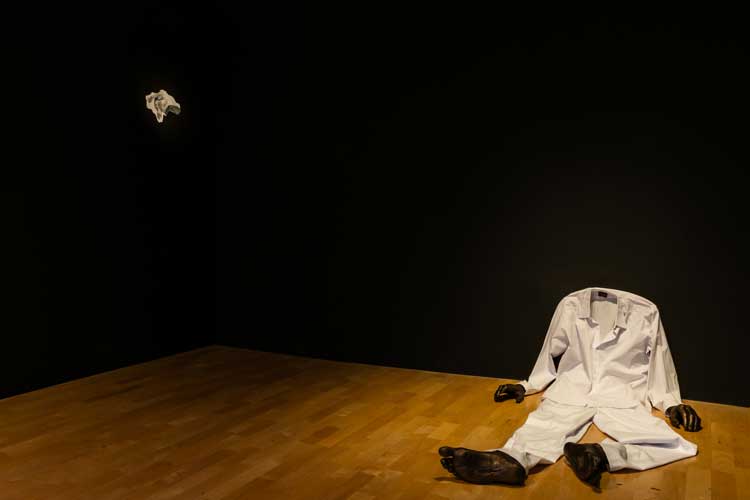
Amol K Patil, Who is invited to the city?, 2026. Part of The Dead Don’t Go Until We Do, 2026. Exhibition view, Talbot Rice Gallery, the University of Edinburgh. Photo: Sally Jubb.
There are small drawings cast into the walls, which come from Patil’s research into the British workers’ housing, created by the Bombay Development Department, which housed multitudes in tiny, cramped spaces called “chawls”. Patil imagines these drawings as cracks in the walls, through which he can peer to see the vibrant lives of the people who lived in them. These are incredibly carefully lit – as if the drawings themselves are glowing against the dark backdrop. I agree with Clegg, who says: “The thing about trying to look at drawings in the semi-darkness, I actually really enjoy it. It activates, I think, a different part of your brain.” Patil, too, while occupying himself with the dark and depressing history of workers’ abuse and the increasing disparity in Mumbai between the rich and the poor, says he is hopeful, according to Clegg. Perhaps Solnit is right: by taking the time to look at these dark times and topics, with the thread of resilience running through them, we can allow our own spirit of hope to emerge.
Click on the pictures below to enlarge

Copyright © 1893–2026 Studio International Foundation.
The title Studio International is the property of the Studio International Foundation and, together with the content, are bound by copyright. All rights reserved.
 |
 |
 |
|---|
-1000-300.jpg)