




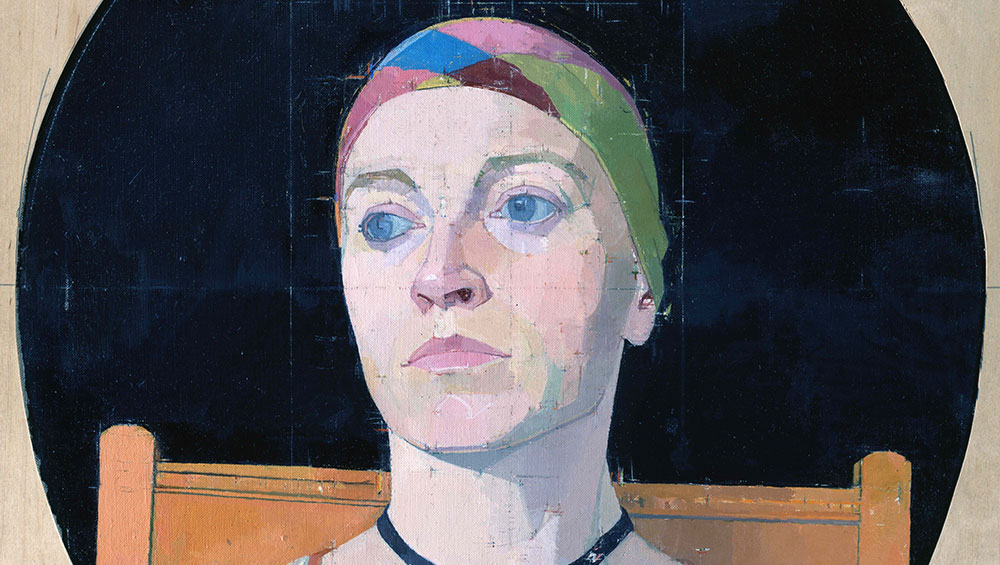
Euan Uglow, Head of Pat, 1978-83 (detail). Oil on canvas laid on panel. Collection of Bernard Jacobson Gallery. Image courtesy Browse and Darby, London. © The estate of Euan Uglow. All rights reserved 2025 / Bridgeman Images.
MK Gallery, Milton Keynes
14 February – 31 May 2026
by DAVID TRIGG
Working with a punctilious and mathematical rigour, Euan Uglow (1932-2000) obsessed over every detail of his paintings. Whether picturing the human figure, still lifes or landscapes, each new work was a visual conundrum to be solved. Painting exclusively from life, he relied on plumb lines, rulers, tape measures and, above all, the act of intense looking to capture the world exactly as it appeared to his naked eye. A fastidious and uncompromising perfectionist, he would spend many months and sometimes years on his compositions. It’s a wonder he ever completed any of the 40-odd canvases in this major survey of his work at MK Gallery. Indeed, he didn’t even like the notion of finishing; for him, paintings simply stopped, brought to a point where they could progress no further.
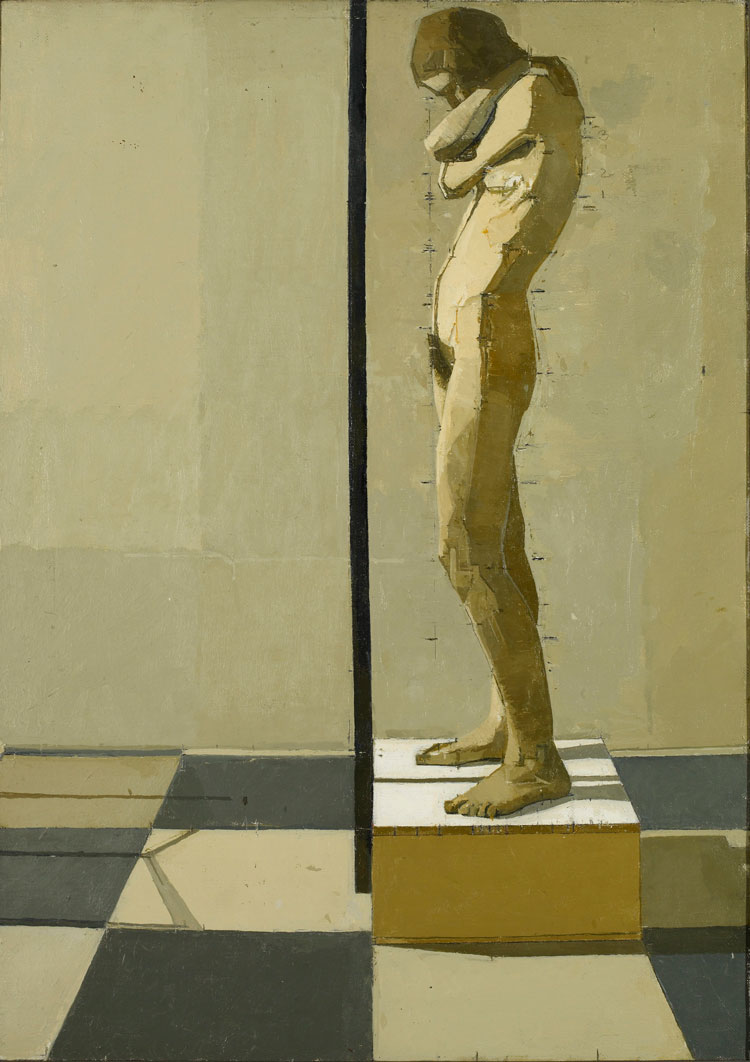
Euan Uglow, Snake, 1976. Oil on canvas. AC 1586, Arts Council Collection, Southbank Centre, London. Image © and courtesy Arts Council Collection, Southbank Centre, London. © The estate of Euan Uglow. All rights reserved 2025 / Bridgeman Images.
Uglow’s analytical precision was partly inherited from the exacting, almost scientific methods of observation practised by William Coldstream, under whom he studied at the Camberwell School of Art and then Slade School of Art in London from 1948-54. Paintings by Coldstream and other artists who either taught or influenced the young painter – including Victor Pasmore, Claude Rogers, Paul Cézanne and Alberto Giacometti – are displayed in the exhibition’s first room alongside Uglow’s early canvas The Musicians (1953). This Arcadian scene, painted during his final year at the Slade, and clearly indebted to Piero della Francesca, depicts naked youths singing and playing instruments. Showing us his workings, Uglow leaves visible the grids used in the transfer of his drawing to canvas – an idiosyncrasy of his paintings, which are typically littered with distinctive measuring marks and other signs of their making.
-The-estate-of-Euan-Uglow.jpg "Euan Uglow, Root Five Nude, 1974-5. Oil on canvas. Image courtesy Browse and Darby, London. © The estate of Euan Uglow. All rights reserved 2025 / Bridgeman Images.")
Euan Uglow, Root Five Nude, 1974-5. Oil on canvas. Image courtesy Browse and Darby, London. © The estate of Euan Uglow. All rights reserved 2025 / Bridgeman Images.
In 1959, Uglow took a studio in Battersea where he began to develop the distinctive way of working for which he became known. Here, he created carefully constructed environments for his subjects called “set-ups”, which included scaffolds, platforms and modified furniture. For each painting, he would establish the relative distances between fixed points within his setup and corresponding points on his canvas, a painstaking approach that involved all manner of measuring devices and sometimes even marking up the bodies of his sitters with indelible ink. His stretchers were all hand made to exact dimensions: typically, a square, a golden rectangle or a rectangle of precise root value. The painting Root Five Nude (1974-75), in which a woman reclines with one knee raised, is so named for its proportions, the length being 2.23 times the height. Even the table on which the model posed was made specifically for this work.
Uglow typically posed his female sitters in awkward positions that emphasised the geometry of their bodies. A notable example in a room dedicated to his large-scale nudes is The Diagonal (1971-77), a root-two rectangle in which a naked young woman perches uncomfortably on a chair, her body stretched to form an elegant diagonal line. Evidently, posing for Uglow was physically demanding and many models abandoned the job, including the first sitter for this painting, who walked out after six weeks. While three models were involved in Three in One (1967-68), in which the composite figure lies sprawled on a blue mat, others remained committed to the process from beginning to end.
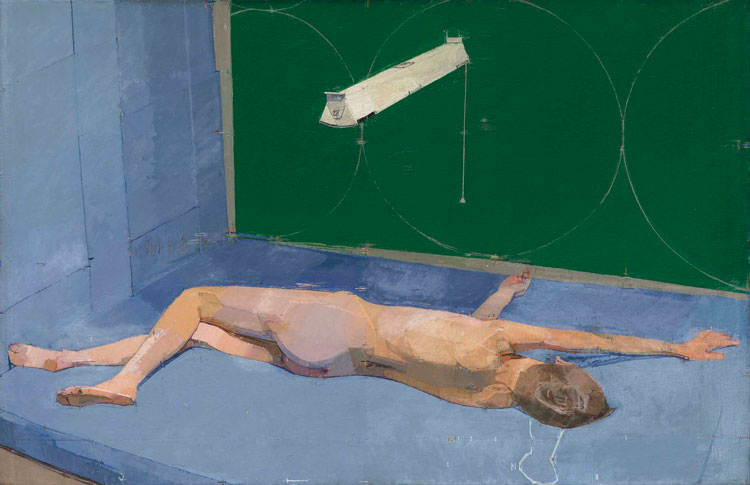
Euan Uglow, Three in One, 1967-68. Oil on canvas. Image © 2014 and courtesy Christie’s Images Limited. © The estate of Euan Uglow. All rights reserved 2025 / Bridgeman Images.
The author Celia Lyttelton, who modelled for Curled Nude on a Stool (1982-83) recalled wanting to “scream with boredom and pain” and it is not hard to see why: here she is, head bowed, doubled over with her knees pressed to her breasts and her clasped hands touching the tops of her feet. Such poses had to be held for hours, and it was not unusual for Uglow to spend up to 45 minutes positioning a model before he even picked up a brush. With the artist making such huge demands on his models, often over the course of years, it is a wonder he found anyone willing to pose for him. Yet many saw the job as a collaboration with the artist. As the second model for Root Five Nude, Sietske Smid, said: “We were a contributing factor to his painting.”
Many of Uglow’s lesser-known Mediterranean landscapes, which fill a wall at MK Gallery, have a looser, incomplete quality, and at least one of them was considered unfinished by the artist. These somewhat bland pictures are really studies in light, picturing the way it hits and interacts with different surfaces. More satisfying is Snow on Lambeth (1987), an enigmatic painting that verges on geometric abstraction. It shows the view from the window of Uglow’s Battersea studio, looking across snow-covered rooftops under an ash-grey sky, the receding buildings articulated with flat planes of orange, brown and grey.
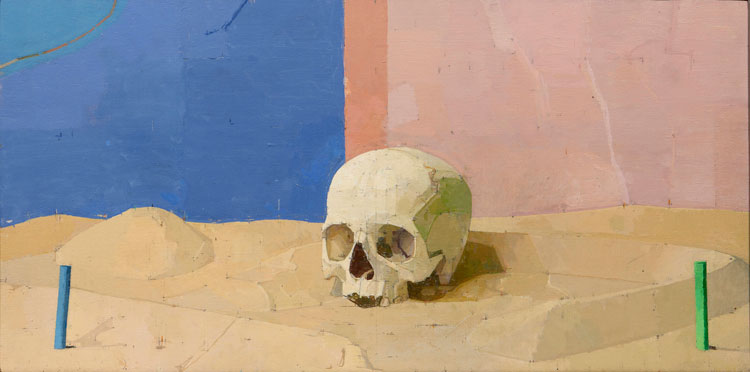
Euan Uglow, Skull, 1994-97. Oil on canvas. Image courtesy of Hazlitt Holland-Hibbert. © The estate of Euan Uglow. All rights reserved 2025 / Bridgeman Images
The modernist flatness of Uglow’s landscapes extends to his small still life paintings, of which a good number are included in the show. There is the brilliant memento mori, Skull (1994-97), in which an ancient skull that the artist found in Egypt sits on a bed of desert-like sand between two sticks of coloured chalk. Nearby, An Arc from the Eye (1998), from which the exhibition takes its title, riffs on the vanitas tradition, contrasting the short-lived nature of flowers with the inert materials of Uglow’s constructed surroundings. This theme continues with Peach II Old (1999), which depicts the titular fruit in a state of decay, a subject that demonstrates how Uglow could paint relatively quickly when necessary.
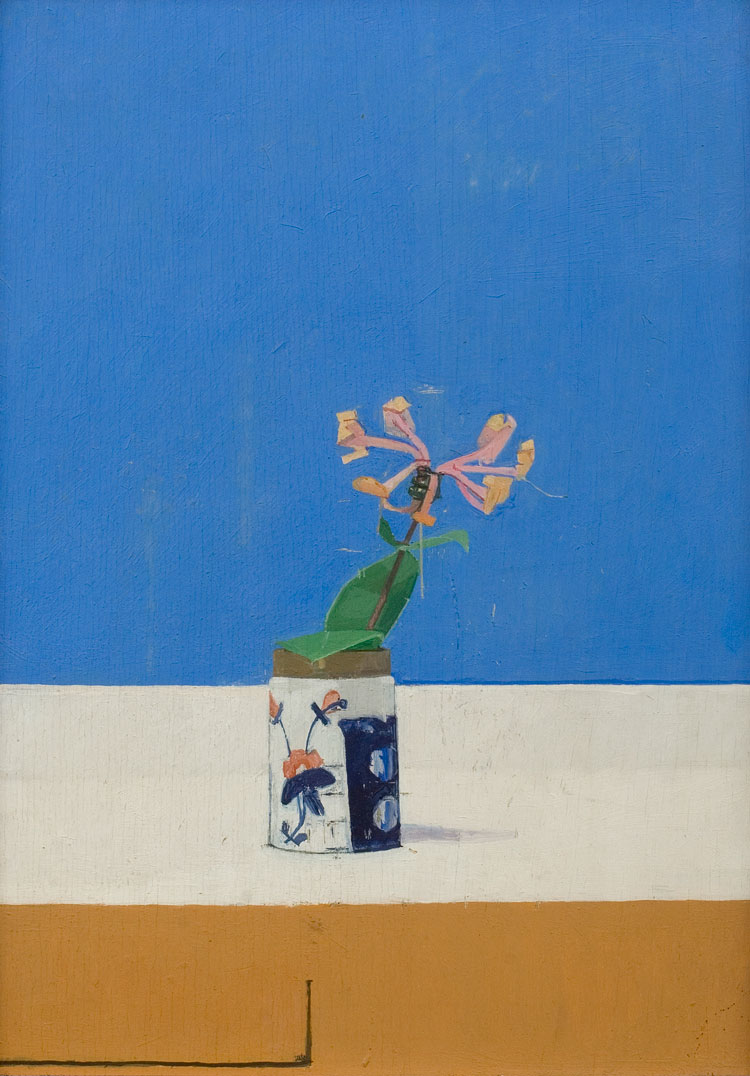
Euan Uglow, Still Life with Honeysuckle, 1968. Oil on panel. Image courtesy Piano Nobile, London. © The estate of Euan Uglow. All rights reserved 2025 / Bridgeman Images.
A standout work in the final room is Still Life with Honeysuckle (1968), an apparently straightforward painting of a single honeysuckle stem in a jar set on a white tabletop against a cerulean-blue wall. It is, in fact, a complex pictorial game. Few clues are given regarding depth, which creates an indiscernible sense of space. The flower’s yellow and pink petals seem to exist on the same plane as the back wall and their form is echoed by their container’s decoration. A single shadow on the table helps make sense of the scene, as does the top of the container, which disturbs the horizontal meeting point of wall and table. It is a prime example of Uglow’s fascination with modernist flatness, as well as his mastery as a colourist.
It seems paradoxical that, for all their scrupulous precision and intense close looking, Uglow’s paintings do not approach anything resembling illusionistic realism. Instead, you are constantly made aware of their artifice: from the visible measuring marks to the unblended planes of flat colour. As the artist himself insisted, his works have nothing to do with illusionism and everything to do with constructing a new world that stands on its own terms. His stated aim was to “paint a structured painting full of controlled and therefore potent emotion”.
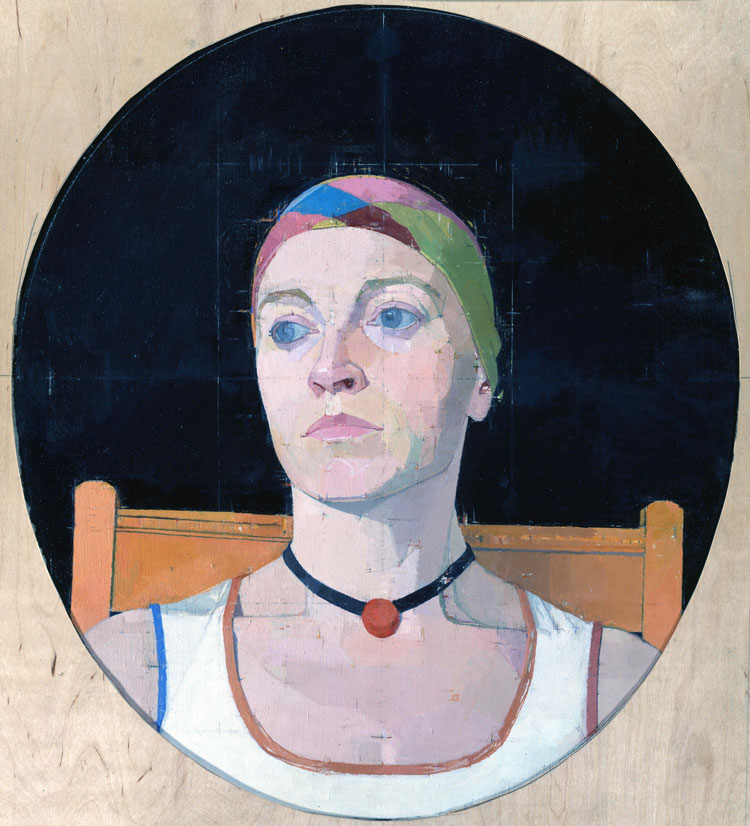
Euan Uglow, Head of Pat, 1978-83. Oil on canvas laid on panel. Collection of Bernard Jacobson Gallery. Image courtesy Browse and Darby, London. © The estate of Euan Uglow. All rights reserved 2025 / Bridgeman Images.
Yet it is hard to detect much real emotion amid the stark minimalism and exacting geometry on display at MK Gallery. Indeed, the tender warmth occasionally seen in early portraits such as that of his close friend Gloria Ceccone (Gloria Wearing a Necklace, 1959-60) gives way to the cold kind of mechanical mapping of Head of Pat (1978-83), an elegant and technically brilliant work but one that turns warm, human flesh into something austere and lifeless. As the artist once said: “The proper subject of a painting is painting itself. It’s not what gets painted that matters, it’s how.”
Uglow may have been a master of rendering the way people and things appeared spatially, but he captured little of what it felt like to be in their presence.
Click on the pictures below to enlarge
-The-estate-of-Euan-Uglow.jpg)

Copyright © 1893–2026 Studio International Foundation.
The title Studio International is the property of the Studio International Foundation and, together with the content, are bound by copyright. All rights reserved.
 |
 |
 |
|---|
-1000-300.jpg)
 Ingrid Pollard – interview: ‘I like to concentrate on that vast history of the world as it has been photographed since 1835’
 Laura Knight: A Panoramic View
 George Stubbs: All Done from Nature
 Paula Rego – interview: ‘I’m interested in seeing things from the underdog’s perspective. Usually that’s a female perspective’
 A History of Drawing