




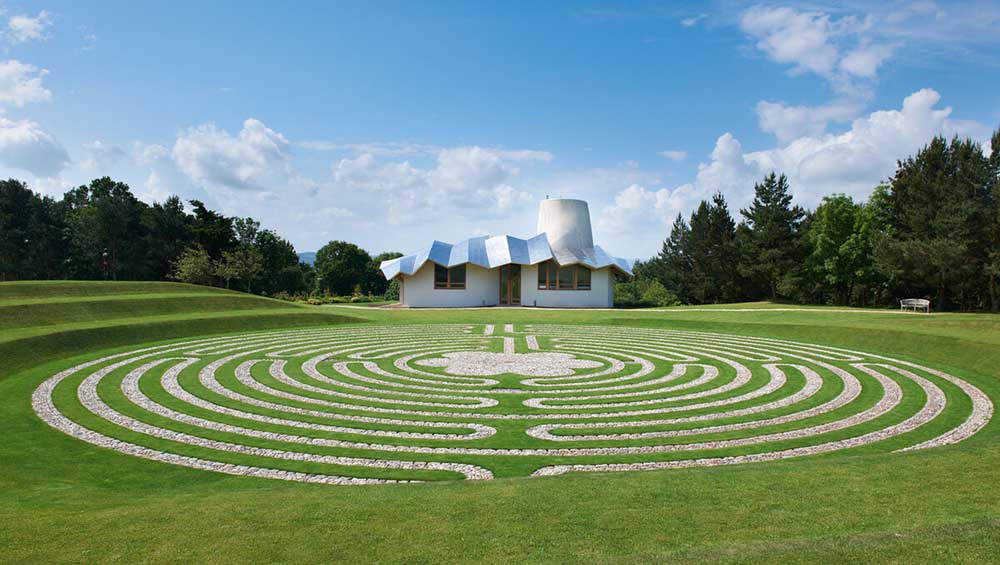
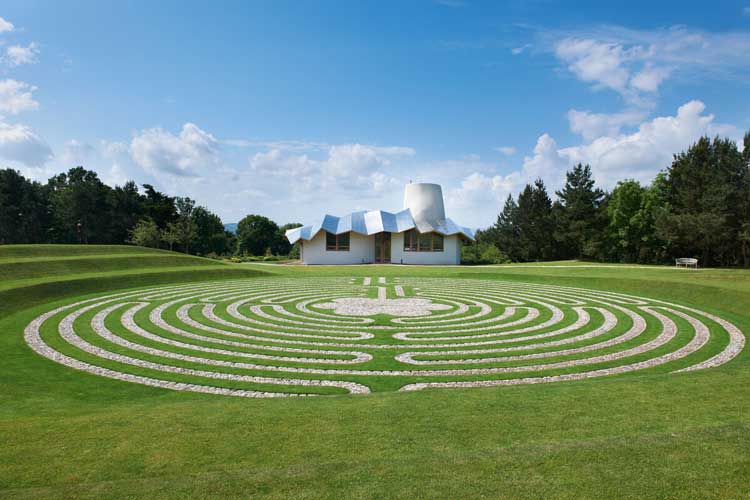
Maggie's Centre Dundee by Frank Gehry, garden design by Arabella Lennox-Boyd. Photo courtesy Maggie's.
V&A Dundee
6 March – 1 November 2026
by VERONICA SIMPSON
Maggie’s Centres for cancer care are now widely celebrated around the UK and beyond. They are remarkable for many things, not least the way their modest, humane and uplifting architecture contrasts with the huge and impersonal infrastructure of the modern hospital campuses on which they are located. Their goal is to support those people with a cancer diagnosis and their family and carers. Domestic in scale and furnishings, informal in their programme, each Maggie’s Centre is a place where patients can take time to understand their diagnosis, come to terms with the prognosis and explore the choices available to them. Welcoming and light-filled, with high-quality furnishings and views on to planting and nature, the purpose of these buildings is to provide “a little bit of transformation”.
Conceived by the artist and landscape designer Maggie Keswick Jencks, the idea was born in 1993 when she was told that the breast cancer she had been diagnosed with in 1988 had returned. She and her husband, the landscape artist and designer Charles Jencks, felt that the bland, clinical machinery of the modern hospital was particularly hostile for those receiving a cancer diagnosis, and she wanted to create a new type of support, a centre that could change the way people live with cancer as well as supporting their family and friends.
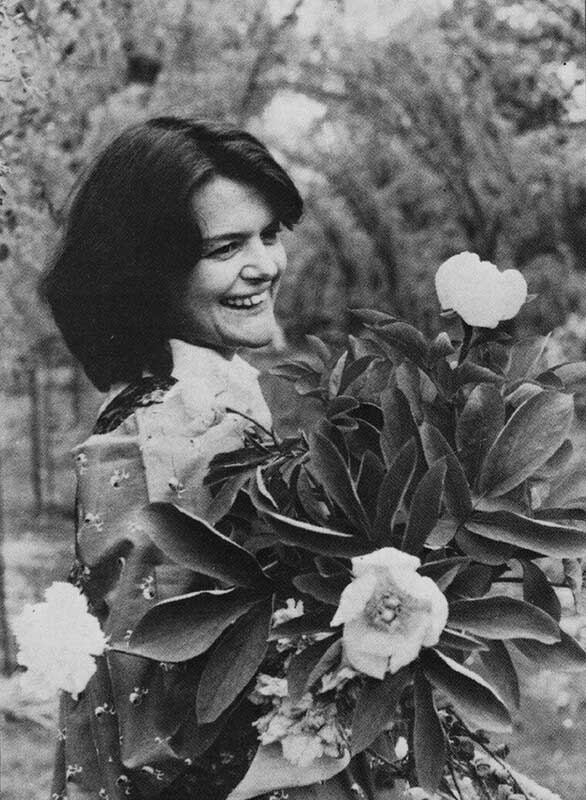
Maggie Keswick Jencks. Photo courtesy Maggie's.
They numbered many prominent architects among their friends and, together with Keswick Jencks’ cancer support nurse, Laura Lee (now Dame Laura Lee DBE and chief executive of the Maggie’s charity), plans were drawn up for the first pilot scheme. Designed by Richard Murphy, it opened at the Western General hospital in Edinburgh in 1996, a year after Keswick Jencks died.
So much has changed since then. Thanks to enormous progress in the detection and treatment of cancer, the disease is now highly survivable. But Keswick Jencks’ vision has generated something bigger than perhaps she ever dreamed of. The commission to design a Maggie’s Centre has become one of the most sought after in architecture, and has transformed the sense of what a healthcare building can be and do.
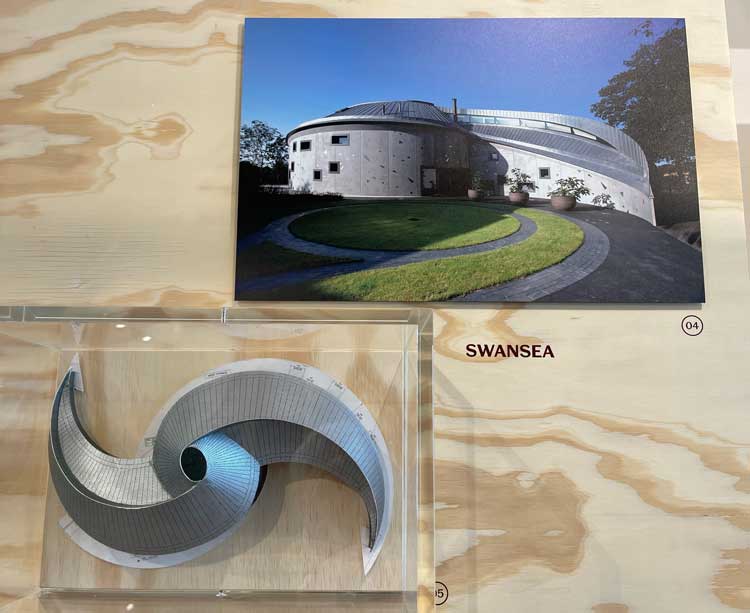
Detail of Maggie's Swansea by Kisho Kurokawa Architects, with Garbers & James. Installation view, Maggie’s: Architecture That Cares, V&A Dundee. Photo: Veronica Simpson.
There are now 28 Maggie’s centres around the UK, four further afield – in the Netherlands, Hong Kong, Tokyo and Barcelona – with more in development. The architects who have been favoured with a commission include Frank Gehry (a personal friend of the Jencks’s, he designed two, one in Dundee and one in Hong Kong, the latter with landscaping by their daughter, Lily Jencks), Steven Holl, Zaha Hadid, Daniel Liebeskind, Amanda Levete (AL_A), Richard Rogers (Rogers Stirk Harbour + Partners) and Norman Foster, plus Rotterdam’s OMA. Less flamboyant but equally highly respected practices, including dRMM and Wilkinson Eyre, have also been commissioned. The list goes on … Cullinan Studio (Newcastle) and two of Scotland’s foremost architects, Reiach and Hall (who designed Maggie’s, Lanarkshire) and Page\Park Architects (Maggie’s, Highlands). Japanese architects also feature, with Abe Tsutomu having designed Maggie’s, Tokyo and Kisho Kurokawa Architects creating the sculptural Maggie’s, Swansea, together with Garbers & James.
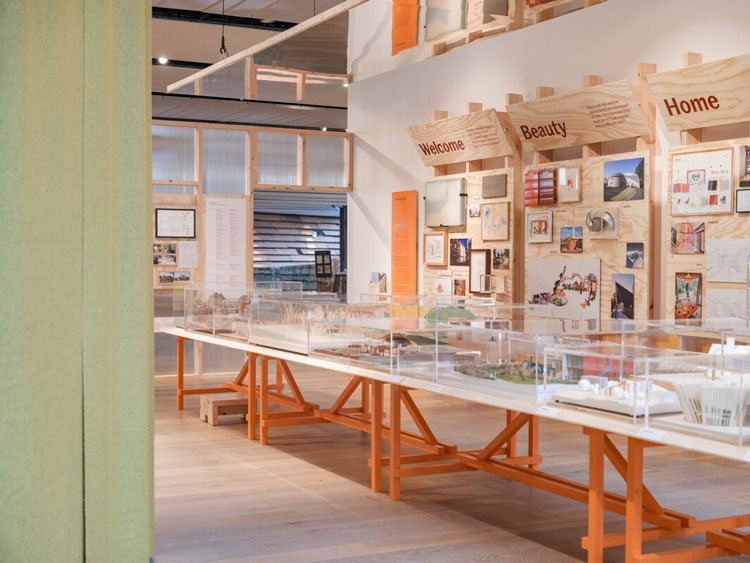
All the built projects are featured in one form or another at the V&A Dundee, in a timber-frame corner gallery carved out of the large first-floor foyer in Kengo Kuma’s landmark cultural building.
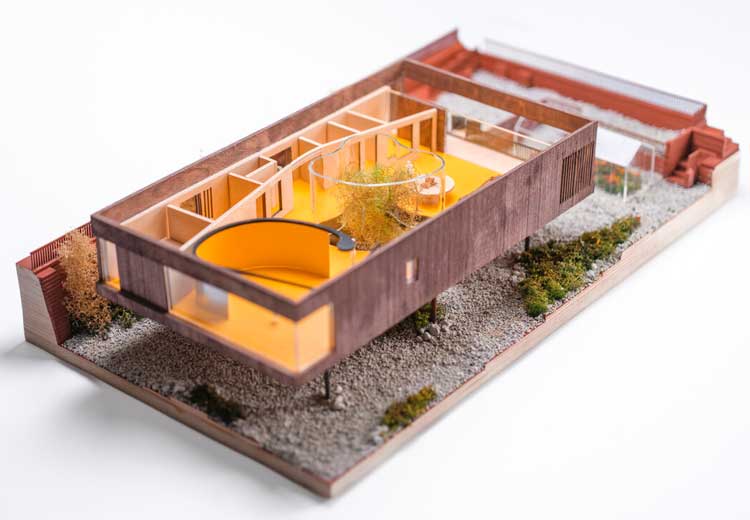
Model of Maggie's Oldham designed by Alex de Rijke of dRMM. Installation view, Maggie’s: Architecture That Cares, V&A Dundee.
Thoughtfully curated by V&A Dundee’s senior curator, Meredith More, the stories of these projects, their evolution and their impacts, are told not through the usual architectural ephemera of huge diagrams, baffling plans and cross sections or architectural models, but primarily through “mood board” presentations of the qualities that are sought in each building, and three moving documentary films.
Along the left-hand wall, immediately beyond the entrance, we are treated to large display boards that categorise many of the buildings via the core qualities deemed key to the DNA of Maggie’s Centres, such as “welcome”, “beauty”, “home” and “nature”. Useful quotes (confusingly, not credited, but presumably given by members of the client team) are added in the top right-hand corner. On the Beauty board, for example, we read: “They must look and feel joyous (and) have zest as well as calm. The impression they must give is: ‘I can imagine feeling different here.’”
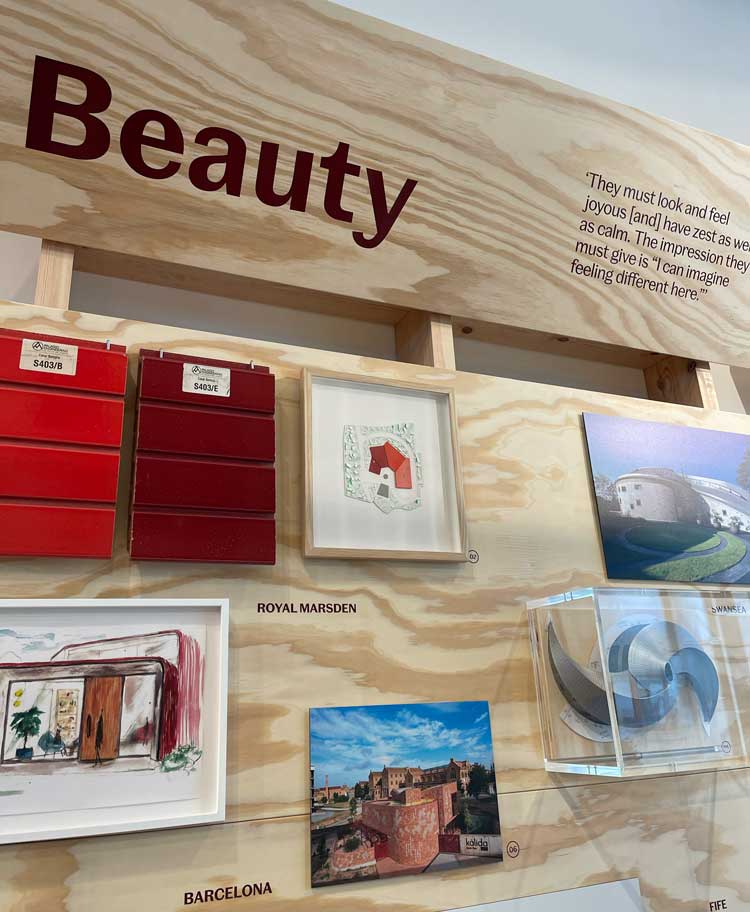
Maggie’s: Architecture That Cares, installation view, V&A Dundee. Photo: Veronica Simpson.
Five or six Maggie’s Centres are picked to represent the qualities heading up each board and each is represented by two or three items – a mixture of photographs, sketches, swatches and even objects (mugs, tiles). The effect is to conjure a sense of the personality and charm of each place, even if some translate better than others.
The Home board, for example, features Gehry’s Maggie’s, Dundee – possibly my favourite of all his buildings. This landmark Maggie’s, from 2003, is the first purpose-built centre (Murphy’s was an adaptation of a stable building), and the people of Dundee are deservedly proud of it. But here I don’t feel the display does it justice. There is a photograph of this white-rendered building, perched, like a small, quirky Scottish croft, atop a hill, with its crinkled aluminium roof. Sadly, you can’t see its stunning view out over the glistening Tay River but we do have in the foreground a glorious, ornamental garden, by the designer Arabella Lennox-Boyd, its labyrinth pattern apparently inspired by one at Chartres Cathedral. Next to this is a photograph from Gehry’s studio showing an exuberant family of curly, crazed, paper models on shelves that were part of his thought process (apparently Maggie appeared to him in a dream and told him to “keep it simple”, which, thankfully, he did). There is also a classic squiggly sketch. What is marvellous when you experience this building in person is how it embraces the visitor, drawing you in and under the curving timber “wings” of its roof. But as it’s the local Maggie’s, perhaps many visitors to this show will already know that.
To emphasise the lovingly curated selection of furniture and crockery in each Maggie’s, there is on this board a shelf containing the gentle, spice-hued mugs as used in Maggie’s, Wirral. And a photo of Murphy’s Maggie’s, Edinburgh is accompanied by a selection of swatches to demonstrate the importance of all the textures and tones in furniture, flooring and walls.
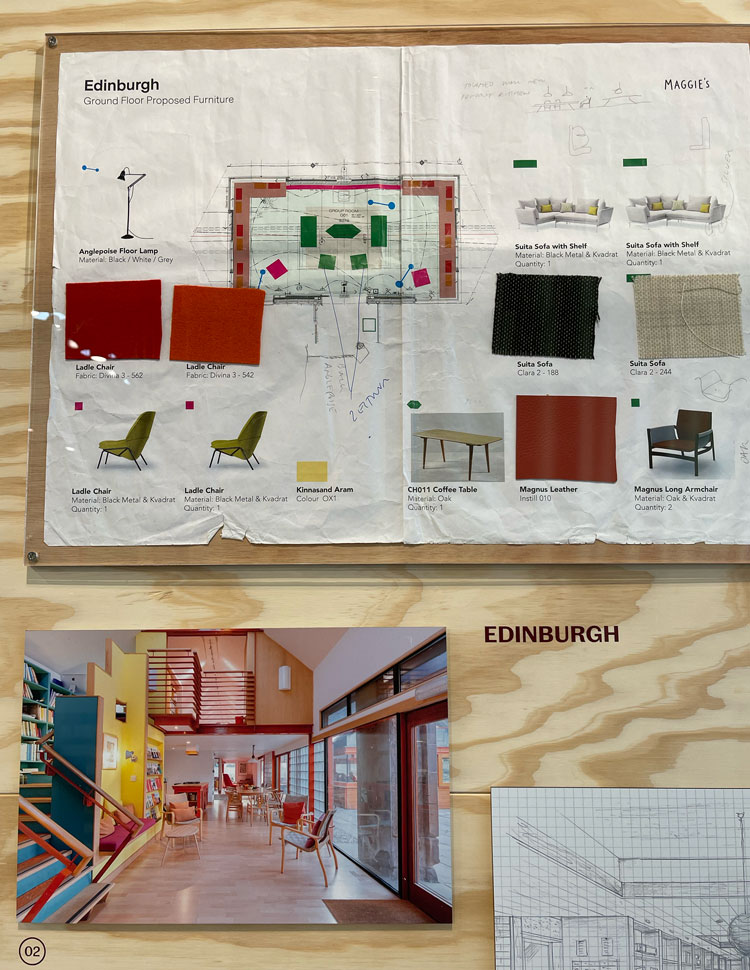
Richard Murphy's original Maggie's Edinburgh with swatch showing how important to its homely atmosphere the materials and colour scheme are. Installation view, Maggie’s: Architecture That Cares, V&A Dundee. Photo: Veronica Simpson.
Insightful captions are offered for each project on these boards. For example, of the original Maggie’s, Edinburgh – which has been extended twice, in 2001 and 2018 – we are told: “Richard Murphy’s design responded to Maggie’s desire for there to be no signs on the doors and for it to feel more like visiting a friend’s house than an institution. To create a domestic, welcoming feel, at the centre of his design he situated a kitchen table, a familiar gathering place often at the heart of a home. To make use of limited space, he made the staircase also into a bookcase and reading area. Colours were chosen by artist Linda Green to create a domestic atmosphere that was uplifting as well as comforting.” This placing of a kitchen table as central to the experience of a Maggie’s, with a clear invitation to help yourself to tea, coffee and biscuits at the nearby kitchen counter, has become a Maggie’s trademark. There is no intimidating reception desk or sense of being “processed”. The visitor is free to roam.
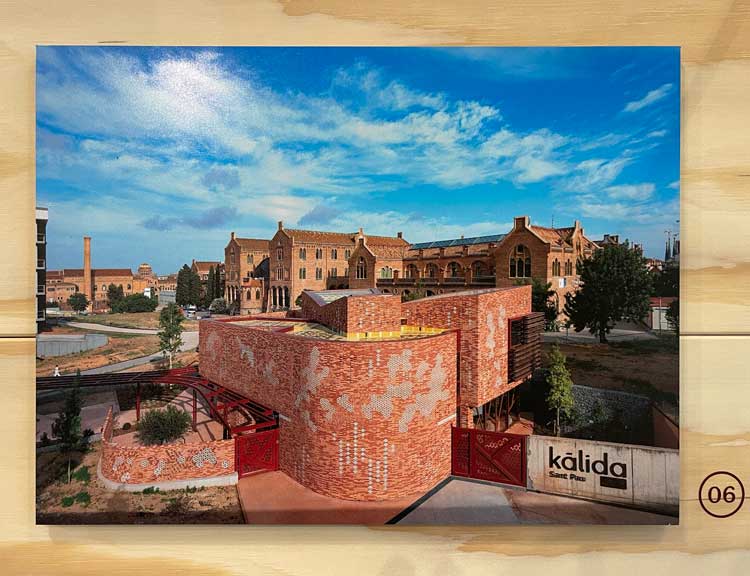
A photo showing the decorative qualities of Maggie's Barcelona designed by Benedetta Tagliabue, architect of Kalida Barcelona. Installation view, Maggie’s: Architecture That Cares, V&A Dundee. Photo: Veronica Simpson.
Which are the standout Maggie’s Centres judging by what is on display here? It is hard to decide. I have visited only Dundee, Oldham (by dRMM) and Richard Rogers’ Maggie’s, West London, and no drawing, photograph or model can compare with the real thing. But on the basis of what I have seen at this show, I would love to visit the Maggie’s in Barcelona (by Benedetta Tagliabue, EMBT Architects). Its brick facade is adorned with ceramic tiles to create abstract floral patterns, while the layout of the building resembles petals unfolding from a central core, with visitors moving seamlessly between the inside and outside space.
Reiach & Hall’s gently elevated pavilion in a walled garden, in Lanarkshire, looks serene. And Maggie’s, Oxford’s ethereal treehouse by Wilkinson Eyre (with landscaping by Flora Gathorne-Hardy and Pip Morrison) is another wonder: the building is placed within a nature reserve next to the oncology unit and lifted up into the tree canopy.
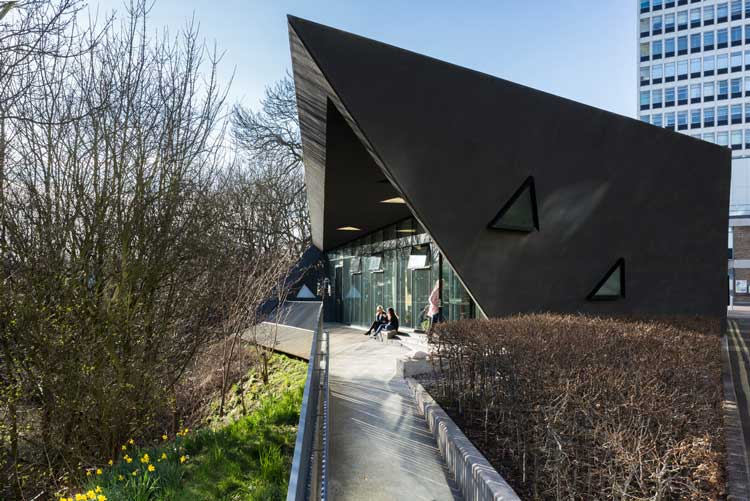
Maggie's Fife by Zaha Hadid Architects. Photo courtesy Philip Durrant.
The one I’m least inclined to visit is Zaha Hadid’s. I can’t imagine anyone would feel uplifted by the pointy intersection of hard, black planes that constitute its entrance – indeed, it looks more like a portal to the underworld.
There are, of course, models. These are corralled into a central “catwalk” under glass. It is amazing how little some of these models give away, though some are better than others at storytelling (Ab Rogers’ model for his Maggie’s at the Royal Marsden is exemplary in that respect, a sequence of red/maroon tiled pavilions in an enchanted garden). But what the storyboards and models do convey is the remarkable multiplicity of ways in which each architect has responded to the same brief.
And let us pause to consider the power of that brief. Although it is not now seen as unusual, in the 1990s, it was not yet fashionable to focus on the people who would inhabit a building. Back then, the profession was still fixated on the building as object, the architect as a lone genius, fusing engineering with sculpture. And that genius seemed to be measured by the “signature style” with which they delivered their trademark twirls, concrete or fibreglass curves or glittering towers.
Not so here. This brief is about the experience of the building, not the shape of it. It is vital that every architect puts “feeling” at the heart of the experience, we are told in the introductory panels. We also learn that architects are selected not by competition but instinct on the part of the people who have jointly steered the evolution of this unusual healthcare concept. While Charles Jencks and daughter Lily were heavily involved, also contributing garden designs on occasions, the named co-clients here are Dame Laura and Keswick Jencks’s dear friend and fellow artist, the sculptor Marcia Blakenham. These two are interviewed, in a quietly compelling film shown here, about the push and pull of each project. After 30 years working together, it is heartening how sincerely they sing each other’s praises: Blakenham commends Lee for her courage, her rigour and commitment to a holistic, person-centred approach, while Lee admits that Blakenham, as a sculptor, will address architects in ways she wouldn’t dare – usually to push the boundaries a little harder, to get the best possible building.
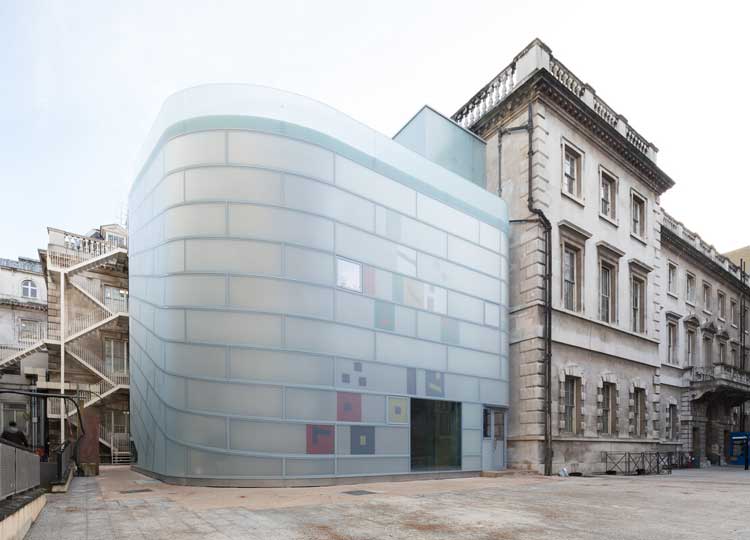
Maggie’s Centre Barts, London by Steven Holl Architects. Photo courtesy Maggie's.
On the back wall, looking in towards the models, is a panel describing the “Maggie’s Blueprint” and how it evolved, from sketchbooks and conversations between Keswick Jencks, her husband and their architect and garden designer friends.
It also has to be asserted that the Maggie’s team are exceptional clients. As the wall text observes: “They encourage imaginative ideas, providing they serve the needs of the people who will use the centres.” While ensuring that the required level of care and humanity is present throughout the buildings, each one also ends up expressing something essential about the architect’s creative spirit. I would argue that they all represent a career high.
How do they pick the architects for the task? At the opening, Dame Laura said Keswick Jencks looked for “architects who know who they are”. In the introductory panels, we learn that it’s all about “choosing people with the sensitivity for the emotional aspects of the brief”. It is vital that every architect puts “feeling” at the heart of the experience. Architects are selected not by competition but instinct.
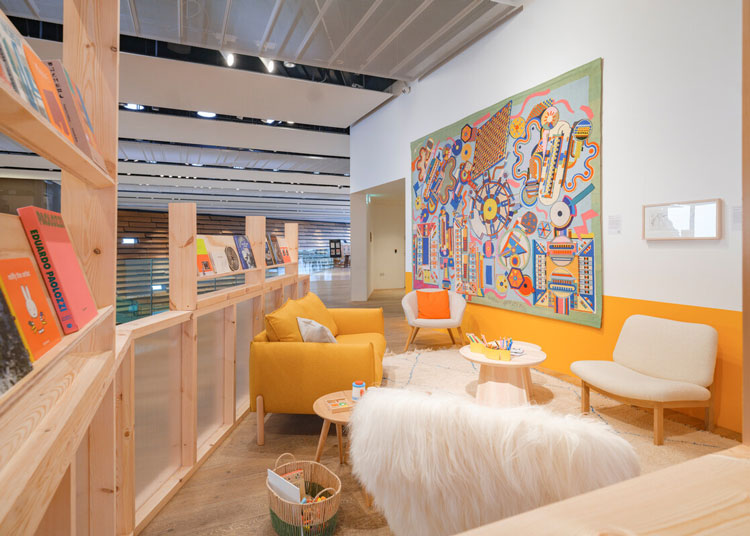
Maggie's themed seating area at V&A Dundee.
The exhibition expands into a discretely curtained room, which offers a heartwarming film in tribute to the work that Maggie’s centres do, as voiced by the centre users. Seated comfortably, you are “held” within a rippling felted-wool curtain of mossy green, lined in a vivid orange silk. A seating area opposite the exhibition entrance has an eclectic selection of Maggie’s chairs, all timber-framed, mid-century style. And there is a striking Paolozzi tapestry, loaned from the Maggie’s Dundee.
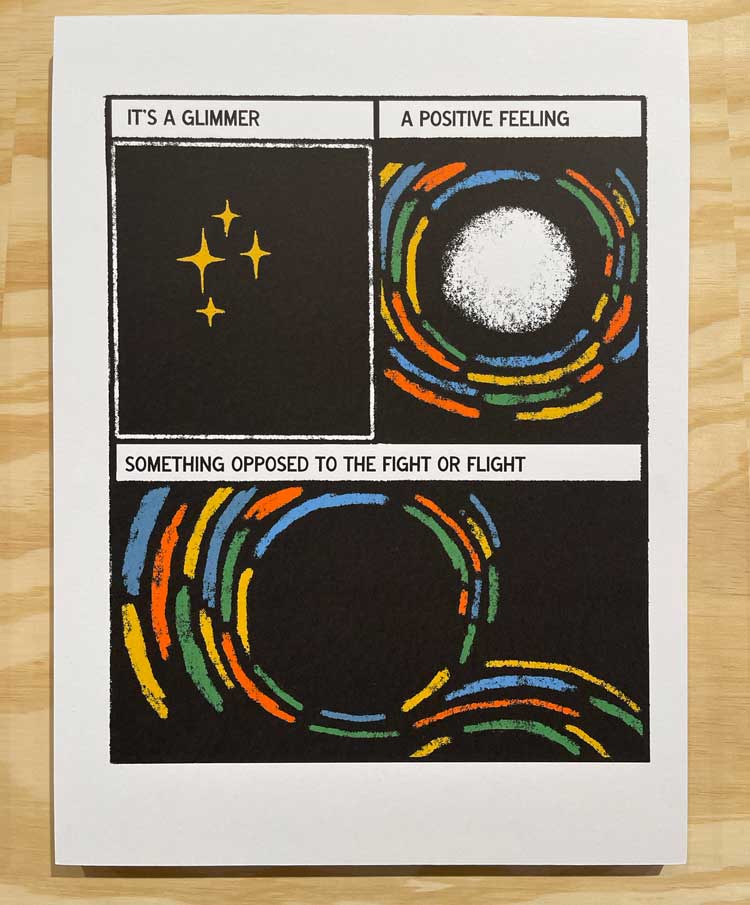
Graphic artist Erin McGrath distilled stories gathered from Maggie's Dundee clients into a moving series of graphic panels. Installation view, Maggie’s: Architecture That Cares, V&A Dundee. Photo: Veronica Simpson.
Along the exterior wall of the exhibition is a poignant graphic work commissioned by V&A Dundee from a local illustrator, Erin McGrath, each panel voicing sentiments expressed by Maggie’s, Dundee clients, whose conversations McGrath dropped in on. And opposite that is a fascinating display of caring buildings that have inspired each of the Maggie’s architects, from Aino and Alvar Aalto’s Paimio Sanatorium in Finland to the Hospital de Sant Pau in Barcelona.
While architects and healthcare professionals have expanded their perspectives, these centres have undoubtedly also influenced the public, not just reframing their ideas of what a healthcare building – and experience – can be but also elevating their appreciation of domestic contemporary architecture. More than 4 million people have visited a Maggie’s in the 30 years in which they have been in existence. And the response is overwhelmingly positive – even to the more avant garde Maggie’s, says Dame Laura, whom I spoke with at the opening. “We have never had anyone say: ‘I don’t like your building because it’s too modern.’ For example, with OMA’s Maggie’s, Glasgow, we have older male users who have come in and love it. They love the light, and they talk about it. And they like that it’s really contemporary. It’s strong but tender. That’s the emotion I think they like about it.”
I suggest it isn’t just centre users who benefit, but also staff. Dame Laura agrees, emphatically: “Oh, you’re in a job, day in day out, of emotional labour, and you’re sitting having a conversation, supporting someone and the building is supporting you. You’ve got a view out to nature. You can choose the right place to sit. And the challenge to the NHS or to all workplaces is: why don’t all your buildings look after your workforce?”
To the question that is occasionally posed – why don’t they use the same architect or design – Dame Laura says: “Isn’t the world much richer for not being homogenous? Because as human beings we’re not homogenous and yet we can still have something that has a value that is consistently running through it.”
More Maggie’s are planned – there are about 60 major cancer centres around the UK and Dame Laura would like to have a Maggie’s at each of them. A few of the future Maggie’s pop up in the exhibition, including one at Stavanger. After the show opened, it was announced that Assemble has won planning approval for a Maggie’s in Maidstone. The task of fundraising for the design, construction and operation of each building is huge, but for now, Dame Laura feels the philanthropic model suits Maggie’s better. “Until we get enlightened commissioners, we don’t want them telling us how to design. Philanthropy is better.”
Click on the pictures below to enlarge

Copyright © 1893–2026 Studio International Foundation.
The title Studio International is the property of the Studio International Foundation and, together with the content, are bound by copyright. All rights reserved.

 |
 |
 |
|---|






-1000-300.jpg)

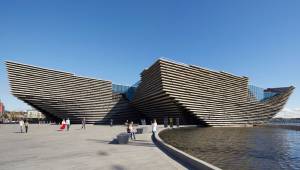 V&A Dundee opens: a monumental structure that aims to take the city under its wing
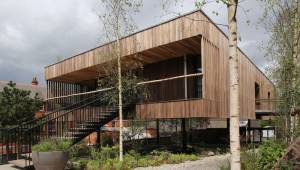 Maggie’s Centre for cancer care, Oldham
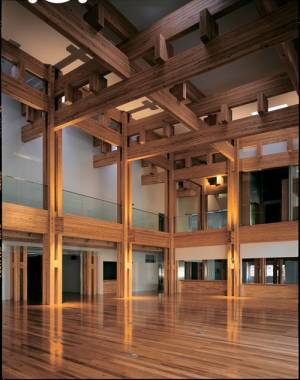 Kengo Kuma: Complete Works
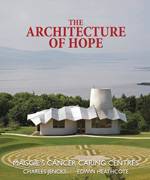 The architecture of hope: Maggie’s cancer caring centres