




-(c)Rob-Battersby-6-1000.jpg)
Paul Eastwood: Unreadings, installation view, Mostyn, Llandudno, 14 March – 20 June 2026. Photo: © Rob Battersby.
Mostyn, Llandudno
14 March – 20 June
by VERONICA SIMPSON
Art that foregrounds its origins in neurodivergence, as Eastwood’s show at Mostyn does, needs to draw us all into its world, raise our consciousness or awareness of what it is to see the world differently, while recognising our universality.
Earlier in March, I visited Turner-prize winning artist Nnena Kalu’s work at Dundee Contemporary Art’s excellent show We Contain Multitudes – a celebration of the work of four artists living with disabilities. The work of Kalu, who is autistic and struggles to verbalise, is remarkable – whether because of or in spite of her condition. Encountering it in the flesh for the first time validated the Turner jury’s decision. There is strangeness but also wonder: you see and feel the inner compulsions, the repetitions and obsessions in the rhythm and whirling energy of the work, but each time it is translated into a glorious field of colour and texture. It opens a window on to how the world might be experienced, without the filter of language but open to everything else: chaos is very much present but reined in with just the right degree of control.
-(c)Rob-Battersby-6.jpg "Paul Eastwood: Unreadings, installation view, Mostyn, Llandudno, 14 March – 20 June 2026. Photo: © Rob Battersby.")
Paul Eastwood: Unreadings, installation view, Mostyn, Llandudno, 14 March – 20 June 2026. Photo: © Rob Battersby.
Eastwood, who was born in 1985 in Wales into an English-speaking household, was dealing with dyslexia in a time before the condition had been widely recognised or accommodated in education. He struggled to come to grips with the languages he read and the two languages he heard and spoke. In this show, Unreadings, the publicity promises a new body of work that “explores language as both material and site of struggle”. Eastwood will, we are told, “transform miscommunication … into creative strategies”. But if the artist’s intention was to make visible the struggles to overcome difficulties in forcing letters, words and sentences to cohere into something meaningful, much of this show seems rarely to stray beyond the two-dimensional or literal.
Take, for example, the transparent, triple-section screen he has set up at the entrance to Mostyn’s main gallery. On the left screen, in clear, black lettering, he appears to set out his stall. It states: “This text begins like any other gallery introduction. The goal is to guide the viewer. Yet, like many gallery texts, it risks becoming a barrier, dense, tangled, performing linguistic acrobatics that can confuse as much as it wishes to clarify.”
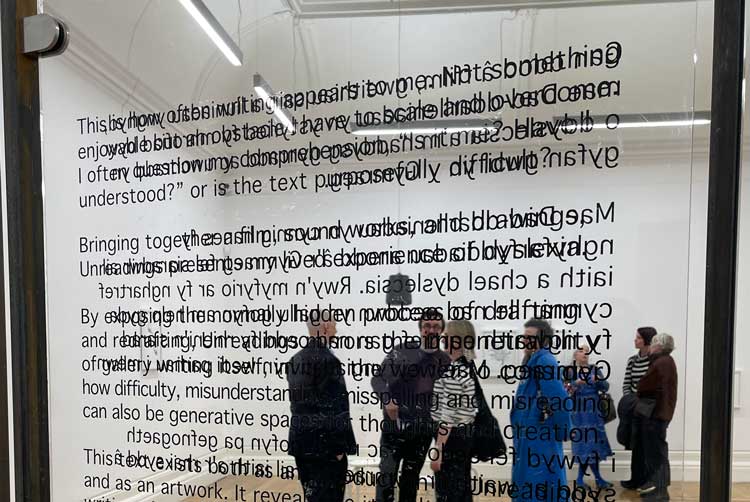
Paul Eastwood: Unreadings, installation view, Mostyn, Llandudno, 14 March – 20 June 2026. Photo: © Rob Battersby.
However, rather than railing against the excessive use of text in galleries, he goes on to take issue with the language used – the tendency to confuse the viewer with a particular “art discourse or philosophical framework”. He asks, in conclusion: “Do artists want to say something specific, or is ambiguity preferred?” The centre and right panels are overlaid with sections of text, laid out on the reverse of the screen, in Welsh and English, making the reading of them impossible – or certainly difficult enough to make me give up. I feel that confusion is the desired effect.
-(c)Rob-Battersby-5.jpg "Paul Eastwood: Unreadings, installation view, Mostyn, Llandudno, 14 March – 20 June 2026. Photo: © Rob Battersby.")
Paul Eastwood: Unreadings, installation view, Mostyn, Llandudno, 14 March – 20 June 2026. Photo: © Rob Battersby.
Around the white walls of this double-height, white-walled space, Eastwood has arranged several framed drawings that depict scrolls of words twisting and curling, their individual letters distinct while the words or phrases remain obscure. Pleasing and skilful though the drawings are – not for nothing did he study at Wimbledon School of Art (2004-07) and the Royal Academy Schools (2011-14) – the way the ribbons of words undulate doesn’t just chop them off midway through: there seem to be repetitions, consonants doubling or trebling, to further cloud any sense of what the word is meant to be or how it connects with the next or previous one. So, are we meant simply to admire the shape of the scroll, the presence of these letters, the three-dimensionality of the drawing?
I found myself wanting these works to leap off the page and draw me in to Eastwood’s discombobulating dyslexic universe, to displace my brain in the way that Eastwood’s presumably is so frequently displaced. Instead, I strolled along this promenade of pictures, enjoying the pleasurable rendition of these forms and letters, waiting for their significance to be revealed.
-(c)Rob-Battersby-9.jpg "Paul Eastwood: Unreadings, installation view, Mostyn, Llandudno, 14 March – 20 June 2026. Photo: © Rob Battersby.")
Paul Eastwood: Unreadings, installation view, Mostyn, Llandudno, 14 March – 20 June 2026. Photo: © Rob Battersby.
I was intrigued by the perception that some of these pages, under glass, seemed to be wrapped in clingfilm (there was a creasing and a warping across some images) while others were not. There was a lack of explanatory captions, but in a later conversation with Eastwood, it emerged that this clingfilm effect was achieved by their being framed beneath a sheet of hand-blown glass – a prestigious technique more typically deployed in the restoration of windows in medieval buildings. That usage here seemed less than impactful, especially as I had misread the folds and ripples as being caused by application of an everyday material used in food preservation.
Eastwood told me: “I started thinking about bespoke glass as a way of talking about imperfections. Rather than looking at a child with poor spelling and thinking they’re an idiot, let’s celebrate imperfections in glass. A lot of the ideas are quite rooted historically or draw on these things.”
All that being well, these framed images, spaced out against the gallery’s double-height, white walls, seemed too small, too polite – illustration rather than art. I found myself wondering later whether Eastwood’s purpose would have been better served had he created a sculpture with this hand-blown glass, inside which he could have placed a scrolling ribbon of letters. A three-dimensional, warped glass form could have obscured the letters while also creating pleasurable warpings and distortions of the possible words and the scroll as we moved around it.
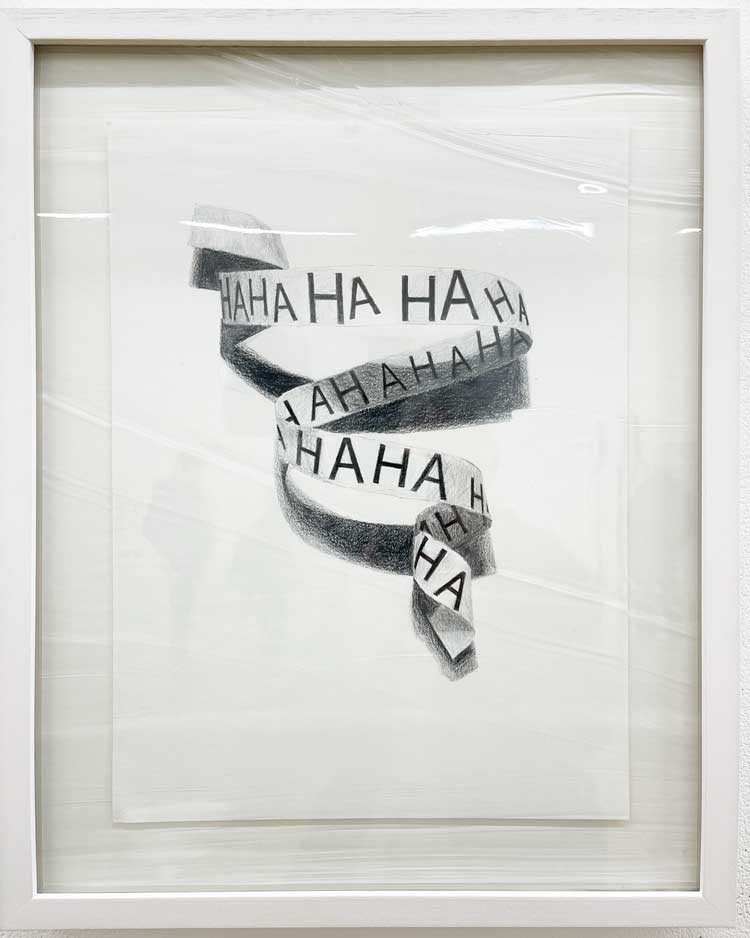
One of several scroll drawings set behind bespoke glass, installation view, Paul Eastwood: Unreadings, Mostyn, Llandudno, 14 March – 20 June 2026. Photo: © Veronica Simpson.
I wanted Eastwood to bring me into that experience of discombobulation. I wished that he had gone bold, gone big, drawn us into his confusion – as large-scale drawings might have done. In a series of his that I have seen online, huge letters dangle in isolation, in vertical lines, fading in and out of clarity, inviting opportunities in their spatial interplay to conjure new and alien readings. Just a few of these could have built up the visual impact overall, made the experience immersive.
The ideas become more compelling, however, in the two works that add an extra sensory dimension. Further into the gallery, two soundscapes are created via dangling speakers, each placed over a circle of white stools, at opposite ends of the room. I stood within one circle and encountered only Welsh. Much as I love the sound of its plosive, percussive and clashing consonants, as a non-Welsh speaker, the language remains pure noise and melody – though possibly my lack of comprehension is also part of Eastwood’s intention.
At the back of the room is an English-speaking version. Sitting within its circle, I hear a female voice stutter and glitch as she reads, the struggle to find the flow and form of words becomes more tangible. I have intimate, albeit secondhand knowledge of this battle – my now adult son is dyslexic and, until he was eight, his primary school failed to diagnose why he couldn’t master what his friends managed so easily. I can imagine all too well the terror – as Eastwood later describes to me – of being asked to read aloud in front of a class. I spent hours helping my son through exercises designed to unravel the strategies that dyslexics develop to bluff their way through impossible-seeming strings of letters.
These sound works came together through serendipity, says Eastwood. He had wanted to incorporate the “cut-up technique” popularised in the 50s and 60s by William S Burroughs, in which written text is chopped about and rearranged to create something new. When Eastwood was working with Samuel Barnes, a sound designer (who also composed the soundtrack for Eastwood’s film, shown here), the instructions and dialogue were printed on sticker sheets. The reader was asked “to read it out the first time without rehearsing it, for practice, and then we kept changing the stickers about. We did some other versions that were almost like digital mashups where you just put an algorithm in with the image that breaks everything up, and you’re asking the reader to try to follow it, so you’re getting all the ums and the ahs, and the hesitations.”
-(c)Rob-Battersby.jpg "Paul Eastwood: Unreadings, installation view, Mostyn, Llandudno, 14 March – 20 June 2026. Photo: © Rob Battersby.")
Paul Eastwood: Unreadings, installation view, Mostyn, Llandudno, 14 March – 20 June 2026. Photo: © Rob Battersby.
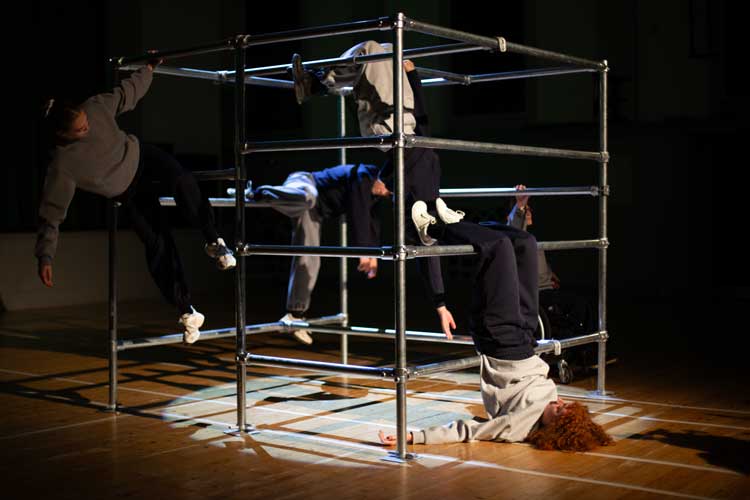
This cut-up technique also informed Barnes’s composition for the three short films shown in a darkened, second gallery, with hypnotic choreography by Angharad Harrop. Each film is labelled (clearly but subtly, in the bottom corner, at the start) with an A, B or C. Two of the films feature half-a-dozen dancers flowing around and between a scaffolding frame, and, in the third, they move without the frame, resting, leaning and folding in and around each other. To be honest, I didn’t register the glitching in the soundtrack. Any repetition or looping of rhythms was so expertly followed by the dancers that it felt entirely intentional.
However, I know, too, thanks to my son’s experiences and my reading on the subject, that the dyslexic brain brings with it an enhanced ability to memorise and visualise objects and spaces in three dimensions; a kind of extra spatial sensibility. I wonder, as I watch these three films (directed by Eilir Pierce), across two screens, whether this is what Eastwood is trying to convey. Watching the dance pieces felt like seeing that three-dimensionality translated into movement. It was fully absorbing. But while the movement was a pleasure to watch, what it was trying to convey was unclear. I found myself wondering whether the looping and folding of their bodies around the centre of the two-tier frame, in the film labelled A, was a way of replicating the central bar of the A. In the B film, was one of the dancers’ repetitive rollercoasting of her arms, with fingers linked, trying to describe the circular shapes of the B? Eastwood says not, when we speak later. “No, it was more about labelling them to distinguish between the films and also to encourage the audience to stay. They might think, ‘I’ve seen this one’ (because they are all shot with the same dancers, in the same darkened room), but they might not have.”
-(c)Rob-Battersby-2.jpg "Paul Eastwood: Unreadings, installation view, Mostyn, Llandudno, 14 March – 20 June 2026. Photo: © Rob Battersby.")
Paul Eastwood: Unreadings, installation view, Mostyn, Llandudno, 14 March – 20 June 2026. Photo: © Rob Battersby.
Eastwood brought the scripts and ideas he had developed in the two sound works – “writing very sculpturally about what language does for me” – into his briefing for the choreographer. The Welsh one deals with being bilingual, he says. “These things overlapping and tongues competing and being in knots. I hoped that would give enough of an instruction to Angharad to go for something visceral, and touching, almost all-consuming.” And, indeed, she does.
Overall, Eastwood says: “I think this (work) was just trying to shape out confusion in a really sophisticated way. It wasn’t just: here’s dyslexia. I wanted to make great work. I wanted to make beautiful drawings. I don’t know if you were able to read the text (in the scroll drawings), but they all stem from medieval speech scrolls.” That aspect escaped me (again, captions would have been helpful).
Eastwood is widely admired and liked. The Welsh artist Bedwyr Williams is a friend of his and was present at the opening. He sang Eastwood’s praises, especially his generosity – he has driven a project to repurpose an old chapel in Wrexham and found funding to adapt it into a shared, low-cost, artist studio space. His generosity extends to including, in a small side room at his show, the work of David Jones, a painter, poet and engraver, who was born in Kent in 1895 to a Welsh-speaking family and therefore had a similarly disconcerting early linguistic experience to Eastwood. Eastwood was intrigued by his paintings of letters, in which the individual forms fill the page, flowing without break or spaces. “Rather than clear language, we see beautifully rhythmic blocks of shapes and gestures,” explains the room’s caption. Eastwood is quoted as saying: “I’m interested in how the fragmented sentences and handwritten forms seem to mirror Wales’s complicated relationship with the lingua francas of Britain, from the Roman period to the present day. The overlapping texts read like a visual palimpsest, history written, erased and written again.”
Later, Eastwood tells me: “My one ambition was to bring words off the page, make them sculptural.” But for me, that ambition was only partially realised. It is impossible to say whether the show worked better on that front for other dyslexic people, or for Welsh speakers. I left feeling that this talented artist could push himself further, take up more space with these valuable perceptions.
Click on the pictures below to enlarge
-(c)Rob-Battersby-10.jpg)
-(c)Rob-Battersby-5B.jpg)
-(c)Rob-Battersby-5C.jpg)

Copyright © 1893–2026 Studio International Foundation.
The title Studio International is the property of the Studio International Foundation and, together with the content, are bound by copyright. All rights reserved.
 |
 |
 |
|---|
-1000-300.jpg)
 The Land We Live In – The Land We Left Behind
 Sussex Modernism: Retreat and Rebellion
 Bedwyr Williams: The Gulch
 Rachel Maclean: ‘I’m taking and contributing to the weird recycled ecosystem of the internet’
 Bedwyr Williams: interview