




.jpg)
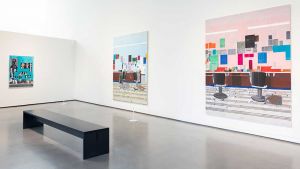
Hurvin Anderson, installation view, Tate Britain, London. Photo: Tate Photography (Larina Annora Fernandes).
Tate Britain, London
26 March – 23 August 2026
by BETH WILLIAMSON
There is a long and well-established history of English landscape painting and just as one exhibition in that tradition, Turner and Constable: Rivals and Originals, comes to a close at Tate Britain, another, Hurvin Anderson, opens as a worthy inheritor. Anderson does not merely inherit the English landscape tradition but makes it his own. His reputation has been growing over the last decade or so. In 2017, he was nominated for the Turner Prize. In 2023, he became a Royal Academician, the same year his well-received exhibition at Hepworth Wakefield showcased his barbershop paintings. In this new exhibition at Tate Britain, spanning Anderson’s entire career, he moves across and through natural, urban and political landscapes, fusing memory and imagination, interior and exterior, architecture and figure, figuration and abstraction. He broaches boundaries, enacts redaction and occupies spaces by balancing distance and proximity.
-Hurvin-Anderson-Courtesy-the-artist-and-Thomas-Dane-Gallery-Photo-Richard-Ivey.jpg "Hurvin Anderson, Limestone Wall, 2020. Private Collection. © Hurvin Anderson. Courtesy the artist and Thomas Dane Gallery. Photo: Richard Ivey.")
Hurvin Anderson, Limestone Wall, 2020. Private Collection. © Hurvin Anderson. Courtesy the artist and Thomas Dane Gallery. Photo: Richard Ivey.
Anderson was the youngest of eight children and the first to be born in Britain when his parents left Jamaica for Birmingham in the 1960s, and his paintings meander to and fro across the Atlantic between the UK and the Caribbean. His particular experience of diaspora and belonging is repeatedly explored through paintings that often delve into a deeply intense Caribbean colour palette, regardless of where he is painting. We can see this, for instance, in paintings such as Maracas III (2004), Last House (2013) or Limestone Wall (2020). Anderson has spoken of “being in one place but thinking about another”. Although he was born and grew up in Birmingham, he lived with family photographs and memories of elsewhere.
-Hurvin-Anderson-Courtesy-the-artist-and-Thomas-Dane-Gallery-Photo-Richard-Ivey.jpg "Hurvin Anderson, Maracus III, 2004. © Hurvin Anderson. Courtesy the artist and Thomas Dane Gallery. Photo: Richard Ivey.")
Hurvin Anderson, Maracus III, 2004. © Hurvin Anderson. Courtesy the artist and Thomas Dane Gallery. Photo: Richard Ivey.
This exhibition stretches across Anderson’s career from formative works to those completed just weeks before the exhibition opening. These richly layered paintings are grouped together in six themed rooms or spaces, each of which takes its name from one of Anderson’s paintings. The first room, Arrival, begins with the artist’s early work and paintings from found photographs in the 1990s, often depicting family and friends, sometimes faceless, confused in their identity. Reimagining settings and relationships, family members from England and the Caribbean are reassembled in imaginary groupings that belie the geographical distance between them. Black and white paintings such as Arrival and Arrival II, both from 1997, evoke photographs of an earlier generation of migrants and his signature blurring of memory and history, real and imagined, is lodged in the viewer’s mind from the very start. So, too, is the blurring between Anderson’s personal history and Black culture more broadly. Where exactly does memory end and imagination begin? It is an impossible question in relation to Anderson’s work. The nicely pitched exhibition interpretation suggests that “time loosens, giving way to light, form and colour”, which is also, I suppose, where figuration gives way to abstraction.
Scrumping, the second grouping of works, covers a wide range of subjects, all of which show Anderson’s bent for capturing and conveying the emotional quality or feeling of a place or moment. In the painting of the same name Scrumping (2013), Anderson paints a childhood memory of his brothers scrumping, but he melds an apple tree and a mango tree, the English and Caribbean landscape, the torn identities of Caribbean families in England. Audition (1999) shows Wyndley swimming pool in Birmingham, but this is no straightforward depiction. Instead, Anderson creates the scene by superimposing images from a series of photographs taken by his brother. Experimenting between realism and abstraction, surface and depth, the painting draws the viewer in to a field of possibilities. As the exhibition highlights, Anderson’s most recent work shifts from the personal to the collective so that the 16 panels of Passenger Opportunity (2024-25), reworked for this exhibition, harks back to postwar Jamaica and earlier still to transatlantic enslavement, exposing, once again, the dark origins of such opportunities, so called.
-Hurvin-Anderson-Courtesy-the-artist-and-Thomas-Dane-Gallery-Photo-Richard-Ivey.jpg "Hurvin Anderson, Country Club: Chicken Wire, 2008. Private Collection. © Hurvin Anderson. Courtesy the artist and Thomas Dane Gallery. Photo: Richard Ivey.")
Hurvin Anderson, Country Club: Chicken Wire, 2008. Private Collection. © Hurvin Anderson. Courtesy the artist and Thomas Dane Gallery. Photo: Richard Ivey.
The third part of the exhibition is Welcome, a space that explores Anderson’s artist residency in Port of Spain in 2002. It was during this eight-week Caribbean Contemporary Arts residency in Trinidad that the direct experience of the place became important for the development of his painting. Artist Christopher Cozier was Anderson’s guide during those eight weeks. In a recent interview in Tate Etc, Cozier recalled: “He kept on talking about spaces in between spaces. He was talking about these kinds of spaces he experienced as young person growing up in England … under flyovers, or empty lots between two buildings - as spaces of freedom. Spaces of becoming.” This plays out in works such as Between Point Radix and Moruga II (2003). This is also where the idea of grids (chain-link fences, security grills and curtains) distance the viewer. Without more direct access to spaces, we can never know precisely what lies beyond the grid.
-Hurvin-Anderson..jpg "Hurvin Anderson, Is It OK To Be Black?, 2015-16. Arts Council Collection, Southbank Centre, London © A 70th Anniversary Commission for the Arts Council Collection with New Art Exchange, Nottingham and Thomas Dane Gallery, London. © Hurvin Anderson.")
Hurvin Anderson, Is It OK To Be Black?, 2015-16. Arts Council Collection, Southbank Centre, London © A 70th Anniversary Commission for the Arts Council Collection with New Art Exchange, Nottingham and Thomas Dane Gallery, London. © Hurvin Anderson.
Is It OK to Be Black? is the title of the fourth exhibition space and Anderson’s painting of 2015-16, a rare example that depicts the faces of political leaders Malcolm X and Martin Luther King. Situating them on a barbershop wall, Anderson foregrounds his longstanding interest in race, identity and the Black experience in Britain. Elsewhere in this section of the show, we encounter Anderson’s repeated revisiting of particular themes, asking us to consider the differing positions from which we view the world.
In the fifth space, No One Remembers, the exhibition gathers together works from the artist’s Jamaican hotel series and his walks along the coastline. Here we see plant life overpowering half-built or ruined hotel complexes. There is a tension between the beautiful postcard image of the Caribbean and the more ominous views that Anderson reveals. There is another tension, too – that between insider and outsider and who gets to occupy these spaces.
-Hurvin-Anderson-DACS-2025.jpg "Hurvin Anderson, Hawksbill Bay, 2020. Tate: Lent by Tate Americas Foundation, courtesy of Mala Gaonkar 2023. © Hurvin Anderson. Courtesy the artist, Thomas Dane Gallery and VeneKlasen. Photo: Richard Ivey.")
Hurvin Anderson, Hawksbill Bay, 2020. Tate: Lent by Tate Americas Foundation, courtesy of Mala Gaonkar 2023. © Hurvin Anderson. Courtesy the artist, Thomas Dane Gallery and VeneKlasen. Photo: Richard Ivey.
Anderson also delves into colonial histories. In Rafting, the final room of the exhibition, two pairs of new paintings approach his foremost thinking on memory and history. Facing each other across the room, one pair took their starting point from historic photographs of 19th-century Jamaica, and a period of British colonial rule, enslavement and abolition. These are merged with invented reminiscences from the early 20th century and a courting couple on a raft travel down river in a tropical landscape. In the other pairing, children can been see climbing an English apple tree to pick the fruit while looking out to see crowds welcome Ethiopian Emperor Haile Selassie to Jamaica in 1966. These global configurations suggest just how fluid Anderson’s references might be. Not only that, the longer he returns to and reworks his subjects, the deeper it seems his understanding becomes and the more generous the space he creates for the viewer to better understand the times and places of his memories and imaginings. These paintings may be spaces in which to better understand the hazy days of Anderson’s personal experience, but their collective gesture is much deeper and more questioning than that. This mesmerising array of work, almost 80 paintings in all, surely questions the bucolic nature of the British landscape tradition and much more besides.
Click on the pictures below to enlarge
-(8).jpg)
-Hurvin-Anderson-Courtesy-the-artist-and-Thomas-Dane-Gallery-Photo-Richard-Ivey.jpg)
-Hurvin-Anderson-Courtesy-the-artist-and-Thomas-Dane-Gallery-Photo-Richard-Ivey.jpg)
-Hurvin-Anderson-Courtesy-the-artist-and-Thomas-Dane-Gallery-Photo-Richard-Ivey.jpg)
-Hurvin-Anderson-Courtesy-the-artist-and-Thomas-Dane-Gallery-Photo-Richard-Ivey.jpg)
-Hurvin-Anderson-Photo-Tate-Photo-(Matt-Greenwood).jpg)
-Hurvin-Anderson-Photo-Catherine-Wharfe.jpg)
,-2010-(c)-Hurvin-Anderson-Courtesy-the-artist-and-Thomas-Dane-Gallery.jpg)
-(1).jpg)

Copyright © 1893–2026 Studio International Foundation.
The title Studio International is the property of the Studio International Foundation and, together with the content, are bound by copyright. All rights reserved.
 |
 |
 |
|---|
-1000-300.jpg)
 Handpicked: Painting Flowers from 1900 to Today
 Soulscapes
 Radical Landscapes
 Hurvin Anderson: Salon Paintings
 Life Between Islands: Caribbean-British Art 1950s – Now