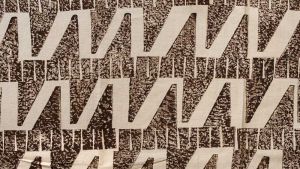

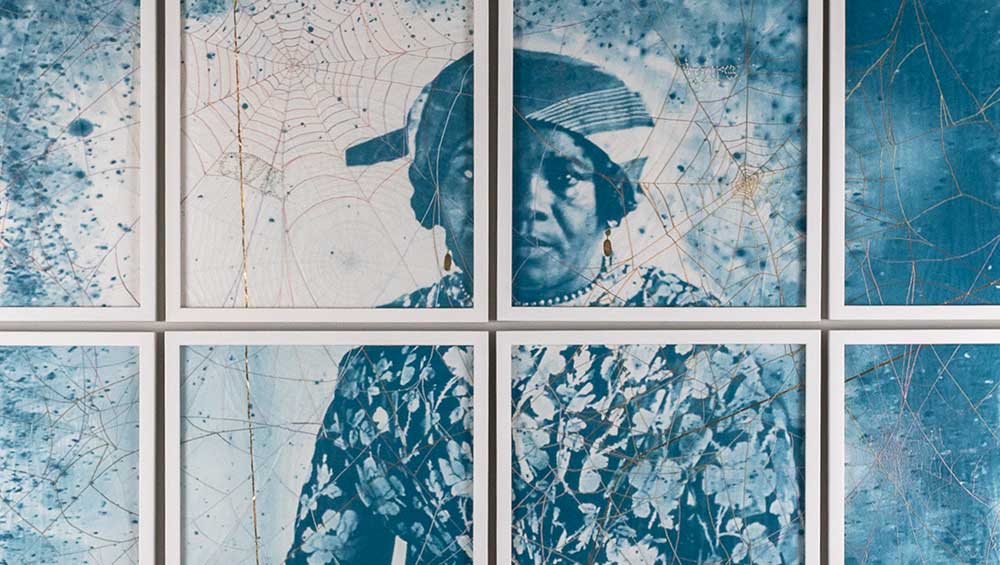
Joscelyn Gardner, With Silent Thread, 2026 (detail). Multi-panel plate lithographs on Somerset and gampi silk tissue, printed by Jill Graham, and hand-embellished with beeswax, embroidery thread and gold leaf. Each panel, 22 x 15 in. Unique. Photo: William Cummins.
Harriet Thomas Weekes: The Right to Opacity
Joscelyn Gardner: Am I a Bad Girl, Nanny? Cries of Innocence and Experience
Barbados Museum & Historical Society, Bridgetown
27 February – 3 October 2026
by CATHERINE MASON
“Times goin’ change again an’ things too, and that great British Empire goin’ change too, ’cause time ain’t got nothin’ to do with these empires.” – George Lamming, In the Castle of My Skin, 1953
For a small island, Barbados has an enormous amount of history. If you take the time to look, this history is all around, packed into 432 sq km (167 sq miles): it is in the buildings and place names, the faces of the inhabitants, and the very soil of this Caribbean island nation-state.
Museums have long been understood as authorising institutions, but that history reveals itself only from particular viewpoints. What are the conditions that make stories possible? How can museums confront the weight of traumatic histories?
Two fascinating, interrelated exhibitions on view at the Barbados Museum & Historical Society (BMHS), attempt to address this, by placing two women front and centre of the narrative – Harriet Thomas Weekes, a 19th-century Black Barbadian, and Joscelyn Gardner, a contemporary Barbadian-Canadian artist. These exhibitions continue a conversation within the museum of what it means to hold history and to be accountable to the lives contained within its collections. The director of the museum, Alissandra Cummins, clarifies: “What assumptions have we inherited and what absences have we normalised and what new understandings might emerge if we listened differently?”
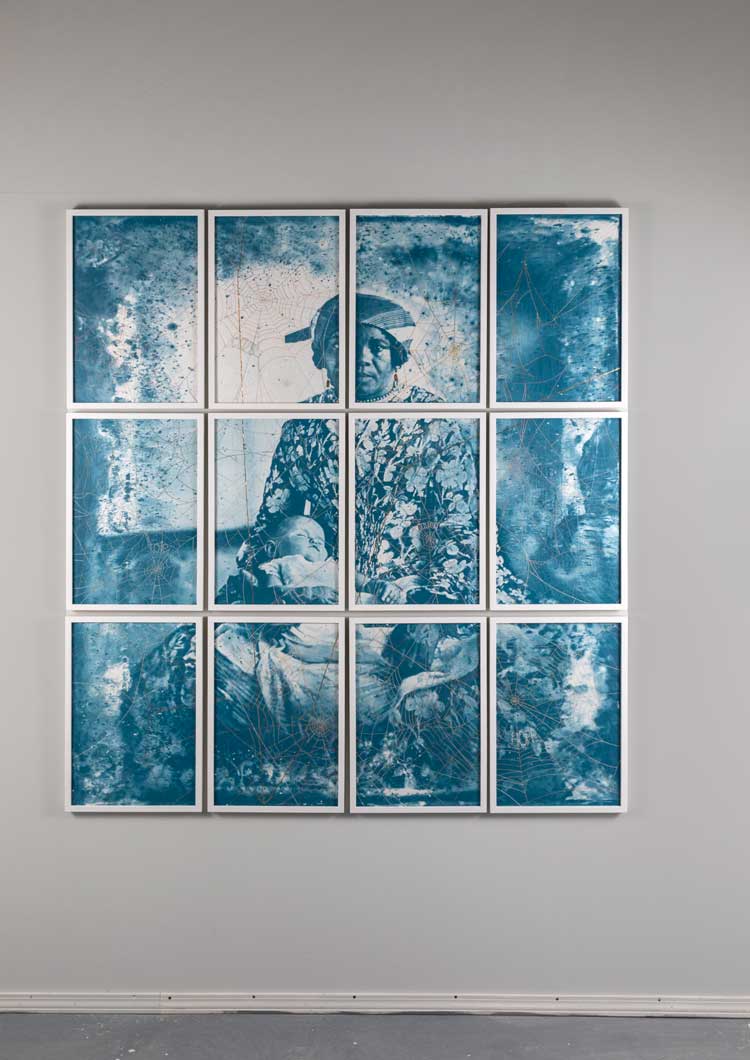
Joscelyn Gardner, With Silent Thread, 2026. Multi-panel plate lithographs on Somerset and gampi silk tissue, printed by Jill Graham, and hand-embellished with beeswax, embroidery thread and gold leaf. Each panel, 22 x 15 in. Unique. Photo: William Cummins.
Both exhibitions use as a starting point two rare photographic records, held in the BHMS collection, of Thomas Weekes (1815-97), a woman whose life covered a period of profound social and economic transition, as she worked as a nurse caring for three generations of the same family. A small black-and-white ambrotype, c1858, depicts her as a nanny, dressed in traditional creole attire, holding a white infant – Eva Douglas Richards. There is also a second ambrotype showing Thomas Weekes singly. The cost, access to photographic studios, and social barriers of the period meant that few named portraits of Black individuals were produced or preserved. As Cummins explains: “Nineteenth-century full-frontal images of Black individuals are extremely rare and when they do appear, they were often framed through typologies – spectacle, or ethnographic anonymity. These two portraits are in every sense extraordinary – not only of a Black Barbadian woman, but to hold two images of the same woman is nothing short of miraculous.”
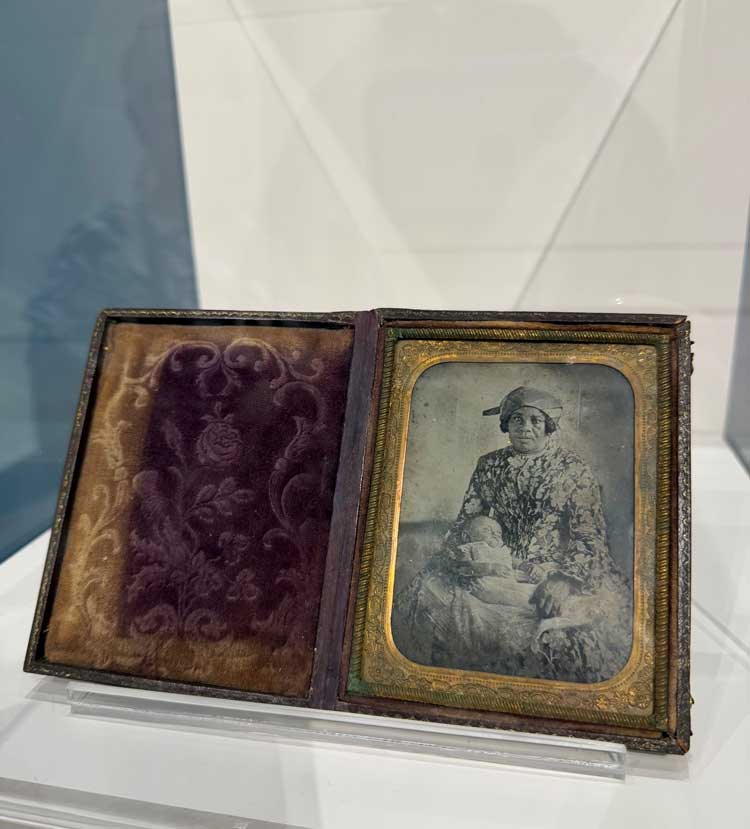
Ambrotype portrait of Harriet Thomas Weekes with Eva Douglas Richards, 1858. Gift of Beatrice Sinckler to the Barbados Museum & Historical Society.
Enslaved and formerly enslaved Black women played a central role in domestic life in Barbados as nannies, wet nurses and caregivers, providing intimate, daily care for white children within plantation and post-emancipation households. This labour was shaped by profound inequality: affection and closeness existed alongside coercion, racial hierarchy and limited autonomy.
Recent archival work has uncovered some fragments about Thomas Weekes. We gain the briefest glimpse of her life – she is recorded as a two-year-old enslaved child on a plantation, church baptismal records show the christening of her son, and finally her burial at 80 as a free woman. However, rather than seeking to tell her story in full, this exhibition embraces what cannot be fully known, honouring this woman, without reducing her to the limits of the colonial archive. The exhibition’s methodology here uses Édouard Glissant’s concept of the “right to opacity” from his Poetics of Relation (1990). This reading is a decolonial, ethical and political demand for the right of individuals and cultures to be understood as inherently complex and different, without being forced into a transparent, easily categorised, or “known” framework by dominant, often western, systems. Thomas Weekes can exist as diverse and complex, maintaining her own identity to not be completely understood. She is not a closed narrative; she has a right to exist beyond the “completeness” of the colonial record.
Both photographs have been carefully preserved in portable diptych frames that close like a book and were donated by a female descendant of the child pictured, safeguarded by the family for more than a century. The artist Joscelyn Gardner first saw them on loan to the Art Gallery of Ontario and found these objects significant on several levels, “as treasured personal heirlooms from my homeland that possibly held cherished memories; as an important historical record of the British colonial era; as an image that could tell myriad (untold) stories; and, as a means for examining (imagined) domestic relationships between Black and white Creole subjects from the particular viewpoint of a Black nanny and a white child in hopes of understanding (and healing) sometimes turbulent and unspoken feelings that continue to haunt contemporary Creole society and the wider western world.”
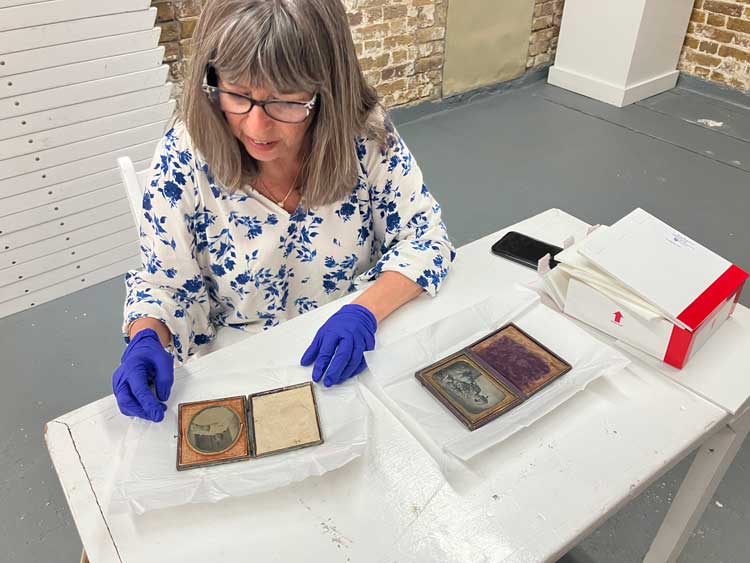
The artist Joscelyn Gardner examining the two ambrotype portraits of Harriet Thomas Weekes at the Barbados Museum & Historical Society, 2025. Photo: Natalie McGuire.
Gardner recognises herself as an “implicated subject” in relation to plantation slavery, owing to her white Creole family history in Barbados that dates from the 17th century. Gardner has been exploring these themes in art for many years. By working with archives and objects she aims to “retrieve incidents that lie buried in our collective memory with a view to reconciling the past with the present and moving towards a metaphorical healing of historical wounds and a future in which radical reciprocity and care are centred”. Her investigations also reflect her personal journey of reckoning and reconciliation with colonial legacies and diasporic identities.
British colonisation of Barbados began from 1627; the indigenous Amerindian Arawak people having disappeared. The first commercial crops, tobacco and indigo, transitioned quickly to the far more lucrative sugar cane. Initially, sugar production began with indentured servants – defeated soldiers and Royalist supporters, white prisoners, vagrants and homeless people, able to “pay off” their debt in four to seven years. However, after complaints and rebellions about the harsh conditions, the intense labour required on Barbadian plantations, and the limited scope for advancement, parliament outlawed the use of such people. Therefore, planters turned their attention to Africa and began the importation and enslavement of Africans. And so, as these few lines from Kamau Brathwaithe’s poem Calypso so evocatively expresses: “The islands roared into green plantations ruled by silver sugar cane, sweat and profit, cutlass profit, islands ruled by sugar cane.”
Estimates place between 387,000 and more than 500,000 enslaved Africans imported into Barbados, as the island served as a primary Caribbean destination in the British Empire. The 1661 Slave Code legalised chattel slavery: it stripped the enslaved of rights, normalised punishment, and defined a racial order that protected planters’ property first. Barbados served as a laboratory where planters and politicians tested techniques for controlling labour and maximising profit.
Following emancipation in 1834, a mandatory “apprenticeship” system was enforced where previously enslaved people over the age of six had to work 40-45 hours a week without pay for their former masters, until full freedom was granted in 1838. Colourful chattel houses dating from this period are still seen dotted around the island – the small, movable wooden homes for plantation workers who did not own the land they lived on (the origins of the phrase “goods and chattels”). Many Black women continued to work as nannies or wet nurses under new but still restrictive economic and social conditions, navigating survival within a society slow to dismantle the structures of slavery.
With these exhibitions, the BMHS proves itself an exemplar in how the combination of built environment with historical archive materials can inform contemporary art to create profound connections across time. The museum, founded in 1933, is housed in buildings that were originally a military prison, constructed in the 1820s, as part of the Garrison area. Located south of the capital Bridgetown, this was the 18th-century headquarters for British forces in the Caribbean, in use up to 1906. The Garrison Historic Area is now a Unesco world heritage site and features 115 protected buildings. Throughout the museum, visitors are invited into a space of listening, reflection and shared meaning-making, where presence matters more than completeness. It is an invitation to stop and consider the silences and absences within archives and to understand that archives, and indeed the discipline of museology itself, have their origins in a western colonial praxis.
In Am I a Bad Girl, Nanny? Cries of Innocence and Experience, Gardner exhibits a folio of 24 stone and plate lithographic prints, working with Jill Graham, a renowned master printer from NSCAD University, Nova Scotia. It is a complex work, with layers of meaning, that rewards careful viewing. Gardner’s richly detailed images each centre on an organic mass, that sometimes takes the form of a pouch, entwined with local flora and fauna. These she calls “Obi balls” in reference to Obeah, the spiritual practice of healing, protection and sorcery that has its roots in West African traditions. Historically used as a form of resistance by enslaved people, Obeah involves manipulating spiritual forces, using herbs, charms and ancestral reverence.
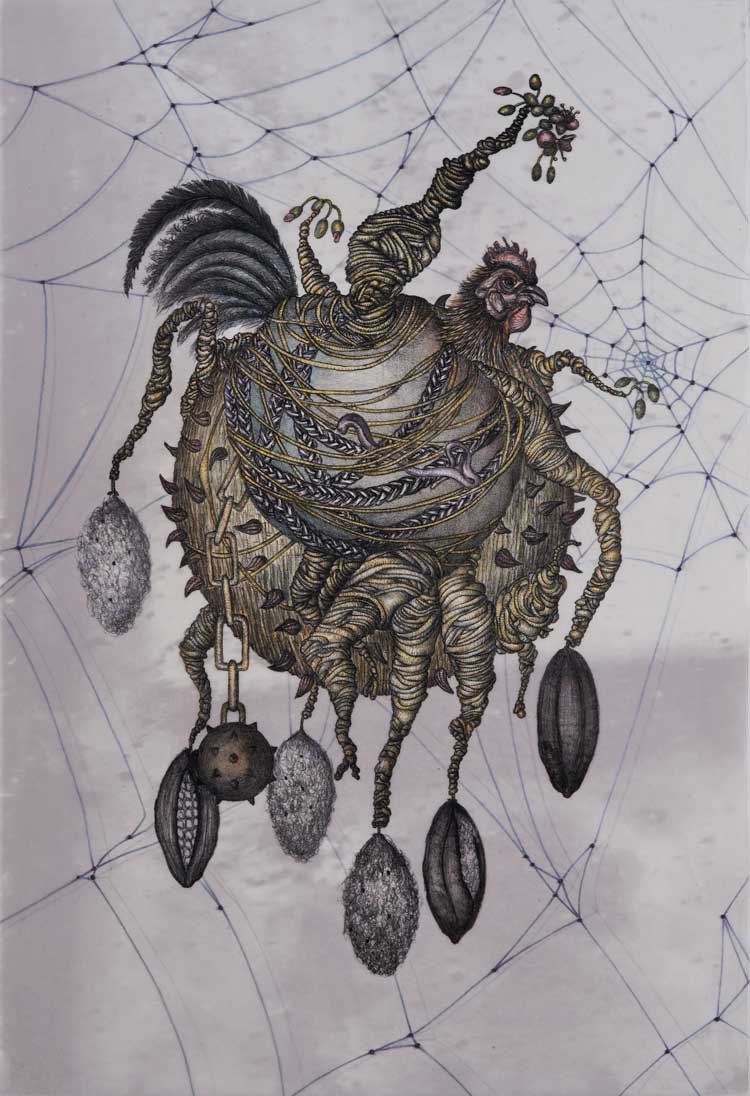
Joscelyn Gardner, Am I a bad girl, Nanny? Cries of Innocence and of Experience, Panel 5B, 2026 (detail) from a folio of 24 hand-embellished stone/plate lithographs on Somerset and gampi silk tissue, printed by Jill Graham, with 12 interleaf digital archival prints on vellum, 22 x 15 in. Variable edition of four. Photo: Paul Lambert.
The intricate drawings appear swollen with memories and island life, waiting to burst out. In all, depictions of roots grow downwards, feeling for the ground. These balls are wrapped and bound with loops of braided female hair, bunching together specimens of herbs, orchids, tamarind pods, insects, even a “yard fowl” (a wild-roaming chicken regularly seen around neighbourhoods, that can symbolise an independence of spirit, as well as being associated with Obeah). These are continuing interests of Gardner, her print series Creole Portraits (2002-11) consists of ambiguous images of the back of female heads with intricately braided Afrocentric hairstyles, some entwined with horrific iron slave collars and others juxtaposed with illustrations of plants, traditionally used by women for medicinal purposes.
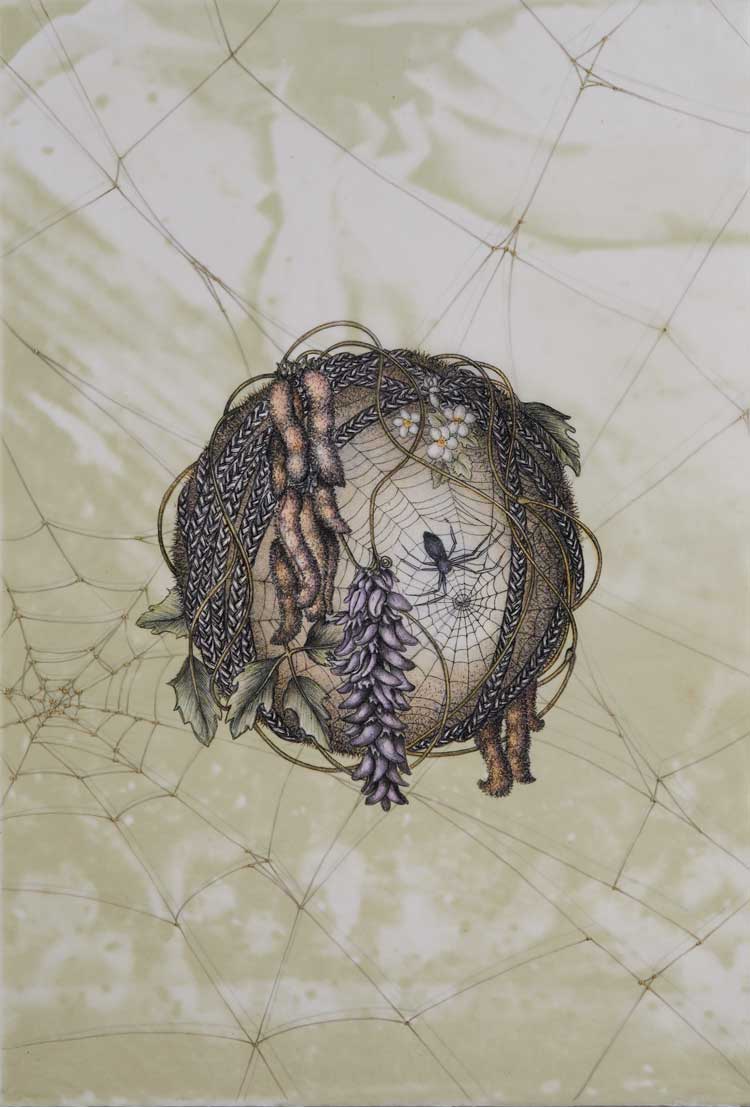
Joscelyn Gardner, Am I a bad girl, Nanny? Cries of Innocence and of Experience, Panel 10B, 2026 (detail) from a folio of 24 hand-embellished stone/plate lithographs on Somerset and gampi silk tissue, printed by Jill Graham, with 12 interleaf digital archival prints on vellum, 22 x 15 in. Variable edition of four. Photo: Paul Lambert.
In the series on view here each print is additionally hand-embroidered by the artist. These threads meander across the picture plane, connecting each sheet to the next, like a spider’s web, forming links across time. Embroidery and sewing speak to the history of women’s work and craft, especially in the 18th and 19th centuries practised as a leisure pursuit by wealthy women, and out of necessity by enslaved or working-class women.
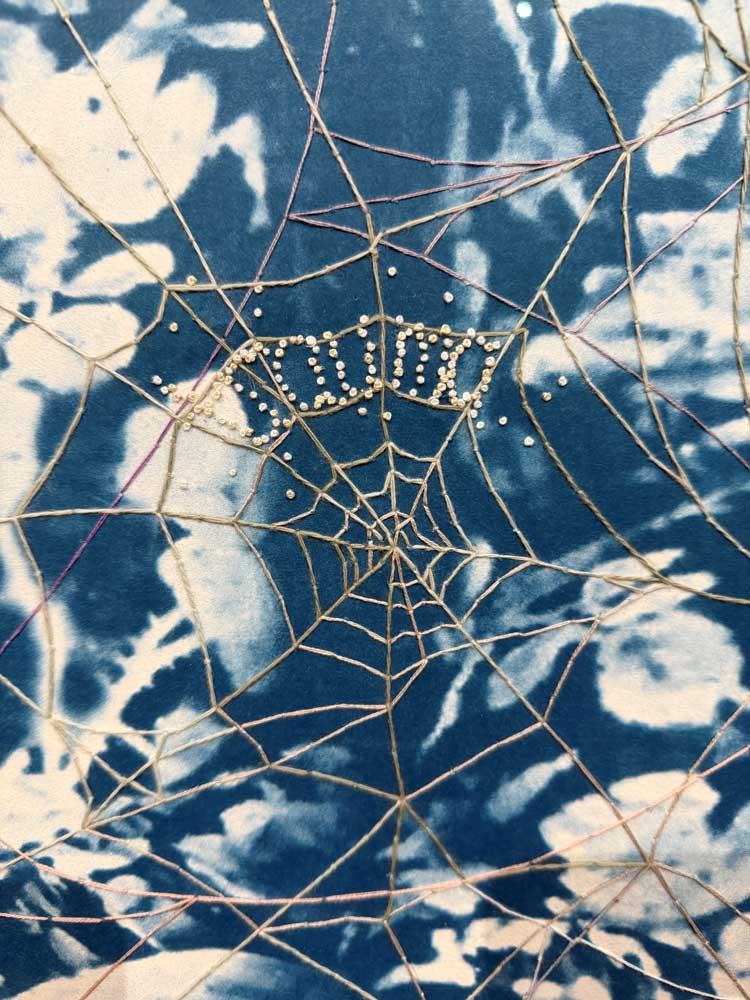
Joscelyn Gardner, With Silent Thread, 2026 (detail). Multi-panel plate lithographs on Somerset and gampi silk tissue, printed by Jill Graham, and hand-embellished with beeswax, embroidery thread and gold leaf. Photo: William Cummins.
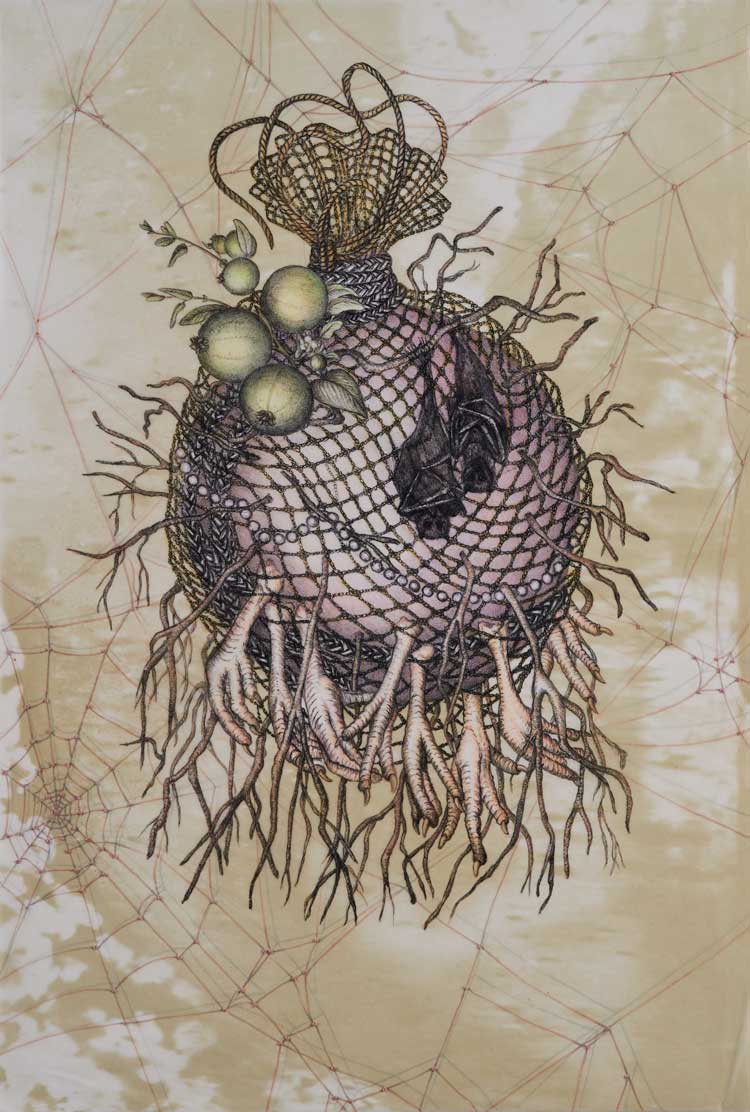
Joscelyn Gardner, Am I a bad girl, Nanny? Cries of Innocence and of Experience, Panel 8B, 2026 (detail) from a folio of 24 hand-embellished stone/plate lithographs on Somerset and gampi silk tissue, printed by Jill Graham, with 12 interleaf digital archival prints on vellum, 22 x 15 in. Variable edition of four. Photo: Paul Lambert.
Alongside each image the artist has produced another print of her handwritten text. These are letters from the child Eva to the nanny from a 21st-century perspective. If you will, a ghost of Eva, or Obis (the traditional spirit), living in our own times, with knowledge that is different from the 1900s. She looks back at her life, exploring the relationship with her nanny using that knowledge and showing compassion. These begin, “Dearest Nurse Weekes” and continue an imaginary rhetorical conversation, wherein Eva asks, for example: “Did you know that we loved you? Please speak your truth, we will listen …”
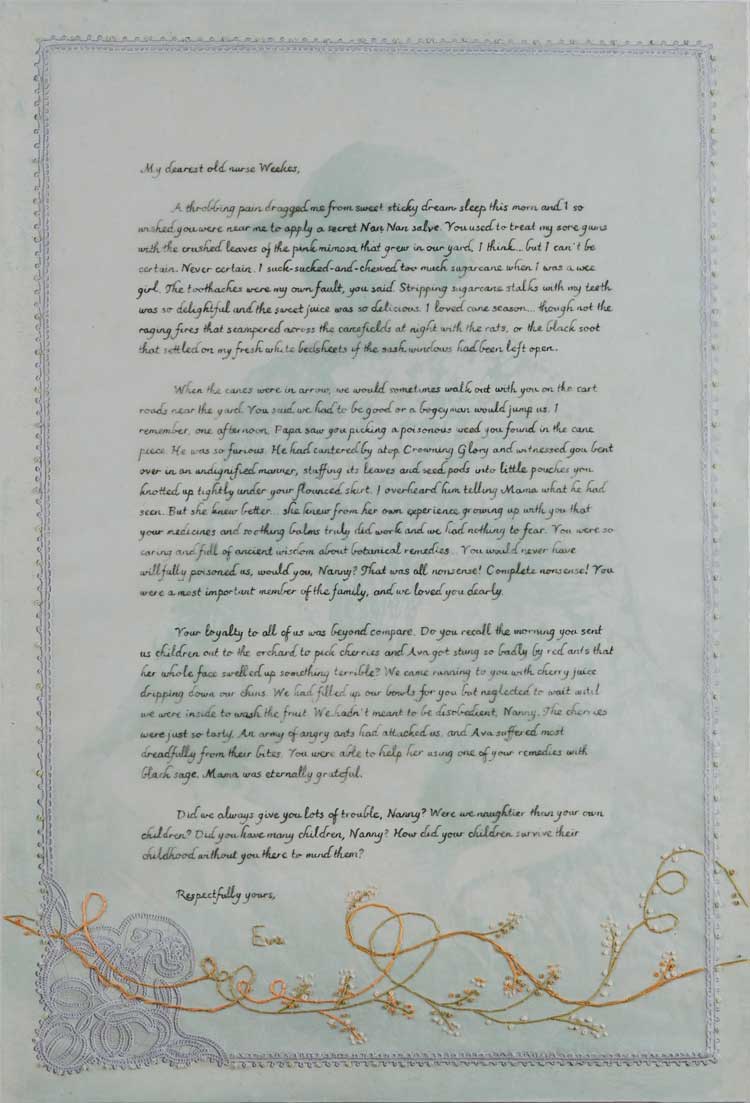
Joscelyn Gardner, Am I a bad girl, Nanny? Cries of Innocence and of Experience, Panel 6A, 2026 (detail) from a folio of 24 hand-embellished stone/plate lithographs on Somerset and gampi silk tissue, printed by Jill Graham, with 12 interleaf digital archival prints on vellum, 22 x 15 in. Variable edition of four. Photo: Paul Lambert.
Joscelyn Gardner, Am I a Bad Girl, Nanny? Cries of Innocence and of Experience, Panel 6A, 2026, detail from a folio of 24 hand-embellished stone/plate lithographs on Somerset and gampi silk tissue, printed by Jill Graham, with 12 interleaf digital archival prints on vellum, 22" x 15". Variable edition of four. Photo credit: Paul Lambert.
Gardner’s series references William Blake’s collection of illustrated poems, Songs of Innocence and of Experience (1794). Blake sees childhood as a state of protected innocence, but one that is not immune to the fallen world and its institutions. In Nurse’s Song, in Songs of Innocence, the nurse is of a jovial and warm-hearted nature and in Songs of Experience she is fearful and bitter, pointing to the fact that destructive forces can replace childlike innocence. In the final letter from Eva, she asks her nanny: “Have we been forever contaminated by the embroidered chaos of our shared history?” Eva quotes Blake’s poem A Cradle Song: “When my little heart doth wake, then the dreadful night shall break.”
Gardner reminds us that concepts of innocence and experience shift through time, as Eva and her nanny’s lives become entangled, born into roles that their skin colour dictated. This calls to mind the Blake historian DG Gillham’s reading: “Human beings, derive their only true life from what they are in association with others.”
Today, as Barbadians continue to debate memory, identity and the responsibilities of freedom, museums such as the BMHS are critical sites, not only for collections management but also as spaces for examining post-colonial relationships and re-energising historical stories for new generations. The museum can become a site of national identity, a place of dialogue that understands how heritage, in this Caribbean region, is an evolving narrative residing in memory as much as artefacts.
Click on the pictures below to enlarge

Copyright © 1893–2026 Studio International Foundation.
The title Studio International is the property of the Studio International Foundation and, together with the content, are bound by copyright. All rights reserved.
 |
 |
 |
|---|
-1000-300.jpg)