




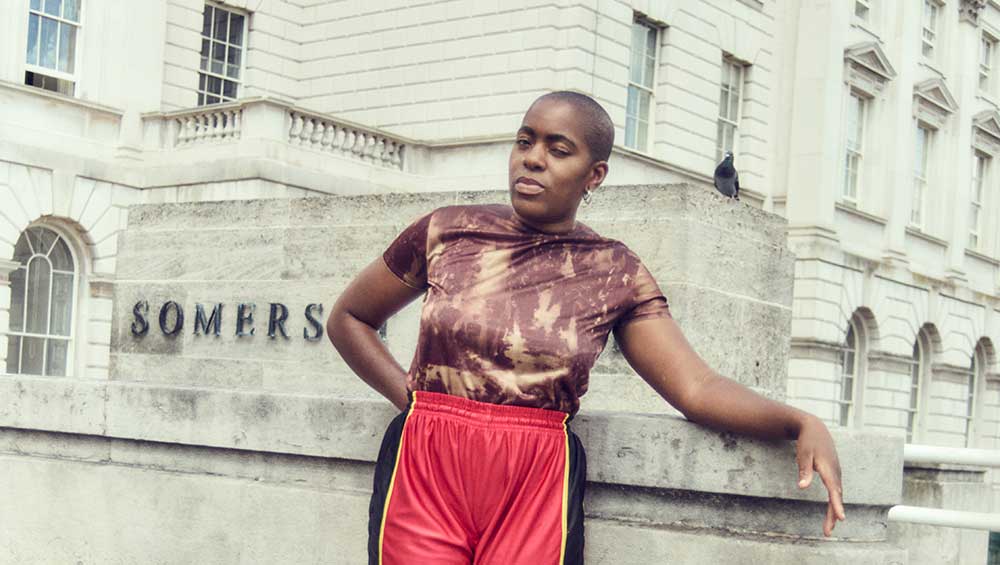
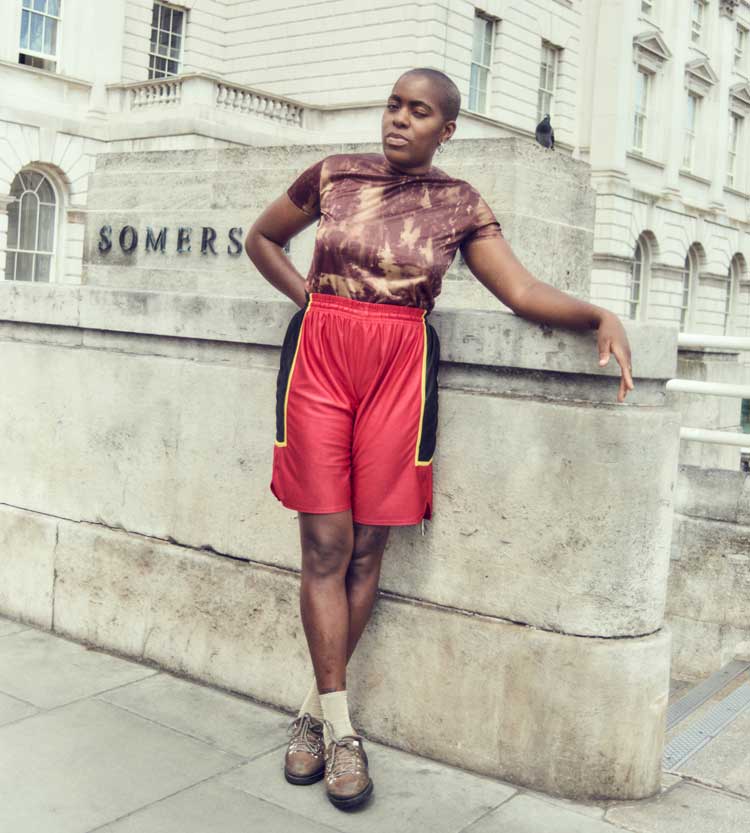
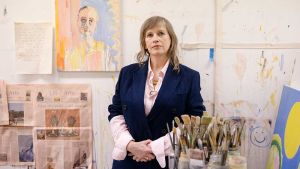
Onyeka Igwe. Photo: Kwame Dapaa.
by NICOLA HOMER
Onyeka Igwe cycled to Tate Britain on a rainy, wintry day to have a conversation with Studio International. The London-based artist and film-maker works with elements of audio, film, text and performance to investigate political and historical questions, as in her Art Now exhibition at the gallery. Entitled Our Generous Mother, it charts the story of the University of Ibadan, the oldest degree-awarding institution in Nigeria and alma matter of the acclaimed African novelist Chinua Achebe, author of Things Fall Apart.
Igwe completed a degree in politics at the University of Bristol before working in TV and doing a doctorate at the University of the Arts London. Among her sources of inspiration, Igwe cites the Black Audio Film Collective’s work, the Danish film director Lars Von Trier’s Dogville, and the Nigerian-American artist Toyin Ojih Odutola’s 2020 exhibition at the Barbican in London. At the Tate cafe, she spoke about the importance of arts and culture in a changing world: “It can feel very much like arts and culture aren’t very important, but I do think that they provide us with a kind of map or a framework for how to imagine a different reality,” she says. “It does give me a little bit of hope.”
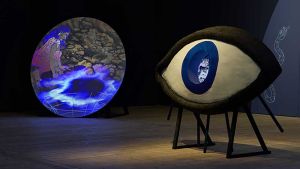
-Onyeka-Igwe.jpg "Onyeka Igwe, our generous mother, 2025. © Onyeka Igwe.")
Onyeka Igwe, our generous mother, 2025. © Onyeka Igwe.
Igwe is associate professor in contemporary art at the Ruskin School of Art, which is part of the University of Oxford’s humanities division. In 2025, she was joint recipient, with fellow artist Morgan Quaintance, of the annual Film London Jarman Award. Both had been shortlisted for the prize three years earlier, so perseverance finally paid off. The award winners were congratulated by Adrian Wootton, chief executive of Film London and the British Film Commission, for their “significant bodies of work at the forefront of artists’ moving image practice”. Igwe was recognised for her essay film A Radical Duet (2023), which presents a fictional meeting, set in 1940s London, when two women of different generations put their imagination into writing a radical play, which explores anti-colonialism. Igwe’s The Miracle on George Green (2022) also received a commendation, following its exhibition in New York at the High Line, an elevated park and promenade built on an abandoned railway line in Manhattan. This spring, the film will be screened at the Fruitmarket Gallery in Edinburgh, in a group exhibition of moving image artists’ works about ecology and the environment. Igwe has built an international reputation through exhibiting works at the contemporary art museum MoMA PS1 in Long Island City in New York and the Venice Biennale.
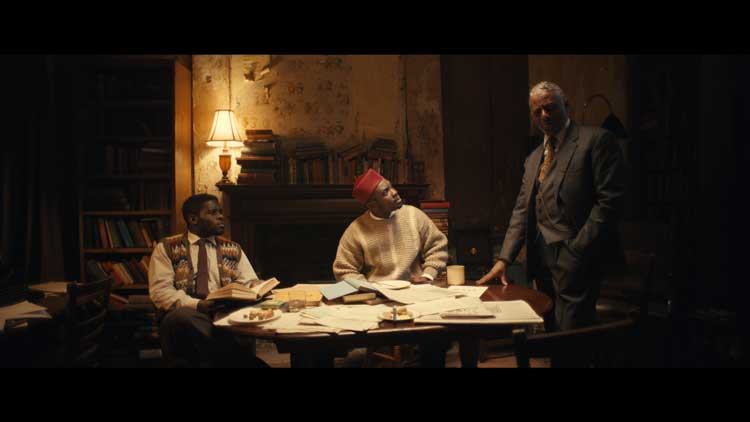
Onyeka Igwe, A Radical Duet, 2023. Digital video, 28:09. Courtesy of the artist.
Igwe spoke to Studio International at Tate Britain, ahead of her performance on 28 March, which is part of Somerset House Studios’ experimental sound and music series in London. The following is an edited version of our conversation.
Nicola Homer: Could you tell me a bit about your background as an artist and film-maker and your journey from studying at university to the present?
Onyeka Igwe: I studied politics at Bristol University. and while I was there, I came to the conclusion that I didn’t want to pursue a career in politics. I was making films as a kind of pastime with friends, and then I decided I would take it a little more seriously and work a bit more in film after graduating. So, I worked for a small production company and spent some years working in roles in mostly TV. I worked as an archive researcher, a technical role, all different things. But I guess I had an encounter with art and artists a little bit later, in my mid-20s, when I moved into a warehouse, where lots of artists lived, and we had a project space and a gallery. And I guess I had a secondary education there by learning, by watching people make. I never really understood what it was to be an artist, and how people lived, and so, I was getting a first-hand impression of that. Then I started changing my film-making to move away from more non-fiction, documentary, reality-based work, to think about how ideas could be portrayed in films. I started moving my work into the art world in some way and showing more in gallery spaces. Then I started a PhD 10 years ago, and that really allowed me time to think about what a practice was, and that’s how I emerged, I guess.
NH: So, when did you start enjoying art?
OI: Good question. I have always enjoyed art in its broadest sense. If we are talking about contemporary or visual art, I would say not until my mid-20s did I really start engaging with it, going to see things, and I understood it in its more expansive and contemporary sense. I think, prior to that, I had thought about art as being something relegated to the past, like large-scale paintings that I would see in a museum. But when I was 25, when I started seeing people my own age making art, and understanding how they made it, I started enjoying it.
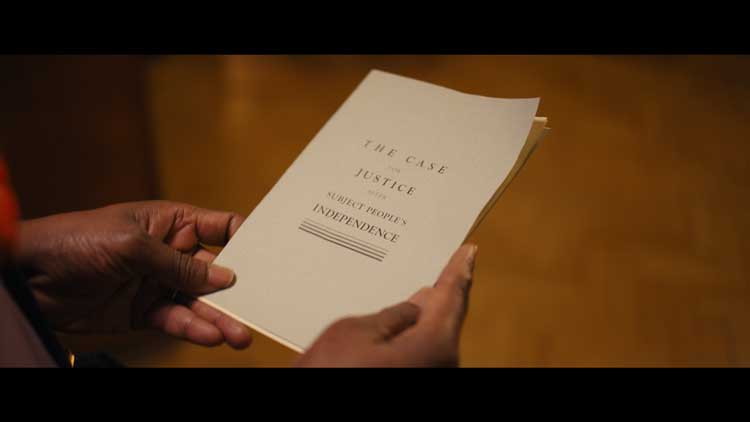
Onyeka Igwe, A Radical Duet, 2023. Digital video, 28:09. Courtesy of the artist.
NH: Now you have an installation at Tate Britain. What was the idea behind your new body of work, which is currently on display at this museum?
OI: One of the main ideas was going back to thinking about colonial archives and how to use them … There is this question that I have always had, when thinking about the archive, and especially the colonial archive, is that it puts you in a position, where they are often one of the only ways to encounter the past for a particular people, particular places, but it also comes with this racist, extractive legacy, so how to deal with that. I always wanted to try to transform those images in some way. And this time, coming back to it after doing several works in the past, I thought what I want to try and show in an installation is that one thing could be seen in many, many different ways, so that feeds into the film, that there are all these different voices in the film, telling the story of one place, but in contradictory ways, often.
NH: I gather that it is about an intellectual beacon of a university in Nigeria. How has Nigeria influenced your work?
OI: My family are from Nigeria, and I guess one of the big questions I was interested in when I started making films, was thinking about how I came to be, what the influences were that constructed my particular place in the world, and in time, and one of those things was definitely Nigeria. So, it’s a place I have filmed in, and made films about, engaged with its history. It comes up quite a lot in my work.
NH: How do you use literature to engage with its history?
OI: There was one time when I was making a film, and I was asking my dad questions about his past, and he told me I should read Omenuko by Pita Nwana, which is reportedly the first book published in Igbo. It is the narrative biography of a real person, who came from the same part of Nigeria as my parents, and features my grandfather as a character. I think literature can be a tool to help to connect to things. And I guess my relationship to Nigeria is one of some kind of distance – I don’t live there, I didn’t grow up there, so I’m always trying to encounter it. And yes, I can encounter it from my family, through myself, but other creative mediums also help me encounter it, be that literature, be that music, be that dance. They are all ways in which I can come to know it.
NH: It is a great achievement to be exhibiting at this museum. How has Tate Britain supported your work?
OI: They were very keen for me to make it an ambitious installation. So, that was a new opportunity to think a bit more expansively about my own work. Also, I think something about exhibiting here is that so many people see it. People have contacted me out of the blue, people I don’t know. The other day I was at the ICA, and I overheard someone talking about going to see my exhibition, so the visibility that it provides is a big support.
,-video-still-Courtesy-of-the-artist_10.jpg "Onyeka Igwe, The Miracle on George Green, 2022. Digital video, 12:09. Courtesy of the artist.")
Onyeka Igwe, The Miracle on George Green, 2022. Digital video, 12:09. Courtesy of the artist.
NH: In 2022, you exhibited the film The Miracle on George Green at the High Line in New York. I understand the High Line is an elevated park in the city, which is above an abandoned railway line. What did you learn from that experience?
OI: One of the reasons I was interested in making The Miracle on George Green is thinking through the history and the legacy of the commons [land collectively owned and used], what that meant in the past, and what that means today. The film was selected to screen at the High Line because they saw some resonance with an idea of the commons and the High Line. But what I think I learned about that is that film as a public commission is a very tricky thing to do. It could only be screened when the sun came down, so you could see it better, and there were so many people passing through, so people really stayed for a very short time to watch the work. It made me think about what it means to show something when there are so many other distractions, so when people are busy, what do they get from it. And because the film has a lot of music and song in it, I think that’s what stayed. It definitely made me think more about how and where to show your work, and what are the best conditions for moving image work.
Onyeka Igwe, The Miracle on George Green (2022), excerpt
NH: Absolutely. I understand you drew on social history and memories for that fascinating work. How did your childhood inspire The Miracle on George Green?
OI: I grew up in Leyton [in east London] in the 90s, and there were really big anti-road protests because the government at the time was building new motorways, and people were campaigning against them. A link road was planned to [the M11] motorway. People from the local area and from outside came to protest about this road being built, and one of the things that they were going to do to build the road was knock down a sweet chestnut tree. So, I had these memories. I mean the protests took over in some ways parts of where I grew up in Leyton, in Leytonstone, in Wanstead. People squatted in all these buildings, they created this kind of free town, and it changed the atmosphere of that place. And all these local schools were writing letters to the tree. I had this vague memory of something around these details, not precise, and, during the lockdown, there was this time of nostalgia, and I moved back closer to where that happened, and so I was having these memories about it, and I wanted to try to make something that reflected a kind of meandering, creative, is this true, isn’t this true, encounter with the history.
,-video-still-Courtesy-of-the-artist_5.jpg "Onyeka Igwe, The Miracle on George Green, 2022. Digital video, 12:09. Courtesy of the artist.")
Onyeka Igwe, The Miracle on George Green, 2022. Digital video, 12:09. Courtesy of the artist.
NH: During that time of the lockdown, during the global pandemic, people paused and did quite a bit of walking and thinking … Now, moving on to 2023, I gather that the Jarman Award recognised your achievement of creating not only The Miracle on George Green, but also a film from 2023 called A Radical Duet, and both films are notable for their audio elements. On A Radical Duet, how did you investigate cultural issues through forms of theatre and performance?
OI: I think the film tries to think about the role of theatre as a space that allows us to imagine possible worlds, imagine the future, imagine different ways of doing things, rehearse other social formations. I was thinking through both the historical moment, the 1940s, and particular anti-colonial movements, and their use of theatre and creativity, to think about a political problem, and trying to transpose those tools, those ideas, into a present moment, and a current political issue that came out, the idea of reparation. So, I was using the past and theatre as a way of thinking through a really thorny current issue.
NH: I noticed a well-known poem by Shakespeare was performed in that work that was very moving. Would you like to say a little bit more about your choice of works in the film?
OI: When I was researching some of the historical figures that the film was inspired by, they came from the colonial Caribbean, and they were schooled in a very traditional English culture, literature, heritage and their references were classical figures. So, when I was trying to think about what these characters would draw on to illustrate a point about the power of theatre or the power of words, I thought they would go to something like Shakespeare, they would go to a famous soliloquy to illustrate their point and everyone would understand it. So, I was definitely working with it in the historical framework and thinking about what people of that time would have done.
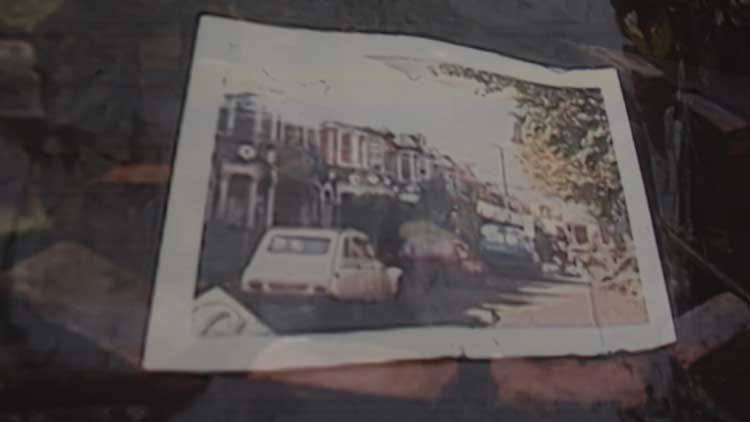
Onyeka Igwe, The Miracle on George Green, 2022. Digital video, 12:09. Courtesy of the artist.
NH: What are your future aims and ambitions in terms of the direction in which you may see your work progressing?
OI: I’m interested in expanding my practice in terms of duration, thinking about longer form works. The longest work I have made is probably around 30 minutes. And I’m interested in pushing structure in some way in terms of making a feature film. I’m also interested in working, of course, in a different way, more collectively, trying to experiment with different models of film-making. Also, in the gallery space, I’m still curious about extending this idea of choreographing space through film, how people can move around a space and encounter a film in multiple ways.
NH: That links to your research question, which you have been addressing in your line of inquiry. Would you like to talk a bit about that, about how people live together?
OI: A long time ago, maybe during my degree, someone told me that politics is the question of how we live together, and so how we make rules about how we live together, how we negotiate other people. I think my work is very much thinking about that, thinking about political questions, historically but also in the present, so thinking always about how we live together. For example, the installation here is a question of, what does a university mean, how is it that we like think about study, how has that changed through time, and how does that work in a different place like Nigeria, and how can it potentially work in the future?
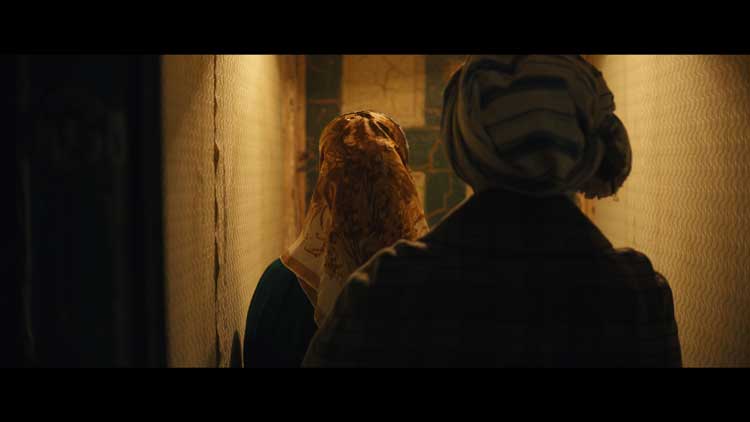
Onyeka Igwe, A Radical Duet, 2023. Digital video, 28:09. Courtesy of the artist.
NH: Those are very interesting questions. Would you agree that your work is perhaps a continuous process of inquiry into the world?
OI: Yes, I think my work is really cumulative, and it is about my encounter with the world. And so those questions don’t necessarily end with a particular work. They sometimes live a bit longer. I’ll find aspects of my last work in my new work. For example, with this installation here at Tate Britain, the seed of it happened when I was researching for A Radical Duet. I went to a university to do some research, because they had some archival papers, and the experience of going there led me to this work. I didn’t know it at the time. It took me a few years to figure it out. But that often happens.
NH: How do you investigate the concept of the archive through storytelling in your practice?
OI: I think that the archive as an institution, as a place that we go, has a lot of power, the power to dictate what we understand as history. And I think storytelling punctures that power in some way, because there are so many different ways in which we can understand the past, and archives are a process of the production of knowledge, and they are the implementation of power. And so, if we can understand history as the theory of multiple stories, multiple narratives, which I think storytelling allows us to do, then maybe we can, as I say, puncture the power that states, that hegemony dictates for how we should be thinking about history.
NH: That’s excellent. Now could you discuss the projects that you have coming up this year, perhaps the exhibitions that you will be doing internationally?
OI: Yes. I have an exhibition at Secession in Vienna, in the summer, where I am revisiting a video and a sound piece that I did for the Nigeria Pavilion at the Venice Biennale two years ago. So, I am restaging that work in their galleries, and thinking about how to foreground the sound elements of it in a different way, and how to bring in new things I have been working on … I used slides in this exhibition. So, I’m coming back to slides for this new exhibition in Vienna as well.
• Onyeka Igwe: Art Now is at Tate Britain until 17 May 2026. The artist will present a live iteration of a film installation, created for the Nigeria Pavilion at the 2024 Venice Biennale, at Somerset House, London on 28 March, as part of Assembly 2026. Her work is being shown as part of the group exhibition Where We Meet Land: Environment and Ecology in Artists’ Moving Image, Fruitmarket, Edinburgh, during 7-22 March 2026. She also has a show at Secession, Vienna, from 12 June to 30 August 2026.
Click on the pictures below to enlarge

Copyright © 1893–2026 Studio International Foundation.
The title Studio International is the property of the Studio International Foundation and, together with the content, are bound by copyright. All rights reserved.
 |
 |
 |
|---|
-1000-300.jpg)
,-2020-300.jpg) Lagos, Peckham, Repeat: Pilgrimage to the Lakes
Lagos, Peckham, Repeat: Pilgrimage to the Lakes Grace Ndiritu – interview: ‘Museums hold our collective past and they can hold our future’
 The Film London Jarman Award 2020
 Drawn Together Again
 Daria Martin – interview: ‘Most people can relate to the feeling of being in exile’