




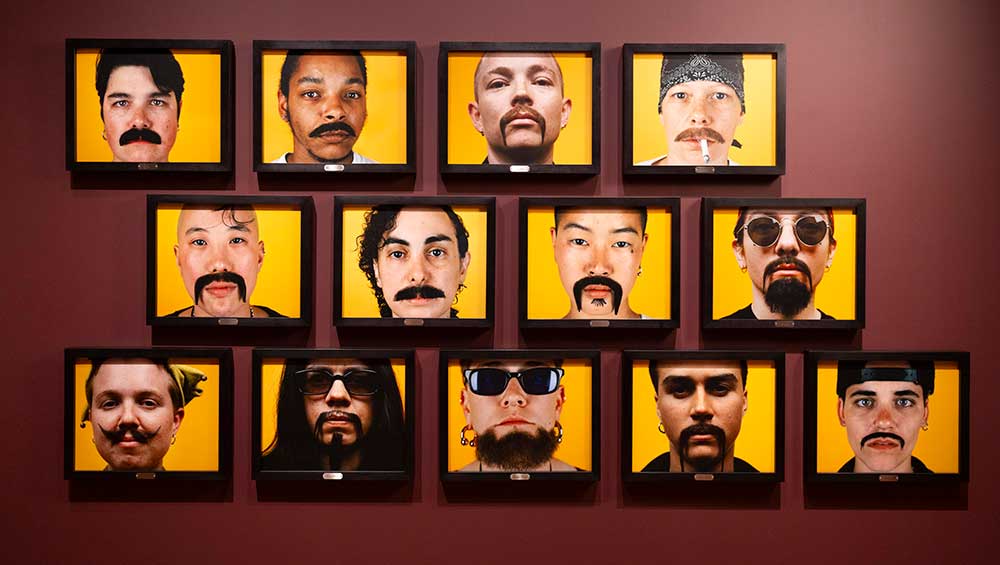
Catherine Opie: To Be Seen, installation view, National Portrait Gallery, London. Photo copyright © David Parry.
National Portrait Gallery, London
5 March – 31 May 2026
by TOM DENMAN
In Catherine Opie’s magnificent Self-Portrait/Nursing (2004), she breastfeeds her son against a red backdrop, the composition referring – and the referent is instantly recognisable – to the most norm-defining image of maternity in western art. Except it is all flesh: her farmer’s-tanned, tattooed, scarified – with the word “Pervert” across her chest – body conjoined with the baby’s overspilling the foreground puts a spanner in the holy archetype’s ideological works. Best known for her studio portraits of queer women against richly saturated, single-colour plain or brocaded backdrops, the American photographer has spent the past three and half decades using the camera to countervail regimes of looking and being looked at, often rubbing against western art history’s instilment of patriarchal precepts in our collective psyche. Here she queers London’s National Portrait Gallery – even if her portraits of “national treasures” in its permanent collection cannot help but adhere, to some extent, to the monumentalising tradition of portraiture – by giving the socially ostracised confidence “to be seen”, to refer to the show’s title, signifying less the passive act of being looked at than the acting out and recognition of a persona in all its inventive nuance.
-Catherine-Opie.jpg "Catherine Opie, Self-portrait/Nursing, 2004. © Catherine Opie, courtesy Regen Projects, Los Angeles; Lehmann Maupin, New York, Hong Kong, London, and Seoul; Thomas Dane Gallery.")
Catherine Opie, Self-portrait/Nursing, 2004. © Catherine Opie, courtesy Regen Projects, Los Angeles; Lehmann Maupin, New York, Hong Kong, London, and Seoul; Thomas Dane Gallery.
Charting her career from when she graduated from California Institute of the Arts in 1988, the show presents a full sweep of Opie’s practice as a photographer of people. Girlfriends (1989-90) is a series of small, square, black-and-white prints reminiscent of Peter Hujar (who died of Aids-related complications in 1987, the pandemic precipitating a resurgence of homophobia as well as, to counter it, the gay activism that Opie’s work embodies), while their tenderness cuts through, and electrifies, the more conceptual and synthetic, large, polychrome prints for which she is best known. These portray fellow butch lesbians against coloured backgrounds in a way that invites empathy while allowing her subjects to hold their ground. Her use of different off-primary colours grabs the attention, alluding, it seems, to the “rainbow flag” of queer solidarity that Gilbert Baker designed in 1978, yet also calling out the arbitrariness of identity, prompting questions about the role of our surroundings in making us who we are, or how we are perceived, with the visible artifice of the studio blurring boundaries of real and performed.
-Catherine-Opie.jpg "Catherine Opie, Pig Pen, 1993. © Catherine Opie, courtesy Regen Projects, Los Angeles; Lehmann Maupin, New York, Hong Kong, London, and Seoul; Thomas Dane Gallery.")
Catherine Opie, Pig Pen, 1993. © Catherine Opie, courtesy Regen Projects, Los Angeles; Lehmann Maupin, New York, Hong Kong, London, and Seoul; Thomas Dane Gallery.
The art press – in line with the wall labels – is quick to revel in the proud afront these works are making, but their strength lies, to my mind, in the way they combine this with woundedness: identity matters because there is someone beneath the mask who needs it to. Opie’s friend Pig Pen (1993) perches on a stool in the middle distance against a red background, their legs in a butch figure-four lock to echo their crucifix pendant – a symbol of heteronormativity if there ever was one, which the subject rebelliously hijacks. This geometry fixes Pig Pen in the centre of the frame – they are in the “hot seat” – while also diminishing them in scale to render them childlike and fragile, not to mention that vulnerable glint in their eye betraying what is otherwise a look of assurance. That their eye-to-eye contact with us is also their exposure bears witness to the inseparability of brave mask and fragile self. In the now iconic Self-Portrait/Cutting (1993), Opie shocks with her bleeding back (we have to understand it in the context of HIV/Aids when blood was a semaphore of tragedy and fear), which also seems to be physically and emotionally painful for her, the scratched-in image of the “happy family” of two stick figures in skirts expressing a longing for a domesticity commensurate with her desire – something like what we see in her affectionate Domestic series of the 1990s, for which she travelled around the US photographing lesbian families.
-Catherine-Opie.jpg "Catherine Opie, Oliver & Mrs. Nibbles, 2012 © Catherine Opie, courtesy Regen Projects, Los Angeles; Lehmann Maupin, New York, Hong Kong, London, and Seoul; Thomas Dane Gallery")
Catherine Opie, Oliver & Mrs. Nibbles, 2012 © Catherine Opie, courtesy Regen Projects, Los Angeles; Lehmann Maupin, New York, Hong Kong, London, and Seoul; Thomas Dane Gallery
Her later studio works do away with the coloured backdrop in favour of a Caravaggesque spotlight in the dark, and now the politics of gender have given way to something more ontological. These are less groundbreaking than her brightly coloured prints, yet at their best they interestingly build on her representation of the queer community to address the murky, more general question of what it is to be a person. Oliver and Mrs Nibbles (2012) shows a young boy with a mouse in his waistcoat pocket, a reference to Leonardo da Vinci’s Lady with an Ermine (1489-91). It is less of disruption than an adaptation, but then Leonardo’s is a very strange and ambiguous picture, hardly conformist despite its centrality in the canon, and Opie seems to tap into its enigma to bring out the magic of childhood, of feeling protective over – even identifying with – what most adults regard as vermin (it is no coincidence that the author Philip Pullman drew inspiration from the same painting by Leonardo for the interspecies bonding that occurs in his coming-of-age trilogy His Dark Materials, 1995-2000). Consider how the young boy looks across at Lawrence (2012), a shirtless, white-bearded, smoking man. Identity is unfathomable, spooky, and it changes.

Catherine Opie: To Be Seen, installation view, National Portrait Gallery, London. Photo copyright © David Parry.
Opie is also great when takes her studio practice outdoors, examples of which, in this show at least, we see more of after the turn of the millennium. Standing in a river trickling through a wood, with her hands on hips and a direct gaze, that questioning tilt of the head, the bare-breasted Julie (2009) combats the neoclassical archetype of woman’s sexuality within a sylvian setting as nymphic (as a sex object fused with “nature”), rendering gender and all its associated trappings as fluid as the river itself. Opie’s Surfers (2003) and High School Football (2007-09) series take on people’s identification with sport. In Stephen (2009), young, muscly, donning a Superman T-shirt hitched up and with the sleeves rolled to flourish his abs and biceps, the boy’s pose – with its unwitting confusion of toughness and campery, its excruciating, tragic forcedness – also constitutes his wounds. In a different key, her “football landscapes”, two of which appear here (2007, 2008), set the exhausted players against the sublimity of dusk, with the vast sky taking up most of the print: machismo – and tired limbs – surrendering to the wonderous beauty of the cosmos.
-Catherine-Opie.jpg "Catherine Opie, Self-portrait, 1970. © Catherine Opie, courtesy Regen Projects, Los Angeles; Lehmann Maupin, New York, Hong Kong, London, and Seoul; Thomas Dane Gallery.")
Catherine Opie, Self-portrait, 1970. © Catherine Opie, courtesy Regen Projects, Los Angeles; Lehmann Maupin, New York, Hong Kong, London, and Seoul; Thomas Dane Gallery.
It is testament to Opie’s eye for nuance, and the trust she builds with her sitters – evident in the way they let a part of themselves go – that she brings out such hard-to-dissect psychological complexity. Her subtlety is especially evident in her photographs without an obvious focus on sexual or gendered performativity, but which could easily spark discussion about them nonetheless, highlighting its mundane ubiquity in the presentation of the self. It may be their endorphin-induced high, but in Larkie (2003) and Ken (2003), Opie has found the surfers in a state of candid serenity. Ken is a man passed middle age, possibly feeling rejuvenated by the sea, happy to be holding his board under one arm despite the awkward tilt of his torso; Larkie is a young woman, her distant gaze more opaque. Showing them from the waist up, the blurred beach in the background propping them forward (almost like one of Opie’s studio backdrops), the frame partially cropping their surfboards, Opie all but invites her wave lovers to tell us what surfing means to them (one can almost hear the voiceover). Portraiture has always been about “being seen” – and a collaboration between sitter and portraitist to this end – but Opie has re-evaluated it as inclusive, intimate, incendiary.
Click on the pictures below to enlarge
-Catherine-Opie.jpg)
-by-Catherine-Opie,-1992-(c)-Catherine-Opie.jpg)
-Catherine-Opie-(1).jpg)
-Catherine-Opie.jpg)

Copyright © 1893–2026 Studio International Foundation.
The title Studio International is the property of the Studio International Foundation and, together with the content, are bound by copyright. All rights reserved.
 |
 |
 |
|---|
-1000-300.jpg)
 Peter Hujar: Eyes Open in the Dark
-1000-300.jpg) Real Families: Stories of Change
Real Families: Stories of Change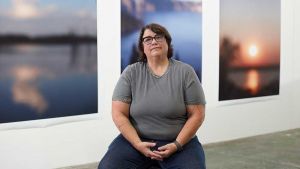 Catherine Opie – interview: ‘I am in love with the medium of photography and the aesthetic pursuits of what I can do within it’
 David Wojnarowicz: History Keeps Me Awake at Night
 Peter Hujar