




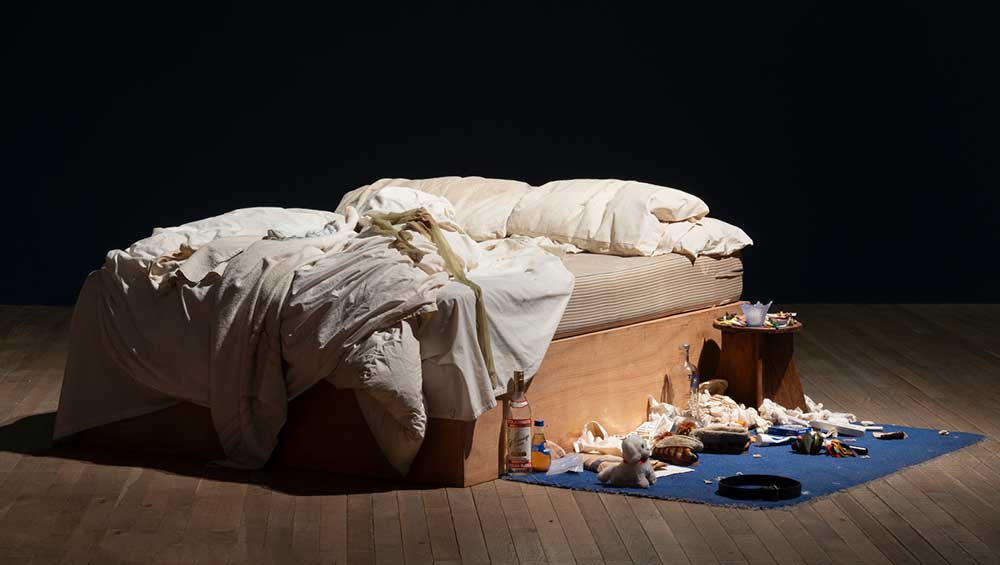
Tracey Emin, My Bed, 1998, installation view, Tracey Emin: A Second Life, Tate Modern. © Tracey Emin. All right reserved, DACS 2026. Photo © Tate (Jai Monaghan).
Tate Modern, London
27 February – 31 August 2026
by ANNA McNAY
The bar has been set high. What can I possibly add to the flurry of voices discussing Tracey Emin’s new retrospective exhibition, A Second Life, at Tate Modern, to which there were more than 400 visitors just to the press view? Well, one of the key things talked about by the Tate director, Maria Balshaw, at the press view was the movement from I to You, and how Emin apparently wants her viewers to look at her works and reflect on their own messy lives. So perhaps that is where I ought to begin? I have managed previously to review a couple of her exhibitions for Studio International without gushing too much, but today, at the behest of the artist, I am going to allow myself to ooze.
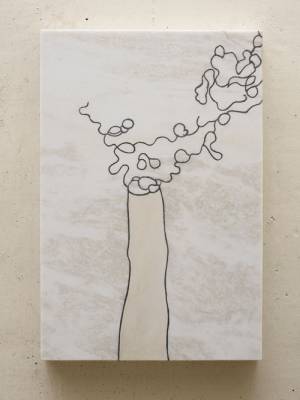
-Tracey-Emin.jpg "Tracey Emin, I followed you to the end, 2024. Yale Centre for British Art. © Tracey Emin. All rights reserved, DACS 2026.")
Tracey Emin, I followed you to the end, 2024. Yale Centre for British Art. © Tracey Emin. All rights reserved, DACS 2026.
It is June 2009, nearly a year since I was discharged from an acute psychiatric ward where I was being treated for anorexia. During that interim, I had spiralled down to a worse state than I had previously been in, before then stabilising (at a dangerously low weight) so as to avoid being sectioned. I was very unwell, and I was very stuck. I had just been to see the Royal Academy Summer Exhibition and was walking down Duke Street, when my attention was caught by a sign to the White Cube gallery in Mason’s Yard. I decided to make the small detour, and, in so doing, had my first encounter with the work of Emin. Those Who Suffer Love was a raw and visceral exhibition – as are all of Emin’s – but this one was perhaps especially so. The walls were filled with wildly masturbating female figures (including an animation made from a collection of such drawings), figures lying bleeding, figures of loneliness, figures of shame … But it was the words that got me. Neons crying out in despair, monoprints and drawings speaking more quietly, but no less urgently. Something’s Wrong. No No No No No No. I Believed in You. You Made Me Feel Like Nothing …
-Tracey-Emin.jpg "Tracey Emin, I whisper to My Past Do I have Another Choice, 2010. © Tracey Emin. All rights reserved, DACS 2026.")
Tracey Emin, I whisper to My Past Do I have Another Choice, 2010. © Tracey Emin. All rights reserved, DACS 2026.
I credit this encounter for a major turning point in my recovery. I suddenly felt not quite so alone. Someone out there felt things with the same burning intensity. Someone out there dared to voice those emotions I couldn’t name. And, as I immersed myself in all things Tracey, my life began to improve; I blossomed thanks to this vital and generous secret friendship. Of course, Emin never knew, and when I interviewed her years later, I was too embarrassed to say anything (instead, we bonded over our respective experiences of cancer), but Tracey Emin saved my life. There, I’ve said it. And I bet I am not alone.
-Tracey-Emin.jpg "Tracey Emin, I Never Asked to Fall in Love – You Made Me Feel Like This, 2018. © Tracey Emin. All rights reserved, DACS 2026.")
Tracey Emin, I Never Asked to Fall in Love – You Made Me Feel Like This, 2018. © Tracey Emin. All rights reserved, DACS 2026.
Back to 2026 and the opening of A Second Life. Titles are very important to Emin, and much has been made of the various levels of meanings of this one: a life pre- and post-surgery (a little disingenuous), a life pre- and post-rape, a life pre- and post-abortion … Harry Weller, Emin’s creative director for 17 years now, suggests it is a show about transcendence. He adds that Emin is very spiritual and believes in a second life beyond this earthly one. Emin herself succinctly says: “So, my second life is this, now. I sometimes think I died, and this is heaven. And my heaven is what I’m creating.”1 Whatever the title means, I knew I was going to love this exhibition. What I didn’t know was quite how much, and how, once again, I would come away feeling revitalised and motivated. And I could sense this vigour in my fellow visitors as well.
-Tracey-Emin.jpg "Tracey Emin, Is This a Joke, 2009. © Tracey Emin. All rights reserved, DACS 2026.")
Tracey Emin, Is This a Joke, 2009. © Tracey Emin. All rights reserved, DACS 2026.
This exhibition is a retrospective, and, as such, it features works from across Emin’s practice, from the early 1990s to the present day. In fact, it reaches as far back as 1982, in My Major Retrospective II 1982-1992 (2008), which comprises postage stamp-sized photographs of her earliest (art-school) works, destroyed after her “emotional suicide” in 1992. This was originally shown at her first solo show at White Cube in 1993, which Emin titled My Major Retrospective, before she had achieved even her early days of notoriety, which predated her current fame and adoration as a Dame Commander of the British Empire (since the 2024 King’s birthday honours). Here, it is shown alongside Tracey Emin CV (1995), a nine-page summary of her life to that point, and Hotel International (1993), a blanket commemorating her home in Margate, where she grew up with her twin, Paul, and mother, Pam, also telling multiple stories from her youth, sewn on as patches on to a quilt. It seems appropriate, also, to meditate on the word “international” here, and to acknowledge Emin’s now international fame. I asked myself briefly why this exhibition was taking place at Tate Modern rather than Tate Britain, but then it seemed like a no-brainer that she should be placed out there among the global stars.
-Tate-(Sonal-Bakrania).jpg "Tracey Emin, It’s Not the Way I Want to Die, 2005 (right) and I needed you to love Me, 2023 (left), installation view, Tracey Emin: A Second Life, Tate Modern. © Tracey Emin with Photo © Tate (Sonal Bakrania).")
Tracey Emin, It’s Not the Way I Want to Die, 2005 (right) and I needed you to love Me, 2023 (left), installation view, Tracey Emin: A Second Life, Tate Modern. © Tracey Emin with Photo © Tate (Sonal Bakrania).
From the tiny to the enormous, It’s Not the Way I Want to Die (2005), a wooden rollercoaster, also pays homage to her hometown and its amusement park, Dreamland. This is shown alongside the film Emin & Emin (1996), which depicts the artist and her father playing in the sea. The racism encountered by the whole family for the mixed-race pairing of her parents is addressed in a number of the works, and several cite her and Paul going home and asking their mum what “wog” meant (to which she answered, rather brilliantly, “western oriental gentleman”).
One work I am especially excited to see is There’s a Lot of Money in Chairs (1994), Emin’s great-grandmother’s armchair, which travelled around America with her as she gave readings from her autobiographical book, Exploration of the Soul (1994) (also on display).
Initially, sculpture was something Emin considered herself doing for fun, not seriously as work – until, that is, she found herself creating things she had never seen before, when she realised she was “on to something”. A long vitrine down the centre of the gallery contains a number of her small sculptures – Mother (2014), Tormented Reason (2016), I Want You Because I Can’t Have You (2014) and more – on which you can discern her finger and palm prints from the kneading and moulding of the clay originals. You really need to have seen these to appreciate the larger bronzes which appear later on, including I Will Not Be Alone (2025), near the end of the exhibition. The intimate and personal, including her unique finger-printed signatures, have been carefully transferred up to this much larger scale; nothing is lost in the pieces’ growth.
-Photo-(c)-Tate-(Yili-Liu).jpg "Tracey Emin, Why I Never Became a Dancer, 1995, installation view, Tracey Emin: A Second Life, Tate Modern. © Tracey Emin. All right reserved, DACS 2026. Photo © Tate (Yili Liu).")
Tracey Emin, Why I Never Became a Dancer, 1995, installation view, Tracey Emin: A Second Life, Tate Modern. © Tracey Emin. All right reserved, DACS 2026. Photo © Tate (Yili Liu).
Two of the videos on show are Why I Never Became a Dancer (1995) and How It Feels (1996). These are good examples of why people often struggle to talk about Emin’s work. Why I Never Became a Dancer relays an account of the bullying and abuse she received, being called a “slag” during the final of a dance competition, and How It Feels tells the experience of a badly botched abortion. In the 90s, Emin’s work was spoken about a lot as “confessional art”, but, in her catalogue interview with Balshaw, the artist defiantly states: “It wasn’t. I wasn’t confessing anything at all to anybody. Nothing to confess.”2 Indeed, terming it “confessional” implies a level of shame that is not to be found anywhere in Emin’s work, which might better be described as “anti-confessional” or “anti-shame”. Why I Never Became a Dancer is also an example of the way in which Emin counteracts pain and trauma with joy and humour. This can be found in more recent paintings in the presence of a cat (her cats Pancake and Teacup are her spirit guides and companions).
The small embroidered work Broken World (2009) is another perfect reminder of what I first and foremost love about Emin – her poetry (and idiosyncratic spelling!). It reads:
Broken Mind
Broken Heart – Broken Soul – Broken Life
And it’s somewhere – so close by
Just floating around in my head
A life witch is safe
A place that is not my mind
-Tracey-Emin.jpg "Tracey Emin, Exorcism of the Last Painting I Ever Made, 1996. © Tracey Emin. All rights reserved, DACS 2026.")
Tracey Emin, Exorcism of the Last Painting I Ever Made, 1996. © Tracey Emin. All rights reserved, DACS 2026.
Another piece I’m thrilled to see is the recreation of the gallery space Emin inhabited in Stockholm in 1996 for three weeks, Exorcism of the Last Painting I Ever Made (1996). Here, she battled with her demons and finally began to paint again, having thought she had given it up for ever. This is something I thought I would never be able to experience, and therefore it’s an extra special treat
-Tate-(Sonal-Bakrania)-(1).jpg "Tracey Emin, Naked Photos – Life Model Goes Mad, 1996, installation view, Tracey Emin: A Second Life, Tate Modern. © Tracey Emin. Photo © Tate (Sonal Bakrania).")
Tracey Emin, Naked Photos – Life Model Goes Mad, 1996, installation view, Tracey Emin: A Second Life, Tate Modern. © Tracey Emin. Photo © Tate (Sonal Bakrania).
Next, we reach the corridor gallery – a notoriously difficult space to curate, but one that seems perfectly suited to Emin’s display of the 10 undeniably sexy Polaroids comprising Self-Portrait 12-11-01 (2001), juxtaposed against 10 more recent shots of her body, including her stoma, her body immediately post-surgery, and trickles of blood. It is this frankness and exposure of her trauma that has helped turn Emin into an international icon.
-Tate-(Sonal-Bakrania).jpg "Portrait of Tracey Emin, Tate Modern 2026. Photo © Tate (Sonal Bakrania).")
Portrait of Tracey Emin, Tate Modern 2026. Photo © Tate (Sonal Bakrania).
Of course, this could not be called a retrospective were it not to feature My Bed (1998). Interestingly, however, this notorious Turner Prize-losing work has been placed firmly into the second half – second life – of the exhibition, alongside a more recent painting (I Never Asked to Fall in Love – You Made Me Feel Like This, 2018), neon (It’s Not Me That’s Crying It’s My Soul, 2011) and sculpture (Ascension, 2024). This was not unpremeditated, and Emin hopes it will allow for a public reconceptualisation of the piece as a structure and a place for recuperation – basically what she argued it was from the outset, but, which, recast in the light of her recent illness, we, the audience, may finally take her word on. Moreover, there is deliberately no wall text to accompany this seminal work, since the artist and her team want us to think for and of ourselves. “I don’t want them to think about my life,” says Emin. “I want them to think about their own life.”3
The final room of the exhibition is what Weller terms “a mausoleum”. “This is a place to hold a vigil, to light a candle in her memory … I envisage her soul passing through this corridor, encountering its own history: childhood memories, regrets, triumphs and lost opportunities … Linked together, they both greet her and bid her farewell, giving her permission to pass; ‘It’s OK, you are free now.’”4 A corridor of recent, full-length self-portraits, with her death mask in a vitrine in the centre, a powerful, traditional memento mori. Nevertheless, for me, the mask is the work that speaks the least of death in the whole room. Not that the self-portraits are morbid or overly concerned with dying or even illness, but they have an air of acceptance in the face of the final judgment.
-Tracey-Emin.jpg "Tracey Emin, Ascension, 2024. © Tracey Emin. All rights reserved, DACS 2026.")
Tracey Emin, Ascension, 2024. © Tracey Emin. All rights reserved, DACS 2026.
Weller describes Emin as a “wild force in the studio, a frenetic banshee”, such force, in fact, that in a topically Wuthering-Heightsian manner “she is the canvas,”5 and yet, and yet … More recently her body has not always let her do what she would have it. On days when she has adamantly wanted to paint, but was unable even to stand, Weller would pull up a chair, and she would sit and focus on passages of minute detail, creating patches of geometric pattern, depicting, for example, with a nod, once again, to her mixed-race heritage, a Turkish rug (see I Watched Myself Die and Come Alive, 2023).6
Knowing how to conclude this article is even more difficult than knowing how to start it was, and I am sure there will be many others making puns on “major retrospectives” (this time it really is) and “rollercoasters” (that too – a rip-roaring ride to put it mildly), so I will keep it brief, and urge you to stop reading my words, and go and read Emin’s, and see her imagery. There are so many more works I haven’t the space to mention, not least the behemoth I Followed You Until The End (2023) on the riverbank side of the Tate, and the teeny tiny bronze baby items (Baby Things, 2008) just outside the exhibition space. All I can really say is this: thank you, Tracey Emin, for everything. You have brought us fantastic art, but, as many of us are gratefully here to attest, also so very much more. Through sharing your life, including now what you see as your second chance, you have given us our own.
References
1. A Second Life: Tracey Emin in Conversation with Maria Balshaw. In: Tracey Emin: A Second Life, exhibition catalogue, Tate Publishing, 2026, pages 13-20, page 14.
2. ibid, page 15.
3. ibid, page 20.
4. Painting, Premonitions and the Tomb by Harry Weller in exh cat, 2026, pages 235-39, page 238.
5. Harry Weller speaking to the press conference for Tracey Emin: A Second Life, on 25 February 2026.
6. Emin studied sacred geometry as her second subject at the Royal College of Art in 1988.
Click on the pictures below to enlarge
-Tracey-Emin.jpg)
-Tracey-Emin.-Tate.jpg)
-Tracey-Emin.jpg)

Copyright © 1893–2026 Studio International Foundation.
The title Studio International is the property of the Studio International Foundation and, together with the content, are bound by copyright. All rights reserved.
 |
 |
 |
|---|
-300.jpg)
-300.jpg)


 Sarah Lucas: Situation – Absolute Beach Man Rubble
 Rodin
Rodin The Naked Portrait
 Art Bin: Landyfill
 GSK Contemporary, Earth: Art of a changing world