




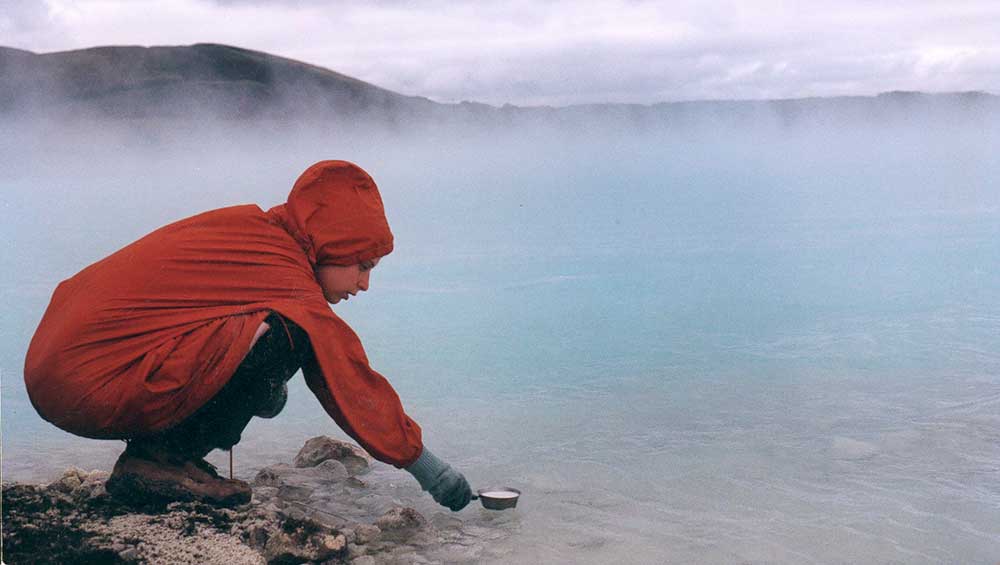
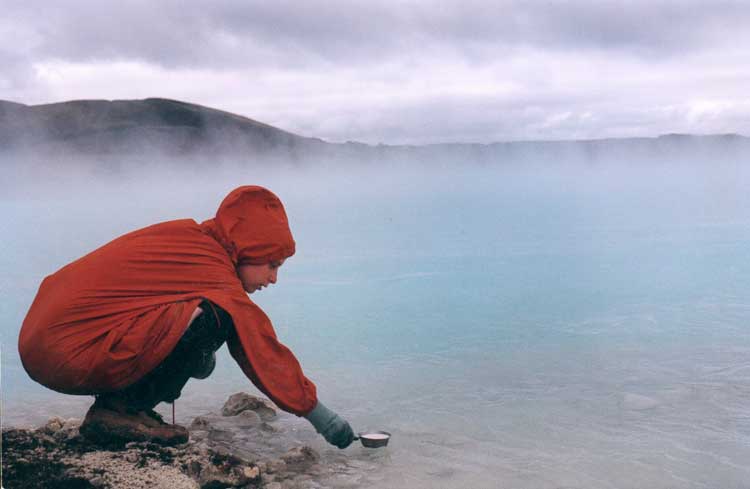
Ilana Halperin, Boiling Milk Solfataras, 1999. Courtesy the artist and Patricia Fleming Projects.
Fruitmarket, Edinburgh
27 February – 17 May 2026
by BETH WILLIAMSON
How do you explore big concepts like deep time through artistic practice? How do you achieve that with materials such as rocks, volcanos and hot springs and still retain a sense of connection and continuity with the human condition? The Glasgow-based American artist Ilana Halperin does just that by collaborating with minerologists, geologists, vulcanologists and archaeologists. Working in the field and in the studio, the intimate nature of Halperin’s artistic practice connects human time and geological time in a manner that highlights the fragility of both. Most of us struggle to think beyond two or three generations before or after the present day. It is difficult to comprehend the enormity of a temporal framework that consists of billions of years of geological or deep time. James Hutton, the 18th-century Edinburgh-based geologist who formed the idea of “deep time” is just one of Halperin’s points of reference. It was Hutton who said, “We find no vestige of a beginning, no prospect of an end”, and one of the remarkable things that Halperin’s work does is to aid our comprehension of such ideas by moving beyond the historical and bringing the realisation of deep time moving forwards too.
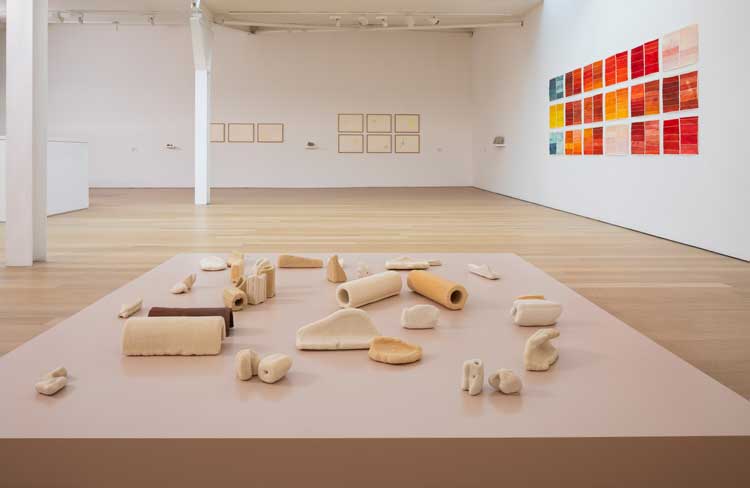
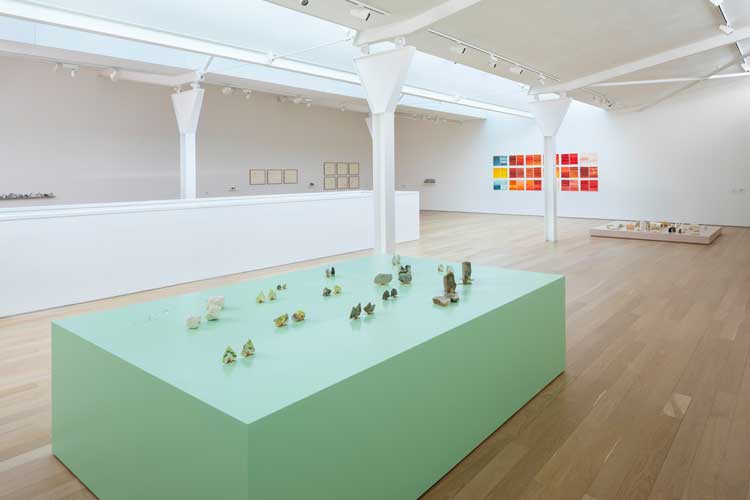
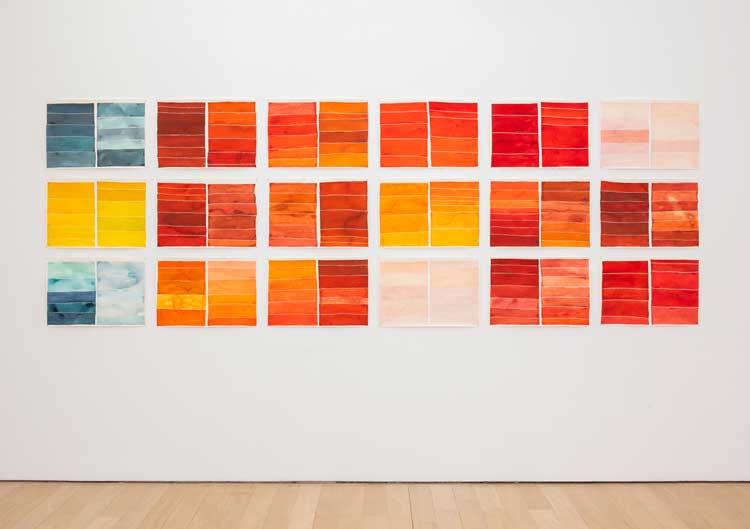
Ilana Halperin. From back to front:
We are All Extremophiles, 2024-26, An Anatomy of Mars, 2024, and The Rock Cycle (Spring, Summer, Autumn), 2021/2026. Courtesy the artist and Patricia Fleming Gallery. Photo: Ruth Clark.
It is Hutton’s tercentenary this year and it was his study of sites local to Edinburgh, such as Salisbury Crags and Siccar Point, that meant he had a major part to play in geology being established as a modern science. Part of what Halperin does is to make scientific research more accessible to a wider audience, although the Fruitmarket director, Fiona Bradley, is clear that this exhibition is about showing Halperin’s work as art, rather than anything else. Her ideas and practice connect with the natural world on a very personal level, something that is especially clear in the way she identifies with the Eldfell volcano in Iceland.
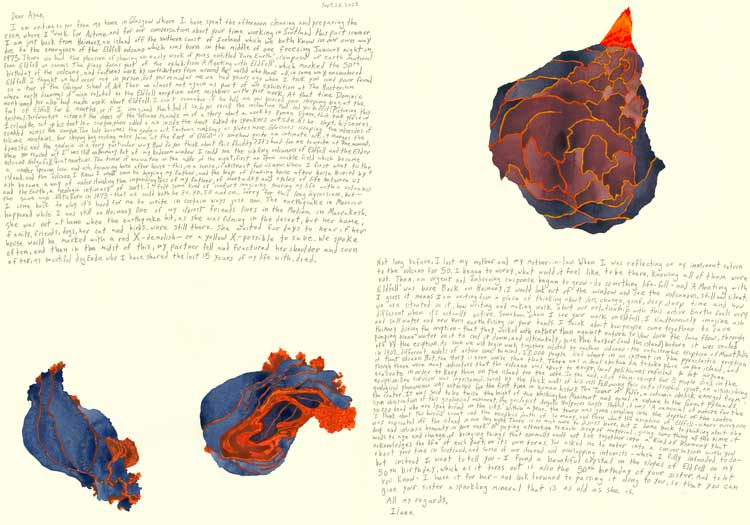
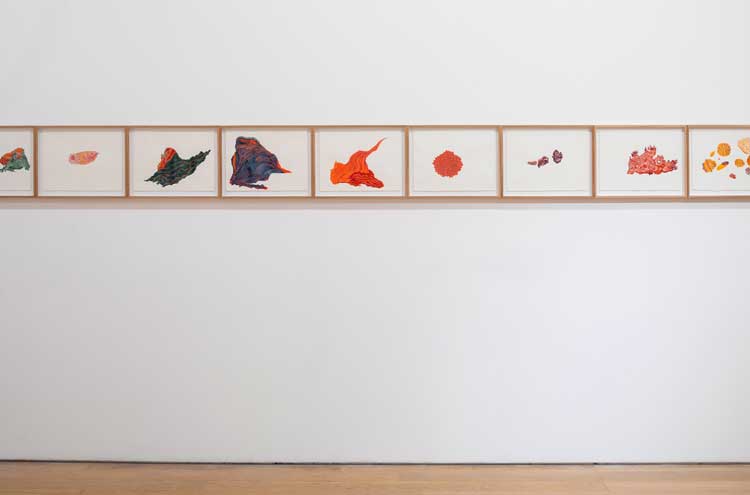
Ilana Halperin, Eldfell is 51, 2025. Watercolour on Fabriano paper, four works, each 28 x 38 cm (unframed dimensions). courtesy the artist and Patricia Fleming Gallery
Halperin and Eldfell were born in the same year, 1973, and an extensive body of work celebrates their 30th, 40th and 50th birthdays. With works such as Eldfell and I turned 50, Now We are 52 (2025), The Day I Turned 50, This Is What I Found on the Slopes of Eldfell (2026) and Eldfell Agates (2013), we get a sense of just how personal this is for Halperin. It includes material given to her by the volcano in the form of crystals, agates and a lava bomb, birthday presents of a sort, I suppose.
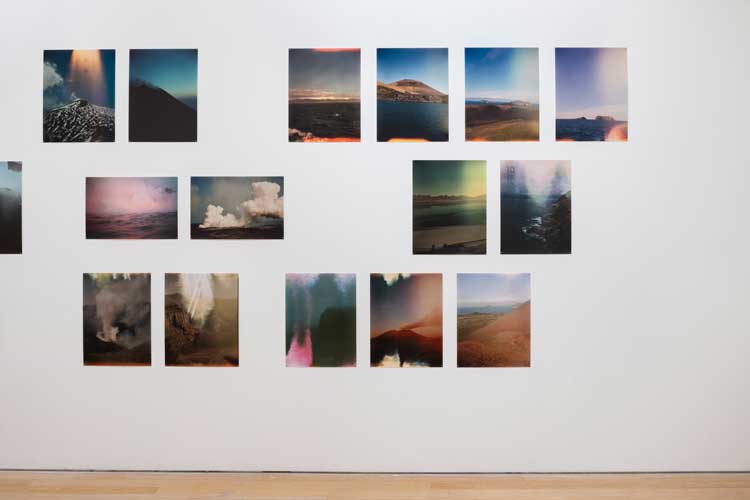
Ilana Halperin, Field Encounters, 1999–present. Courtesy the artist and Patricia Fleming Gallery. Photo: Ruth Clark.
Through sculpture, drawing and photography, Halperin approaches the enormity of the geological world with a tenderness and intimacy that belies the scale of what she is grappling with. The exhibition includes 36 field study photographs, taken over 25 years, and made with an analogue Holga medium format camera. Halperin takes these not as a record of, or reference to, places she visits, but rather as a way of capturing a moment when something might happen, “a staking out of a potential artwork”.
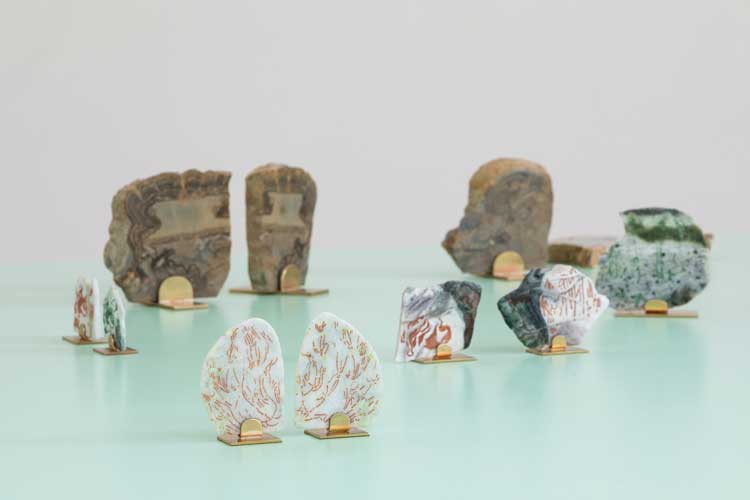
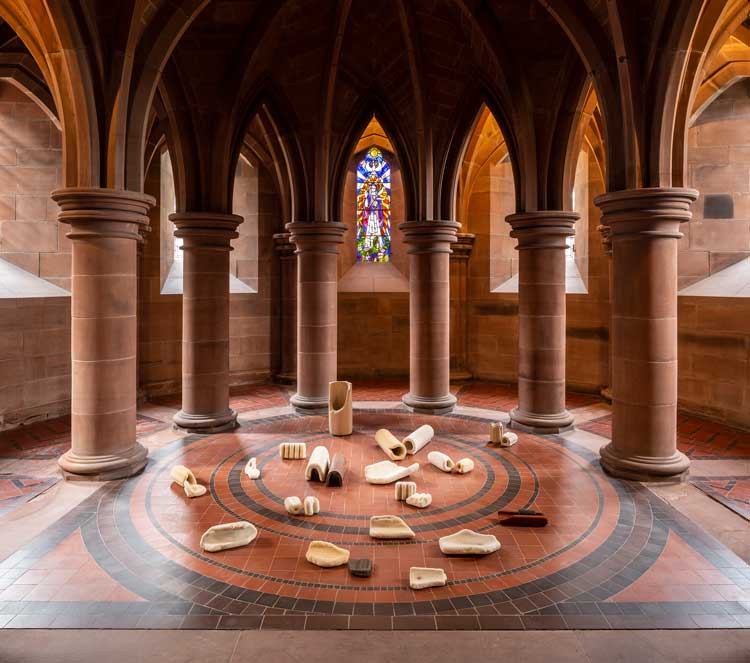
Ilana Halperin. The Rock Cycle (from stromatolites to diamonds), 2026. Fossilised stromatolites with bespoke brass stands; 3 works. Laser-engraved Scottish marble from Iona, Skye, Ledmore and Loch Duich with handmade ink composed of a core sample of soil from James Hutton’s farm and pure malachite with bespoke brass stands. Courtesy the artist and Patricia Fleming Gallery. Photo: Ruth Clark.
This kind of developmental process takes material form in The Rock Cycle (from stromatolites to diamonds) (2026). Working with as little mediation as possible, this exquisite new work shows tiny fragments of laser-engraved Scottish marble from Iona, Skye, Ledmore and Loch Duich with handmade ink composed of a core sample of soil from James Hutton’s farm and pure malachite with bespoke brass stands. It also includes laser-engraved Herkimer diamonds (500m-year-old quartz from upstate New York) with malachite and Charbonnel. It makes for an utterly captivating constellation of fragments that speaks not only to geological time but to the intimacy of human relations. As Halperin explains it: “Mountains and rocks, which remind us they are the product of the living, can become reanimated again, an infinite source of narratives, deeply embedded in our connected identities. Can looking more closely at our geological neighbours help us connect in felt, material and corporeal ways to our place in the deep time story, help us care about our deep time family?” It is these questions she works through in The Rock Cycle.
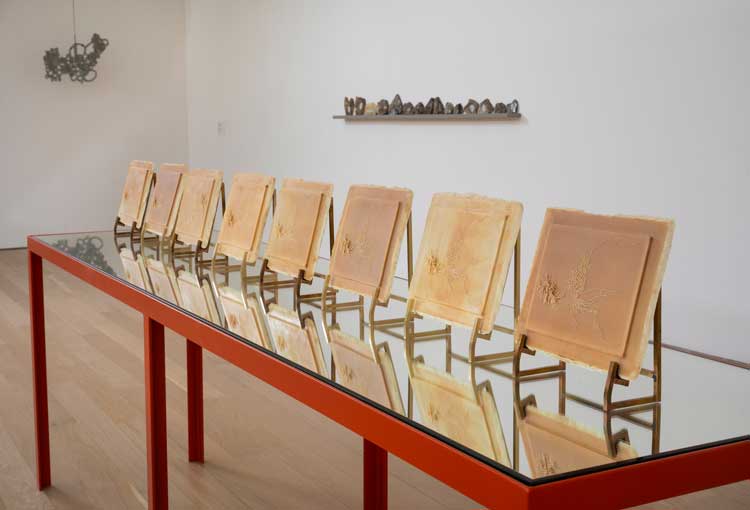
Ilana Halperin, Physical Geology (cave cast/slow time), 2008–09. Limestone formed over nine months in Fontaines Pétrifiantes de Saint-Nectaire and brass. Courtesy the artist and Patricia Fleming Gallery. Photo: Ruth Clark.
Halperin is extremely modest when she speaks about her work. Her collaborations last for months, years, even decades. Perhaps it is the durational aspect of the work, her minimal intervention and the remoteness of the environments in which she works that lend the artist and her work such an attractive quietude. One of the most astonishing works in this respect are the eight elements that make up Physical Geology (Cave cast/slow time) (2008-09), sculptures grown in petrifying springs in Auvergne, France. Conditions in the caves at the Fontaines Pétrifiantes de Sainte-Nectaire, which have been cared for by the Papon family for seven generations, are such that calcium carbonate deposits that would normally take 100 years to grow 1cm take just one year to form. Halperin has returned repeatedly to the caves. Most recently, 17 years after first encountering this unique location and phenomenon, she grew elements for The Rock Cycle where Herkimer diamonds encrusted in beds of dolostone are coated in a new layer of limestone over four months in the calcifying springs.
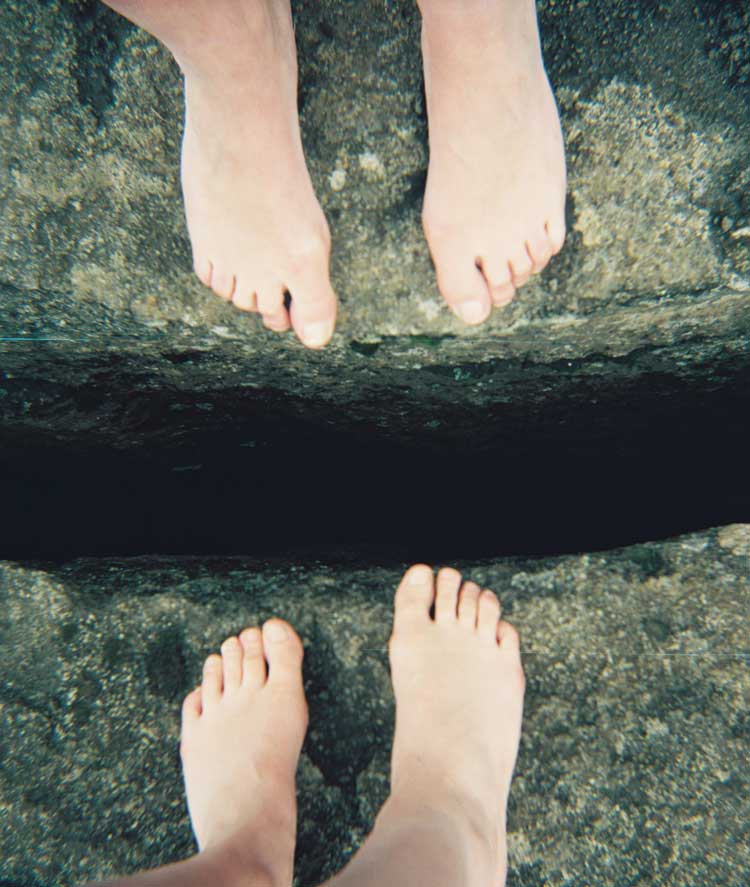
Ilana Halperin, Field Encounters: Meeting on the Mid-Atlantic Ridge, 1999. Fuji Crystal Archive matte. Courtesy the artist and Patricia Fleming Projects.
What is us and what is earth? That is Halperin’s question in the title of the exhibition and explored in every work. The earliest works in the show are from 1999. Meeting on the Mid-Atlantic Ridge and Boiling Milk (Solfatara) both reveal the scale and wonder of geographies in time and space and also in relation to human presence. Beyond a relational connection, Halperin makes other fascinating observations: “We as humans are also geological agents – we form geology. We are like volcanoes, producing new landmass on a micro scale. A body stone is a new territory, a miniature planet travelling through an interior universe. New landmass.” A new landmass, new life, gestures to Halperin’s forward- looking approach to deep time. This is a life-giving exhibition, looking forwards, not back. The collaborative nature of the work is life-giving too, collaborating with artists, scientists, geologists and with nature itself. Then, there is the creative potential of serendipity. Halperin was born on 18 September and commented in conversation that the Herkimer diamonds naturally have 18 facets. In Jewish mysticism, 18 is a lucky number, the chai of L’Chaim, the traditional Jewish toast to life. From vast land masses to volcanos, planets and the inner workings of caves and the human body itself, Halperin’s work is rigorous, generous and hopeful – and this exhibition is a poem to life. L’Chaim.
• The exhibition is being shown at Fruitmarket as part of the RSA bi-centenary. RSA200: Celebrating Together marks 200 years of the Royal Scottish Academy and its members, and is bringing together communities across Scotland and beyond, uniting museums, galleries and cultural partners in a shared celebration. Expect major exhibitions, performances, talks and rehangs of collections that will shine a spotlight on Scotland’s most treasured artworks.
Click on the pictures below to enlarge

Copyright © 1893–2026 Studio International Foundation.
The title Studio International is the property of the Studio International Foundation and, together with the content, are bound by copyright. All rights reserved.
 |
 |
 |
|---|

-1000-300.jpg)
 Flesh Arranges Itself Differently
 Karla Black – interview: ‘I don’t see culture and nature as separate things. There’s just a huge pretend around them’
 Emma Hart: Banger
 Tacita Dean: Woman With a Red Hat
 Lee Lozano: Slip, Slide, Splice