




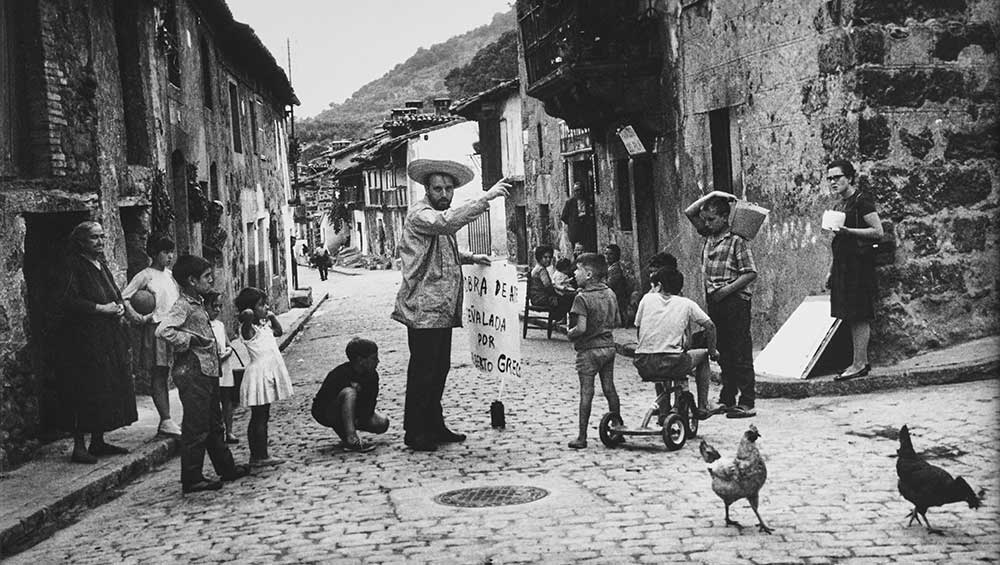
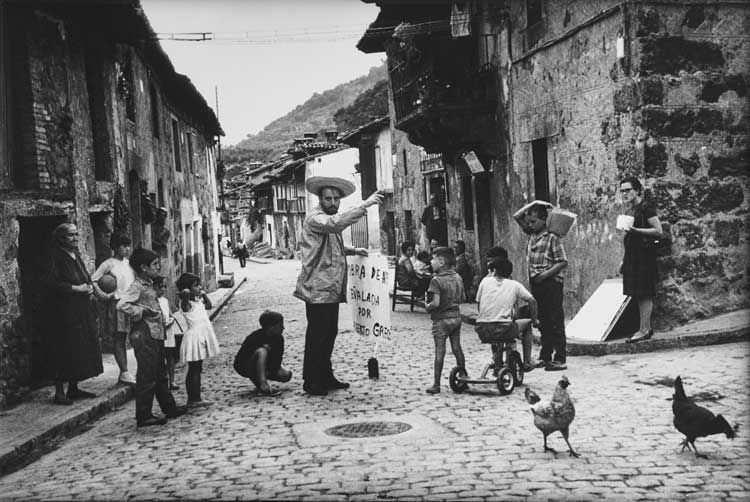
Live act by Alberto Greco in Piedralaves, 1963. Photograph by Montserrat Santamaría. Collection / Archive Galería del Infinito © Montserrat Santamaría © Courtesy of Alberto Greco's estate.
Museo Reina Sofia, Madrid
11 February – 8 June 2026
by JOE LLOYD
Some artists are animated by a burning compulsion to unleash their art on to the world. Alberto Greco (1931-65) seems to have been one of them. His all-too-brief life was a restless gallivant of unbridled artistic activity, much of which tested the sensibilities of his time. His friend and fellow artist Marta Minujín called him “a magician, a wild character who had his own way of living”. Greco’s monochrome paintings integrated urine, his own and that of his friends. In 1950, the launch party for his self-published poetry collection Fiesta was shut down by the Buenos Aires police on suspicion of communism. Thirteen years later he was hounded out of Italy after a sacrilegious, scatological carnival that climaxed with Greco urinating in the mouths of audience members, including the Argentine ambassador and his wife. More on that later.
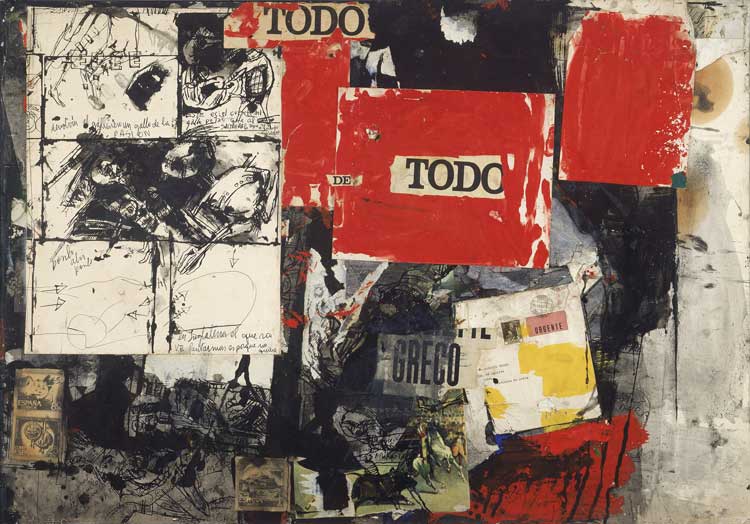
Alberto Greco, Todo de todo, 1964. IVAM Institut Valencià d’Art Modern, Generalitat © Institut Valencià d’Art Modern, IVAM (Photograph: Juan García Rosell, IVAM). © Courtesy of Alberto Greco right holder.
Greco was born in Buenos Aires. He dropped out of the National School of Fine Arts and instead spent his time haunting the city’s bohemian literary, theatrical and artistic scenes. His early poetry mixed kitsch with support for Argentina’s marginalised populations. In 1954, he moved to Paris, where he attended courses by day and sold paintings in bars by night. To make ends meet, he also plied his trade as a fortune teller and prostitute, appeared as an extra in the 1957 film Funny Face and attempted to launch an empanada business. He signed the walls of public toilets with the phrase Greco puto (Greco whore), an act he would claim as a work of art. Somehow amid all this, he arranged a solo exhibition of his abstract paintings, in the art informel mode then all the rage. The sole example of Greco’s early paintings in the Reina Sofia’s survey exhibition, an Untitled work from 1957, has glyph-like blue and white-yellow forms atop a hazy thicket of wiggling black lines. It is not a particularly striking creation.
Things swiftly developed. Back in Argentina, Greco set about creating a mode he called “terrible, strong, aggressive, against public morals and stuffiness”. His new abstract works were volcanic eruptions in black, brown and white. He used oil paint, tar and enamel, mixed with sand and sawdust and exposed to pollution, precipitation and the aforementioned urine. Greco, the exhibition explains, “sought the unplanned transformation of matter – a vibrant movement of paint understood as a living body, troubled by tensions, outbursts, spills, and scratches”. This represents an enormous advance on what came before. The works have a dusky palette reminiscent of Goya’s Black Paintings, and surfaces that churn, flake and peel. Some of them are almost nauseating. It feels as if the paint and the collaged elements might continue to transform, decaying down into some vile muck.
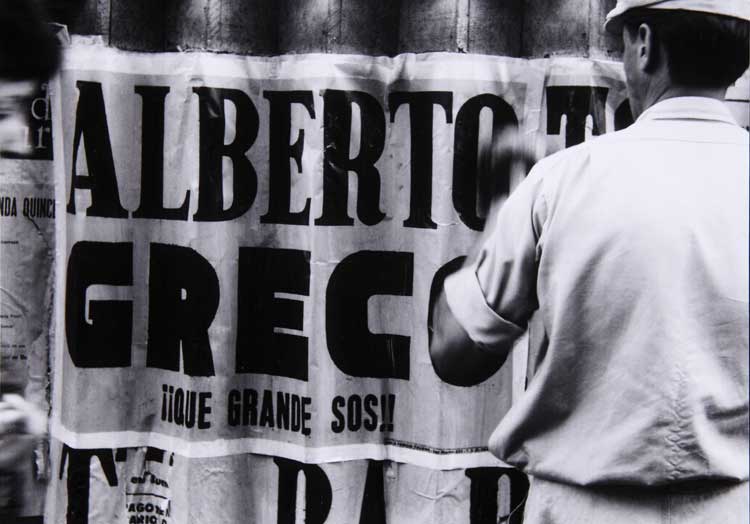
Picture by Sameer Makarius. Alberto Greco, ¡¡Qué grande sos!!, Buenos Aires, 1961
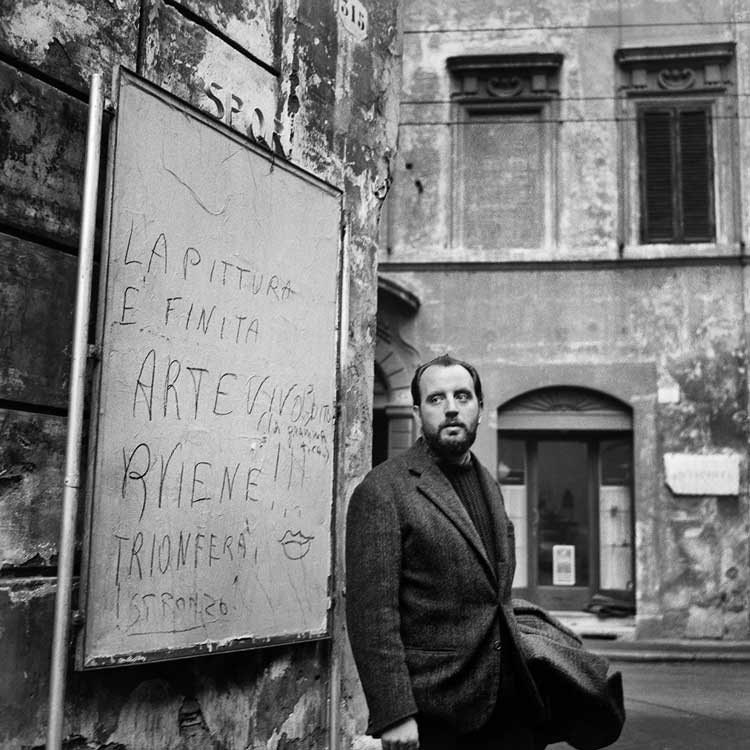
Greco had hit on a winner. But he quickly changed tack. He turned away from abstract painting, and by and large from exhibiting in galleries. Instead, he would make art that intervened directly in the urban landscape. He plastered the streets of Buenos Aires with posters featuring his name and the phrases “America’s most important informalist painter” and “how great you are”. Returning to Paris in 1962, he drew a chalk circle around fellow Argentinian artist Alberto Heredia while holding a sign announcing the “first exhibition of A Greco’s arte vivo”. He also painted the inside of a glass box black and filled it with 30 white mice. He covered Genoa with a poster heralding his new project, variously called arte vivo and vivo-dito (live finger), in which quotidian moments from daily life could be turned into ephemeral artworks. “The artist”, he wrote in his manifesto, “would instruct to see not with paintings but with the finger.” Anything he pointed his finger at could be translated into a work of art.
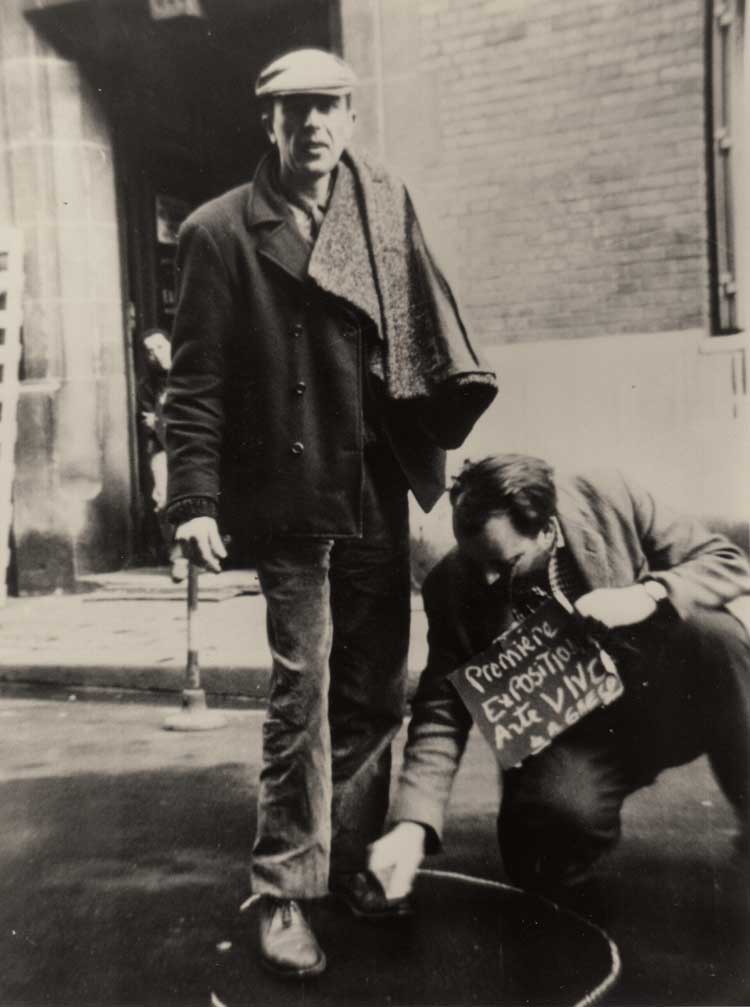
René Bertholo. Alberto Greco with Alberto Heredia during the Première exposition arte vivo of A. Greco in Paris, 1962. Nuno de Castro Brazão Collection, Lourdes Castro-René Bertholo bequest.
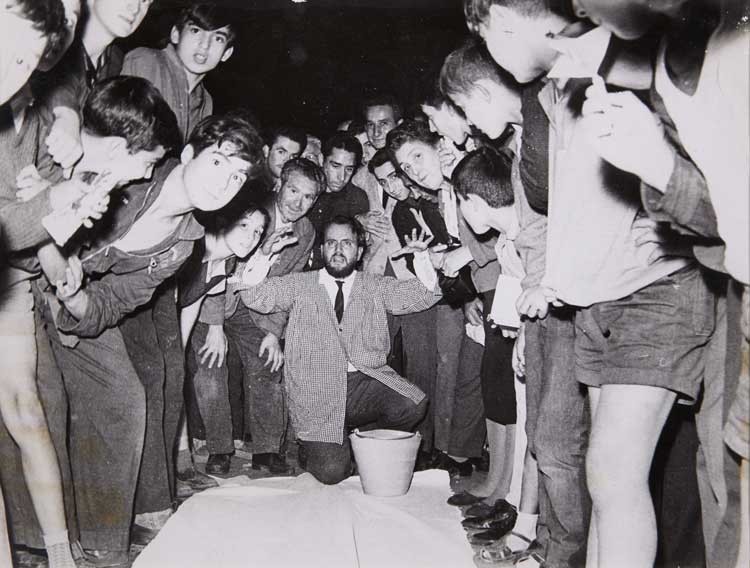
There had long been an element of the carnivalesque to Greco’s work. He had turned up to the opening of his 1961 exhibition The Nuns dressed in a habit. But for the next few years it ramped up. In 1963, he was involved in Christ ’63: Homage to James Joyce, a semi-improvised play by the avant-garde dramatist Carmelo Bene that combined the passion of Christ with scenes from James Joyce’s Ulysses and the pungent, sexually explicit queer novels of Jean Genet. It quickly descended into chaos. Greco, playing John the Apostle, flew into a drunken rage, lifted up his costume and began to let loose a stream of piss – one photograph appears to have been taken just before or after, with a near-naked Greco grabbing his member. An eyewitness account describes him smushing pies into the ambassadorial couple’s face.
-1964.jpg "Photograph by Juan Dolcet. Incorporation of living figures into the canvas (Encarnación Heredia, suffering woman), Private Gallery, Madrid, 1963.")
Photograph by Juan Dolcet. Incorporation of living figures into the canvas (Encarnación Heredia, suffering woman), Private Gallery, Madrid, 1963.
Pursued by blasphemy charges, Greco fled to Spain, where he would be based for the rest of his life. He led a procession across Madrid carrying a giant canvas, which was ceremonially burned in a courtyard. Photographs show the paint-spattered canvas rolled up like a corpse as it is carried across the city. This action was at once a funeral for painting, an act of defiance against the Franco regime’s surveillance, and a celebration of the culture of the street. In his art and writings, Greco remained concerned with the disadvantaged and marginalised. He settled in Piedralaves, a farming village that had barely left the 19th century, and declared it “the international capital of Greco-ism”. While there, he unfurled a vast scroll of drawings, stories, advertisements, police reports and recipes over the streets. He imagined the village as a future art centre, a pioneering attempt to decentralise art.
Although Greco had rejected painting, he continued to create drawings and collages. Given the sparse documentation of his actions, these form a significant plank of the current exhibition. They form another flank of the arte vivo ethos, drawing in everything Greco encountered and thought of – animals, monsters, news headlines about the death of John F Kennedy, magazine clippings, advertisements and hand-written texts including song lyrics – into a chaotic morass. At their best, these collages are transfixing in revealing Greco’s magpie-like interest in the life of the streets.
The best might have been yet to come, but – unmentioned at the Reina Sofia – in 1965, Greco killed himself, possibly over an unrequited love for his boyfriend. He took barbiturates, called his family to ask if they wanted to watch, and wrote down his final thoughts. In his last moments, he wrote “Fin” on his left hand, bringing a premature close to his finger’s artistic powers. It is a sad, lonely end for an artist who aspired to make art joyously communal.
Click on the pictures below to enlarge

Copyright © 1893–2026 Studio International Foundation.
The title Studio International is the property of the Studio International Foundation and, together with the content, are bound by copyright. All rights reserved.
 |
 |
 |
|---|
-300.jpg)

-300.jpg)
 David Wojnarowicz: History Keeps Me Awake at Night