





Thomas Dane Gallery, London
26 January – 20 April 2024
by BETH WILLIAMSON
When Phillip King (1934-2021) and Jeremy Moon (1934-73) met in 1956, they were students at Christ’s College, Cambridge. King was studying modern languages and Moon was studying law and, coincidentally, they lived in the same street. King spent time in Cambridge on a self-taught sculptural practice that saw him exhibit in the local Heffer Gallery. He invited Anthony Caro (1924-2013), whom he greatly admired, to see his exhibition, then took classes with Caro at Saint Martin’s School of Art (1957-58) in London. The following year, King taught at Saint Martin’s, as well as acting as an assistant to Henry Moore. Moon worked in advertising and enrolled only briefly at the Central School of Art in London. Devoting himself entirely to art in the 1960s, Moon also taught sculpture at Central Saint Martins and painting at Chelsea School of Art. He submitted a sculpture to the Young Contemporaries in 1962, winning first prize, thanks to King who was a co-judge for sculpture. Moon and King became firm friends in Cambridge, a friendship that lasted when they moved to London and until Moon’s premature death following a motorbike accident in 1973.
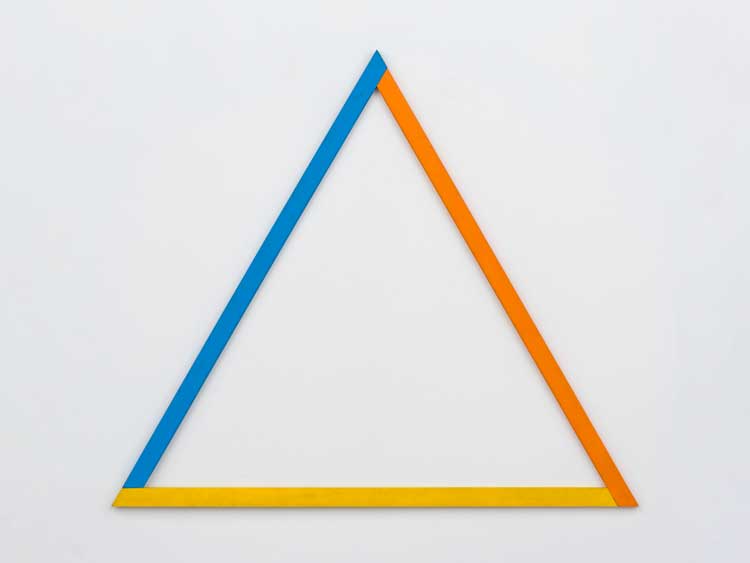
Jeremy Moon, Mandarin, 1964. Acrylic on wood, 168.9 x 195.6 cm (66 1/2 x 77 in). © Estate of Jeremy Moon. Courtesy the estate and Luhring
Augustine, New York. Photo: John Berens.
Their common experience of growing up during the second world war, as well as the undoubted impact of the postwar depression era, saw them seeking out ways to reimagine painting and sculpture in more hopeful and vibrant forms, shedding the outside world and all its forms for pure abstraction. Both looked to Frank Stella and David Smith in America, but also to Caro in Britain. King was probably Caro’s best-known student even though they were near-contemporaries.
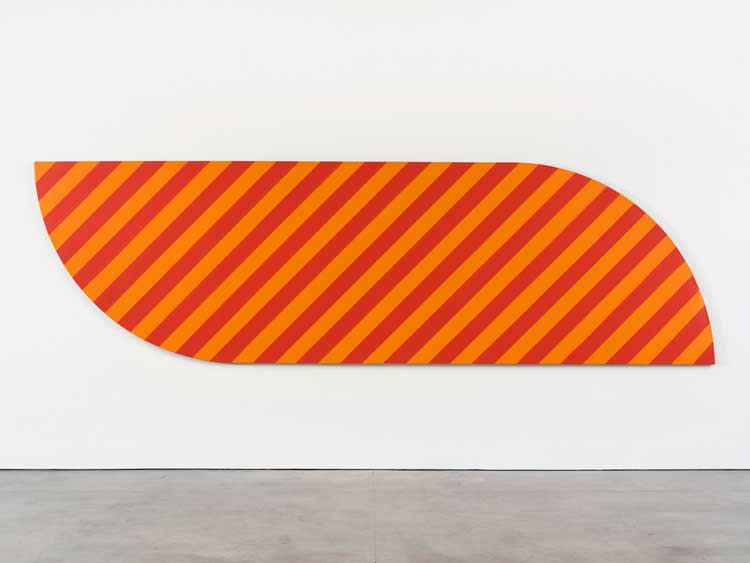
Jeremy Moon, Carousel, 1966. Acrylic on canvas, 140 x 475 cm (55 x 187 in). © Estate of Jeremy Moon. Courtesy the estate and Luhring Augustine, New York. Photo: John Berens.
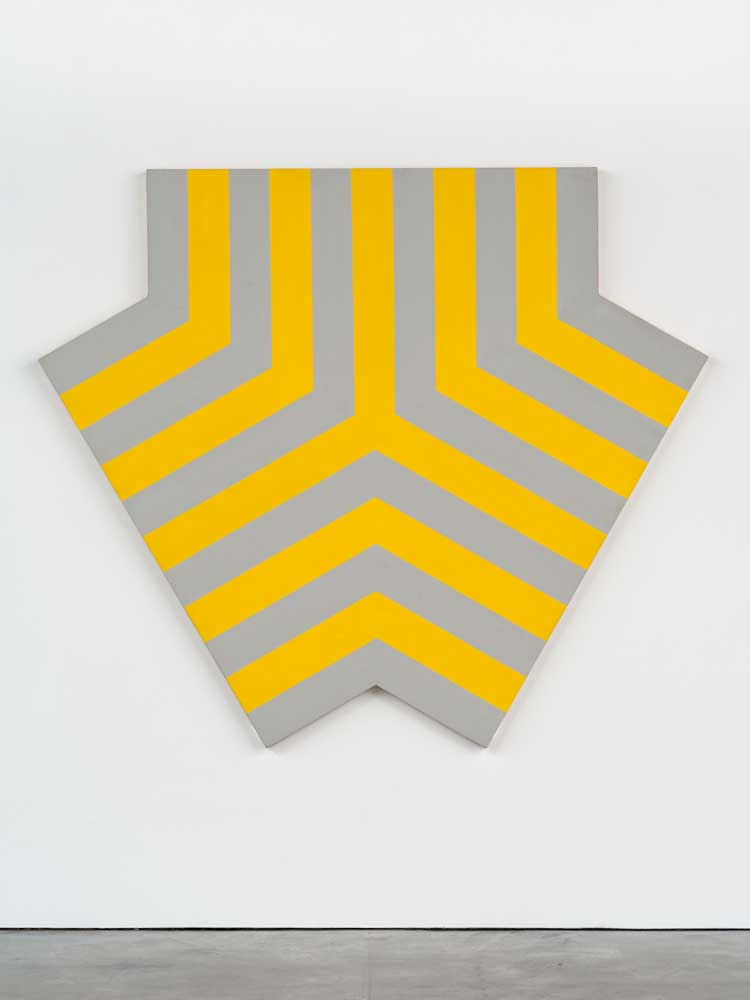
In a sense, the practices of Moon and King mirrored one another in that, through an engagement with colour and surface, King explored the painterly possibilities of sculpture while Moon explored the sculptural possibilities of painting. As King explained: “The clear link to sculpture in Jeremy’s painting is probably what attracted me most: painting as an object, rather than a window to look though”.1 Colour, and its relationship to shape and volume, was a unifying factor in their practices, despite differences. Both artists deployed a geometric lexicon that was inflected by colour, whether in monochrome or polychrome composition. Colour became a tool that could be used to support or destabilise compositions dependent on whether juxtapositions acted to harmonise and resonate, or jar and dislocate, relationships.
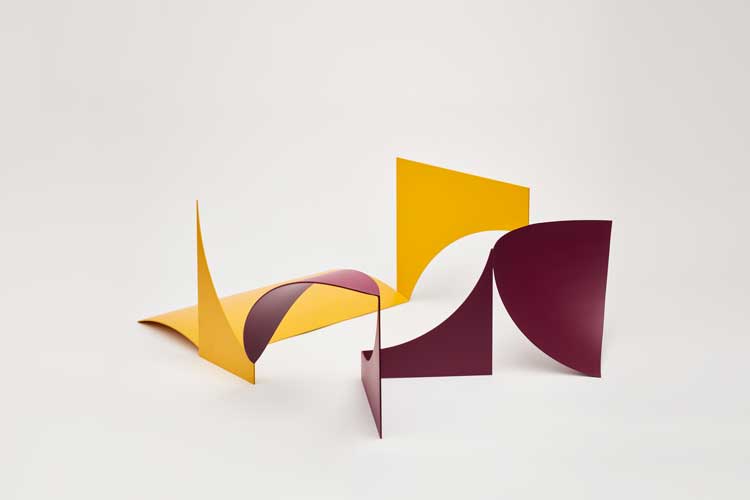
Phillip King, Dunstable Reel Maquette, 2013. Painted steel, 55 x 62 x 24 cm (21 5/8 x 24 3/8 x 9 1/2 in). © The Estate of Phillip King. Courtesy the estate and Thomas Dane Gallery. Photo: Luke A Walker.
The idea of harmony and resonance is especially apposite in the case of Moon’s work: he often looked to music (jazz), choreography and dance for his inspiration. The fixed or static nature of painting was challenged by Moon as he established rhythms across the surface with the repetition of striped and gridded patterns that seem, to the eye, to shift and generate movement. King looked to dance, too, and the place of temporality in works which should theoretically have none. This can be seen in his Reel series such as Dunstable Reel (1970) and Ring Reel (2013), both included in this exhibition in maquette form, and in other works such as Green Streamer (1970).
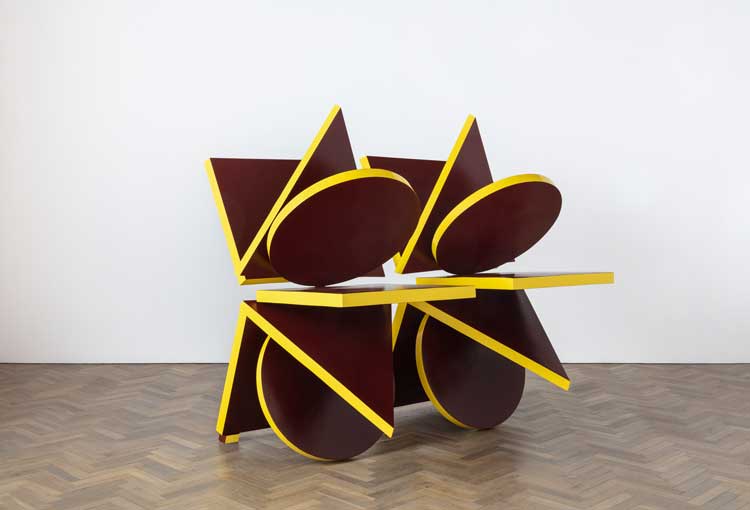
Phillip King, Point X, 1965. Plastic, 183 x 188 x 152.5 cm (72 1/8 x 74 1/8 x 60 1/8 in). © The Estate of Phillip King. Courtesy the estate and Thomas Dane Gallery. Photo: Richard Ivey.
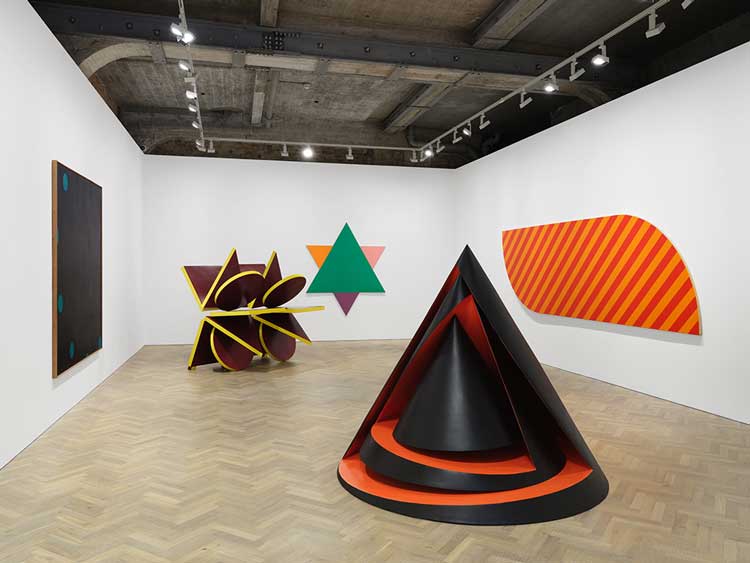
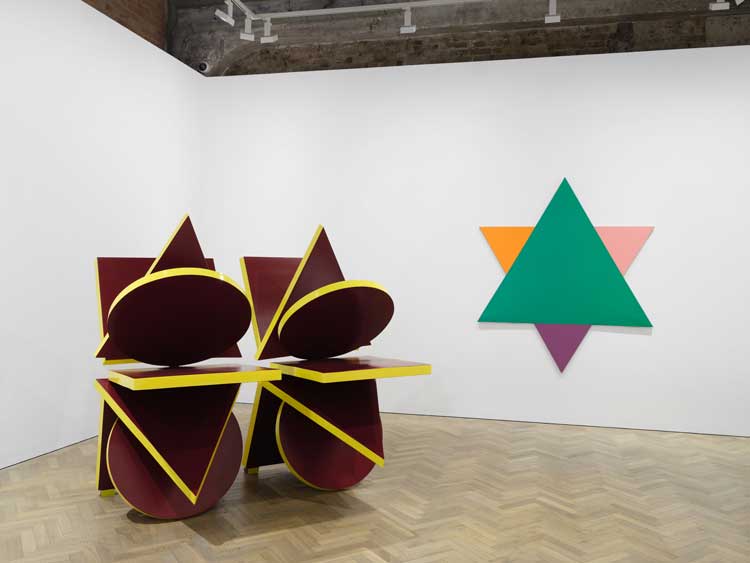
In this show, paintings and drawings by Moon from the 1960s and 70s (as well as geometric floor-based sculpture from 1972) sit alongside two large sculptures from the 60s by King and a group of handmade and editioned maquettes made throughout the latter’s career. Filling both of Thomas Dane’s gallery spaces in Duke Street St James, it is the colour and precision and rigorous handling of space that impress most. This is especially evident in the smaller of the two spaces where the two large floor-based works by King – Point X (1965) and And the Birds Began to Sing (1964/2018) have real impact. The attention to edge and surface is highlighted through King’s use of opposing colours in close proximity to one another. In Point X, flat geometric shapes (circle, square, triangle) are arranged as if balancing precariously on one another. Each geometric figure has two faces coloured a rich burnt umber, while a substantial edge running around its outline appears in acid yellow. The clash of colours adds to the apparent instability of the object, which seems ready to collapse at any moment. Similarly, the three cut-away cone volumes that nest together to form And the Birds Began to Sing are coloured with black surfaces and bright orange edges, lending it a sense of circular motion, as if about to lift off the ground. There are so many resonances between these two sculptures by King and the paintings by Moon that surround them, certainly the attention to surface, colour and sense of movement.
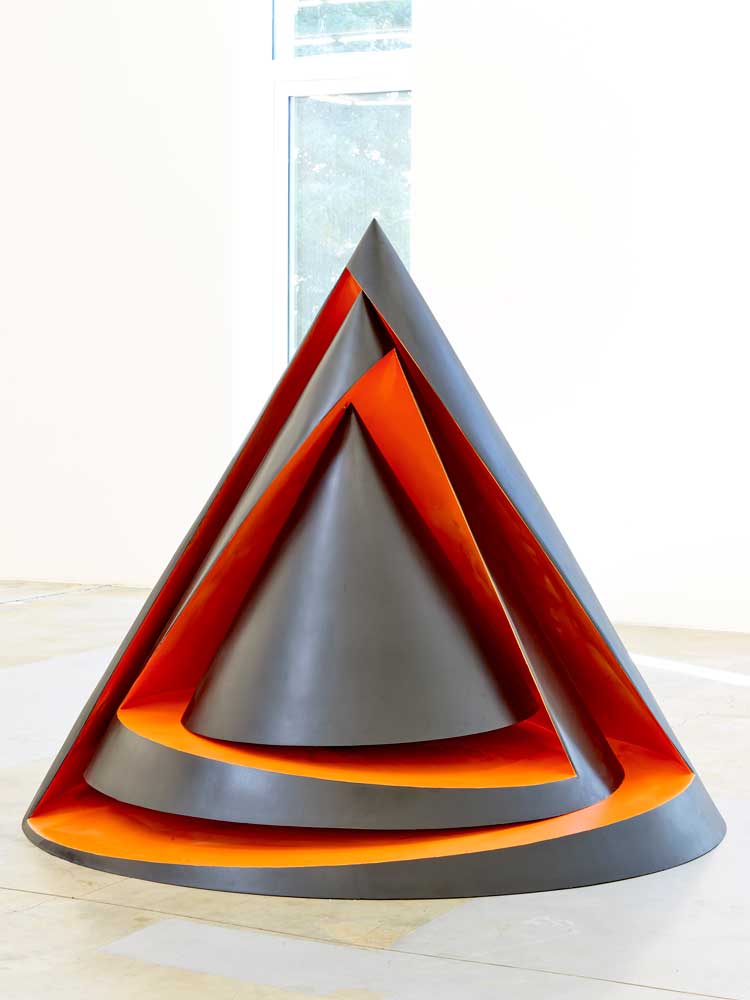
Phillip King, And the Birds Began to Sing, 1964/2018. Painted fibreglass, 168 x 213 x 213 cm (66 1/8 x 83 7/8 x 83 7/8 in). © The Estate of Phillip King. Courtesy the estate and Thomas Dane Gallery. Photo: Studio Rémi Villaggi. Courtesy Ceysson & Bénétière.
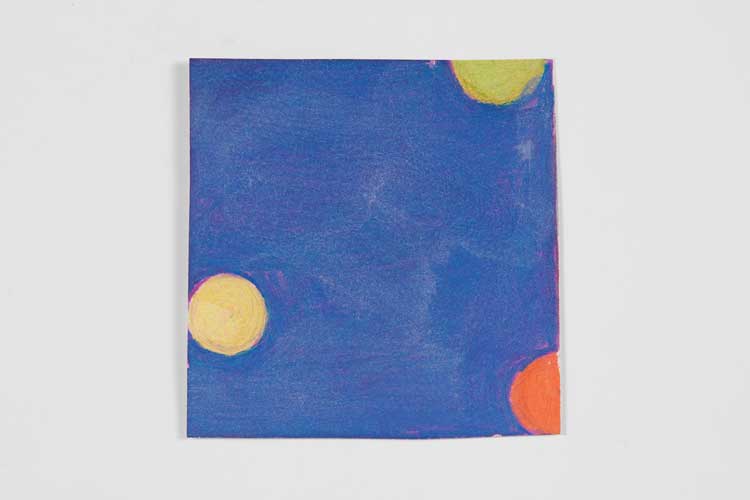
In Thomas Dane’s larger gallery, the rooms and the corridor space are filled with works by King and Moon, but in a way that still gives them room to breathe. The scale and proximity in the works in the corridor space lends Moon’s drawings a profound sense of intimacy. This is quickly countered in the next room where the large geometric floor piece 723D2 (1972) by Moon dominates by virtue of its scale, although that tendency is nicely balanced by the choice of his prints and drawings that encircle the walls.
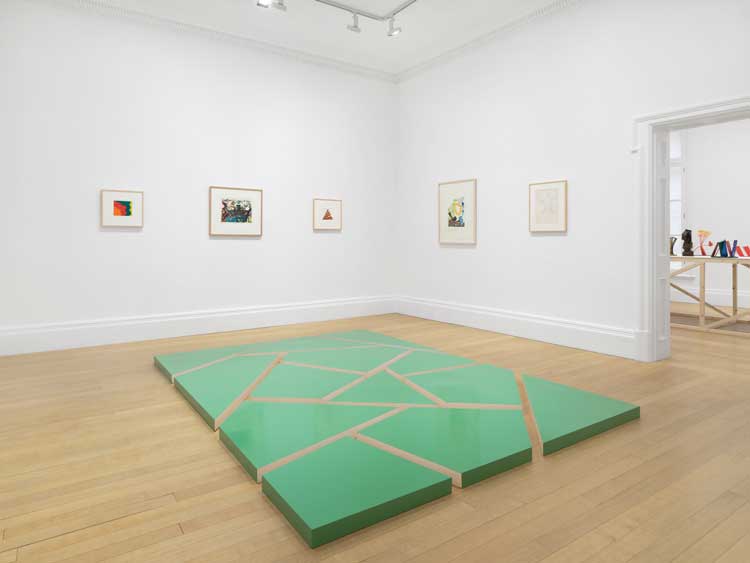
Moon / King: the work and friendship of Phillip King and Jeremy Moon - 1956 to 1973. Installation view, Thomas Dane Gallery, 2024. © Estate of Jeremy Moon. © The Estate of Phillip King. Courtesy the estates, Luhring Augustine, New York and Thomas Dane Gallery. Photo: Ben Westoby.
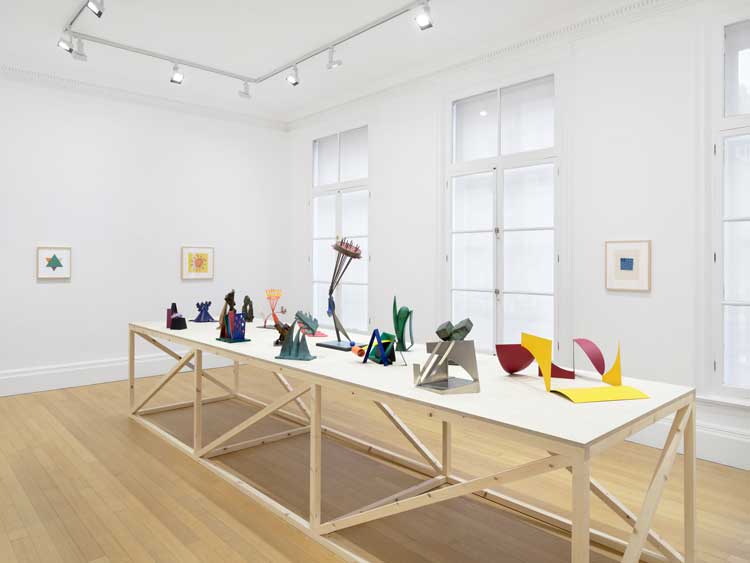
Moon / King: the work and friendship of Phillip King and Jeremy Moon - 1956 to 1973. Installation view, Thomas Dane Gallery, 2024. © Estate of Jeremy Moon. © The Estate of Phillip King. Courtesy the estates, Luhring Augustine, New York and Thomas Dane Gallery. Photo: Ben Westoby.
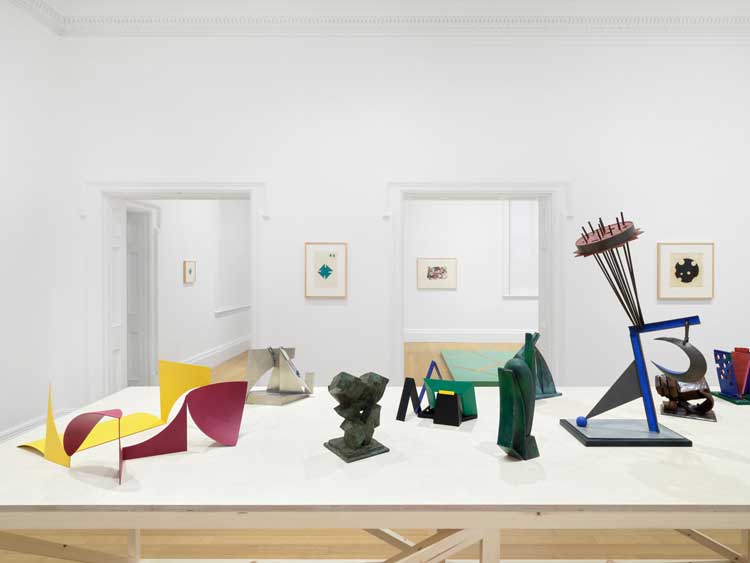
In another room, a long central table populated with 16 sculptures by King, most of them maquettes, is a fabulous way to display a lot of artworks and ideas together in a relatively small space and, once again, being surrounded by a variety of works by Moon really shows both bodies of work to their advantage. The dialogue between the works is what we might imagine the dialogue between the artists was like. In 2021, King wrote: “I realise now, looking back over the years at our work together, that I am [still] ... having a constant, ongoing, subconscious dialogue with a wide range of Jeremy’s works.”2 Perhaps that is how artistic friendships work.
References
1. Phillip King in Jeremy Moon: Starlight Hour, published by Luhring Augustine, 2022, page 67.
2. Phillip King quoted in Thomas Dane Gallery press release for Moon/King.

Click on the pictures below to enlarge
_6.jpg)
The 61st international art exhibition is a vast, volatile project that this year, more than most has...
25th Biennale of Sydney – Rememory
Central to this biennale are First Nations voices and the diverse diasporas that shape contemporary ...
This year is the 250th anniversary of the birth of John Constable and to celebrate, his native Suffo...
MoonSunStarEarthSkyWater, the first UK presentation of the late artist Nancy Holt’s work to includ...
The first UK retrospective of the great Spanish baroque painter Francisco de Zurbarán trades the mo...
Several Eternities in a Day: Form in the Age of Living Materials
Opened within weeks of each other, the Hammer Museum presents a mind-bending show of Brown Art and L...
André Leon Talley – interview with curator Rafael Brauer Gomes
Rafael Brauer Gomes, the director of fashion exhibitions at Savannah College of Art and Design (SCAD...
To coincide with his first UK exhibition, Agua Salada at Hauser & Wirth Somerset, Angel Otero talked...
Paula Rego: Dance Among Thorns
With more than 140 works on show, this exhibition encompasses the breadth of Rego’s art, from her ...
Handpicked: Painting Flowers from 1900 to Today
A smorgasbord of flower paintings from the last 125 years, exploring meaning, metaphor, accuracy and...

Klima Biennale Wien 2026: Unspeakable Worlds
Vienna’s climate biennale takes place across the city with institutional exhibitions and public pr...
Troublemakers and Prophets: Elizabeth Allen and Other Visionary Artists
The amazing story of an artist, who saw herself as a contemporary prophet, and made patchwork artwor...
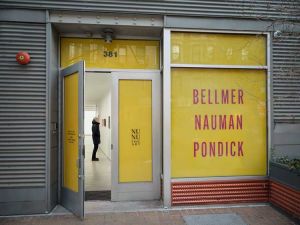
Bellmer Nauman Pondick: Material Desire
Focusing on the work of Rona Pondick, Hans Bellmer and Bruce Nauman, this exhibition considers how b...
-300.jpg)
Spanish artist Angela de la Cruz’s twisted canvases and collapsed objects are a reflection of the ...
,-Red-Devil-(soul-2),-Drifting-Leaves,-1972-300.jpg)
Senga Nengudi: Performance Works 1972-1982
Featuring photographic works, archival materials and films of key performance pieces, this exhibitio...
-Cecily-Brown-Photo-(c)-Jo-Underhill-300.jpg)
A painter’s painter, whose dynamic landscapes take viewers on a walk, Cecily Brown returns to Lond...
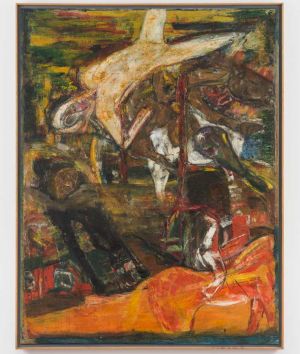
Frank Bowling: Seeking the Sublime
Though containing just 10 works, this exhibition demonstrates the breadth of the British-Guyanese ar...
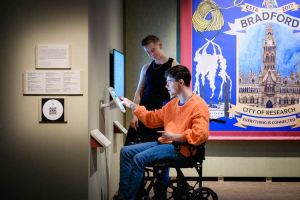
This exhibition explores ageing from the 1500s on, but it was the contemporary works here that reson...
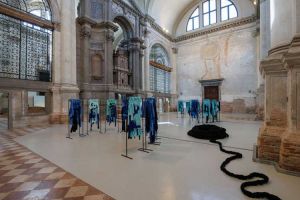
This show focuses on honouring ancient relationships between people, land and water, with new work f...
Gainsborough: The Fashion of Portraiture
Despite once saying he was sick of portraits, Gainsborough was one of the most sought-after portrait...
Histories of erasure, displacement, annihilation and colonisation are told with power, subtlety, cla...
-(8)-300.jpg)
Hurvin Anderson’s paintings, which here stretch across his career, blend his British and Caribbean...
-(c)-DACS,-London,-2026-and-Chiharu-Shiota.-300.jpg)
Chiharu Shiota: Threads of Life
Chiharu Shiota’s immersive web-like installations, fashioned from coloured thread and found object...
-(c)Rob-Battersby-6-1000-300.jpg)
Paul Eastwood, who is dyslexic, attempts to explore neurodiversity and the complexities of language,...
The artist and writer Morgan Quaintance, winner of the 2025 Film London Jarman Award among other acc...
Maggie’s: Architecture That Cares
Celebrating 30 years of the distinctive Maggie’s Centres for cancer care, this exhibition highligh...
Euan Uglow: An Arc from the Eye
His almost scientific methods of observation led Euan Uglow to take months, even years to finish a p...
A look behind the scenes of the travelling exhibition on Berthe Weill
The show celebrating the pioneering Parisian avant-garde gallerist opened in New York before travell...
Hammershøi: The Eye That Listens
A substantial retrospective reveals the mysteries and anomalies of magnetic Danish master Vilhelm Ha...
Barbados Museum & Historical Society challenges narrative around slavery
These two fascinating, interrelated exhibitions – one of a 19th-century Black Barbadian, the other...

Copyright © 1893–2026 Studio International Foundation.
The title Studio International is the property of the Studio International Foundation and, together with the content, are bound by copyright. All rights reserved.
 |
 |
 |
|---|
 Dallas Art Fair
 Sam Cornish: ‘We started with this idea that all works would have to contain repetition, sequence and symmetry’
 Colour is
![Jeremy Moon. Collage [ C3/71], 1971, pencil & pastel on paper, 52 x 63.5 cm, 20.5 x 25"](/images/articles/m/moon/smallpix/moon_b-300.jpg) Mr Jeremy Moon experiments. Jeremy Moon: drawings and collages
Mr Jeremy Moon experiments. Jeremy Moon: drawings and collages