





Neue Nationalgalerie, Berlin
13 July – 27 November 2023
by JOE LLOYD
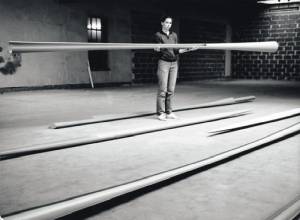
Isa Genzken (b1948) has never lacked ambition. As a student at Kunstakademie Düsseldorf in the 1970s, she collaborated with a physicist and a cabinetmaker to create slender, lengthy wooden sculptures that lie horizontally along the floor. Miraculously, these Ellipsoide (Ellipsoids, 1976-82) only touch the ground at a single point. Drawn on the computer, then painstakingly hand-carved, they seem to defy gravity. Genzken’s Hyperboloide (Hyperbolos,1976-82) manage a similar trick, resting on two points.
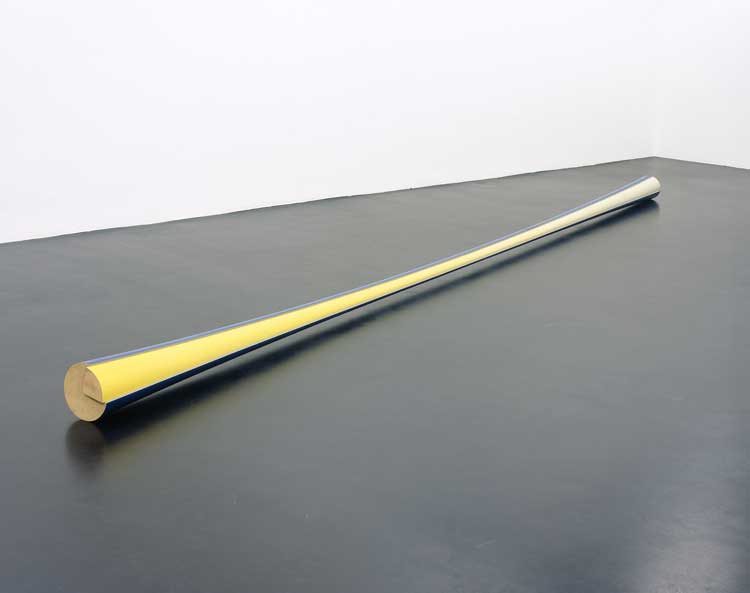
Isa Genzken, Blau-blau-gelbes Hyperbolo ‘Elbe’ (Blue-blue-yellow Hyperboloid 'Elbe’), 1981. Wood, lacquer, 20 x 20 x 44 cm. Private collection, Berlin. Courtesy Galerie Buchholz © VG Bild-Kunst, Bonn 2023.
When these sculptures were first unleashed, American minimal art was at its peak. Genzken’s work was criticised for breaking its mould. She challenged their rigid forms with soft curves. She returned the craft to a discipline that was becoming increasingly reliant on machine techniques. And she affirmed that abstract sculpture could and should provoke comparison to other things, rather than aspire to a Platonic purity of form. Genzken later recalled: “People would say, ‘It looks like a spear, or a toothpick, or a boat.’ This associative aspect was there from the beginning and was also intentional, but from the viewpoint of minimal art it was absolutely out of the question and simply not modern.” Genzken’s sculptures aggressively reveal the fiction behind such claims. As the curator Laura Hoptman later put it: “They’re a smack in the face to minimalism.”
Half a century later, minimalism has become just one byway in contemporary art’s history. And it is Genzken’s manifold, maximalist oeuvre that seems to better represent the modern age. Sometimes it can seem like the whole of the 20th century is captured within her work: concrete architecture, newsprint, mass-produced plastics, the American dream, printed photography, advertising, electronic technology, subcultures, consumerism and calamity. All these aspects are captured in 75/75, an exhibition of 75 sculptures to celebrate Genzken’s forthcoming 75th birthday, held at Berlin’s Neue Nationalgalerie.
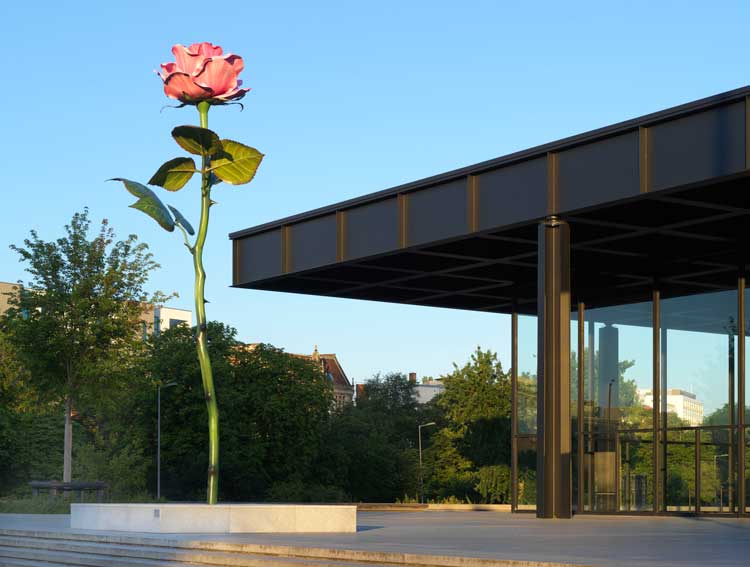
Isa Genzken, Pink Rose, 2016/23. Aluminium, paint, stainless steel, 825 x 289 x 307 cm. Fredriksen Family Collection. Photo: Nationalgalerie, Staatliche Museen zu Berlin / Kens Ziehe. Courtesy Galerie Buchholz © VG Bild-Kunst, Bonn 2023.
The materials, forms and concerns of Genzken’s sculptures are so wide-ranging that the uninformed could easily mistake 75/75 for a group show of a dozen different artists. “In my life,” she said in 2006, “I’ve always been concerned with fluidity and opposed to rigidity.” Her work is defined by a constant movement, darting here and there, sometimes looping backwards but never quite arriving at the same spot. The curators, Klaus Biesenbach and Lisa Botti, have done a particularly good job at capturing this flux.
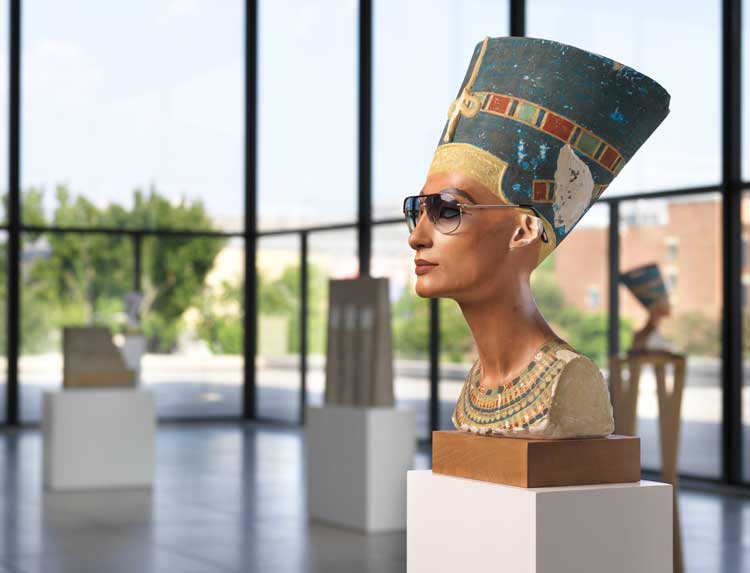
Genzken’s works are clustered together in series across the Neue Nationalgalerie’s upper floor, which is transformed into a play. The arrangement of the sculptures fosters parallels and connections. There are no hard borders between series. Concrete sculptures modelled on forms from modernist architecture sit next to resin works that echo both construction techniques and minimalist sculpture; clothed mannequins stand next to towering Columns (1994-2003), eye-level skyscrapers. Some series, such as her irreverent Nofretete (2012-18), glasses-wearing plaster busts of Nefertiti, are spread out between other series.
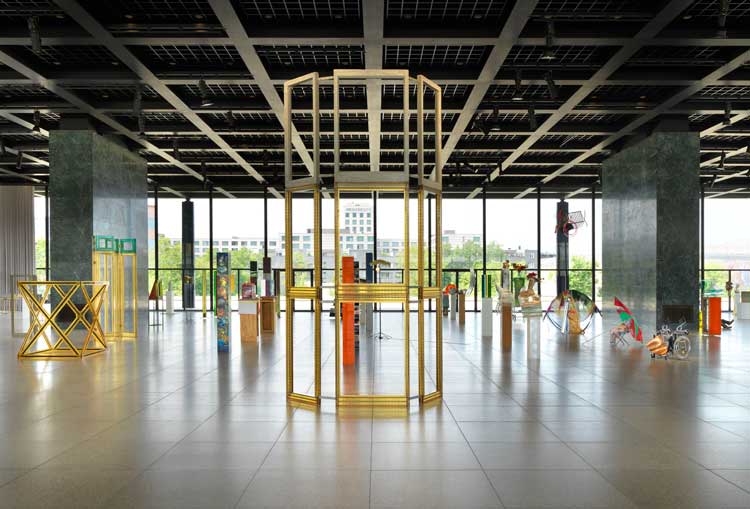
Exhibition view of Isa Genzken: 75/75. Neue Nationalgalerie, 2023. Photo: Nationalgalerie, Staatliche Museen zu Berlin / Kens Ziehe. Courtesy Galerie Buchholz © VG Bild-Kunst, Bonn 2023.
Architecture is one of Genzken’s most persistent interests. The formal purity of the Neue Nationalgalerie, Mies van der Rohe’s masterpiece of modernist architecture, provides a striking contrast to Genzken’s chipped concrete pieces and playful resin forms. Mies (2008) features one of the architect’s Barcelona chairs hanging upside down from the ceiling, its cushion sliding off and tacky hula hoops attached to its austere frame. The works of the Fenster (Window) series resemble empty window frames. Windows are used to bring in light and provide views of the outside world; Mies’ building is walled by a continuous sheet of glass that performs both functions supremely well. But Genzken turns windows into aesthetic forms to be observed, in a neat absurdist twist.
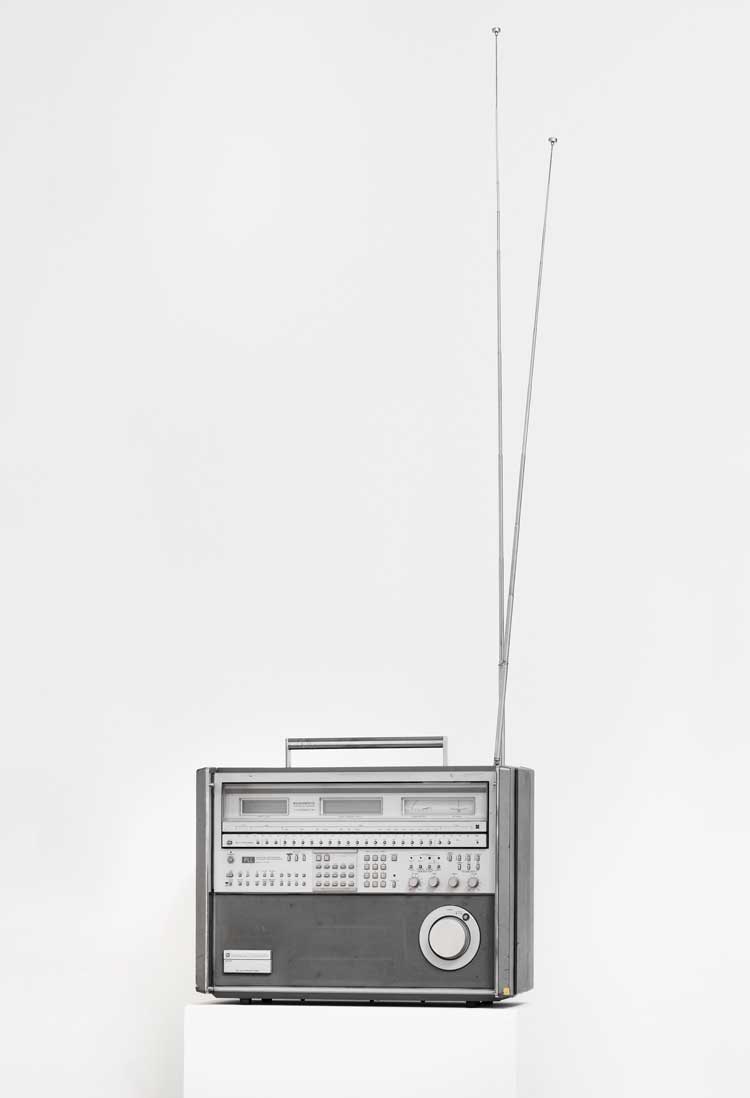
Isa Genzken, Weltempfänger (World Receiver), 1982. Radio, 37 x 51 x 20 cm. Courtesy Galerie Buchholz © VG Bild-Kunst, Bonn 2023.
This tendency to take objects from daily life and turn them into sculptural objects appears often in Genzken’s practice. In 1979, she photographed advertisements for new hi-fi sets, which then seemed the bleeding edge of modernity. She determined that for a sculpture to have a purpose to exist, it had to be better than a stereo set. The Weltempfänger (World Receiver) series was the result. It began with Genzken’s own stereo (1982), still used today in her studio but here placed on a plinth as if sculpted. Then she began creating concrete blocks that imitated its shape. Their antennas became symbols for receiving the matter of the world. They also serve as a sort of bodily extension, groping outwards. Genzken says: “My antennas were also meant to be ‘feelers’, things you stretch out in order to feel something, like the sort of the world and its many tones.” Mein Gehirn (My Brain, 1984) even imagines the artist’s thinking organ as a hunk of plaster with a metal receiver.
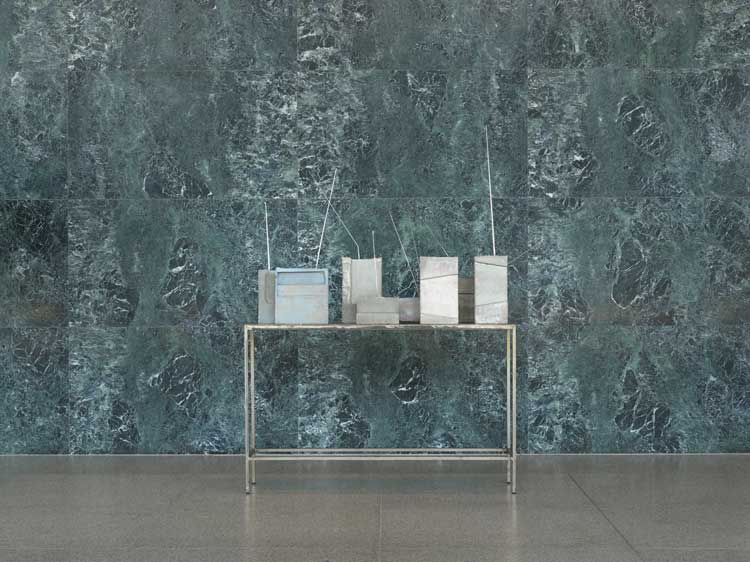
Exhibition view of Isa Genzken: 75/75, Neue Nationalgalerie, 2023 featuring Weltempfänger (World Receiver), 1988-89. Private collection, London. Photo: Nationalgalerie, Staatliche Museen zu Berlin / Kens Ziehe. Courtesy Galerie Buchholz © VG Bild-Kunst, Bonn 2023.
As Genzken marched on into the 90s, she started experimenting with assemblage and mixed media. She coated columns in photographic prints, as if cut out from a magazine. One is covered in fish and other aquatic creatures. Genzken adds an edge of the absurd. One of the Zwei Regiesessel (Director’s Chairs, 2003), which resembles a bench, constantly rotates; two feet peek out from within it. Gradually, more bric-a-brac from contemporary life enter her work: action figures, newspapers, shop mannequins. If she was concerned before with overcoming and outdoing modernity, here she puckishly pushes it aside. One series of abstract sculptures resembling kitschy architectural models is even called Fuck the Bauhaus (2000), sticking two fingers up at a sacrosanct moment in Germany’s history.
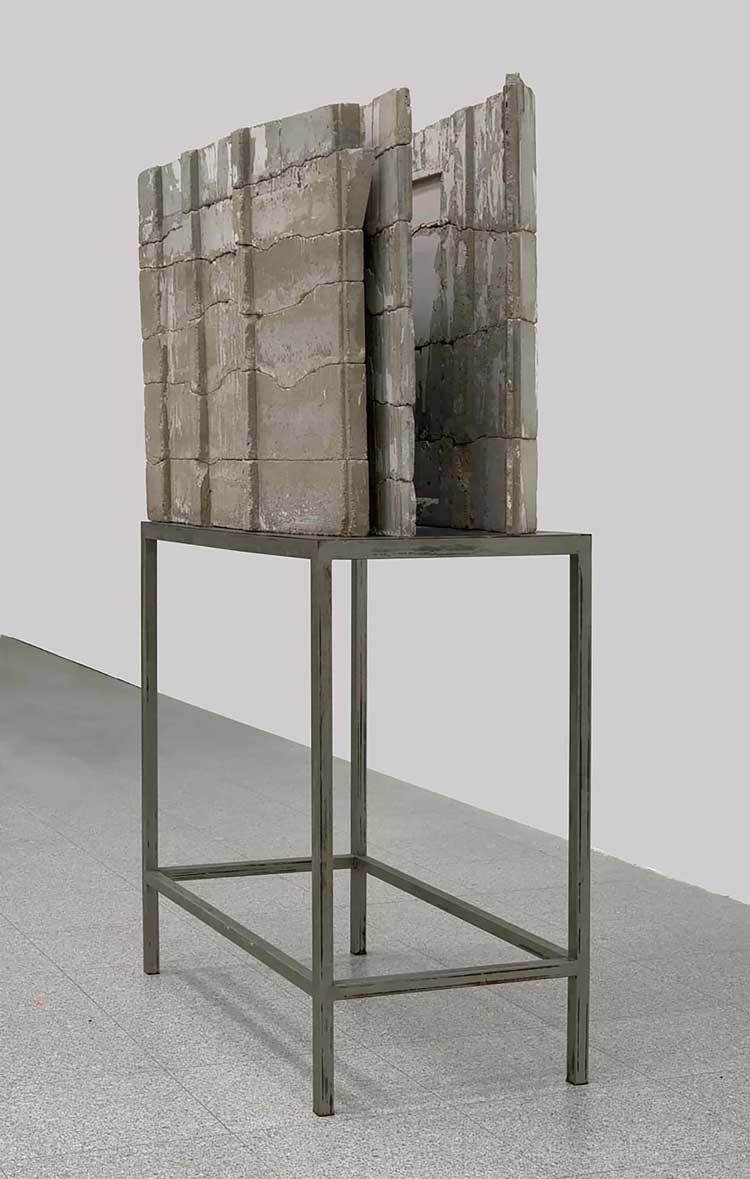
Isa Genzken, Atelier, 1990. Concrete and steel, 265 x 76 x 163 cm. Donation of the Hoffmann Collection, Dresden State Art Collections. Installation view © Art and Exhibition Hall of the Federal Republic of Germany GmbH. Courtesy of the Buchholz Gallery / VG Bild-Kunst, Bonn 2023.
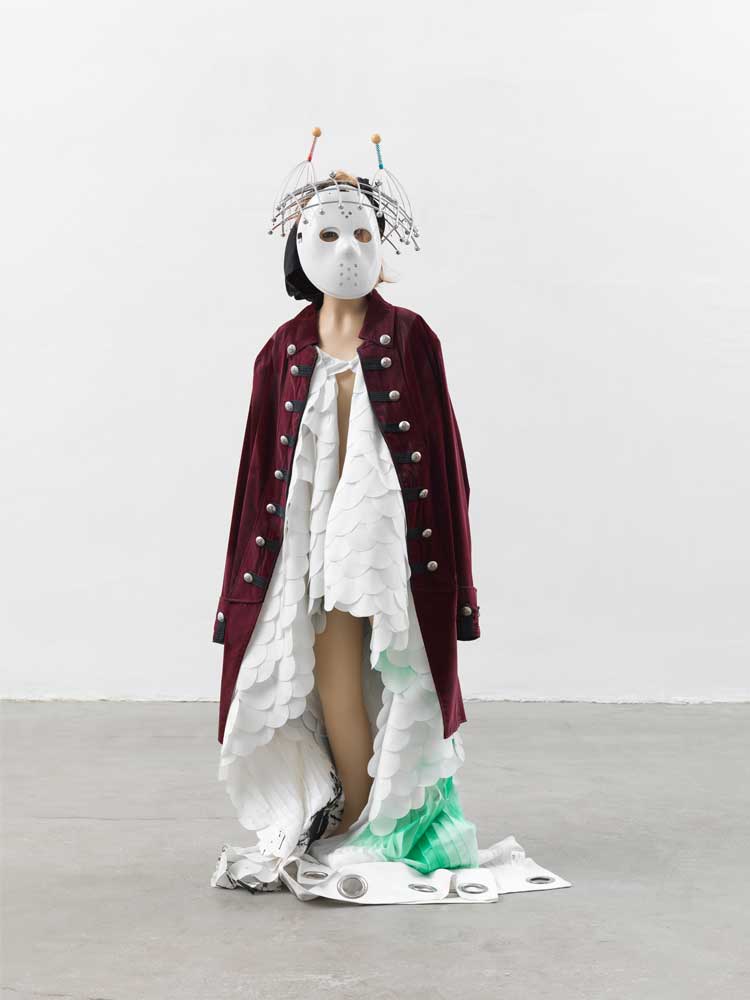
These works combine found materials from the streets of New York into garish assemblages of cheaply mass-produced items, architectural models from a twisted dimension. While her concrete works seem like haunted fragments of the fallen modernist moment, Genzken’s later pieces seem more trenchantly critical of the rampant consumer capitalism that followed. The more colourful her works, the more terror seems to lurk beneath the surface. A 2006 Untitled work features a baby doll on a garden chair, sheltered beneath a tattered parasol; she holds a matchstick and her skin is toned a putrid grey. One 2019 work from the Schauspieler (Actors) series reimagines Velázquez’s Rokeby Venus as an inert mannequin, but posed so that the mirror reflects her rear.
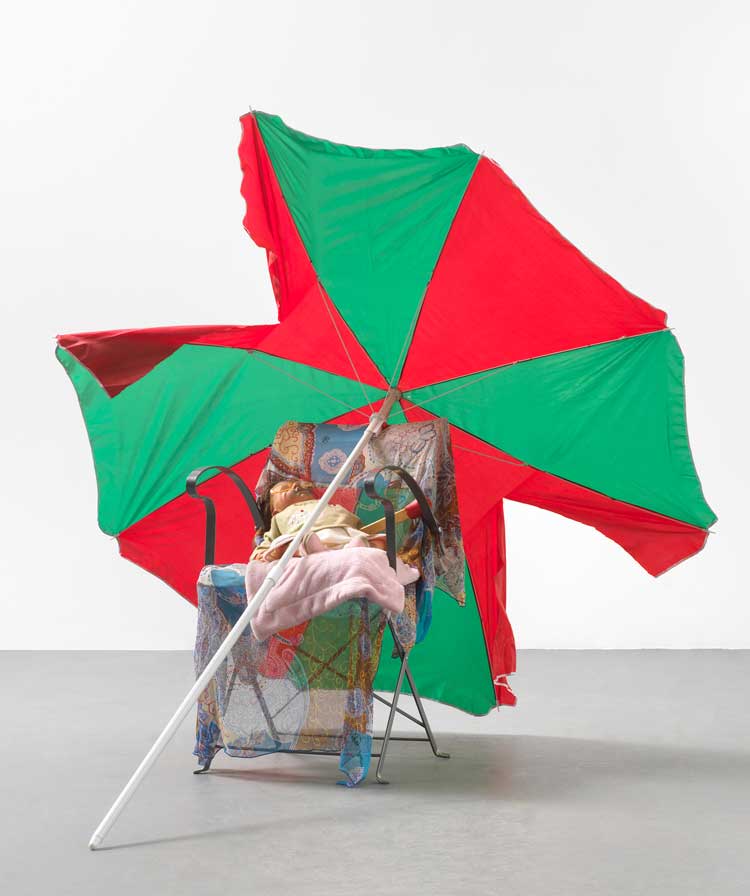
Isa Genzken, Untitled, 2006. Folding chair, doll, blanket, fabric, glasses, plastic, lacquer, spray paint, sunshade, approx 148 x 176 x 160 cm. Hauser & Wirth, David Zwirner. Courtesy Galerie Buchholz © VG Bild-Kunst, Bonn 2023.
These assemblages seem to represent an uneasy pact between the human body and the clutter of products we surround ourselves with. Genzken’s Venus lies next to a poster advertising Incredible India with a tiger, land and nature turned into aspiration and cheap novelty. The final work of the entire exhibition, Untitled (2018), is a pile of newspapers, magazines, CDs and shopping bags, artfully strewn across the floor. Headlines face the ceiling, the decontextualised howls of the press. Modernity has reached its saturation point, offering both too much and too little. It is enough to drive you back into the arms of the Bauhaus.

Click on the pictures below to enlarge
RSA 200 Annual Exhibition, Edinburgh
Despite packing in 560 works, the show doesn’t feel crowded and a walk through the galleries felt ...
The 61st international art exhibition is a vast, volatile project that this year, more than most has...
25th Biennale of Sydney – Rememory
Central to this biennale are First Nations voices and the diverse diasporas that shape contemporary ...

This year is the 250th anniversary of the birth of John Constable and to celebrate, his native Suffo...

MoonSunStarEarthSkyWater, the first UK presentation of the late artist Nancy Holt’s work to includ...
The first UK retrospective of the great Spanish baroque painter Francisco de Zurbarán trades the mo...
Several Eternities in a Day: Form in the Age of Living Materials
Opened within weeks of each other, the Hammer Museum presents a mind-bending show of Brown Art and L...
André Leon Talley – interview with curator Rafael Brauer Gomes
Rafael Brauer Gomes, the director of fashion exhibitions at Savannah College of Art and Design (SCAD...
To coincide with his first UK exhibition, Agua Salada at Hauser & Wirth Somerset, Angel Otero talked...
Paula Rego: Dance Among Thorns
With more than 140 works on show, this exhibition encompasses the breadth of Rego’s art, from her ...

Handpicked: Painting Flowers from 1900 to Today
A smorgasbord of flower paintings from the last 125 years, exploring meaning, metaphor, accuracy and...

Klima Biennale Wien 2026: Unspeakable Worlds
Vienna’s climate biennale takes place across the city with institutional exhibitions and public pr...
Troublemakers and Prophets: Elizabeth Allen and Other Visionary Artists
The amazing story of an artist, who saw herself as a contemporary prophet, and made patchwork artwor...
Bellmer Nauman Pondick: Material Desire
Focusing on the work of Rona Pondick, Hans Bellmer and Bruce Nauman, this exhibition considers how b...
-300.jpg)
Spanish artist Angela de la Cruz’s twisted canvases and collapsed objects are a reflection of the ...
,-Red-Devil-(soul-2),-Drifting-Leaves,-1972-300.jpg)
Senga Nengudi: Performance Works 1972-1982
Featuring photographic works, archival materials and films of key performance pieces, this exhibitio...
-Cecily-Brown-Photo-(c)-Jo-Underhill-300.jpg)
A painter’s painter, whose dynamic landscapes take viewers on a walk, Cecily Brown returns to Lond...
Frank Bowling: Seeking the Sublime
Though containing just 10 works, this exhibition demonstrates the breadth of the British-Guyanese ar...
This exhibition explores ageing from the 1500s on, but it was the contemporary works here that reson...
This show focuses on honouring ancient relationships between people, land and water, with new work f...

Gainsborough: The Fashion of Portraiture
Despite once saying he was sick of portraits, Gainsborough was one of the most sought-after portrait...

Histories of erasure, displacement, annihilation and colonisation are told with power, subtlety, cla...
-(8)-300.jpg)
Hurvin Anderson’s paintings, which here stretch across his career, blend his British and Caribbean...
-(c)-DACS,-London,-2026-and-Chiharu-Shiota.-300.jpg)
Chiharu Shiota: Threads of Life
Chiharu Shiota’s immersive web-like installations, fashioned from coloured thread and found object...
-(c)Rob-Battersby-6-1000-300.jpg)
Paul Eastwood, who is dyslexic, attempts to explore neurodiversity and the complexities of language,...

The artist and writer Morgan Quaintance, winner of the 2025 Film London Jarman Award among other acc...
Maggie’s: Architecture That Cares
Celebrating 30 years of the distinctive Maggie’s Centres for cancer care, this exhibition highligh...
Euan Uglow: An Arc from the Eye
His almost scientific methods of observation led Euan Uglow to take months, even years to finish a p...
A look behind the scenes of the travelling exhibition on Berthe Weill
The show celebrating the pioneering Parisian avant-garde gallerist opened in New York before travell...
Hammershøi: The Eye That Listens
A substantial retrospective reveals the mysteries and anomalies of magnetic Danish master Vilhelm Ha...

Copyright © 1893–2026 Studio International Foundation.
The title Studio International is the property of the Studio International Foundation and, together with the content, are bound by copyright. All rights reserved.
 |
 |
 |
|---|
 Sascha Wiederhold: Rediscovery of a Forgotten Artist
 Kai Althoff Goes With Bernard Leach
 Isa Genzken: Botanical Garden
 Isa Genzken’s Objects: Life into Art