





Kettle’s Yard, Cambridge
8 July – 29 October 2023
by BETH WILLIAMSON
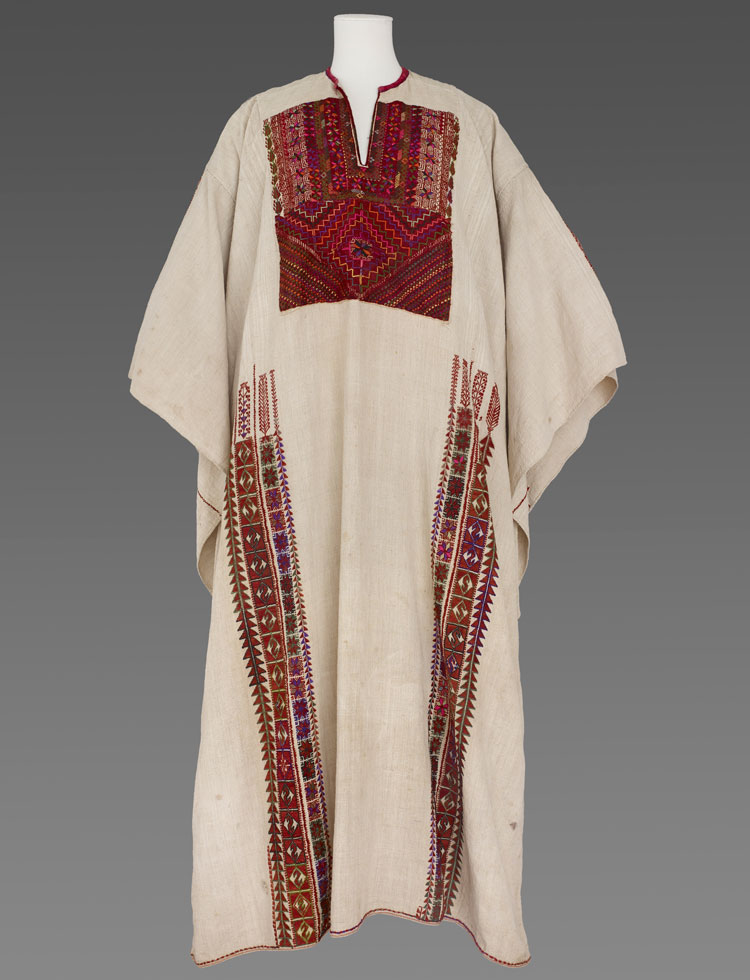
Embroidered crafts in Palestine have a long-established history and this exhibition brings that to new audiences, as well as highlighting its continued significance in contemporary times. Comprising more than 40 dresses, known as thobes, and other embroidered objects, this is the first time such objects, many from important collections in Jordan and the West Bank, have been displayed in the UK. As this deeply researched exhibition shows, the history of these garments is a crucial part of Palestine’s cultural heritage and one that lends a particularly close insight as each garment is so intimately associated with the wearer’s body. Further, interweaving garments with archival material, the voices of the women who made them, and related contemporary artworks makes for a rich and fascinating story. It is a story of how embroidery has been linked to the shifting social, economic and political landscape in Palestine over the last century and it is expertly told by the curator, Rachel Dedman.
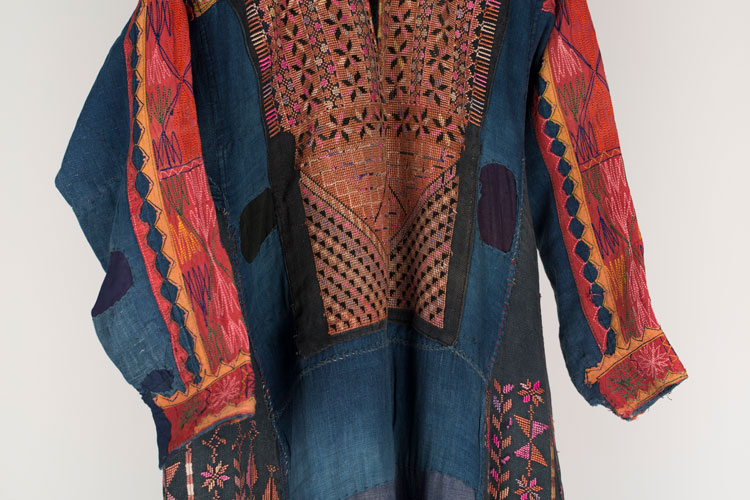
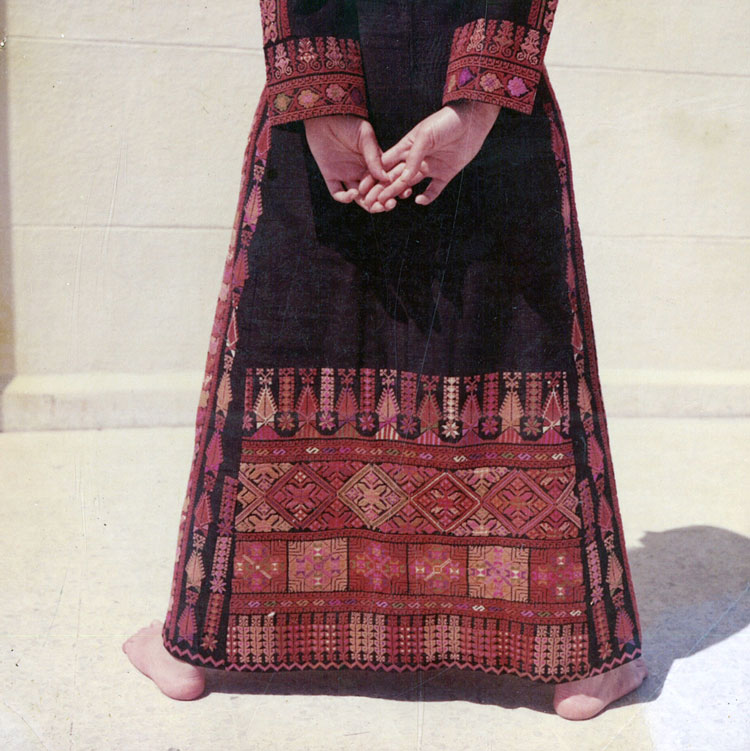
Everyday dress from Gaza or Hebron, 1935-40, from the
collection of Tiraz: Widad Kawar Home for Arab Dress.
The exhibition begins with two dresses from the beginning of the 20th century, quotidian garments worn by women while working in the fields or caring for their families, and everywhere showing signs of wear. Not only are these dresses part of a larger history, but they carry their own history too. One garment, a 1930s dress from the Gaza region, displays its darns and patches as evidence of its wearer’s life working in the fields, and patched holes in the chest indicated how she adapted it for breastfeeding. Its mosaic patterns and faded blue linen carry the traces of older garments inherited from an earlier generation too. In this way, each garment tells its own story while together they build a narrative history that draws a line through the complex politics of Palestine.
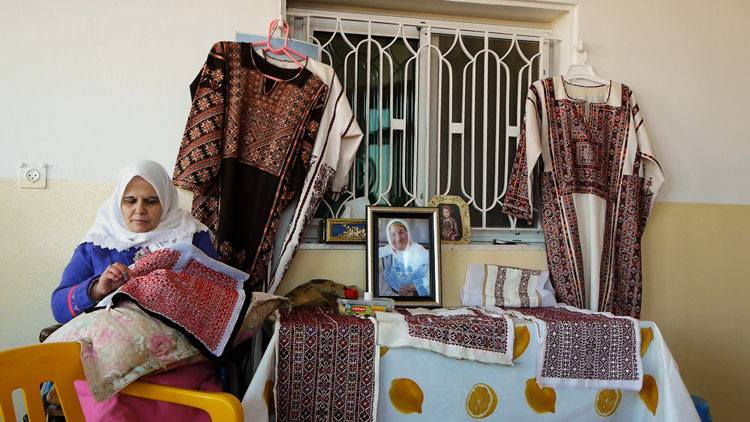
Maeve Brennan, still from The Embroiderers, 2016, courtesy of the artist.
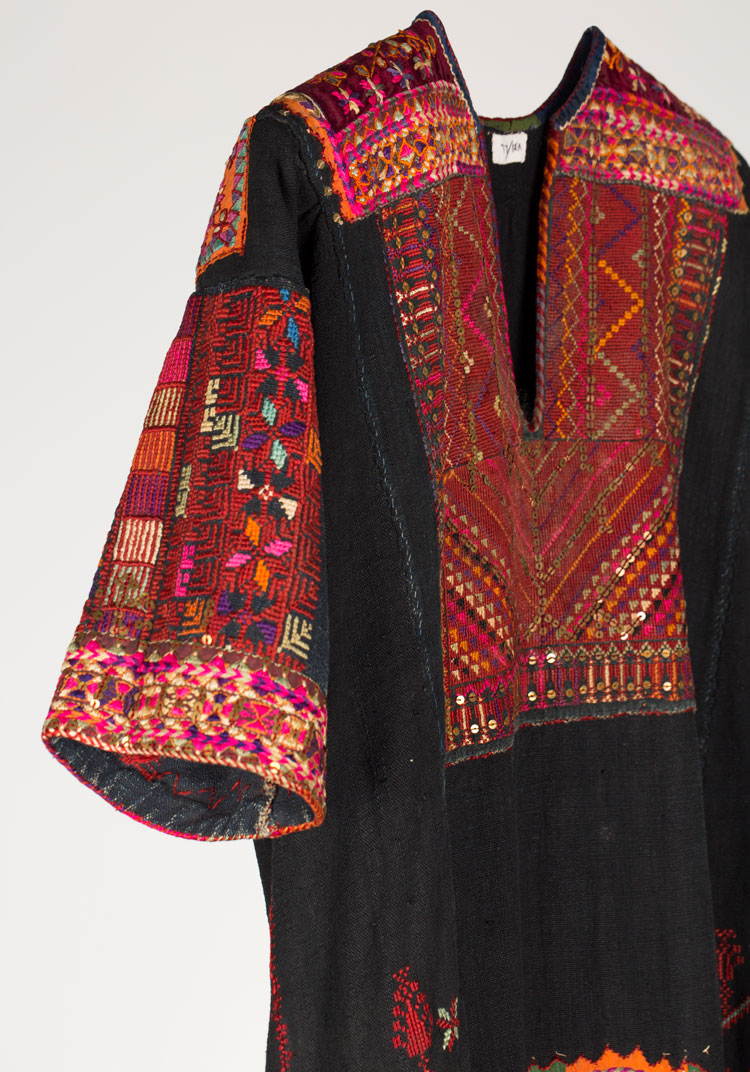
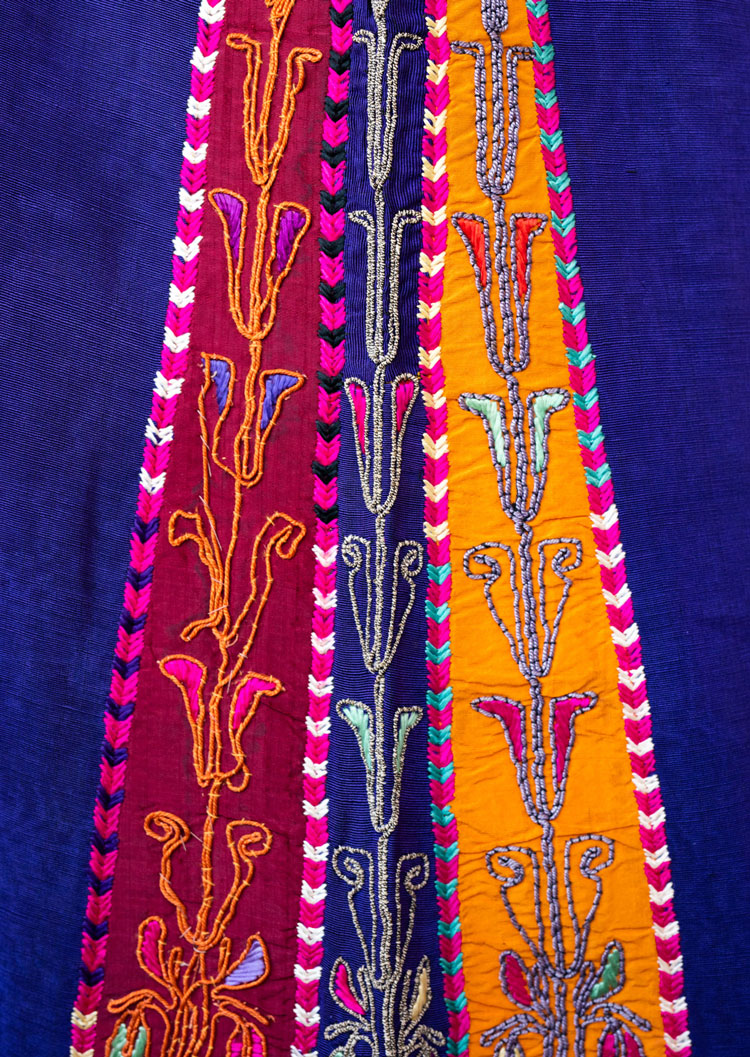
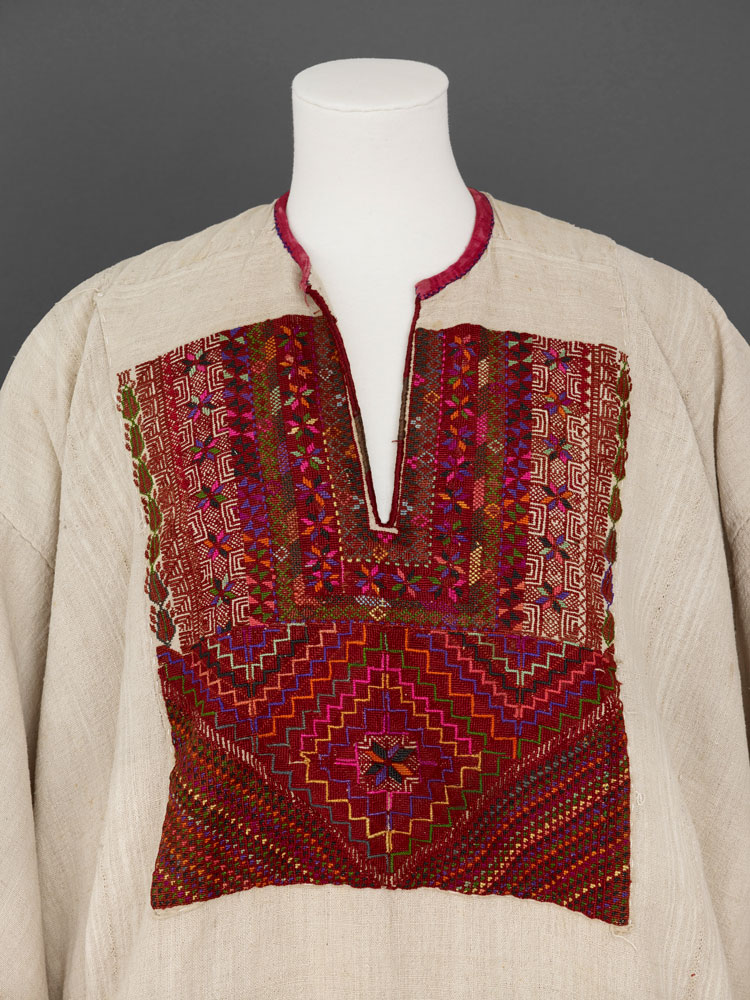
These histories are further enlivened by filmed interviews dotted around the exhibition. Filmed by the artist Maeve Brennan, they give a wonderful sense of embroidery as a living legacy, one that not only passes down through generations but also grows and develops in response to the contemporary situation in which its practitioners find themselves. Garments and their decoration develop across time as the social and political landscape shifts. Beyond the everyday thobes already mentioned are richly ornate garments sewn for special occasions, such as market days or marriage. There are regional differences, too, sometimes in response to varying standards of modesty or simply the diversity of local styles. For instance, the elaborate swirling patterns of embroidery from Bethlehem, known as “tahriri”, contrast with the spare geometric cross-stitch found on garments from Galilee and stitched on to linens of indigo-blue or rust-red.
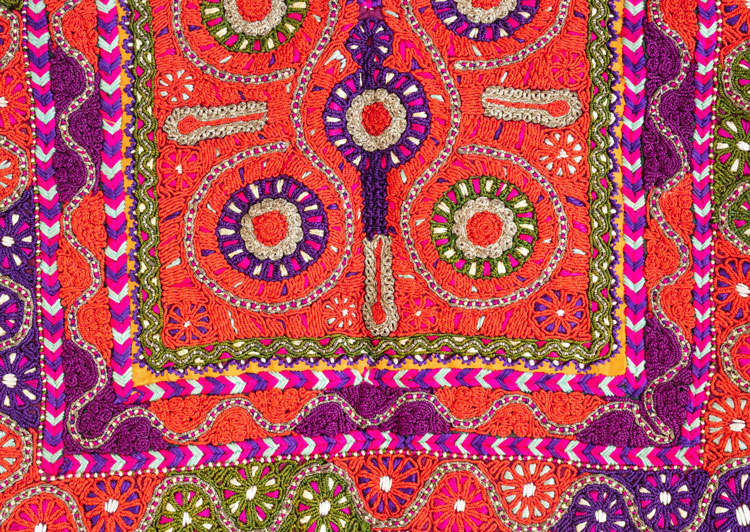
Detail of dress from Beit Dajan, 1930s. From the collection of George M. Al-Ama. © the Whitworth, The University of Manchester. Photo: Ruth Wedgbury.
Underlining the continued narrative potential of thread, work by contemporary artists Mona Hatoum, Khalil Rabah, Mounira Al Solh, Samak Bilab Bi Delo, Aya Haidar and Majd Abdel Hamid interjects in these much earlier stories. What began as a village tradition was transformed by modernity before being recruited by contemporary artists as a tool for politicisation and critical re-interpretation. The dialogue that is established between old and new is fresh and exciting. Two examples of Hatoum’s Hair Grid (2001) works are tiny woven lattices of hair, delicate yet strong. Al Solh’s embroidered hangings honour particular women, such as Fatema Mernissi, an influential Moroccan scholar, or Azza Soliman, a lawyer and human rights activist.
-2001-(Photo-Hugo-Glendinning)-Pompidou-scan-2015.jpg)
Mona Hatoum, Untitled (hair grid with knots), 2001. Human hair, hair spray and tracing paper, 35 x 27 cm (13 3/4 x 10 3/4 in.) © Mona Hatoum. Courtesy White Cube (Photo: Hugo Glendinning).
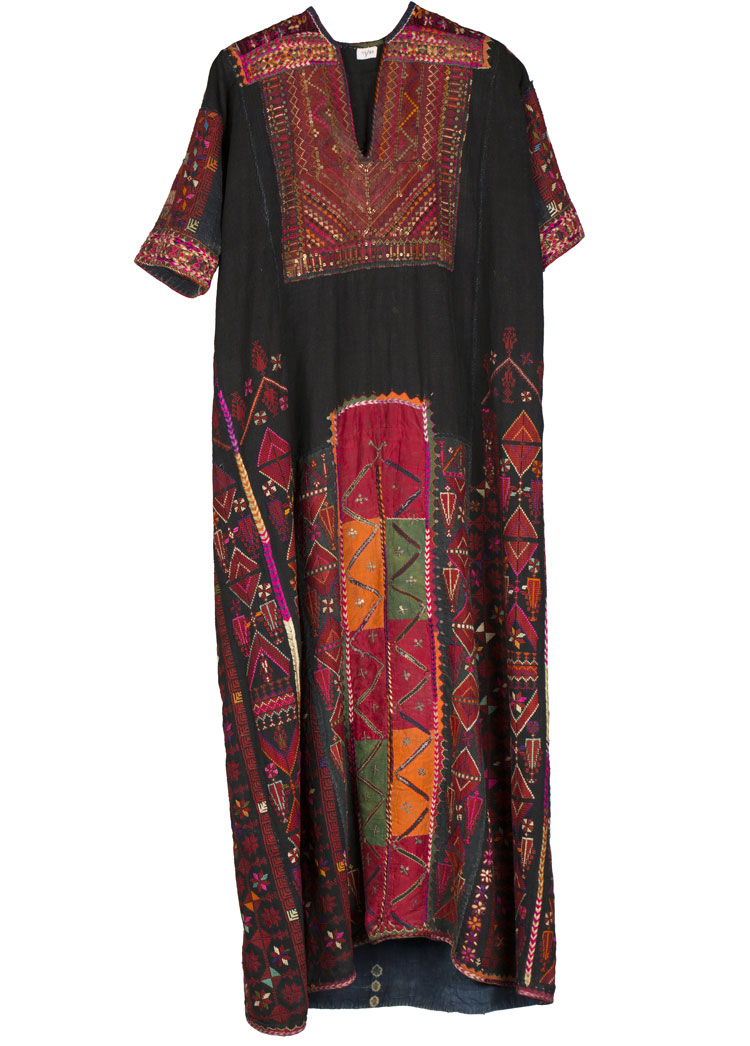
The experience of women fleeing trouble, crossing borders and seeking refuge, is marked in some of these garments too. A dress from Ramallah from the 1930s, we are told, marks the movement between older traditions and more recent events in Palestine. Its rust-red patterns were stitched on to creamy-coloured linen before it was given by its owner to a woman fleeing her home during the Nakba (also known as the catastrophe), the displacement of Palestinians in the 1948 Arab-Israeli war. Visibly enlarged to match its new owner’s stature, a side panel has been stitched in using material from a bag of flour issued by the UN Relief and Works Agency.
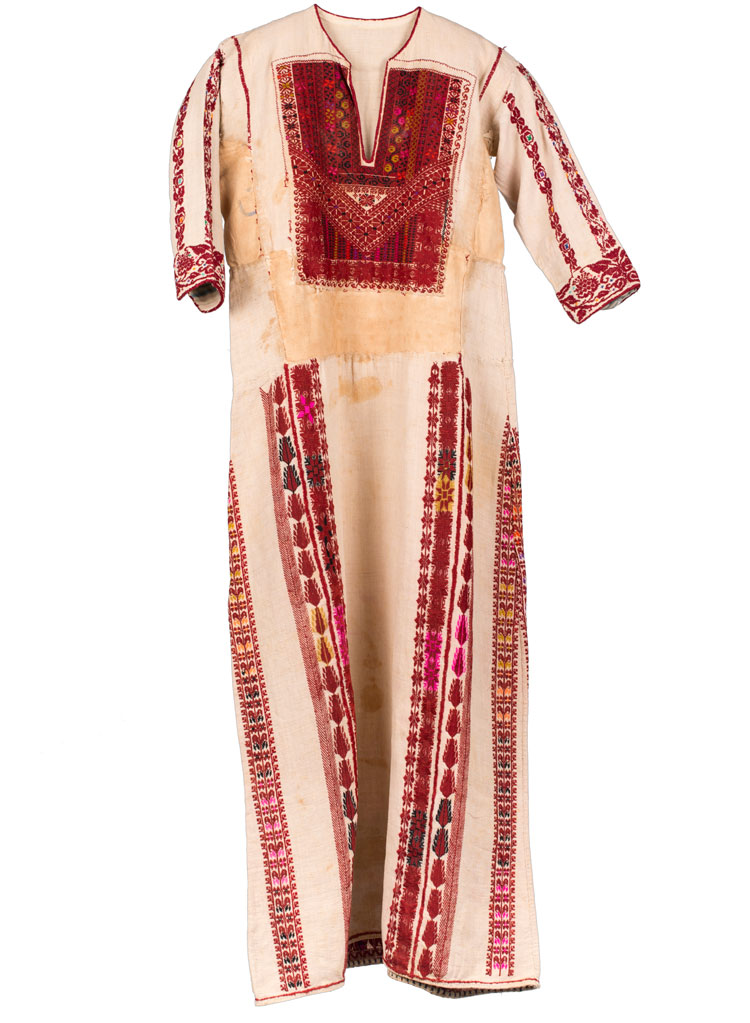
Dress from Ramallah, 1930s, from the collection of Maha Abu Shosheh.
This act of giving and altering gestures to the generosity and solidarity among women in difficult times. Such strengths are once again articulated in the 70s when Palestinian embroidery underpinned a heritage revival and voicing of nationalism and the image of a woman in embroidered dress became synonymous with Palestinian endurance. The embroidered woman began to appear in striking posters displayed in homes and shown to great effect in this exhibition. With titles such as Animating the Present, Liberation, Victory, Return, and Mother and Fighter, their purpose is explicit. By the 80s, such images were increasingly militarised as part of the Palestinian resistance movement. A new kind of embroidered dress emerged during the first intifada (1987-93), the Palestinian uprising against Israeli occupation. Among the familiar embroidery patterns, new symbols of resistance appeared – flags, doves, guns – an effective means of protest as garments are more difficult to confiscate than banners or placards. At a time when the Palestinian flag and its colours were banned in public, maps of Palestine and its flag featured on these dresses and were often accompanied by other motifs stitched in Palestinian national colours. In other instances, these garments feature significant religious sites, or the letters P-L-O. Resistance was writ large on the female body in an act of political struggle.
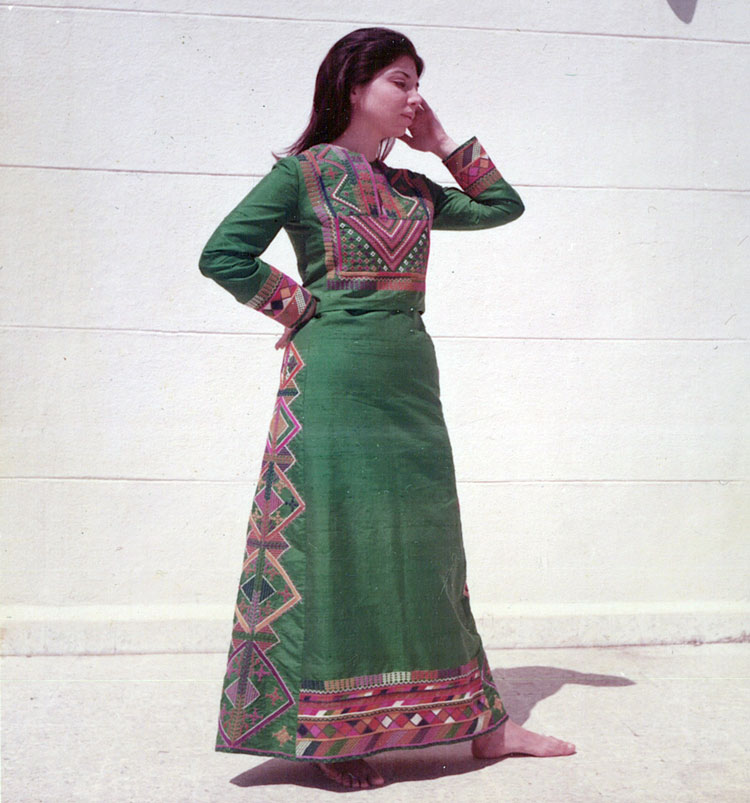
Polaroid, 1973, from the archive of Inaash Al-Mukhayim. Courtesy of INAASH.
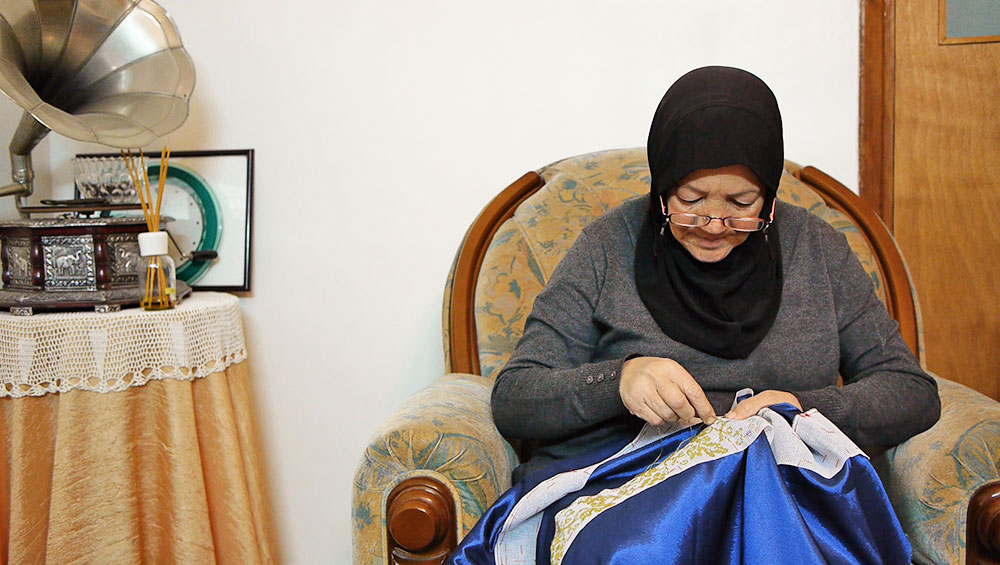
The more recent commodification of embroidery is another important aspect of this exhibition. As established economic and social structures for embroidery were eroded by the Nakba, the practice shifted from its village home (where it was a traditional skill done as part of everyday life for women and a way of articulating their identity) to the refugee camp and, consequently, something practised as a means of earning a living. In this way, embroidery remains meaningful work that connects women to their heritage, although the dynamics of working out of refugee camps in Palestine, Lebanon and Jordan are complex.
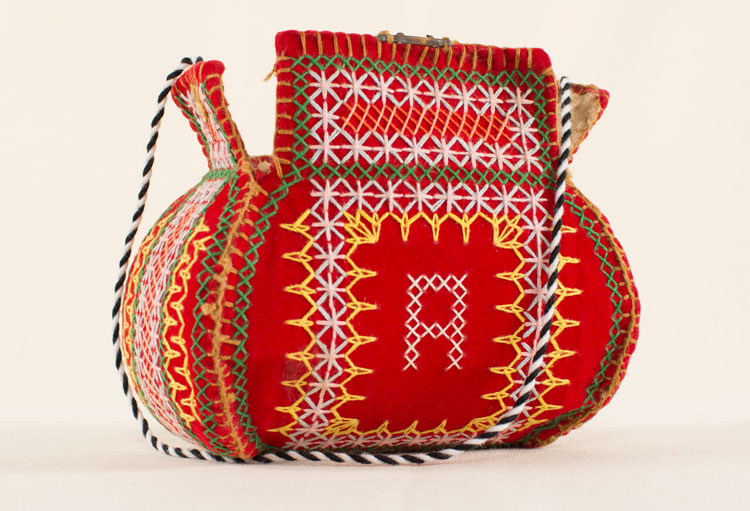
Karam Al-Maloukh, embroidered bag, 2008, silk, textile, and cardboard, made in Al-Naqab prison, courtesy of Karam Al-Maloukh.
Contemporary art takes a critical view of this in work such as Abdel Hamid’s Son, This Is a Waste of Time, and Brennan’s film The Embroiderers (2016). The films and interviews in this exhibition are informative and engaging and add a great deal to the show’s overall narrative. That, alongside the dialogues established between contemporary and historic pieces in each exhibition space makes for a compelling exhibition. What these garments reveal is a complex mode of visual communication that, as Dedman says, sits at the interface of “private resilience and public resistance”, especially in later examples. It is an exhibition that will occupy your thoughts for some time to come.

Click on the pictures below to enlarge
To coincide with his first UK exhibition, Agua Salada at Hauser & Wirth Somerset, Angel Otero talked...
Paula Rego: Dance Among Thorns
With more than 140 works on show, this exhibition encompasses the breadth of Rego’s art, from her ...
Handpicked: Painting Flowers from 1900 to Today
A smorgasbord of flower paintings from the last 125 years, exploring meaning, metaphor, accuracy and...
Klima Biennale Wien 2026: Unspeakable Worlds
Vienna’s climate biennale takes place across the city with institutional exhibitions and public pr...
Troublemakers and Prophets: Elizabeth Allen and Other Visionary Artists
The amazing story of an artist, who saw herself as a contemporary prophet, and made patchwork artwor...
Bellmer Nauman Pondick: Material Desire
Focusing on the work of Rona Pondick, Hans Bellmer and Bruce Nauman, this exhibition considers how b...
-300.jpg)
Spanish artist Angela de la Cruz’s twisted canvases and collapsed objects are a reflection of the ...
,-Red-Devil-(soul-2),-Drifting-Leaves,-1972-300.jpg)
Senga Nengudi: Performance Works 1972-1982
Featuring photographic works, archival materials and films of key performance pieces, this exhibitio...
-Cecily-Brown-Photo-(c)-Jo-Underhill-300.jpg)
A painter’s painter, whose dynamic landscapes take viewers on a walk, Cecily Brown returns to Lond...
Frank Bowling: Seeking the Sublime
Though containing just 10 works, this exhibition demonstrates the breadth of the British-Guyanese ar...
This exhibition explores ageing from the 1500s on, but it was the contemporary works here that reson...
This show focuses on honouring ancient relationships between people, land and water, with new work f...
Gainsborough: The Fashion of Portraiture
Despite once saying he was sick of portraits, Gainsborough was one of the most sought-after portrait...
Histories of erasure, displacement, annihilation and colonisation are told with power, subtlety, cla...
-(8)-300.jpg)
Hurvin Anderson’s paintings, which here stretch across his career, blend his British and Caribbean...
-(c)-DACS,-London,-2026-and-Chiharu-Shiota.-300.jpg)
Chiharu Shiota: Threads of Life
Chiharu Shiota’s immersive web-like installations, fashioned from coloured thread and found object...
-(c)Rob-Battersby-6-1000-300.jpg)
Paul Eastwood, who is dyslexic, attempts to explore neurodiversity and the complexities of language,...
The artist and writer Morgan Quaintance, winner of the 2025 Film London Jarman Award among other acc...
Maggie’s: Architecture That Cares
Celebrating 30 years of the distinctive Maggie’s Centres for cancer care, this exhibition highligh...
Euan Uglow: An Arc from the Eye
His almost scientific methods of observation led Euan Uglow to take months, even years to finish a p...
A look behind the scenes of the travelling exhibition on Berthe Weill
The show celebrating the pioneering Parisian avant-garde gallerist opened in New York before travell...
Hammershøi: The Eye That Listens
A substantial retrospective reveals the mysteries and anomalies of magnetic Danish master Vilhelm Ha...
Barbados Museum & Historical Society challenges narrative around slavery
These two fascinating, interrelated exhibitions – one of a 19th-century Black Barbadian, the other...
Melania Toma explains her interest in collective and interspecies perspectives, her dynamic process,...
Ilana Halperin: What Is Us and What Is Earth
Collaborating with artists, scientists, geologists and nature itself, through her exquisite works, H...
Alberto Greco: Viva el Arte Vivo
The Reina Sofia recovers the art of a queer Argentinian maverick who believed he could turn anything...
The first major museum exhibition of Catherine Opie’s work in the UK charts her career from when s...
British-Nigerian artist Onyeka Igwe is having a busy year. She talks about Our Generous Mother, her ...
An absolute tour de force celebrates the life – and second life – of an artist who has progresse...
Rose Wylie: The Picture Comes First
Don’t be fooled by the cartoonish depictions, Rose Wylie is constantly finding new ways of thought...

Copyright © 1893–2026 Studio International Foundation.
The title Studio International is the property of the Studio International Foundation and, together with the content, are bound by copyright. All rights reserved.
 |
 |
 |
|---|
 Emily Jacir: Europa
 Cayce Zavaglia: ‘I have always wanted my work to be about the portrait and the process. I strive to keep these two aspects of painting in balance’
 Raed Yassin: Kissing Amnesia
-300.jpg) Sophia Narrett: ‘I see the sewing process as akin to drawing’
Sophia Narrett: ‘I see the sewing process as akin to drawing’ Alighiero Boetti: Order and Disorder