





Royal West of England Academy, Bristol
9 May – 9 August 2026
by DAVID TRIGG
In Gillian Wearing’s Dancing in Peckham (1994), the artist throws shapes in the middle of a London shopping precinct, seemingly oblivious to her surroundings. Without headphones and unaccompanied by music, she flails her limbs as baffled passersby look on askance. This classic of British video art, which was inspired by a woman Wearing had observed dancing uninhibitedly by herself at a jazz gig, interrogates how context informs what is considered “normal” or “eccentric” behaviour. But it also celebrates the simple joy of expressing oneself through gesture, rhythm and movement – a sentiment found at the heart of this lively exhibition at the Royal West of England Academy (RWA), which examines the many ways that artists have attempted to capture the power of dance and being swept along by the beat.
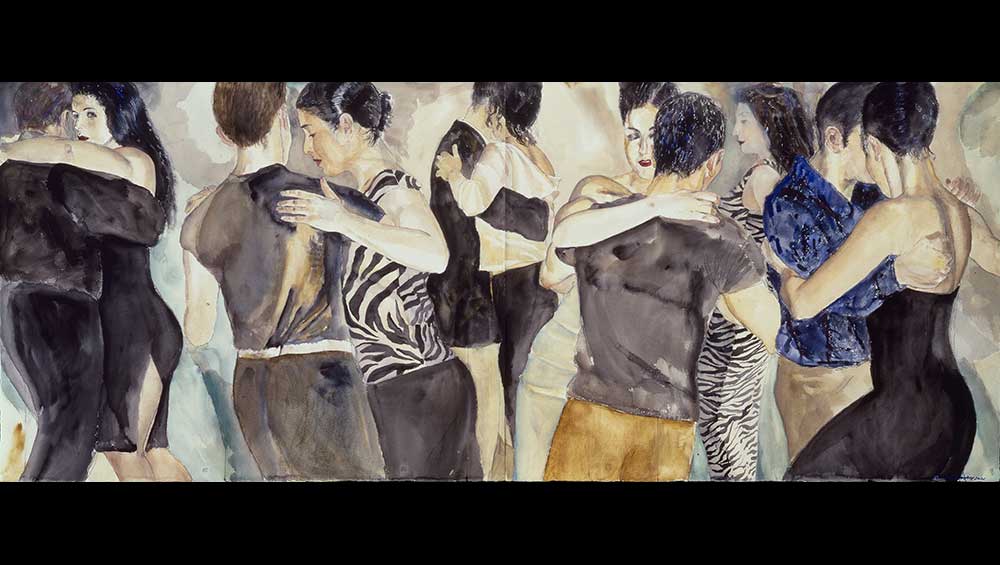
David Remfry, who has co-curated the exhibition with the art historian James Russell, has been depicting after-hours dancing since his student days in 1960s Hull, where he would surreptitiously sketch the local fishermen and their glamorous partners in the legendary Locarno ballroom and nightclub. Several of his drawings and large-scale watercolours are on display, from stylish couples dancing arm-in-arm in New York City, London and Hull, to single figures in joyous abandon. An exuberant 1996 portrait of the singer songwriter Lezlie Harrison captures a moment of pure delight as she raises her hands with a huge smile on her face. Remfry’s confident draughtsmanship, which he combines with diaphanous washes of pigment, is a masterclass in capturing the intimate energy and carefree atmosphere of the dancefloor.
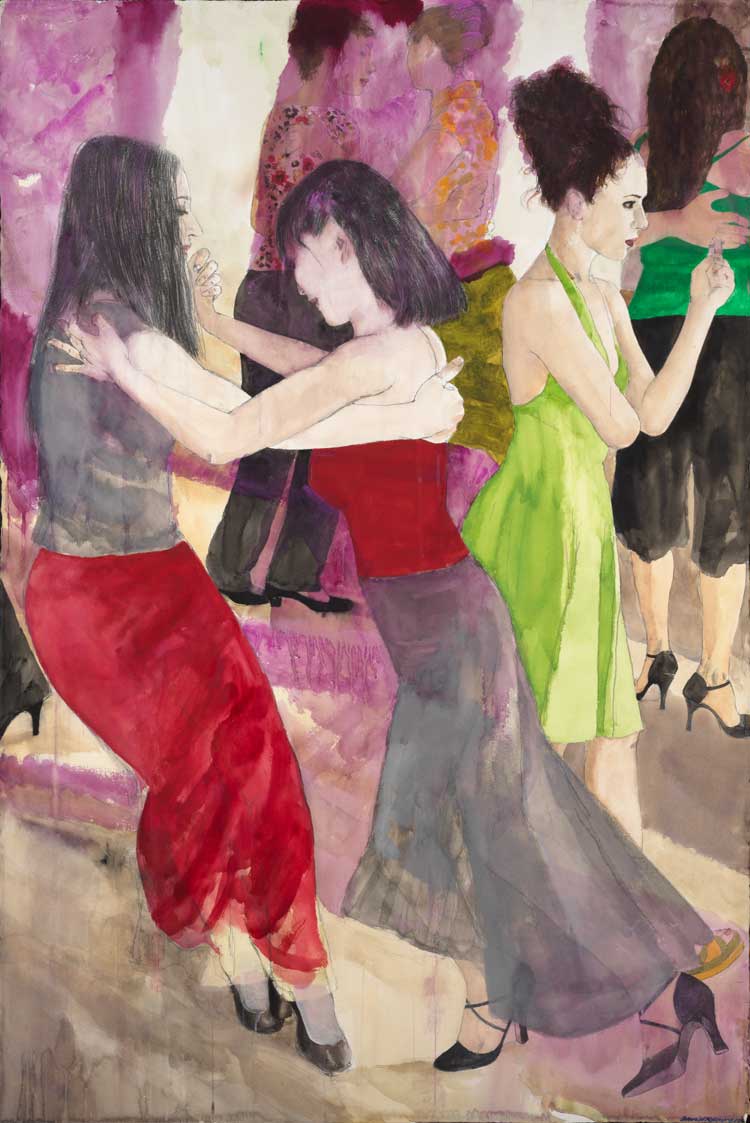
David Remfry, Nightclubbing, 2010. Watercolour on paper, 152 x 102 cm. Marcus Leith.
Another artist taking inspiration from smoky clubs is Denzil Forrester, who was a regular at East London’s dub-reggae parties in the 1980s, where he would sketch the crowd in situ and later use the drawings as source material for his vibrant paintings. The intoxicating pulse of the dancehall is felt in works such as the semi-abstract Itchin’ & Scratchin’ (2019), in which a large crowd of revellers swaying before a throbbing sound system seem to dissolve into an abstract mass of kinetic geometries. A much earlier work, Blue Tent (1984), combines the rhythmic movement of club-goers with the fluttering fabric of a marquee blown by the wind. Although Forrester has routinely addressed themes of racism and prejudice, those tensions are not seen here. Rather, the club is presented as a space of escape and respite from such challenges.
The sense of “losing it” on the dance floor, of being transported from the drudgery of everyday life and into another world, is suggested by the paintings of Amy Dury. But whereas Remfry and Forrester work from direct observation, Dury uses found imagery in the construction of her richly coloured paintings of men and women dancing. One can only surmise what tunes her figures are getting down to, though their hairstyles and attire point to the 70s when disco was going mainstream. Nostalgia for a bygone era that may or may not have existed seems to be at play here, with each canvas combining figuration, graphic floral motifs and gestural brushwork to create images tinged with the fantastical.
.jpg)
Paul Dash, Dancing in the Street, 1961. Oil on board, 61 x 77 cm.
One of the most formal and highly codified forms of dance is, of course, ballet. The French impressionist painter Edgar Degas was famously fascinated by the movement of ballerinas and, more recently, Silke Otto-Knapp drew inspiration from the avant-garde performances of modern ballet productions. Neither artist is included here, for the majority of works focus on dance as a leisure activity, occurring in sweaty nightclubs, ballrooms, or, as with Paul Dash’s bustling crowd scenes, in the streets during carnival. In this show, dance is presented as a form of liberation. As Tracey Emin states in her classic 1995 film Why I Never Became a Dancer: “It felt like I could defy gravity, as though my soul were truly free.” Even in Zoe Spowage’s painting Ballet, Living on Compliments (2023), two muscular, large-than-life women prance with energetic, uninhibited movements – a far cry from the disciplined precision of classical dance.
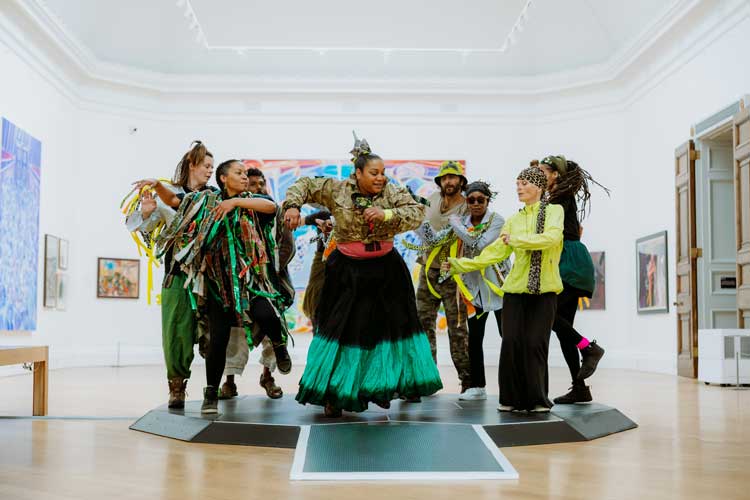
Dancers inside the gallery. Royal West of England Academy, Bristol, 9 May – 9 August 2026,.
“Those who were seen dancing were thought to be insane by those who could not hear the music,” is the oft-quoted phrase that springs to mind when viewing Wearing’s Dancing in Peckham. But in the main gallery of the RWA, the music can be heard, for the show has been soundtracked by Bristol DJs d4rling, DJ Devolicious and Josephine Gyasi in response to the works on display. Not only does the mix of house, jazz, jungle, disco, samba, footwork and reggaeton (among other genres) fill the air, it can also be felt through a haptic dance floor, which transforms sound frequencies into physical vibrations. The exhibition is further animated at regular intervals through an ambitious live programme of dance events, including salsa classes, Afro-Cuban stilt performances, as well as workshops for those who, for various health reasons, find dancing difficult.
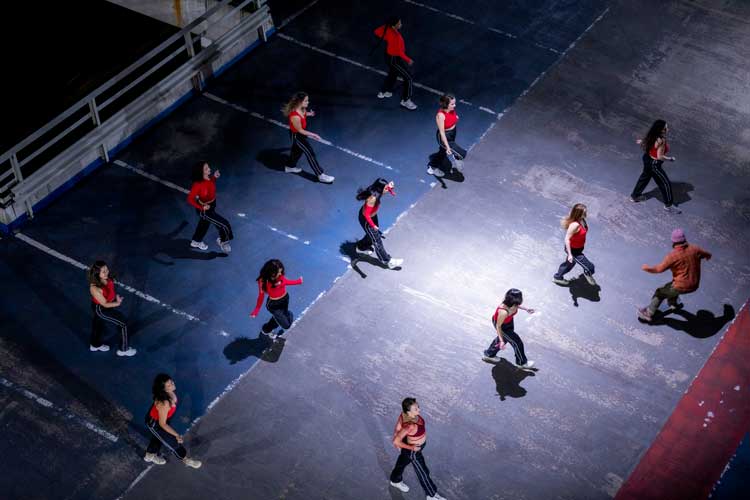
Melanie Manchot, Night Moves, 2026.
Bristol is world renowned for its dance, music and nightlife culture. Melanie Manchot’s newly commissioned Night Moves (2026) is a spectacular five-channel video installation in which Bristol-based dancers and groups perform after dark in locations around the city, from Stoke Park to Cumberland Basin to the roof of Trenchard Street car park. Skateboarders zoom past a pirouetting ballet dancer in a skate bowl, morris dancers perform in the shadow of Clifton Suspension Bridge, and a lone female dances to reggaeton on an old railway bridge. Visually and aurally arresting, it reflects the diverse cultural melting-pot of the city while asking subtle questions about the place of dance at a time when the night-time sector is battling severe economic headwinds, aggressive gentrification and the privatisation of public space. Above all, though, it is a compelling celebration of bodies moving in space – another reminder of the empowering nature of dance and its ability to strengthen our connection to each other and our own bodies.

Click on the pictures below to enlarge
In a city known for its dance, music and nightlife culture, this exhibition of paintings, drawings a...
Ásta Fanney Sigurðardóttir – interview
The artist representing Iceland at this year’s Venice Biennale with her enchanting Pocket Universe...
This mammoth show is huge, exhausting and dazzling and will dwarf any future exhibitions of the Ital...
-300.jpg)
Winston Churchill: The Painter
Known to all for his wartime leadership, Churchill is here presented specifically as an artist and t...
-300.jpg)
Sendak, Mozart and The Magic Flute
Though best known as the author and illustrator of children’s books, in particular Where the Wild ...
-Tate-(Larina-Fernandes)-(12-1000)-300.jpg)
This major exhibition is a once-in-a-generation opportunity to see the full extent of Whistler’s p...
Glasgow International Festival of Contemporary Art
Warmth, generosity and creative spirit shine through in this, the 11th iteration of Scotland’s bie...
-18-300.jpg)
Comrades in Art: Artists Against Fascism
A teeming exhibition tells the story of the Artists International Association (AIA), from radical un...
Monster Chetwynd: A Friends Making Machine
In her first solo outdoor exhibition, Monster Chetwynd plunges us into her imaginative universe of s...
From Peter Struycken’s 1969 Computerstructuur, using computer programming to draft images, to Mais...
Genti Korini talks about A Place in the Sun, his twisty, challenging video installation at the Alban...
Aleksandra Kasuba: Shelters for the Senses
The Lithuanian-American Aleksandra Kasuba worked across art, design and architecture, creating publi...
-300.jpg)
From mummified cats to Tamagotchis and medieval assistance dogs to my own support dog barking at the...

The Columbian artist Delcy Morelos on how she made her enormous earthen outdoor sculpture now on sho...

Evelyn Taocheng Wang – interview
At her new exhibition in Bolzano, the Chinese-born, Netherlands-based artist Evelyn Taocheng Wang di...
RSA 200 Annual Exhibition, Edinburgh
Despite packing in 560 works, the show doesn’t feel crowded and a walk through the galleries felt ...
The 61st international art exhibition is a vast, volatile project that this year, more than most has...
25th Biennale of Sydney – Rememory
Central to this biennale are First Nations voices and the diverse diasporas that shape contemporary ...

This year is the 250th anniversary of the birth of John Constable and to celebrate, his native Suffo...

MoonSunStarEarthSkyWater, the first UK presentation of the late artist Nancy Holt’s work to includ...

The first UK retrospective of the great Spanish baroque painter Francisco de Zurbarán trades the mo...
Several Eternities in a Day: Form in the Age of Living Materials
Opened within weeks of each other, the Hammer Museum presents a mind-bending show of Brown Art and L...

André Leon Talley – interview with curator Rafael Brauer Gomes
Rafael Brauer Gomes, the director of fashion exhibitions at Savannah College of Art and Design (SCAD...
To coincide with his first UK exhibition, Agua Salada at Hauser & Wirth Somerset, Angel Otero talked...
Paula Rego: Dance Among Thorns
With more than 140 works on show, this exhibition encompasses the breadth of Rego’s art, from her ...

Handpicked: Painting Flowers from 1900 to Today
A smorgasbord of flower paintings from the last 125 years, exploring meaning, metaphor, accuracy and...

Klima Biennale Wien 2026: Unspeakable Worlds
Vienna’s climate biennale takes place across the city with institutional exhibitions and public pr...
Troublemakers and Prophets: Elizabeth Allen and Other Visionary Artists
The amazing story of an artist, who saw herself as a contemporary prophet, and made patchwork artwor...
Bellmer Nauman Pondick: Material Desire
Focusing on the work of Rona Pondick, Hans Bellmer and Bruce Nauman, this exhibition considers how b...
-300.jpg)
Spanish artist Angela de la Cruz’s twisted canvases and collapsed objects are a reflection of the ...

Copyright © 1893–2026 Studio International Foundation.
The title Studio International is the property of the Studio International Foundation and, together with the content, are bound by copyright. All rights reserved.
 |
 |
 |
|---|
 31 Women
 Gillian Wearing and Claude Cahun: Behind the Mask, Another Mask
 One and Other
 Gillian Wearing: ‘I don’t have any typical practice. Every project is different’
 Reflections on the Self: From Dürer to Struth