




-Tate-(Larina-Fernandes)-(12).jpg)
James McNeill Whistler, Whistler Smoking, 1856-60, installation view, Tate Britain, London 2026. Photo © Tate (Larina Fernandes).
Tate Britain, London
21 May – 27 September 2026
by BETH WILLIAMSON
What can you expect from Europe’s largest retrospective of James McNeill Whistler (1834-1903) in three decades? That is what is on show at Tate Britain over the summer and it is already proving to be a huge draw – the galleries were packed with fellow visitors when I travelled into central London in sizzling temperatures to take a look. There is a lot that is new here among the 150 artworks, a once-in-a-generation opportunity to see the full extent of Whistler’s practice from painting, drawing, printmaking and design. There are previously unseen sketchbooks, a joy to see, his famous nocturnes and, of course, Arrangement in Grey and Black, No 1 (1871), known colloquially as Portrait of the Painter’s Mother. With nine sections to navigate, it is an extensive exhibition and requires some stamina to get through.
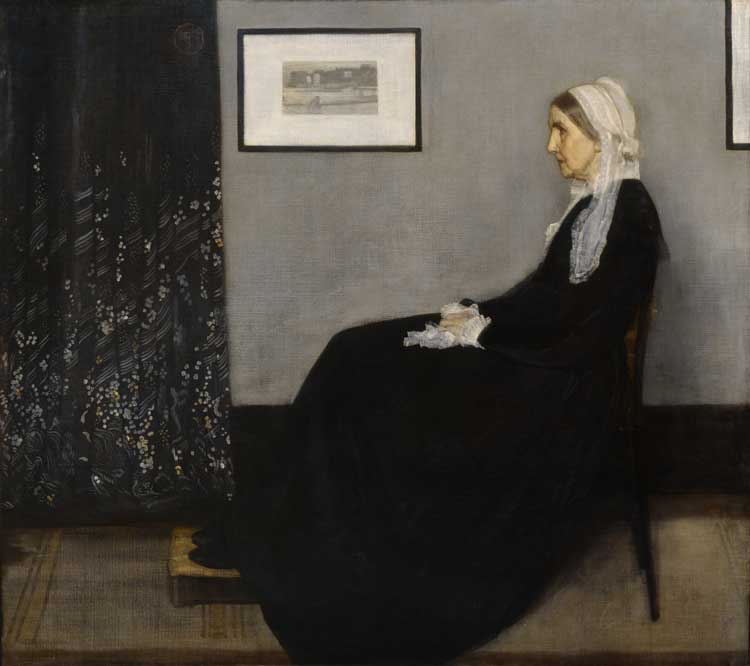
James Abbott McNeill Whistler, Arrangement in Grey and Black No.1, 1871, Musée d’Orsay, Paris, France.
The story begins in Whistler’s waterside studio in London’s Chelsea in the 1870s. It was here that he painted his mother and his nocturnal views of the Thames. He eschewed the fussiness of Victorian tastes and instead preferred a much cleaner sharper design for his home and studio, including a collection of East and South Asian artefacts such as blue-and-white Chinese Kangxi style ceramics. There is also a pleasing display of the long-handled brushes he used to paint at a distance from the canvas, allowing him to experiment with textures and give an impression rather than detail. Earlier, when Whistler was enrolled at the US West Point Military Academy, he excelled at drawing and had produced almost 200 studies by the age of 20. Exquisite little sketches – such as that of his half-sister Deborah Haden, newly married with her baby daughter Annie, made in 1848 when Whistler was just 14 – are intimate and tender in their manner. Later, the bohemian image he crafted in his early career came to the fore and is evident in paintings such as Whistler Smoking (1856-60). After four years steeped in the modernity of Paris, Whistler was drawn to London and the Thames. He preferred to work from nature, but also quipped: “Painting from nature! Needs to be done at home!” Painting the river and the sea, his works at this time included The Last of Old Westminster (1862) and Green and Grey, Channel (The Sea) (1865).
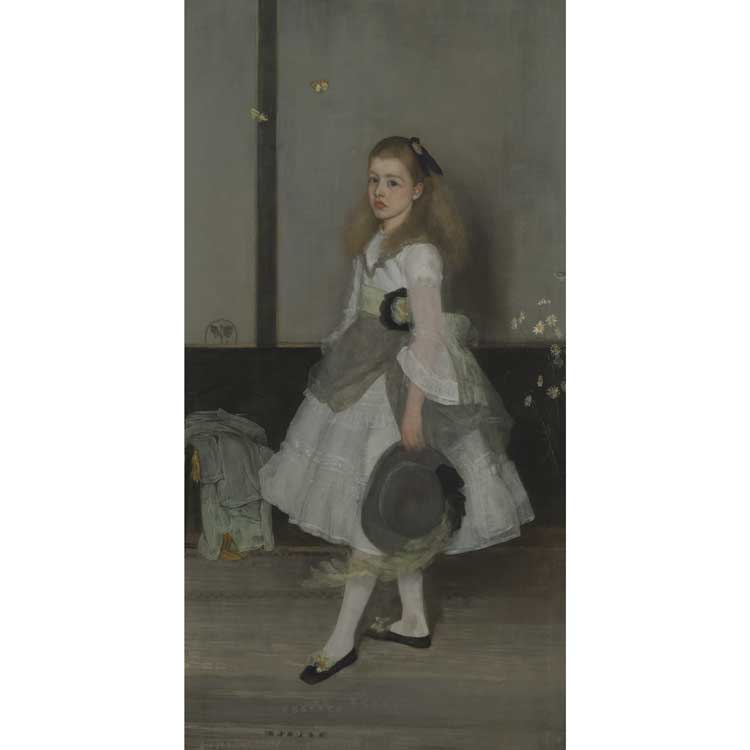
James McNeill Whistler, Harmony in Grey and Green: Miss Cicely Alexander. 1872-3. Tate. Photo © Tate.
Breaking into mainstream art, Whistler tested the limits of impressionism to achieve the results he desired. He did not shy away from inconveniencing his sitters and in the case of eight-year-old Cicely Alexander, he called her back 70 times to complete Harmony in Grey and Green: Miss Cicely Alexander (1872-74). In the previously mentioned Arrangement in Grey and Black, No 1, Whistler’s technique is strikingly modern with areas of light strokes and thin paint on the face, hands and veil of his mother, Anna.
It was Whistler’s enthusiastic study of East Asian culture that enabled him to blur the boundaries between art and design. This reshaped his approach to such an extent that he gained the plaudits of Japanese artists and critics. The delicate pastel work Four Ladies in Japanese Costume (c1870) captured my imagination here, much more so than the reconstruction of the bold decorative interior for the Peacock Room, which was originally created for the shipping magnate Frederick Leyland, and is now on permanent view at the Freer Gallery of Art, Washington DC. This reconstruction is quite an achievement but, for me, it is the subtlety of works such as Four Ladies and Variations in Violet and Green (1871) that truly captures the influence of East Asian culture on Whistler.
-The-Hunterian,-University-of-Glasgow-(1).jpg "James McNeill Whistler, St Petersburg Sketchbook, p.6, 1844–48. © The Hunterian, University of Glasgow.")
James McNeill Whistler, St Petersburg Sketchbook, p.6, 1844–48. © The Hunterian, University of Glasgow.
The gallery containing Whistler’s nocturnes is perhaps the most thrilling of all in this exhibition. These deeply atmospheric works take the fog, smoke and pollution around the river at twilight and transform it into something magical: long brush strokes evoke the flow of the river itself while his experimentation with flatness and depth creates an interplay of nearness and distance. He described the misty distances in his paintings as being like “breath on the surface of a pane of glass”.
-The-Hunterian,-University-of-Glasgow.jpg "James McNeill Whistler, Head of a Peasant Woman, 1855–58. © The Hunterian, University of Glasgow.")
James McNeill Whistler, Head of a Peasant Woman, 1855–58. © The Hunterian, University of Glasgow.
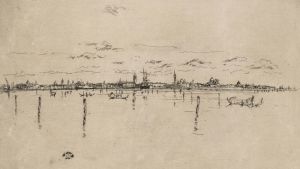
At 45, Whistler left London for Venice under the shadow of bankruptcy. Within 18 months he had produced about 200 experimental pastels and etchings. Following his return from Venice, he delivered his provocative lecture “Mr Whistler’s Ten O’Clock” in 1885. The rest of his life was spent wandering in Britain and Europe making small landscapes in a variety of media. He looked to the ordinary people and places for his inspiration rather than more conventional subjects. These included the urban scenes close to his printers, such as Drury Lane Rags (1888).
In the last two decades of his life Whistler once again turned to society portraiture, a highly competitive genre. Arrangements in Black was the title he gave to a series of full-length figures emerging from shadows. Their technical virtuosity and reflections on historic art gained him an increased following and influenced a younger generation of artists. A related image, a late self-portrait, Gold and Brown: Self-Portrait (c1896-98) is elusive. There is a mischievousness about his expression that is echoed in the flickering brushwork. The red fleck on his lapel is the ribbon of the Légion d’Honneur, France’s highest decoration. Here is the elderly artist painting himself for posterity and, really, still aiming to shape his identity in the same way he did as a young man 40 years earlier in Whistler Smoking.
Click on the pictures below to enlarge
-Tate-(Larina-Fernandes)-(12-1000).jpg)

Copyright © 1893–2026 Studio International Foundation.
The title Studio International is the property of the Studio International Foundation and, together with the content, are bound by copyright. All rights reserved.
 |
 |
 |
|---|
-1000-300.jpg)


 A Different Impressionism: International Printmaking from Manet to Whistler
 Hunterian Art Gallery Reframed
 Aubrey Beardsley