




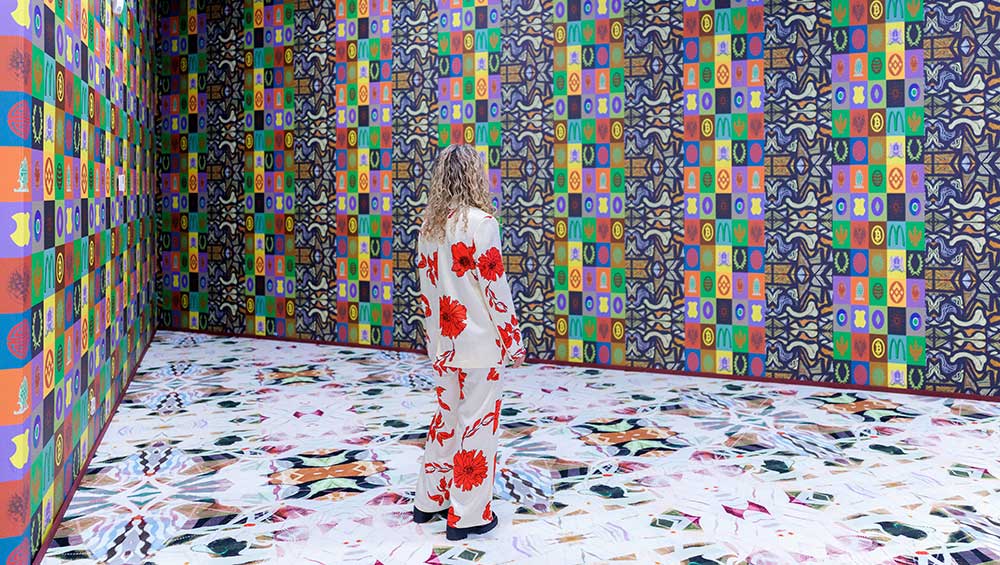
Claudia Hart, Empire Failure, 2026. Installation View, Pixel Pioneers, Depot of Museum Boijmans Van Beuningen, Rotterdam, 2026. Commissioned by Museum Boijmans Van Beuningen. Photo: Aad Hoogendoorn.
Depot, Museum Boijmans Van Beuningen, Rotterdam
25 April – 13 September 2026
by TOM DENMAN
It has become a cliche to say that we live through our screens, that this world, for anyone reading this article at least, is imagined. But things are, of course, more complicated than that. The era of pixelated reproduction – or inhabitation – is not without materiality, not to mention the environmental damage, invisible to many, caused by the industrial plants that store our data. One of the remarkable things about this show, thoughtfully curated by Amira Gad, is the way it demonstrates the physicality of the pixel (and not necessarily by dint of being an art exhibition in a gallery), and the way it encourages us to think about the development of the pixel’s presence in our lives over the past half century. There is a concerted effort among the dozen practices exhibited here to explore the threshold between the tangible and not-so-tangible, often with an ambiguous criticality that puts the onus on us to ponder the pros and cons of technological advancement.
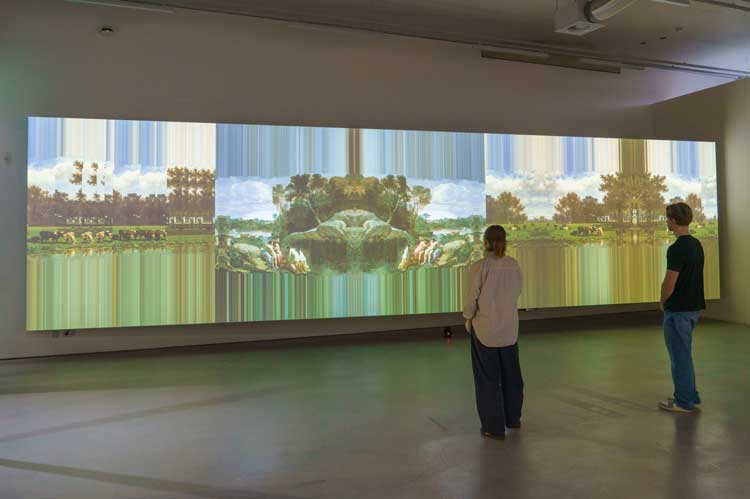
Geert Mul, Horizons, 2008/2026. Installation View, Pixel Pioneers, Depot of Museum Boijmans Van Beuningen, Rotterdam, 2026. Commissioned by Museum Boijmans Van Beuningen. Photo: Aad Hoogendoorn.
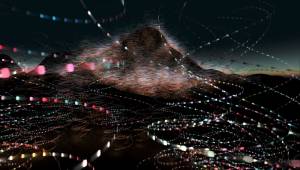
Rotterdam’s Depot, part of Museum Boijmans Van Beuningen, which opened in 2021, is a public access art storage facility (and the inspiration behind London’s V&A East Storehouse, which opened last year). With works by Bruegel and Rembrandt set within a futuristic atrium and glass-fronted restoration labs, the architecture reminds us of the museum’s ever-shifting archival function, with today’s technology constantly inflecting our view of art history. This is reflected in Geert Mul’s Horizons (2008), a large video-projection displaying hundreds of landscape paintings from the museum’s collection, which shift, split, warp, multiply and fold into each other along a horizonal axis as you move about the room. Mul projects the experience of online databases and PowerPoint presentations – 2008 would be roughly when slides were made redundant at the art history department I was attending as an undergraduate – on to the wall to invite comparison with traditional museum viewing. Art history exists in triangulated relation between object, archive and us.
The works in the atrium further elaborate the archival theme. As a digital garment designed by fashion houses Maison Margiela and The Fabricant (the latter being a pioneer in AI design), MetaTABI (Tier 2) (2024), displayed on a monitor, is the show’s most ethereal work. Even still, as an imaginary version of Margiela’s Tabi shoes – “real” versions of which are available in stores, for those willing to pay for them – the work sets up a dialogue between the digital item and the physical, the non-fungible token format and the hi-tech physical storage facility. The work’s inclusion also alludes to the fantastical – for being aspirational – status that fashion has anyway. To what extent, we might ask, is the digital image an extension of images that have been used in advertising for decades, images we have long projected ourselves into, even without an onscreen avatar?
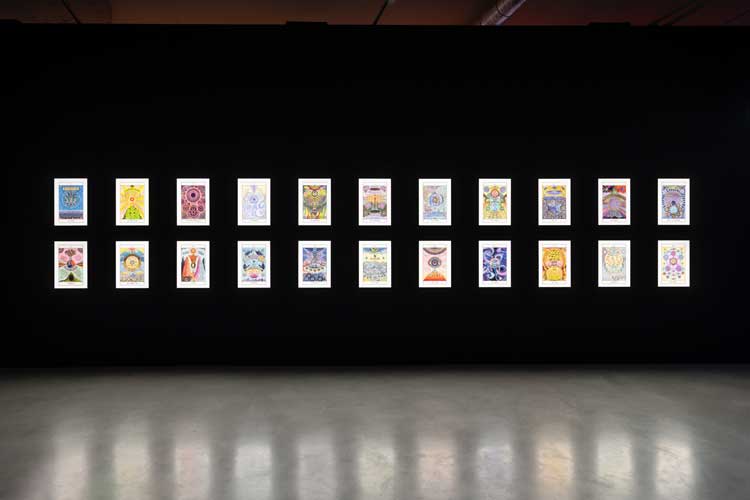
Suzanne Treister, HEXEN 5.0/Tarot, 2023–2025. Installation view, Pixel Pioneers, Depot of Museum Boijmans Van Beuningen, Rotterdam, 2026. Courtesy of the artist, Annely Juda Fine Art, London, and P·P·O·W Gallery, New York. Photo: Lotte Stekelenburg.
Videogames – and their potential to absorb us – are central to several of works in the main gallery. Suzanne Treister’s Fictional Videogame Stills (1991-92) comprises a grid of photographs of computer screens on which the artist used an Amiga computer to invent needlepoint-like images like those seen in a gaming arcade. Aside from this urban sociality – highlighted in the tactile crudeness of the prints – the images and texts themselves are existentially immersive: “system message: presume virtual breakdown” is written in a box against a glitchy purple, yellow and black, part-aquatic, part-outer space background. Already in the early 90s, this artist was tapping into the notion that a screen was a world that we – or versions of us – inhabit.
Larry Achiampong’s The Gaming Room (2021-ongoing) recreates a lounge bedecked with gaming consoles from the 90s. You are invited to play Street Fighter and other iconic games on three of the monitors, while one of them presents a film. In it, over the top of videogame, martial arts and WWF wrestling footage, the artist talks about the importance of these games for him growing up as a Ghanian in London, describing a utopian world through which he could shape complex, mythic identities, bond with his brother (and his brother’s avatars) and tackle crime. The formation of monitors in the centre of the room presents gaming as a connector between people within a physical setting that offsets the imaginary one. In the 21st century, the lounge acts as counterpoint to, and anticipatory metaphor for, its online equivalent, bearing witness, perhaps, to the latter’s IRL roots.
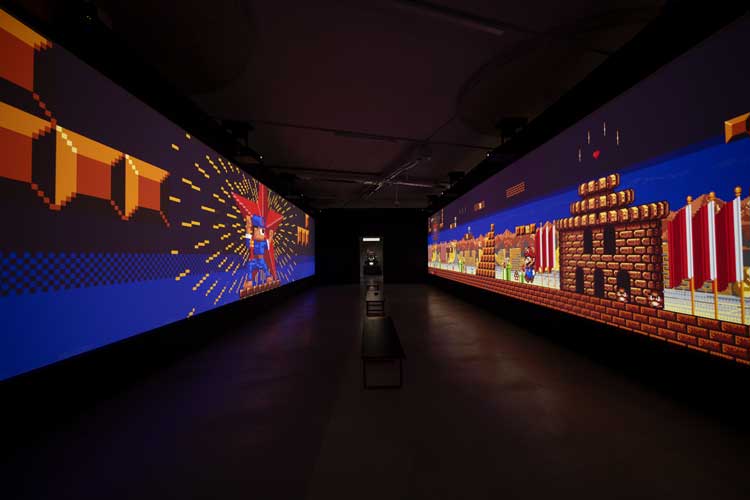
Feng Mengbo, Long March: Restart, 2008. The Museum of Modern
Art. White Rabbit Collection, Sydney. Installation view, Pixel Pioneers, Depot of Museum Boijmans Van Beuningen, Rotterdam, 2026. Photo: Lotte Stekelenburg.
The juxtaposition of Achiampong’s lounge and Feng Mengbo’s more sceptical Long March: Restart (2008) demonstrates this, suggesting more generally the ambivalent place of the pixel in contemporary life. Age-old anxieties around modernity are as valid as more optimistic attitudes which, as Achiampong shows us, can do more than simply plug us into the neoliberalist machine. For his work, Mengbo hacked 80s side-scrolling console games, most recognisably Nintendo’s Super Mario franchise, by putting a blue-suited Red Army soldier in the place of Mario (or Luigi), who becomes the enemy. And you can use Coke cans as hand-thrown missiles, wittily combining symbols of Chinese communism, US capitalism and “Nintendo capitalism”, the latter being defined in part by the Japanese company’s aggressive intellectual property enforcement. Aside from being a funny take on China’s fraught geopolitical position, the work highlights the political – and subversive – potential of this impossibly absorbing form of entertainment.
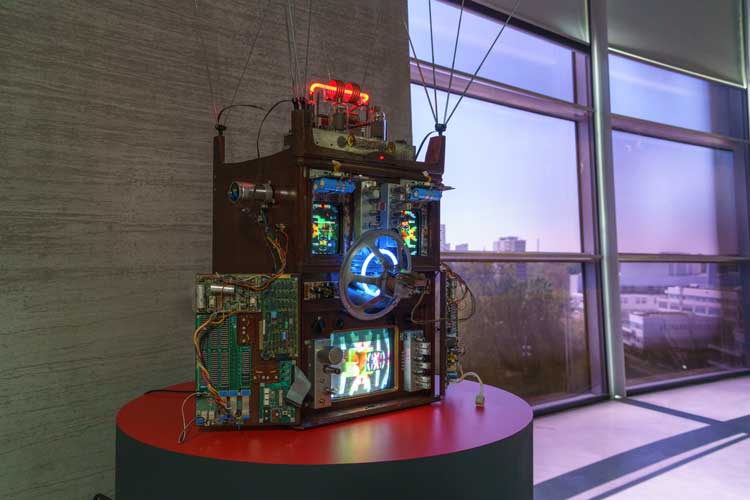
Nam June Paik, Internet dweller:
mpbd.three.cgsspv, 1994. Installation View, Pixel Pioneers, Depot of Museum Boijmans Van Beuningen, Rotterdam, 2026. Commissioned by Museum Boijmans Van Beuningen. Photo: Aad Hoogendoorn.
That most of the works were made before the standardisation of the smartphone and social media does not lessen their significance today. The show’s earliest work is Peter Struycken’s Computerstructuur (1969), a computer-designed, square enamel print of black and white pixels, shown beside a sequence of short videos from 1976-77, which presents grids of pixels with a voiceover in which the artist explains his technique of using computer programming to draft his images. The low-bit simplicity is poignant today, reminding us of the naive optimism that can attend a new technology, such as the internet or Facebook, before its absorption into authoritarian praxis becomes too apparent. Nam June Paik’s Internet Dweller: mpbd.three.cgsspv (1994), a robot-like curiosity cabinet made of monitors, antennae and exposed motherboards – and pertinently displayed near a Commodore SX-64 personal computer from 1983 – offers a playfully ambiguous materialisation of both the hopes and the fears surrounding what was still novel technology.
Zooming to the present, some of the humour felt in Paik’s projection of technological anxieties in wildly science fictional terms is felt in Claudia Hart’s two installations, made especially for this exhibition. Just as Paik made the internet into furniture, Hart has made futuristic rooms, or decorative, quasi-habitable reinterpretations of online life. Empire Failure (2026) can be viewed through a screen of glass in the Depot’s atrium, positing itself as an archive, the room itself – from this angle – resembling the 3D animation the artist used to make it. The wallpaper is a grid of corporate, neo-imperialist logos (Bitcoin, McDonald’s), the carpet a swirling vortex of materialised digital colour. No escape – technocapitalism has co-opted oceanic creativity. While much of this show’s success lies in its open-ended criticality, it feels nonetheless necessary to proffer the depressing flipside of Maison Margiela and The Fabricant’s crypto coin. If the joke feels obvious, that may be because we are living the moment it stages, feeling the carpet underfoot.
Click on the pictures below to enlarge

Copyright © 1893–2026 Studio International Foundation.
The title Studio International is the property of the Studio International Foundation and, together with the content, are bound by copyright. All rights reserved.

 |
 |
 |
|---|



-1000-300.jpg)


 Zarah Hussain: ‘I don’t think something that’s spiritual precludes the use of technology’
 Matthias Dörfelt: There are not many people using code and technology as an expressive tool’
 Toshiyuki Inoko: ‘We are exploring the ways in which the relationships between people can be changed through art’
 Carla Rapoport: ‘I like to think we’re the Elvis of the art world’
 The Lumen Prize Awards 2016