
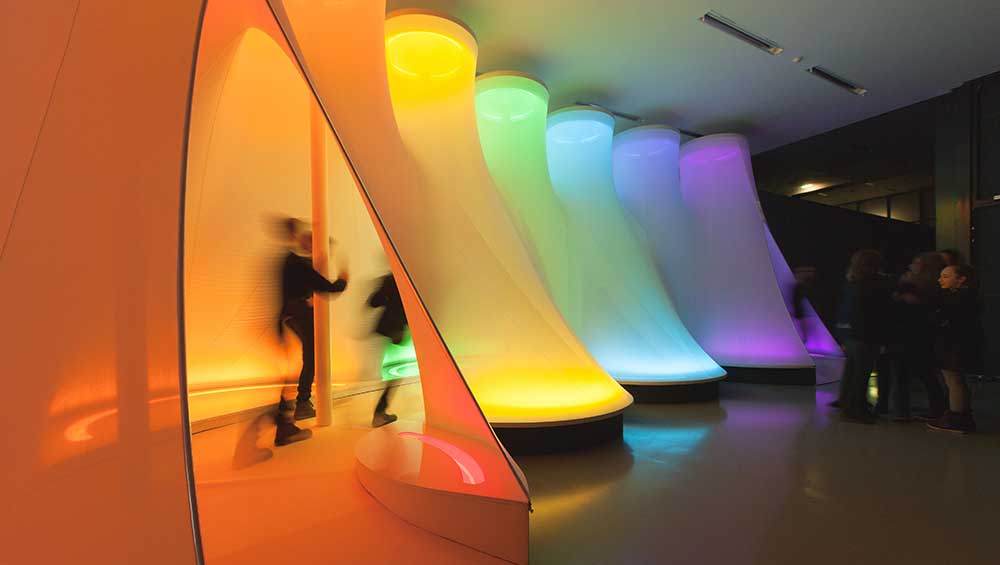
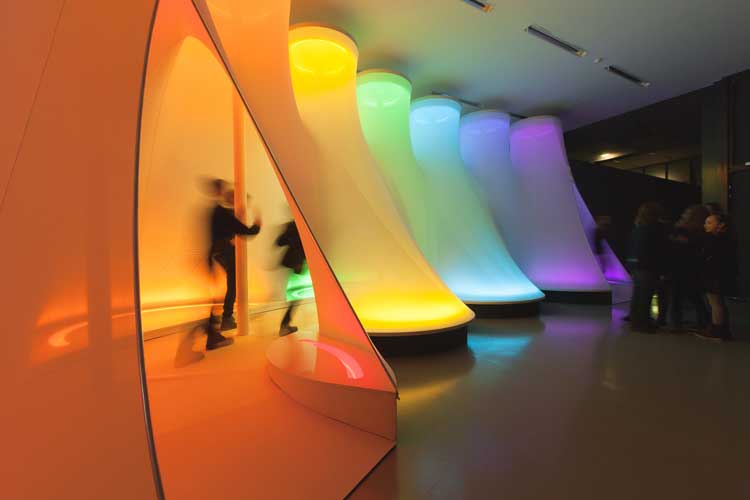
Aleksandra Kasuba Spectrum, An Afterthought, 1975/2014. Tate St Ives, 2026. Photo © Tate (Kathleen Arundell).
Tate St Ives
2 May – 4 October 2026
by DAVID TRIGG
What does the colour yellow smell like? For Aleksandra Kasuba (1923-2019), it was a rich, woody-balsamic aroma: a combination of amyris essential oil, cubeb and guaiac wood, among other ingredients. With the help of a perfumer, the Lithuanian-American artist concocted six scents associated with colours of the rainbow, reflecting her interest in the phenomenology of synaesthesia. All of them can be experienced at Tate St Ives as you traverse her multicoloured, stretched fabric corridor, Spectrum, An Afterthought (1975/2014). The immersive, luminous environment forms the prismatic heart of the artist’s first UK museum exhibition, which reveals how, across seven decades, Kasuba’s multidisciplinary investigations of form and structure sought to forge deeper connections between humans and the natural world while positing alternative modes of living.
Having studied art at the Kaunas Institute of Applied and Decorative Arts and then sculpture at the Vilnius Academy of Arts, Kasuba fled Lithuania with her husband in 1944 following successive Soviet and Nazi occupations. The couple settled in the United States, first in New York, before relocating to New Mexico in later life. The traumatic experience of displacement would come to feed Kasuba’s explorations into how architectural environments might contribute to the wellbeing of their inhabitants, though the earliest pieces in the exhibition see her working with painted ceramic tiles. Her solemn, icon-like self-portrait of 1952, in which her face is rendered yellow and delineated with clean graphic lines, was made while working for the prominent New York furniture manufacturer Kagan Dreyfuss Inc, where she produced tiles for tabletops and cupboard doors.
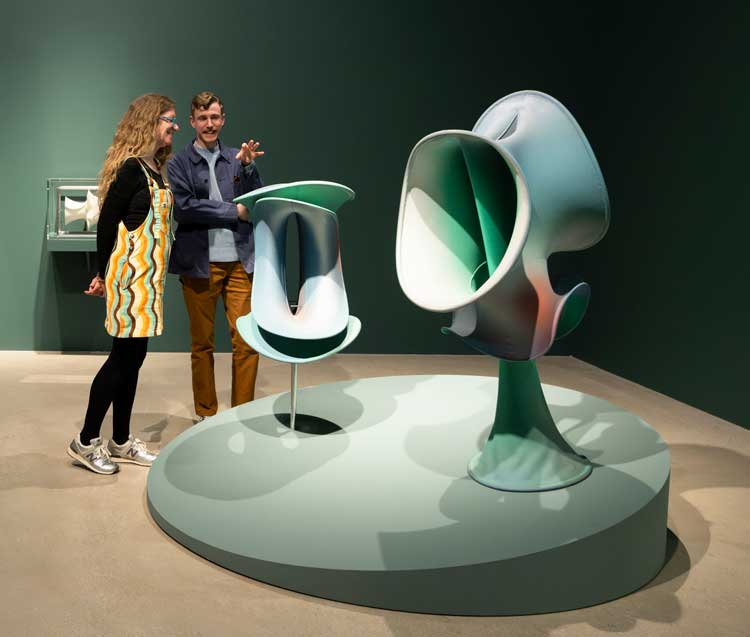
Aleksandra Kasuba Spectrum, An Afterthought, 1975/2014. Tate St Ives, 2026. Photo © Tate (Kathleen Arundell).
In the early 60s, Kasuba’s painted tiles gave way to mosaics as she began moving towards abstraction. Dreaming III (1963), made with white marble tesserae, features rudimentary figures, one of whom stands on a stylised horse. This character may represent “The Walker”, a mysterious alter-ego that recurs in her early paintings and diaries, and which she later revisited in A Life (2012-13), a series of elegantly simple watercolour and collage works in which the little figure appears in various oneiric scenarios.
Kasuba’s participation in the landmark 1962 exhibition Collaboration: Artist and Architect, at the Museum of Contemporary Crafts in New York, represented a pivotal moment in her career, leading to collaborations with architects on large-scale public-realm works. In 1966, she turned heads with 14 striking abstract mosaics at Grippi & Waddell Gallery in New York, three of which are included here. These mesmerising compositions are made with black sandstone fragments arranged to create optical effects that perhaps reflect the influence of the burgeoning op art movement, which had been showcased the previous year at New York’s Museum of Modern Art in the groundbreaking exhibition The Responsive Eye.
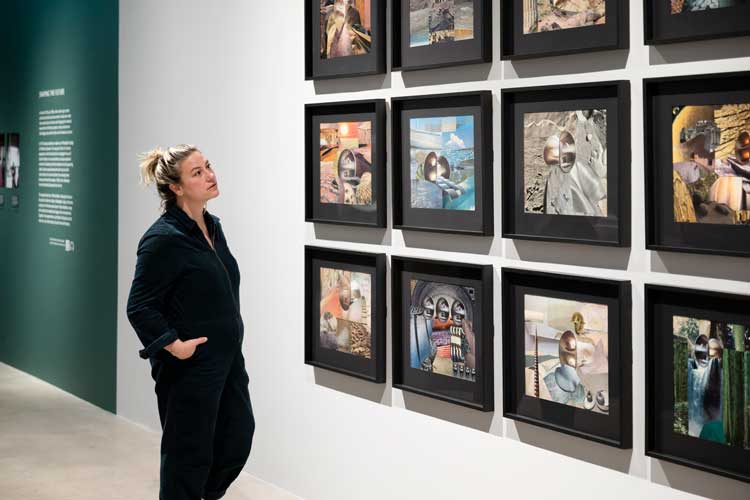
Aleksandra Kasuba Spectrum, An Afterthought, 1975/2014. Tate St Ives, 2026. Photo © Tate (Kathleen Arundell).
When the architect Edward Larrabee Barnes caught sight of these mosaics, he commissioned her to translate them into brick for his new campus at Rochester Institute of Technology. It was a relationship that led to her becoming established in the field of architectural art, producing large-scale reliefs for the exteriors of buildings, including the Lincoln hospital in the Bronx (1973) and Amherst Street metro station, Buffalo (1980-81). These are represented here by archival photographs showing how her flowing designs unified and softened the buildings’ hard geometries. In 1986, she designed the acid-engraved granite wall on the east face of 7 World Trade Center in Manhattan, which was to be her final major public space commission. Poignantly, it was completely destroyed in the terrorist attacks of 11 September 2001, becoming one of more than 100 works of art at the World Trade Centre complex that were lost on that fateful day.
The stretched fabric habitats for which she is best remembered stemmed from formative experiments with her husband’s vests, which led her to use the new, synthetic fabrics being produced by companies such as DuPont. With her first such work, Contemplation Environment (1969-70), which was shown at the Museum of Contemporary Crafts, New York, Kasuba established herself as a key figure in the environmental art movement. Her innovative investigations into the properties of different materials were spurred on by her encounter with the Experiments in Art and Technology (EAT) collective – a pioneering group of artists, engineers and scientists working with emerging technologies. She continued experimenting with tensile fabric sculptures well into the 80s, many of which resemble seedpods, seashells and other biomorphic structures abundant in nature.
In 1971, inspired by a visit to ancient Irish stone circles, Kasuba conducted a major spatial experiment titled Live-In Environment, for which she transformed an entire floor of her family’s Manhattan home into a flowing series of translucent fabric pods with individual zones for working, sleeping, eating and sensory contemplation. The ambitious project, which explored dynamic, meaningful and open-ended ways of living, was animated by a spirit of collaboration and community, with its spaces containing electronic soundtracks by the composer Emanuel Ghent and colour-inspired scents by perfumer Danutė Pajaujis Anonis. A small fragment of the environment (the sleeping section) is recreated at Tate St Ives, which contains a sculptural, handwoven rug by the fibre artist Urban Jupena. But this, along with Live-In Environment’s other spaces (shown here as large-scale photographs), remains tantalisingly inaccessible.
Live-In Environment spawned multiple similar concepts and experiments with tensile structures, which similarly drew from the organic, fluid shapes of nature. These took the form of museum display spaces, study areas, divides for open-plan offices and sheltered public gathering spaces, many of which are documented in a display of archival photographs. Her interest in community and sensuality were key ingredients in these spatial environments, which were intended to positively impact how people felt and interacted. “Nobody ever argues in these places … there are no restrictions, our modes of taboos simply go,” she observed.
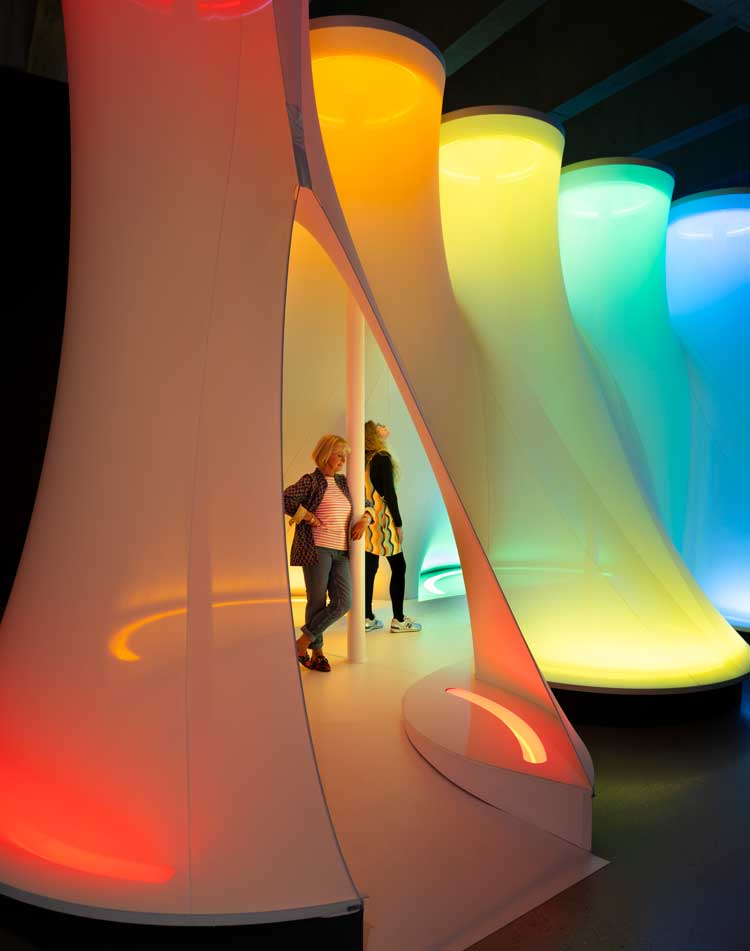
Aleksandra Kasuba Spectrum, An Afterthought, 1975/2014. Tate St Ives, 2026. Photo © Tate (Kathleen Arundell).
The centrepiece of the exhibition is the aforementioned Spectrum, An Afterthought, conceived in 1975 but not created until 2014. Reflecting Kasuba’s fascination with the visible colour spectrum, its relation to the other senses and the transformative nature of light, the piece invites you to become immersed in a world of shifting colours and olfactory sensations as you walk through it while sniffing scented swatches. For Kasuba, this was a space for contemplation and heightened sensory awareness, although from the vantage point of 2026, where dazzling immersive environments have become commonplace, it is hard to fully appreciate its groundbreaking nature.
Although she always considered herself an artist, Kasuba worked across art, design and architecture. In 2001, a few years after the death of her husband, she relocated to New Mexico where she built a house in the Mission Hills near Albuquerque. Named Rock Hill House, the residence and studio is one of the most complete examples of her creative ideas. Seen here in photographs, the building’s quirky shell-like structure exemplifies Kasuba’s rejection of the flat planes and “intrusive” right angles of so much conventional Euclidean architecture. She also designed many unrealised prototypes for futuristic, and in some cases fantastical, buildings inspired by the natural world and which emphasised collective living. These include buildings embedded into cliff faces and the utopian Global Village (1971-72), a complex of luminous interiors in a self-contained environment designed to float on water.
With an emphasis on collective living as an alternative to the extreme individualism of modern society, Kasuba envisioned a future of social unity in harmony with nature and technological innovation. Yet her preference for synthetic, primarily petrochemical-based, materials seems misplaced in light of their devastating ecological footprint. Did she take such issues into consideration? It is a question not answered by the exhibition. Of course, the environmental impact of these products is far better understood today than it was in the 70s. This is why, in a world where the need to find alternative and sustainable ways of living becomes ever more urgent, visionary thinkers such as Kasuba are needed more than ever.
Click on the pictures below to enlarge

Copyright © 1893–2026 Studio International Foundation.
The title Studio International is the property of the Studio International Foundation and, together with the content, are bound by copyright. All rights reserved.
 |
 |
 |
|---|
-1000-300.jpg)