




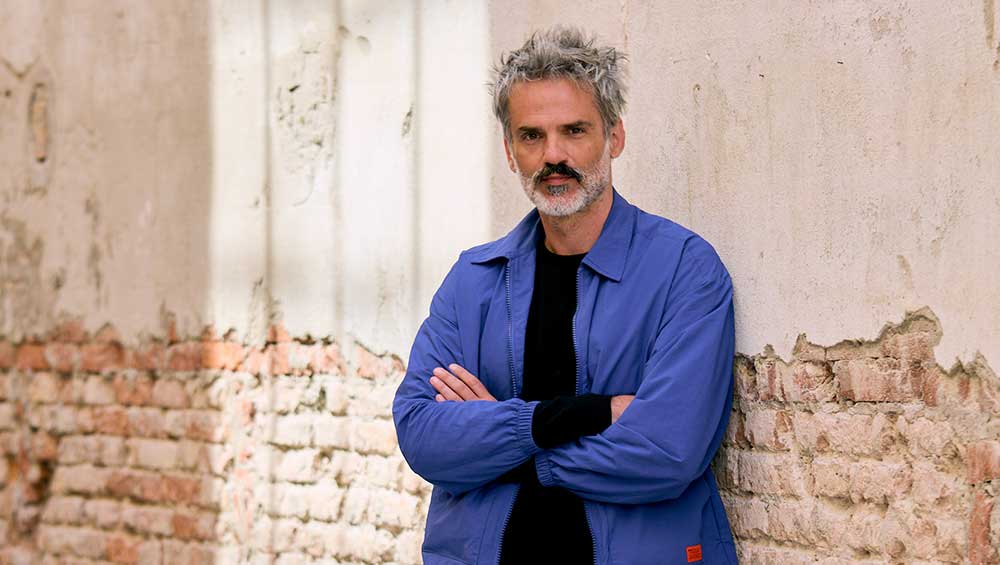
Genti Korini. Photo; Clelia Cadamuro.
by LILLY WEI
The Albanian Pavilion at the 61st Venice Biennale, In Minor Keys, is represented by the artist Genti Korini whose quirky, speculative three-channel video, A Place in the Sun, was organised by the Polish curator and art critic Małgorzata Ludwisiak. Live actors, puppetry, animation and an original score are part of a staging that uses as its mode of communication an experimental transrational language called Zaum, which was proposed by a group of early 20th-century Russian futurist poets to correspond to a new world, one in which the failures of the existing social order would be dismantled and rectified.
A Place in the Sun is characterised by dissonance, disparity, seemingly mistimed loops, idiosyncratic imagery, metamorphoses and a compelling sonic component. It is visually sophisticated and seems plausible when you are watching it, but it is twisty and challenging, and when it is over, what remains is a haunting, residual feeling of unsettledness, the slippage of the provisional, an undertow of remembered sound.
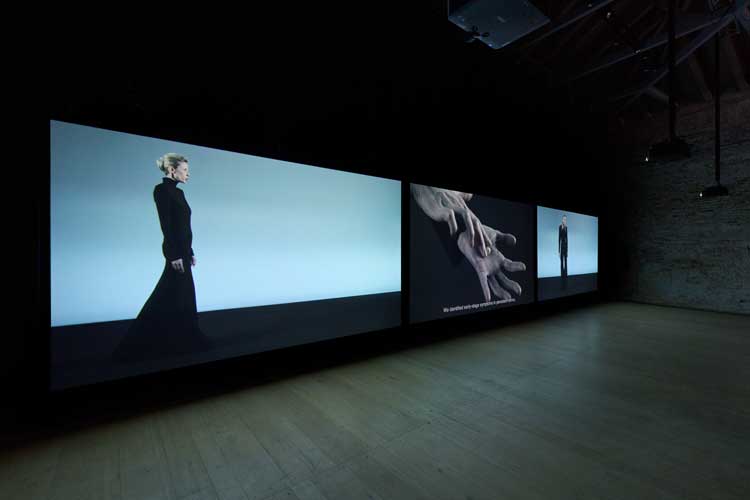
Genti Korini, A Place in the Sun, installation view, Albania Pavilion, Venice Biennale 2026. Photo: Clelia Cadamuro.
Korini’s multidisciplinary projects orbit the history of Albania as well as the constructs of history itself, with its tectonic, unstable layers of narrative and its reformations and unreliability. He has long been intrigued by how cultural identities are forged, particularly those of what he calls “minor cultures”, such as his, positioning the discords and flux of the beginnings of the previous century in confrontation with those of the present, as the world, then (and now), teetered on the brink of seismic changes.
The following is an edited, excerpted conversation with Genti Korini at the Albanian Pavilion in Venice.
Lilly Wei: You are very much interested in language, as is evident in the work you are showing here. Could you tell me more about that focus?
Genti Korini: The work I’m showing here goes back more than 100 years to the Russian futurists, to the Russian avant garde. They created a language they called Zaum, which was intended to abolish conventional social and linguistic orders, replacing them with more radical structures.
LW: It’s not like Esperanto?
GK: Esperanto is a language that has meaning and is comprehensible. Zaum is beyond meaning. It was not intended to make sense in a conventional way. It connected through sound, more like poetry. In A Place in the Sun, I use it as both method and metaphor. My question, my idea is, how do you describe a place that you don’t know, a country that you don’t know, and an identity that you don’t know. It is seemingly impossible.
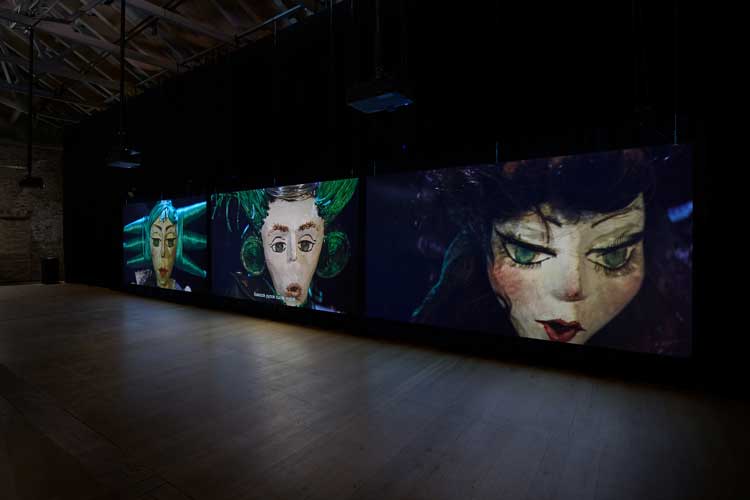
Genti Korini, A Place in the Sun, installation view, Albania Pavilion, Venice Biennale 2026. Photo: Clelia Cadamuro.
LW: The Albanian Issue was published by a group of Russian futurist artists and writers in Petrograd (now St Petersburg) in 1916 and is a primary reference for your project. Would you talk about that?
GK: It was in the experimental avant garde magazine called Bloodless Murder (Beskrovnoe ubiistvo) and the issue was a satire of pre-revolutionary Russia, a parody of a racist, orientalist travelogue using Albania as a symbol, a sign for the exoticised peripheral countries projected through the lens of European imperialists. The magazine mocks that and includes a king of Albania – we have always had issues with power and authoritarianism. I used the publication as a kind of plot. But I wanted to do my own take, a re-enactment of an absurdist theatre from a century ago. It connects to the anxieties we are living through now and forms a symmetry of sorts. The world a century ago was enthusiastic about the future, technology, and progress – as it still is, AI, for example. It was a moment in history where everything was radical, when abstraction was invented, as well as the creation of new social and political borders. But it all collapsed due to war, destruction, mayhem, malice.
LW: They claimed that finding a new language was essential to describe what had never been seen before.
GK: Yes.
LW: Would you talk about that connection?
GK: There are all these parallels that are not necessarily in the work because it has its own life. I decided to do a theatre piece that was staged with a Polish actress. I studied in that part of the world, and I like the tradition of experimental theatre in Poland. As you know, there are many things that must be connected to construct a project. A Place in the Sun starts with a book, and then I set out to learn about Zaum, what it was and how it was used. It’s very obscure and existed for only a few years and no one knows what it sounded like. I find that fascinating.
,-2026-Courtesy-of-the-artist.jpg "Genti Korini, A Place in the Sun (still), 2026. Three-channel video installation. Courtesy of the artist.")
Genti Korini, A Place in the Sun (still), 2026. Three-channel video installation. Courtesy of the artist.
LW: You said that nobody knows about Albania either, that it is invisible.
GK: Well, either it is exoticised and romanticised as a primordial, beautiful Arcadia, or it is thought of as uncivilised, to be pushed aside or ignored. But all of that is a construction.
LW: Is the Albanian language also a parallel to Zaum?
GK: The Albanian language is its own unique branch of Indo-European, which very few people speak, perhaps six million in the world today, and yes, perhaps it is its own Zaum. I like to play with language, but I have doubts about storytelling. A lot of art now is storytelling. But I want to go into a more meta mode. What tools do we use to construct the story? What is the language? The structure is an abstraction, and it is the tools that are actually the narrative. That’s why I flirt with the idea of investigating language and Zaum is a vessel for these questions. What does it mean to make meaning out of the unknown? Out of something that is always in formation? Also, when you present in Venice, there is always the idea of national identity. What does that mean to me as an artist?
LW: Would you talk a little about A Place in the Sun?
GK: I had a good time with this because I wanted to play with fantasy. There are masks, puppets, folkloric images, animation, gaming, costumes, a score, rituals, a site. Then there is the actor and the viewer. And I like the structure that looks like storytelling but the content is very abstract and becomes sounds. It talks about Albania, but it doesn’t talk about Albania at all. There is nothing that connects to the anthropological aspects of identity culture. Minor cultures, like my own, have a tendency to claim a folk tradition in order to be identified. If you ask what is Albania, that might be the first thing we say to prove that we exist. The masks in the film, for example, seem to be part of an established ritual but everything is invented.
,-2026-Courtesy-of-the-artist.jpg "Genti Korini, A Place in the Sun (still), 2026. Three-channel video installation. Courtesy of the artist.")
Genti Korini, A Place in the Sun (still), 2026. Three-channel video installation. Courtesy of the artist.
LW: They look persuasive to me.
GK: That’s because Albania is still often considered a pre-modern spiritual world. But it’s a fantasy to think you can go to some kind of esoteric shamanistic other world. It’s fiction. These are the kinds of ideas that are in my head, and I like to play with them. It all depends on how you see it, because the work has its own life.
LW: Are you surprised by how some people interpret it?
GK: I’m prepared. It’s an open work. It doesn’t have a fixed meaning; that’s the beauty of it. I’m completely open to the reactions of the viewers. That’s also the beauty of being in Venice. There are so many different audiences. We are a secular country with a mix of religions – Christian, Eastern Orthodox, Catholic, Muslim. Values differ but I don’t intend to go there. My ambition is to make a less transparent work.
LW: Where is your film sited, and have you altered it?
GK: The site is real, two hours away from Tirana where I live, and it’s also not real. I call it a real prop. You can make art using reality as a prop. There is an art zone, in conversation with other arts, and then there is reality. I try to filter reality into my work. Cultures without a multitude of expansive, hegemonic references, such as mine, are left in a zone of obscurity. For me, it’s very challenging and also very interesting to see how that space works. It’s like [Samuel] Beckett. It’s like a rehearsal. It’s not a finished narrative. We as a country are still trying to build our identity, whatever that means.
LW: And how did you structure the film?
GK: The script was the base, and the conversation that was created held it together. It’s the same actress who plays both parts, who carries on a dialogue with herself. And the text uses pseudo-scientific terms about the disease of language. The cure is like a pearl that slowly forms in the shell from a grain of sand. Language should be like a pearl.
LW: At one point in the film, you show the image of a perfect, luminous pearl placed in the palm of a hand that fills the screen, caressed by the fingers of the other hand. It’s quite beautiful, even tender.
GK: I like the beautiful poetic things I extracted from this research and used as material.
LW: You are also a painter?
GK: Yes, but I go back and forth. I love the autonomy of my studio practice, but it can become too solitary and then it’s fantastic when I have a project like this, where I work for six or seven months with a team, developing the project with others, working with artists in other disciplines, other countries. But painting was the door that led me to art. We all enter through different doors.
• A Place in the Sun by Genti Korini is at the Albanian Pavilion, Arsenale, until 22 November, as part of the 61st Venice Biennale.
Click on the pictures below to enlarge

Copyright © 1893–2026 Studio International Foundation.
The title Studio International is the property of the Studio International Foundation and, together with the content, are bound by copyright. All rights reserved.
 |
 |
 |
|---|
-1000-300.jpg)
 Ásta Fanney Sigurðardóttir – interview
 Venice Biennale 2026 Roundup
 Petrit Halilaj: Very Volcanic Over This Green Feather