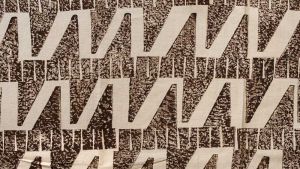

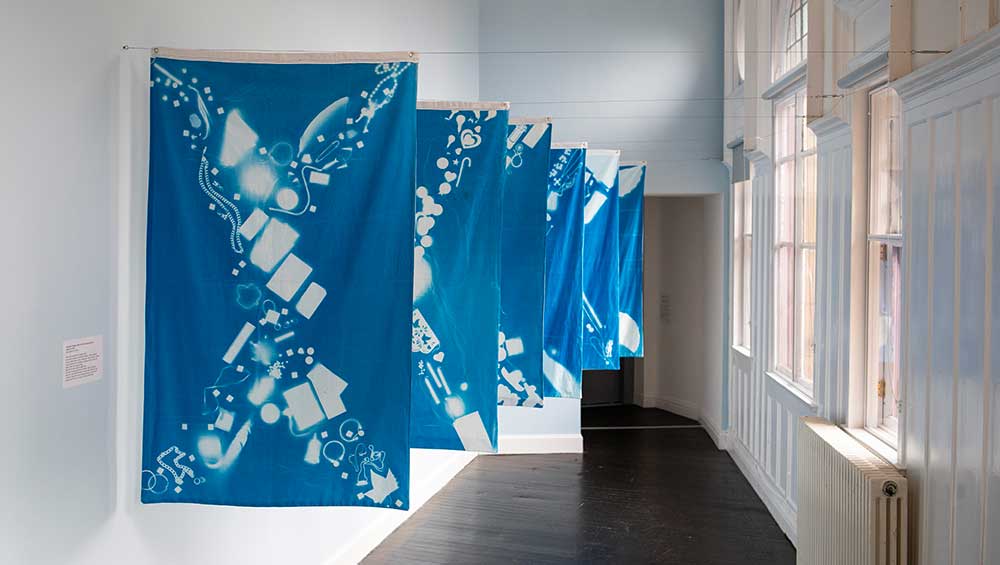
Alixandra Prybyla, with workshop participants, Saltire Series, 2026. Cyanotype on cotton. Installation view, We Make Museums, Glasgow Women's Library, 2026. Photo: Matthew Arthur Williams.
Various venues, Glasgow
5-21 June 2026
by BETH WILLIAMSON
This year’s Glasgow International (GI) is the 11th edition of Scotland’s biennial festival of contemporary art. The question is how to make such a grouping of exhibitions and events relevant in the face of the local and global conditions we face today. The answer is to engage head on with those realities and that is what GI supports artists to do. Travelling around the city over the course of three days, the feeling was of being part of something bigger, the experience was one of warmth and generosity, and a creative spirit articulated across borders and flattening hierarchies. These things are especially evident in those projects that are deeply embedded in Glasgow’s communities.
With more than 60 artists across 32 venues throughout the city, the task of this short review is simply to give the edited highlights as I experienced them. The rest, as they say, is up to you.
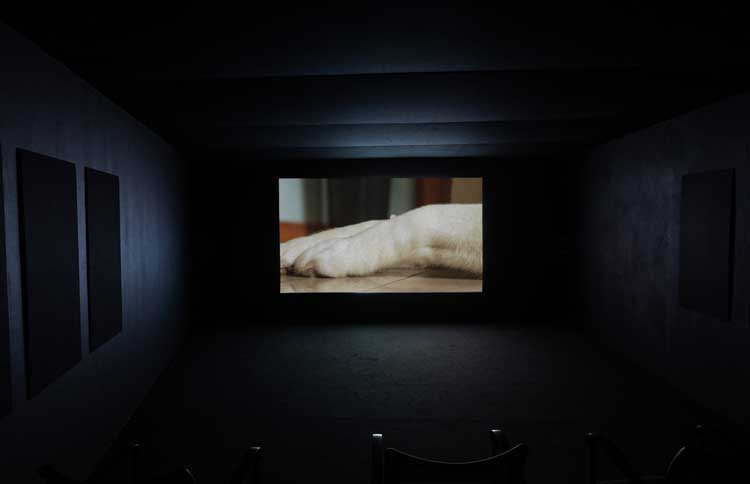
Renèe Helèna Browne,Flat, 2026, film still. Installation view: The Briggait, Glasgow International 2026. Photo: Eoin Carey.
Renèe Helèna Browne’s new moving image installation at the Briggait is both documentary and a tender love story between the artist and their uncle. I’ve written about Browne’s work before when their film Sanctus! featured in the Edinburgh Art Festival in 2024. On that occasion, Browne’s film was an intensely personal portrait of a close relationship with their mother. Now, in Flat, it is Browne’s relationship with their uncle that comes under our gaze. Telling the tale of the mica scandal in Donegal, Ireland (when thousands of homes were found to have defective crumbling concrete blocks) is just one part of the story. The other is Browne’s uncle, his gathering and sharing of knowledge through informal channels and his resilience in constructing a new home for himself in the face of Ireland’s failure to address the scandal. It is a truly beautiful film, tender without sentimentality and full of love.
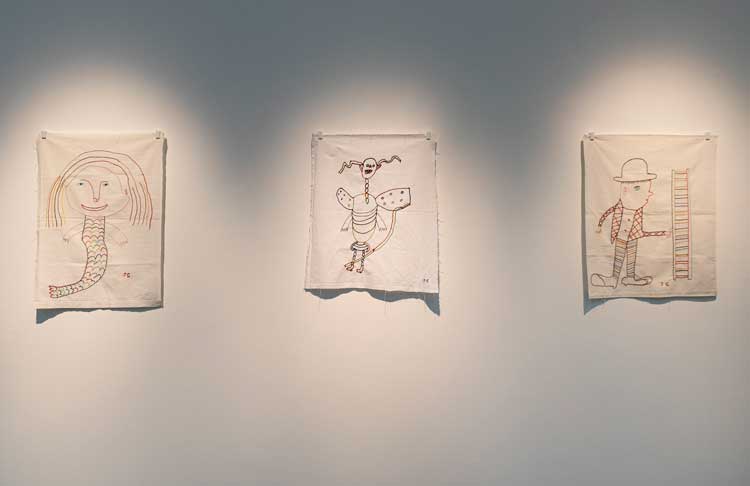
James Gladwell, Project Ability, installation view, Trongate 103. Photo: Eoin Cary.
At Project Ability, Trongate 103, it is James Gladwell’s cross-stitch drawings that bring sheer joy. Born in 1952 into a Romany Gypsy family, Gladwell says he began needlework at the age of seven. He learned from his grandmother and his work is inspired by dreams. In the 1980s, he came across Barrington Farm in Norfolk where, as one of about 40 artists there, his creative talents continue to be supported. Over the last 10 years or so Gladwell has been exhibited, won prizes and awards, and had work acquired by the Norfolk Museums Service Costume and Textile Collection. It is, however, his own account of his work that is most telling: “I won’t give up sewing. I’ll just keep going till I can’t. My passion is all my needlework. I’d be lost without doing the sewing.” It is utterly delightful work.
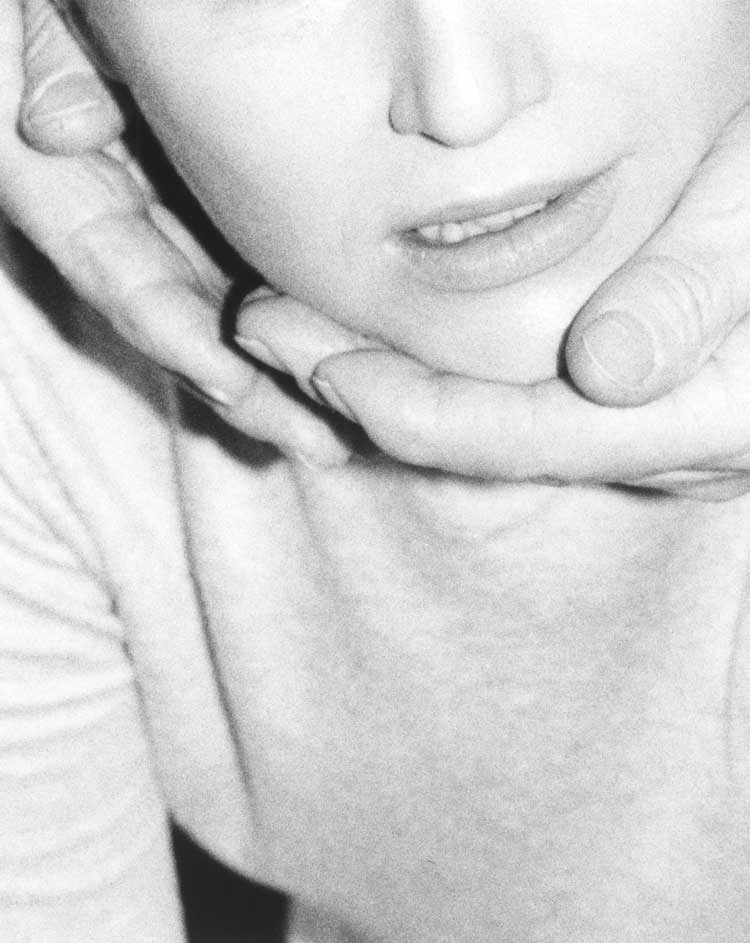
Joanna Piotrowska, Untitled, 2026, collage, dimensions variable. Courtesy of the artist and Phillida Reid.
The London-based Polish artist Joanna Piotrowska’s A Moment of Darkness at Noon (showing at The Common Guild) is a very different prospect. Rooted in the unconscious through the artist’s exploration of Jungian psychoanalysis, Piotrowska’s experiments in the expanded field of photography are ambiguous, disturbing and intriguing all at once. Using photographic collage and including images from the family archive, Piotrowska takes inspiration from dream states and partial memories. The narrative is uncertain and sits in a shifting space between dreams, memories and the unconscious.
At Kinning Park Complex, The Subtle Body brings together archival material from artists Katy Dove and Lygia Clark. Their shared interest in how meaning emerges through gesture and sensorial experience shines through beautifully in this pitch-perfect show. The conversation between the archives of the two artists here is a companionable one that is also accompanied by the dialogue between artworks and the body. If you haven’t encountered Dove’s work previously, it is useful to know that psychology and art therapy both impacted her work. Watercolour, fabric, print and moving image all use colour joyfully. Colourful but meditative works bring a vibrancy and sense of life to the archive.
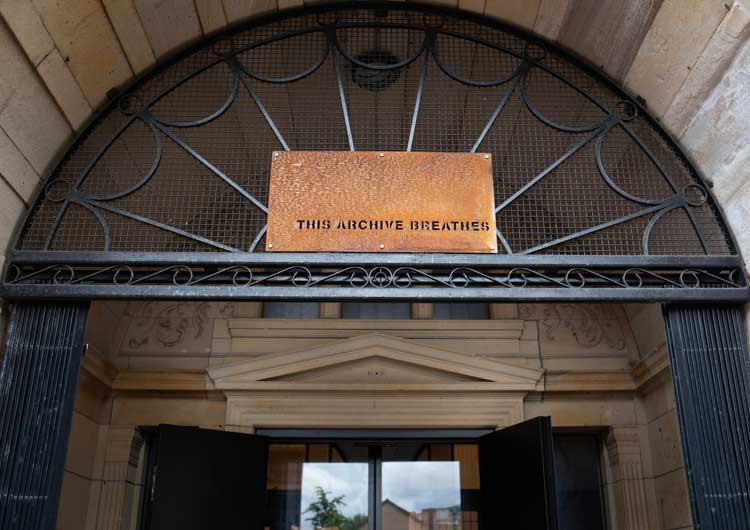
Sohaila Baluch, This Archive Breathes, 2026, Corten steel. Photo: Matthew Arthur William.
Finite Structures is a show of work by artist Bettina Grossman at Cento in Glasgow’s Albert Road. Known simply as Bettina, she lived and worked in the Chelsea Hotel in New York from 1972 until her death in 2021. Working conceptually, Bettina engaged with themes of surface, rhythm, distortion, surrealism and bodies in motion. In Phenomenological New York (1970s), for instance, she captured a distorted and shifting city space as reflected in glass windows of skyscrapers. Exquisite marble egg sculptures – Options for an Angle: 24 Inconstants from One Constant (1970) – were made during a fellowship in Carrara, Italy, and further illustrate her interests in light, perspective and mathematics.
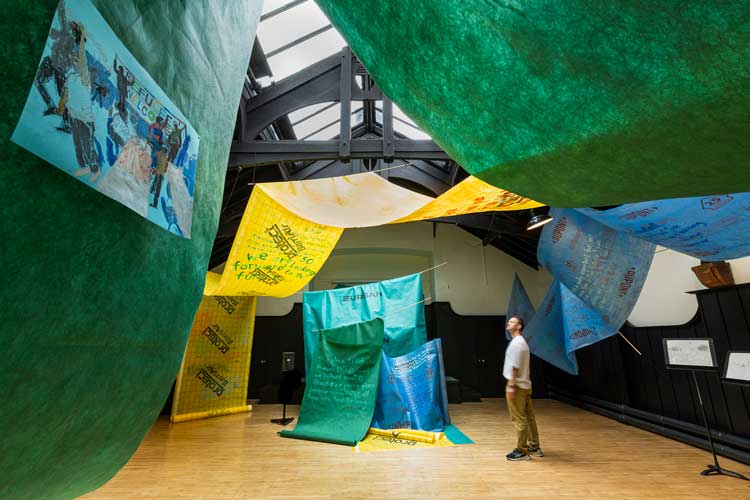
Helen McCrorie and Annabel Wright , This Home, This Voice, Maryhill Integration Network (MIN). Installation view, Queen’s Cross Church (The Mackintosh Church), Glasgow.
Across the city in Maryhill, the Maryhill Integration Network (MIN) worked with Helen McCrorie and Annabel Wright to create This Home, This Voice shown in the Mackintosh Queen’s Cross Church. The church, commissioned in 1896 and opened for worship in 1899, is also, coincidentally, where my parents were married in 1961. Developing artistic responses to the experience of community-building in Glasgow is a difficult task. McCrorie and Wright approach it through mutual learning and exchange. It is a beautifully balanced project and perfectly timed for MIN’s 25th anniversary year. Banners are draped throughout the space, recording the words of MIN members on their experiences. Drawings, sound recordings, 16mm film and animation capture the sense of care, passion and grass-roots activism. It is a wonderful example of embedded practice of which GI must be very proud.
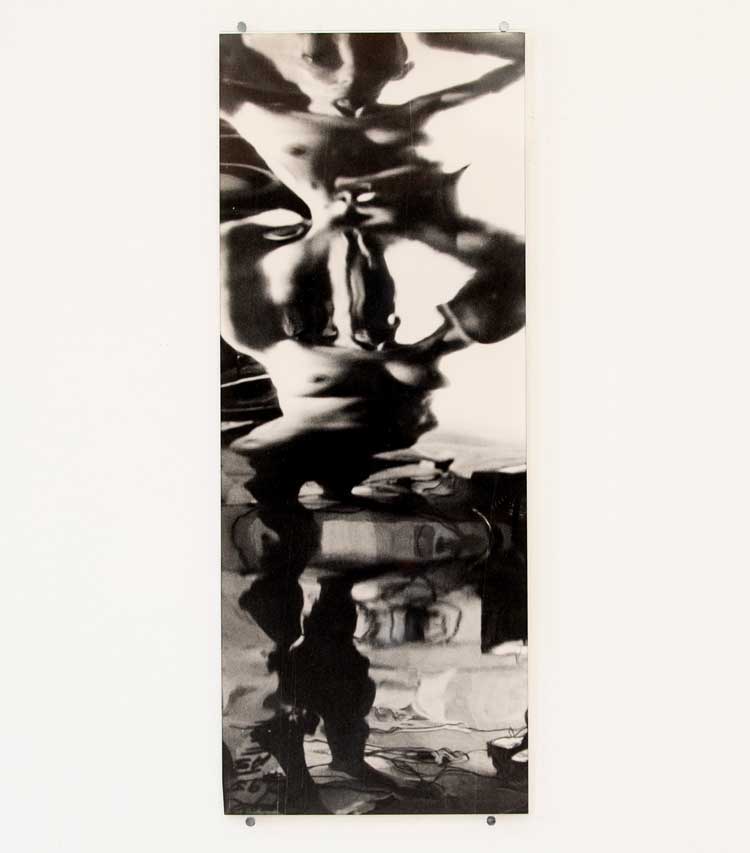
Installation view, Bettina, Finite Structures, Cento, 20 Albert Road, Glasgow. Produced as part of Glasgow International 2026. Image courtesy of the Estate of Bettina, Cento, Glasgow and Ulrik, New York. Photo: Matthew Arthur Williams.
In Glasgow Women’s Library in Bridgeton, We Make Museums: Sustaining and Changing Worlds contains work by three artists – Sohaila Baluch, Ruth Ewan and Alixandra Prybyla. I was especially drawn to Baluch’s work, which explores acts of maintenance (cleaning, dusting and cataloguing) needed to sustain collections and cultural life. Part of this is a series of embroidered cloths made of a teal-coloured fabric that echoes that of the archive boxes used in the library. Each is hand-embroidered collectively. At the front desk, a large mirrored plaque by Baluch gathers fingerprints and outside above the entrance a Corten-steel plaque is subjected to the weather. The artist’s invitation, I suppose, is to leave your mark in one way or another.
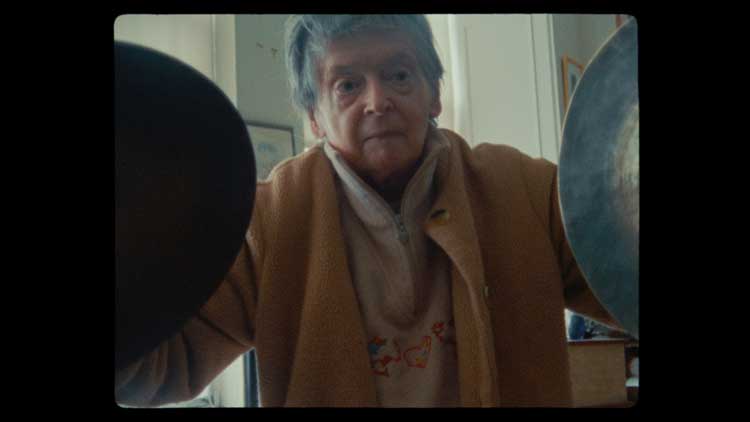
Luke Fowler, A Sensation Never Yet Known, 2026 (still). 16mm transferred to 4k digital, 19 min, 18 sec. Courtesy of the Artist and The Modern Institute / Toby Webster Ltd., Glasgow.
Luke Fowler’s film, A Sensation Never Yet Known is being shown at GLOSS in Florence Street. It is a beautifully evocative film about the life of the composer Janet Beat. Filmed over the course a year in Beat’s home, it reveals the 88-year-old’s considerable contribution to electronic music, including experimental techniques such as the visual scores she developed for non-musicians and dancers. Her accounts of listening to nature as a child are entrancing.
This is just a flavour of what is running as part of GI, an expansive and welcoming festival for visitors and artists alike. It feels truly integrated into the city, caring about the people who live there as well as those who visit. If I were to revisit, it would be to see Keira McLean’s Fire Stories, a multimedia project that is co-designed and co-produced with the residents of Easterhouse. I had the great privilege of hearing McLean talk passionately about the project which runs on 19 and 20 June at The Glenburn Centre. This is exactly what GI is about.
Click on the pictures below to enlarge

Copyright © 1893–2026 Studio International Foundation.
The title Studio International is the property of the Studio International Foundation and, together with the content, are bound by copyright. All rights reserved.
 |
 |
 |
|---|
-1000-300.jpg)