




.jpg)
Sir Winston Churchill painting in Belgium, September 1946. © Churchill Archives Centre, (colourised).
Wallace Collection, London
23 May – 29 November 2026
by JULIET RIX
Even as I enter the show, I hear people expressing surprise. Winston Churchill (1874-1965), soldier, statesman, writer, cigar-smoker and world-famous wartime leader, was also an artist – and one worth looking at. A conventional painter, not especially original and certainly not reinventing the genre, what he did, he did well. Well enough, indeed, that, in 1925, he was almost disqualified from winning an amateur artists’ competition (entered under a pseudonym) because leading art dealer Lord Joseph Duveen couldn’t believe he was not professional.
None other than Picasso once said: “If Churchill were a painter by profession, he’d have no trouble making a living” – though whether from Picasso that was a genuine complement or a backhanded one it is hard to be sure. Either way, Churchill never aspired to be a professional artist and rarely sold his paintings. Painting for him was a hobby that became crucial for his mental health, self-administered therapy for a man with a lifelong tendency to depression and a rollercoaster career.
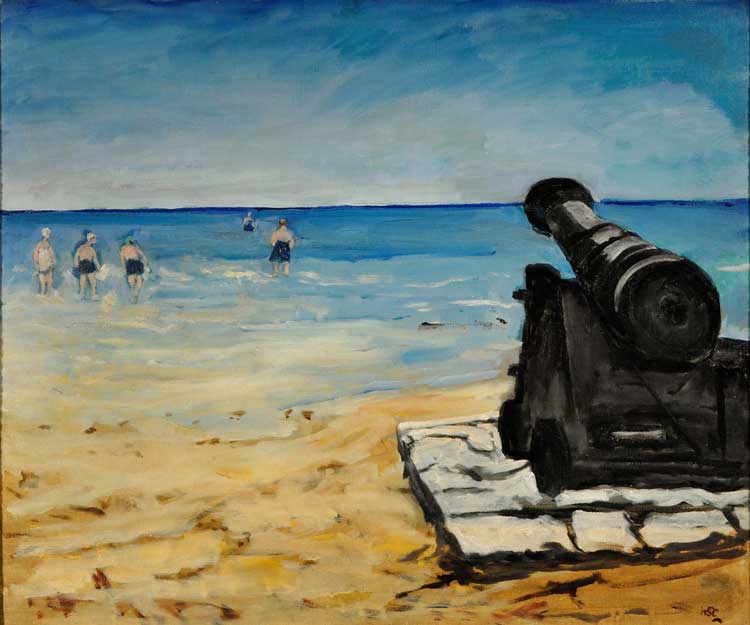
Sir Winston Churchill, The Beach at Walmer, 1938. America's National Churchill Museum at Westminster College, Fulton, Missouri. © Churchill Heritage Ltd.
He began to paint in 1915 (when he was already 40) after the Dardanelles naval disaster for which, as First Lord of the Admiralty, he was held responsible. Demoted and convinced he was politically finished, Churchill later wrote that he had felt, “like a sea-beast fished up from the depths, or a diver too suddenly hoisted, my veins threatened to burst from the fall in pressure. I had great anxiety and no means of relieving it.” His wife, Clementine (Clemmie), was seriously worried about him, and his sister-in-law, Gwendoline Churchill, wife of his younger brother Jack, suggested he try painting to take his mind off politics.
It worked and Clemmie encouraged him to continue. “Painting is complete as a distraction,” Churchill wrote in his essay Painting as a Pastime (1921-22). “I know of nothing which, without exhausting the body, more entirely absorbs the mind … Whatever the worries of the hour or the threats of the future, once the picture has begun to flow along, there is no room for them in the mental screen.”
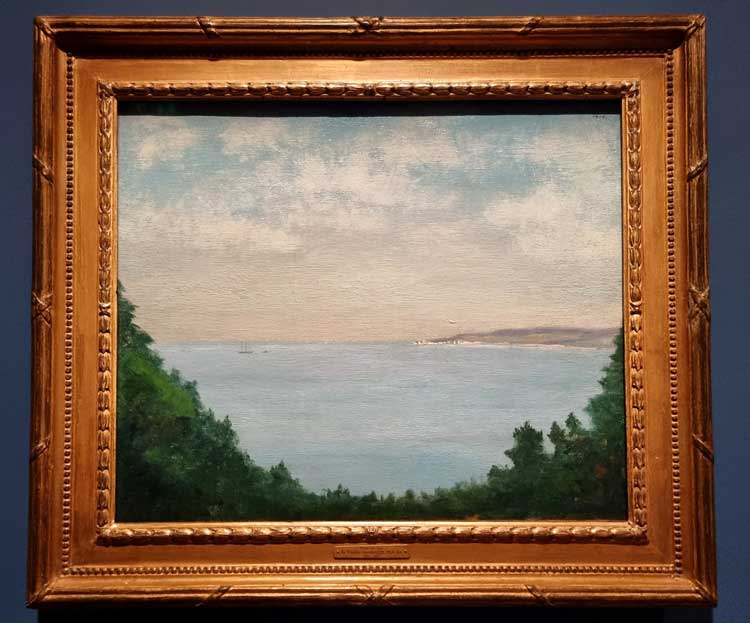
Sir Winston Churchill, Branksome Dene, 1916. Installation view, Wallace Collection, London, 2026. Photo: Juliet Rix.
During the times of inactivity and stress that accompanied periodic dips in his career, Churchill often produced pictures with a marked sense of calm: from Branksome Dene (1916) to A Lake Scene (Lake Maggiore?) (1945), painted just after he lost the postwar general election. In the mid-to-late 30s, though, when he was out of government and warning of the threat posed by nazism, his paintings sometimes include a note of threat. In Storm Scene, South of France or The Bridge (1935) half of the highly atmospheric landscape is in sunlight while the other half hangs beneath heavy storm clouds – though this may just have been something he saw and found visually striking. The threat looks more conscious in The Beach at Walmer (1938). Based on a photograph of the Churchill family playing on this Kent beach, the holiday scene is dominated and disturbed by a huge Napoleonic cannon, created to ward off invasion, pointing out across the Channel. After the second world war, Churchill gave this picture to one of his generals. But we are jumping ahead.
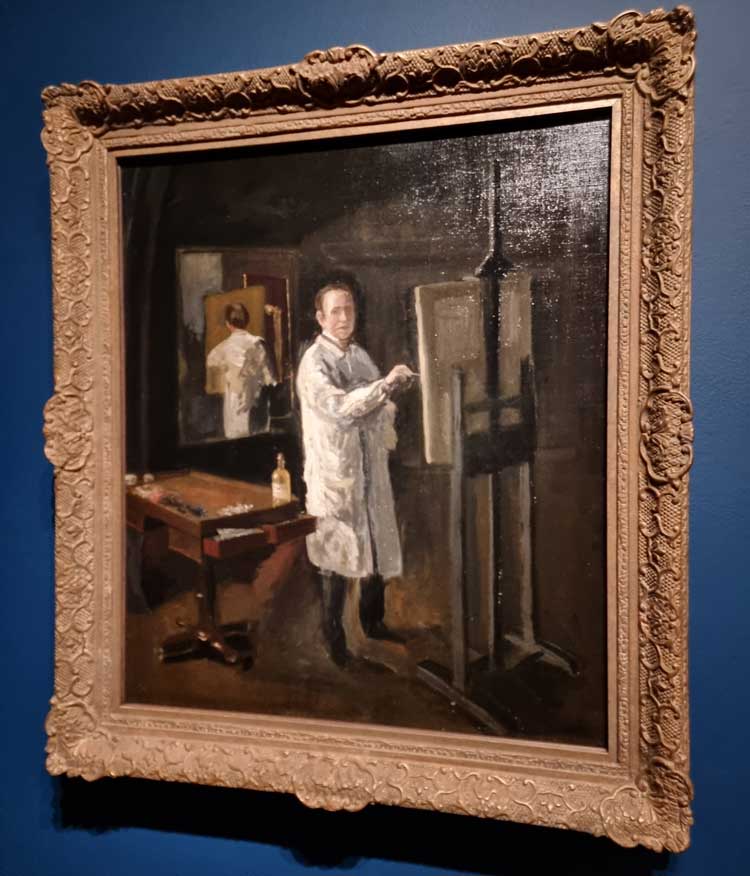
Sir Winston Churchill, Sir John Lavery, 1915. Installation view, Wallace Collection, London, 2026. Photo: Juliet Rix.
Back in 1915, Churchill’s friend Hazel Lavery arranged for him to work alongside her husband, the leading portraitist Sir John Lavery, in his studio and en plein air. Churchill may always have been an amateur painter, but his extensive social network gave him access to top professional mentors also including William Nicholson and Walter Sickert.
The first painting in this show is an already-accomplished 1915 portrait of Lavery at his easel and reflected in a mirror. Nearby hangs a striking self-portrait done in the same year, showing Churchill in his painting jacket, brush in hand, emerging from a darkened background. Churchill clearly had an aptitude and an eye, and he learned fast.
In the first room, too, is an early landscape, the first painting he made alone, without an artistic mentor, and – a rare thing among Churchill’s works – a war picture. Out of political office, he joined the Royal Scots Fusiliers and was sent to the front in Ploegsteert, Belgium (Plugstreet to the Brits). His painting Plugstreet (1916), shows the aftermath of a shell attack. One of his officers recalled that Churchill was in a black mood for days, before suddenly appearing cheerful and lighthearted. Asked how the change came about, Churchill said that he had finally worked out that if he added a little white to the craters in his painting they would stop looking like hills and look like holes.
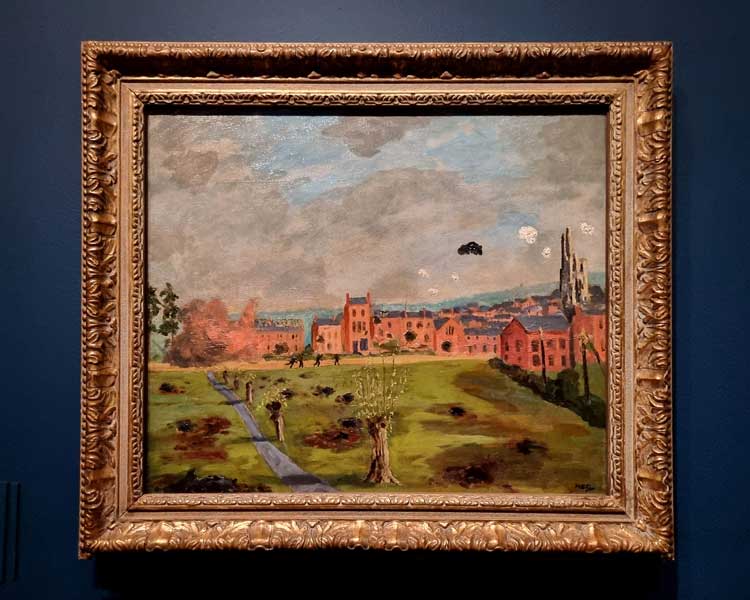
Sir Winston Churchill, Plugstreet, 1916. Installation view, Wallace Collection, London, 2026. Photo: Juliet Rix.
A pair of still lifes on the opposite wall each shows a bunch of very similar flowers in a glass vase. One is by Churchill, the other by Nicholson who encouraged Churchill to modify his tendency towards a very bright palette. They often painted together in the 1930s at Chartwell, Churchill’s Kent home. “Test yourself: which is which?” asks the Wallace Collection director, Dr Xavier Bray, in front of these paintings. “Some well-known names [in the art world] have got it wrong.”
From here, the exhibition takes us through Churchill’s art in more-or-less chronological order, on gallery walls painted in rich colours well-chosen to set off the work. Labels give historical context where relevant – and sometimes it is very relevant – but the Wallace Collection describes this show as the first to curate Churchill’s work like that of any other artist.
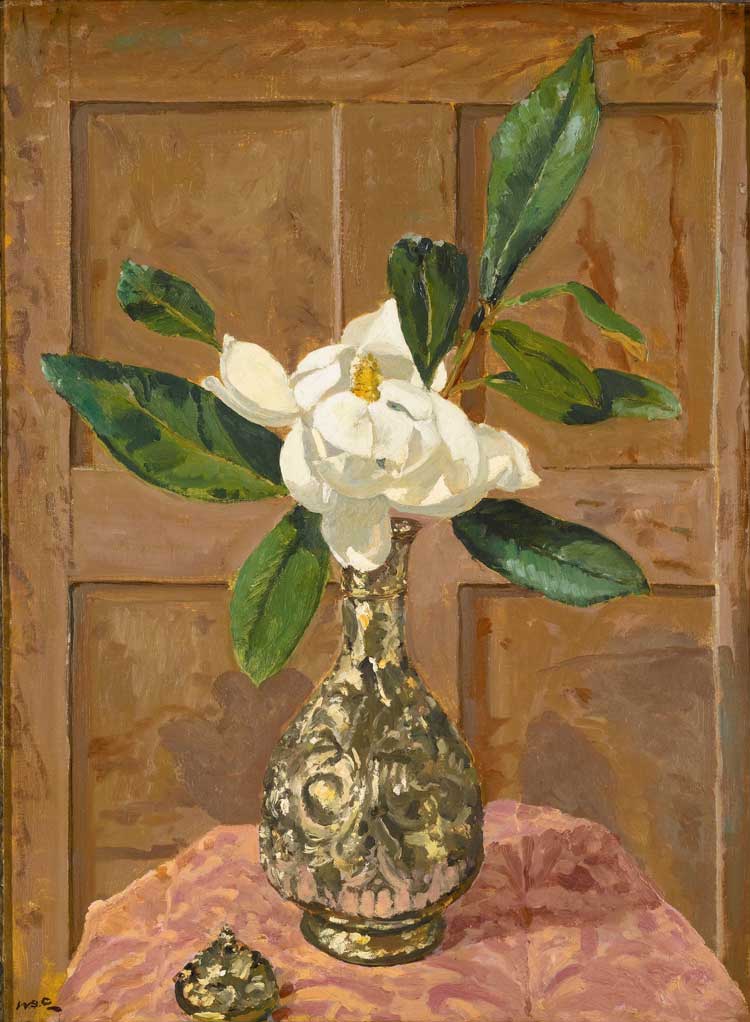
Sir Winston Churchill, Magnolia, 1930s. Private Collection. © Churchill Heritage Ltd. Image courtesy Sotheby's.
We discover Churchill’s interest in painting architecture – which he does with a light touch and a Sickert-like mix of detail and impressionistic atmosphere – notably in North Porch at the Manor House, Cranborne (1930s). This was home to Churchill’s friend Lord Salisbury (Robert Gascoyne-Cecil) to whom the picture was given. Churchill painted places he knew, including his ancestral home and birthplace, Blenheim Palace. The Tapestries at Blenheim (1928) shows the interior of the Second State Room with vast tapestries depicting the military victories of Churchill’s ancestor, John Churchill, 1st Duke of Marlborough, whose biography Winston wrote in four volumes during his political “wilderness years” of 1929-39.
The Lake at Blenheim (1926-29) exhibits one of Churchill’s other painterly obsessions, and to my mind one of his most successful: reflections, particularly on water. Here, a vast range of aquatic blues and greens is set off by terrestrial yellows, oranges and browns (a colour combination to which Churchill is repeatedly drawn) in a work clearly influenced, as many of his most expressive paintings are, by impressionism. Sketch of Lake Carezza, or “The Twenty Minute Sketch” (1949) is a vibrant example. The clue is in the nickname and Clemmie apparently asked Winston’s bodyguard to hide the picture so that her husband could not return and overwork it.
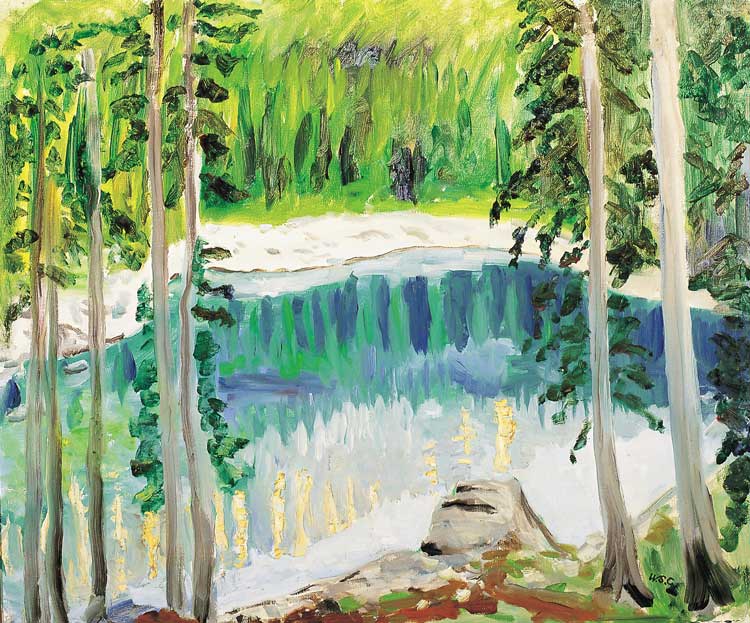
Sir Winston Churchill, Sketch of Lake Carezza, or The Twenty-Minute Sketch, 1949. National Trust Collections, Chartwell. Reproduced by kind permission of the National Trust. © Churchill Heritage Ltd. Image courtesy Churchill Heritage Ltd.
Churchill very much admired Paul Cezanne, Henri Matisse and Claude Monet in particular, and an original Monet of Charing Cross Bridge in fog (1902) hangs on the wall of the sitting room at Chartwell. The painting was a gift from his publisher in 1949 after the success of Churchill’s six-volume history of the second world war, which sits on a shelf nearby. Between these two stand a pair of lamps, recognisable from a painting in the London exhibition. Churchill’s Bottlescape (1926) is a light-hearted still life of, well, bottles and a lamp with glasses. The reflections in a brandy glass is seen by some as a blurred reflection of the painter (I’m not convinced).
Churchill bought Chartwell in 1922, despite it being barely affordable, and without consulting his wife, who had just given birth to their fifth child. He loved this place for the rest of his life (she not so much) and many of his paintings were made or completed in Chartwell’s grounds, the house, or his studio. Fifteen of the pictures at the Wallace Collection (including the bottles) usually hang at Chartwell, now a National Trust property, but much remains at the Kent estate, making it a fascinating complementary visit to the London show. And the Wallace collection has much to add to what can be seen at Churchill’s home, including many works borrowed from America and rarely seen works from unnamed private collections.
Chartwell features as a subject too. We see it surrounded by snow in Winter Sunshine, Chartwell (1924) – the painting that, despite Duveen’s protestations, won Churchill (under the pseudonym David Winter) the 1925 amateur artists competition, and in Chartwell Kitchen Garden (1948) which includes brick walls Churchill built himself (another therapeutic activity). The Goldfish Pool at Chartwell (1932) is one of Churchill’s most admired paintings. Full of reflections and ripples, it depicts one of his favourite spots – a pond between the house and his studio where Churchill took his grandchildren to feed the fish and where he sat alone for hours in older age painting in a chair that still flanks the pool today.
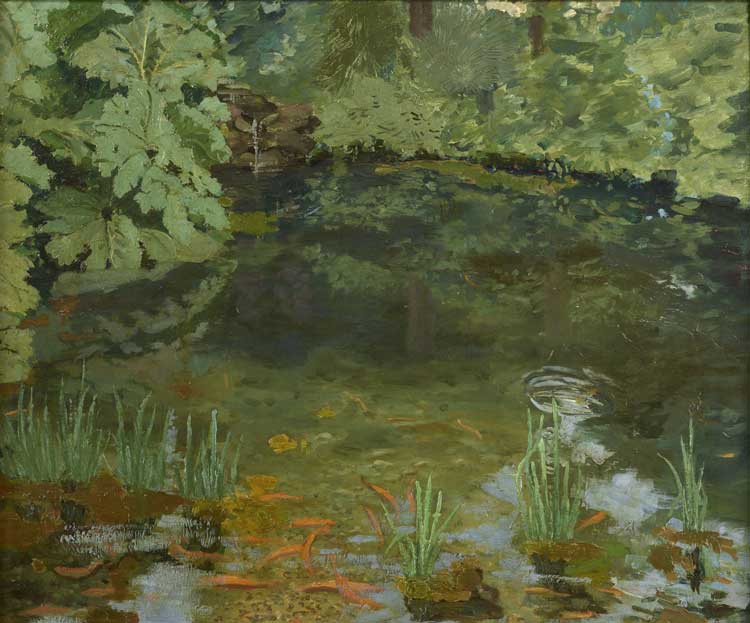
Sir Winston Churchill, The Goldfish Pool at Chartwell, 1932. Private Collection. © Churchill Heritage Ltd. Matthew Hollow Photography.
Churchill took his paints on almost any trip, whether social, leisure or official – when his staff were sometimes obliged to transport his travel easel and materials, both on display here, and even clear scenes for him to paint. He loved the light of the French Riviera – a favourite holiday spot – and of Morocco. Churchill was enthralled by the blue of the Mediterranean, noting that it could not be captured by “any single colour that was ever manufactured”, and by the fleeting intensity of sunsets (blues and oranges again). In Jerusalem (1921), he captures such a moment in a view of the Old City from the balcony of Government House. He painted it after chairing the Cairo Conference in his role as colonial secretary in the Lloyd-George government.
A whole room is dedicated to Churchill’s paintings of Morocco, most interesting among them the only picture he painted during the second world war. For once this was not painted for pleasure or therapy, but as a soft-power tool in the then British prime minister’s war effort. Following the 10-day Casablanca Conference in January 1943, Churchill persuaded Roosevelt to go with him to Marrakech to witness the sunset over the city and the snowy Atlas Mountains. Roosevelt had to be carried from his wheelchair to the tower viewpoint, but the moment of peace and beauty seems to have helped cement the crucial “special relationship”. Churchill stayed on for two days after Roosevelt had left to paint the glowing view, here titled Tower of the Koutoubia Mosque (1943), which he sent to Roosevelt for his birthday a couple of weeks later.
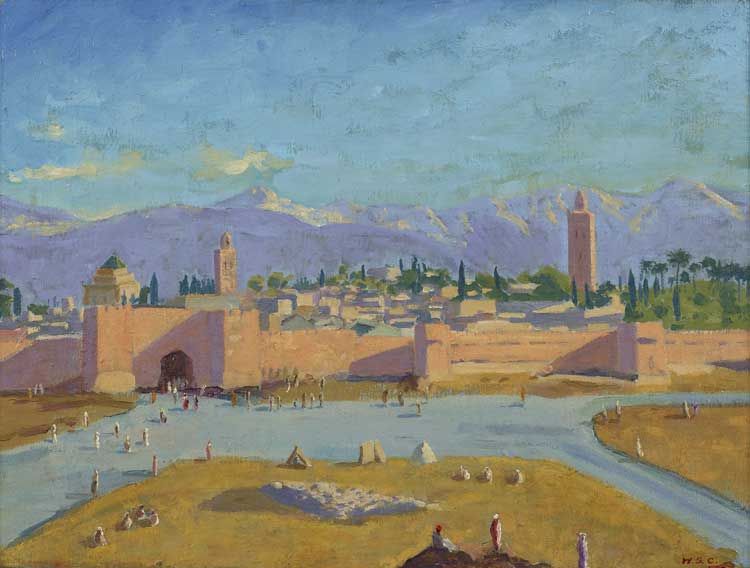
Sir Winston Churchill, The Tower of the Koutoubia Mosque, 1943. Private Collection. © Churchill Heritage Ltd. Image courtesy Churchill Heritage Ltd
On the opposite wall is a rural Moroccan scene, Valley of the Ourika and Atlas Mountains (1948), which once hung in the White House. The painting was selected by President Eisenhower in 1958 when Churchill asked him to choose a picture as a thank you for organising an exhibition of Churchill’s paintings that travelled to great acclaim across the US, Canada, Australia and New Zealand. The show ended up at the Royal Academy in London, an institution with which Churchill was already familiar.
In 1947, the President of the RA, Sir Alfred Munnings, like Churchill a conservative painter and artistic traditionalist, had invited Churchill to exhibit at the Summer Exhibition. Churchill agreed to submit only under a pseudonym but nonetheless had two works selected, both on view here: Winter Sunshine, Chartwell and The Loup River, Alpes Maritimes (1936), which was also later also chosen by the Tate for its collection. In 1948, Churchill was elected Honorary Royal Academician Extraordinary, a title created for him, and the only time an amateur has been elected to the Academy.
The success of the “World Tour” of Churchill’s art prompted the RA to exhibit this collection of 35 pictures on its return to the UK and to expand the show into a full retrospective of 62 works in 1959. So popular was it that it had to be extended, yet there has been no substantial exhibition of Churchill’s work in this country since - until now.
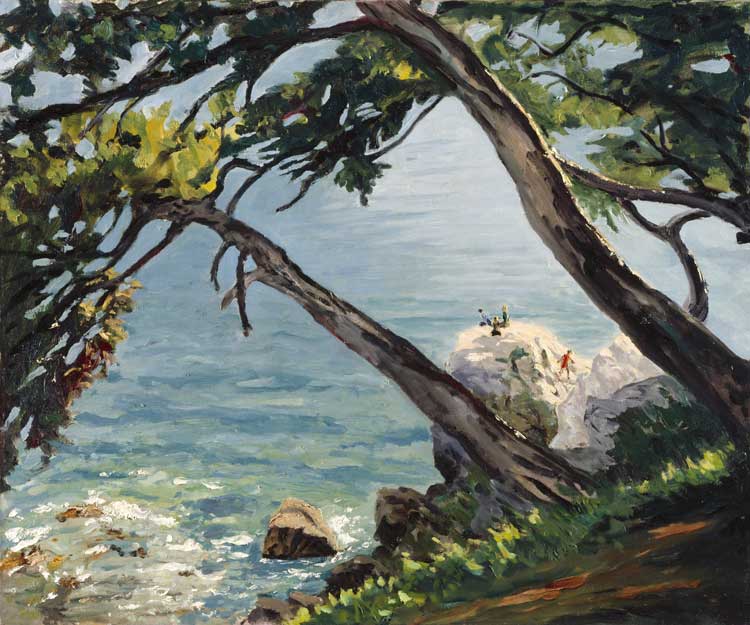
Sir Winston Churchill, Cap d’Ail, Alpes-Maritimes, 1952. Royal Academy of Arts, London. © Churchill Heritage Ltd. Photo: © Royal Academy of Arts, London. Photo: John Hammond.
Click on the pictures below to enlarge
.jpg)

Copyright © 1893–2026 Studio International Foundation.
The title Studio International is the property of the Studio International Foundation and, together with the content, are bound by copyright. All rights reserved.
 |
 |
 |
|---|


-Tate-(Larina-Fernandes)-(12-1000)-300.jpg)

-18-300.jpg)


-Flora-Yukhnovich-2-300.jpg) Flora Yukhnovich – interview: ‘I’m always looking at history through a kaleidoscope of contemporary references’
Flora Yukhnovich – interview: ‘I’m always looking at history through a kaleidoscope of contemporary references’ Portraits of Dogs: From Gainsborough to Hockney
 Tom Ellis: ‘Defining yourself in opposition to something else is always going to be self-defeating’