




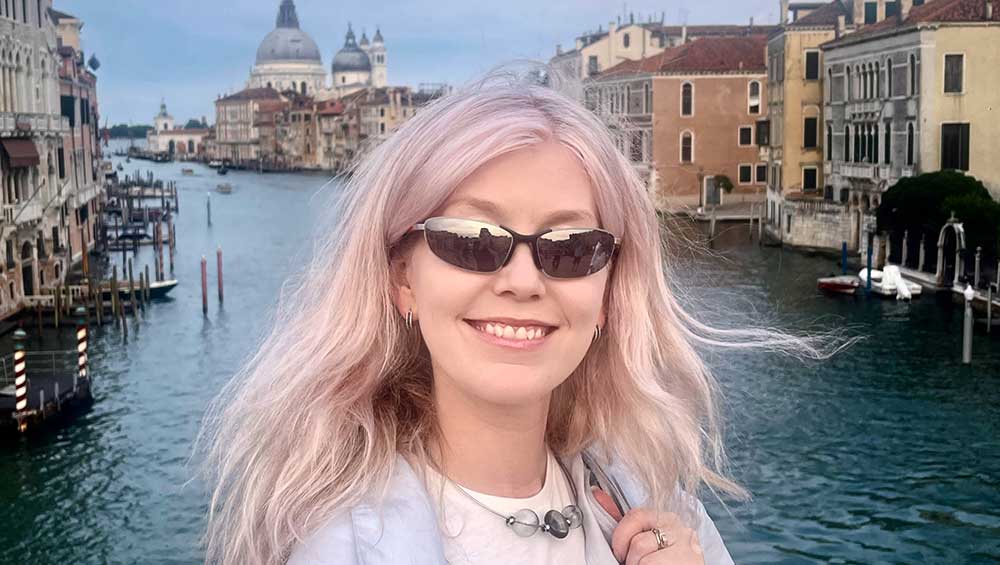
Ásta Fanney Sigurðardóttir, Courtesy of the artist, Icelandic Pavilion at 61st Venice Biennale, 2026.
by AMIE CORRY
Ásta Fanney Sigurðardóttir’s Pocket Universe– the Icelandic Pavilion at the 61st Venice Biennale – plays out over a series of interconnected spaces in a former shipyard in Castello. Sigurðardóttir selected the site of Cantieri Cucchini over Arsenale, which makes sense given the project’s sensibility. Pocket Universe is a subtle accumulation of gestures, sounds, words and forms. Together, they forge a speculative framework that is entirely Sigurðardóttir’s, yet so expansive that it binds and enchants visitors who encounter it.
I spoke to Sigurðardóttir during the biennale’s opening week, aboard a small, scrappy boat she has commandeered as part of the presentation. The notion of vessels, as well as the transportive power of water, are thematically important to Pocket Universe, which proposes fluidity and movement as a foundational premise for approaching a world in flux. Bright yellow buoys, shaped like gourds, are strung from the boat’s bow and recur inside the presentation. Moored adjacent to the shipyards, which host performance, moving image, sculpture and installation, the boat – painted the same white and vibrant sky-blue of the installation – is the site of performances and sound pieces over the biennale’s run. That said, no one fully knows Sigurðardóttir’s plans, beyond the fact that there will be continual interventions, activations and adjustments, as befits a multidisciplinary artist who eschews fixity wherever possible.
.jpg "Pocket Universe by Ásta Fanney Sigurdardottir, installation View, Icelandic Pavilion, Venice, 2026. Photo: Andrea Ferro Photography.")
Pocket Universe by Ásta Fanney Sigurdardottir, installation View, Icelandic Pavilion, Venice, 2026. Photo: Andrea Ferro Photography.
I ask Sigurðardóttir about her decision to favour encounter over spectacle with this presentation. “My intuition was saying, don’t go bigger, go smaller, go smaller,” she explains. “I really had to listen to that. When things go smaller, they can go bigger. It brings your attention closer to what is there, and when the attention is there, you are more of yourself and that moment is more alive. There is a beautiful word someone used for the show: vivacious. I had never heard this English word before. And I was like, yes! Something that’s full of life. When your attention is brought into just one dot, there can be so much in that moment. If your attention’s scattered all over, there’s less of life somehow.”
We discuss the sense of movement and change inherent in Pocket Universe, and Sigurðardóttir notes how her approach to permanence underwent a shift some years ago. “For a seven-year period, I only wanted to read poetry that I wrote for that occasion,” she says. “Because it was coming straight from the mouth, straight to the ear. That was their natural form. When they were printed, it was like they died or something. [At that time] I wanted everything to disappear – I didn’t want videos or photos of my performances, and I didn’t want to publish my poetry.”
.jpg "Pocket Universe by Ásta Fanney Sigurdardottir, installation View, Icelandic Pavilion, Venice, 2026. Photo: Andrea Ferro Photography.")
Pocket Universe by Ásta Fanney Sigurdardottir, installation View, Icelandic Pavilion, Venice, 2026. Photo: Andrea Ferro Photography.
Sigurðardóttir was working on a music album and travelling when she lost five years’ worth of recordings when her bag was stolen. It was a turning point. “I was like, OK – I will be an earthly being!” she laughs. “I will be in this body. I like invisibility – there are invisible things in the [Venice] show, but it’s also good to exist on Earth in a physical, tangible way.” Even so, she has found the lack of spontaneity requisite to a presentation of this complexity, which will remain on display for seven months, a new challenge.
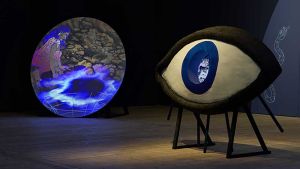
She describes her practice as a form of “spiritual fluxus”, in which different worlds and disciplines intermingle. The pavilion features glowing orbs – which crop up in her performances – charms and talismans, handwritten poems and an exquisite fan-shaped sculpture made of Icelandic sheep’s wool. The central film is a surreal creation story featuring the artist in the guise of a mythic being, Creature Zero. Zero, wearing an extraordinary pure white wool costume with a large O-shaped headpiece, designed by Sól Hansdóttir, sets out in search of the “original rock”. The Icelandic landscape with its active volcanic surface, itself always in a state of flux, is a protagonist in the film, but its narrative is informed by creation stories the world over, many of which involve creatures that connect heaven to the earth. Recordings of Sigurðardóttir whispering the opening lines of different cosmological stories accompany the score and soundtrack, which is infused with techno. It’s a wild, brilliant ride, predicated on questioning and thought, rather than didactics. “It was just something I was thinking about / I was just thinking about it / that’s just what I was thinking about,” Zero muses in the film.
Pocket Universe by Ásta Fanney Sigurdardottir, installation View, Icelandic Pavilion, Venice, 2026. Photo: Andrea Ferro Photography.
“I was reading so many different tales from different places,” Sigurðardóttir says. “They’re so beautiful. Across Asia there are many stories of monkeys that swing from heaven to Earth, making a bridge for humans to the spiritual world. They are the bridge. [I wanted Zero to be] this creature that’s looking for the beginning but also has a portal on their head, or maybe it’s an eye, or a zero. It’s about seeing, because it frames the light or nature.”
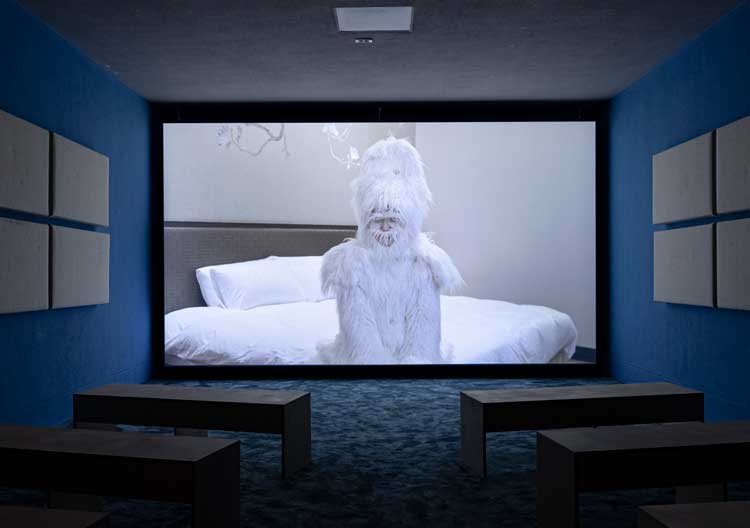
Pocket Universe by Ásta Fanney Sigurdardottir, installation View, Icelandic Pavilion, Venice, 2026. Photo: Andrea Ferro Photography.
Is Creature Zero a form of alter ego, or a means of sublimating personal identity? Sigurðardóttir considers this, and notes: “Well, I’m Aquarius, and then I’m a rising Leo. And they are opposites. Aquarius wants to be behind the scenes, not in the spotlight, and then Leo is like, ‘Look at me!’ So, yes, I have a slight tendency to go into hiding mode and then, when I’m performing, I emerge.”
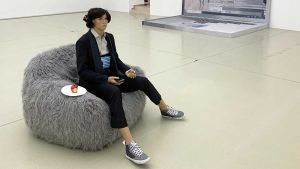
The work in Pocket Universe is enigmatic, yet refreshingly sincere. A “creation station” invites visitors to make their own marks, while a singular chair, labelled “Asta’s angel” sits quietly, waiting for the artist, or some other guest. In fact, the chair appeared to Sigurðardóttir in a dream, months before she received the invitation to represent Iceland. The installation reflects the radical potential of speculative thought as a practice. “Imagination is an undervalued source,” she notes, “a skill of endless possibilities”. Sigurðardóttir observed that there are many affinities with Koyo Kouoh’s curatorial framework for the biennale, In Minor Keys. The minor keys, according to Kouoh, “come alive in the quiet tones, the lower frequencies, the hums, the consolations of poetry, all portals of improvisation to the elsewhere and the otherwise”.
.jpg "Primal Pocket, Performance by Ásta Fanney Sigurdardottir, Venice Biennale 2026, Photo: Andrew James, Foxall Lever Street.")
Primal Pocket, Performance by Ásta Fanney Sigurdardottir, Venice Biennale 2026, Photo: Andrew James, Foxall Lever Street.
On Friday 8 May, Iceland, along with about a third of the biennale’s national pavilions, participated in strike action for Palestine. Elsewhere during opening week, protests and marches took place throughout the city and exhibitions. The appetite for change and need for discursive space was palpable.
Pocket Universe is a conversational mode of resistance, in keeping with Kouoh’s notion of minor keys. Sigurðardóttir is ambitious, and fundamentally optimistic, about the moment we find ourselves in. “I think now is the time to change things, to take things apart and put them back together differently,” she says. “I think we can do that through softness, although when there’s a transition, there’s always a fire, a kind of burning. But I think that’s a good thing. And I think everybody feels it. You can’t ignore it. Nobody can any more. This is the time. Now. Let’s do it. Our thoughts are free. We can use our imagination to figure out solutions for how to do it. There are no limitations on thoughts, figure out ways to do it that are most beneficial for humanity, for Earth, for these vivacious creatures. I think we should enter ‘square zero’ – in Icelandic, that translates not just as a square, but as a circle – similar to a dot or a point, like a meeting point of people.”
• Ásta Fanney Sigurðardóttir’s Pocket Universe, the Icelandic Pavilion, at the Venice Biennale 2026, runs until 30 September.
Click on the pictures below to enlarge

Copyright © 1893–2026 Studio International Foundation.
The title Studio International is the property of the Studio International Foundation and, together with the content, are bound by copyright. All rights reserved.
 |
 |
 |
|---|
-1000-300.jpg)
 Hildigunnur Birgisdóttir – interview: ‘I am inspired by the underwhelming’
 Sigurður Guðjónsson: Perpetual Motion – Venice Biennale 2022