




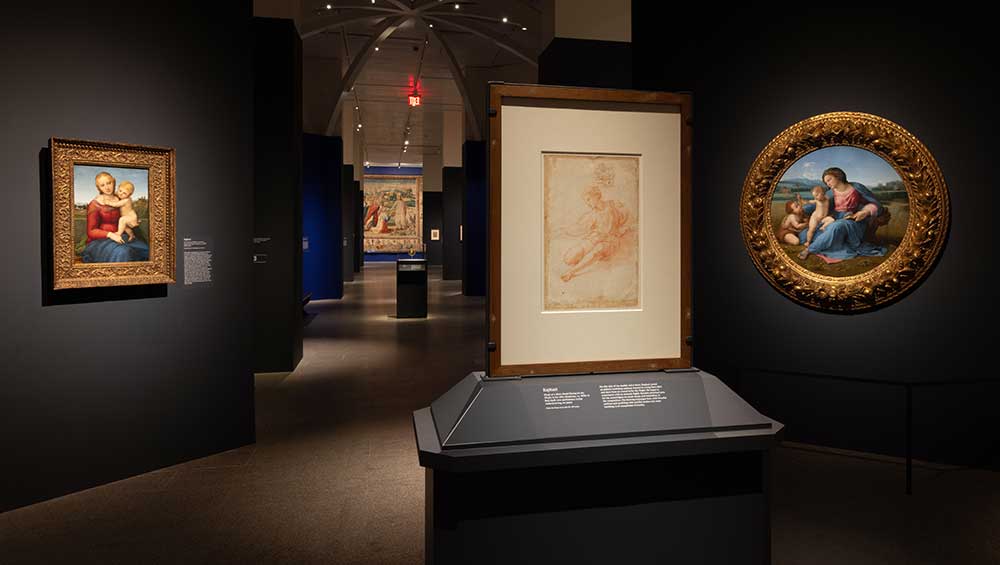
Installation view of Raphael: Sublime Poetry, on view March 29–June 28, 2026 at The Metropolitan Museum of Art. Photo; Eileen Travell, Courtesy of The Met.
Metropolitan Museum of Art, New York City
29 March – 28 June 2026
by MICHAEL PATRICK HEARN
The Met is done. Raphael: Sublime Poetry marks the end of the museum’s in-depth exploration of the Holy Trinity of the Italian Renaissance. It follows the monumental exhibitions Leonardo da Vinci: Master Draftsman of 2003 and Michelangelo: Divine Draftsman and Designer in 2017-18. It lives up to all expectations. Leonardo’s spirituality and Michelangelo’s sheer physicality are now joined by Raphael’s deep humanity. All three blockbusters have been organised by the brilliant and intrepid Carmen C Bambach, the Marica F and Jan T Vilcek curator in the department of drawings and prints at the Met. The great triumvirate’s current vast popularity touches the sublime and the ridiculous. Michelangelo, Leonardo and Raphael are known by their first names like, well, Madonna and Ninja Turtles. The museum has done much to explain why they were and still are important. The title of the current exhibition is not an anomaly: Raphael’s graceful art seems to contain Wordsworth’s definition of poetry as “emotion recollected in tranquility”. Leonardo called painting poesia muta (“mute poetry”): “Painting is poetry that is seen rather than felt.” Raphael: Sublime Poetry is itself a masterpiece. It should not be missed.
The mammoth show embraces 237 works, 175 by the master himself including 33 paintings, from 62 public and private collections including the Louvre, Prado, Uffizi, Vatican Museums, National Gallery in London and National Gallery in Washington DC. It required eight years to prepare and unknown millions or maybe billions of dollars to complete. The massive magnificently illustrated catalogue, though printed in type that is far too small, will now serve as the textbook for Raphael studies. All future shows will seem small by comparison. Raphael was as much of a challenge as Leonardo and Michelangelo. To say he was a “Renaissance man” is no mere cliche: he excelled as a painter, draughtsman, architect, poet, printmaker, designer of tapestries and surveyor of antiquities. What he accomplished in 37 years and at such a consistently high level was heroic. Of course, Raphael: Sublime Poetry is far too much to take in on one leisurely afternoon. It requires several visits to fully comprehend the various aspects of this wide career. It is well worth all the time it requires to fully embrace his extraordinary accomplishment.
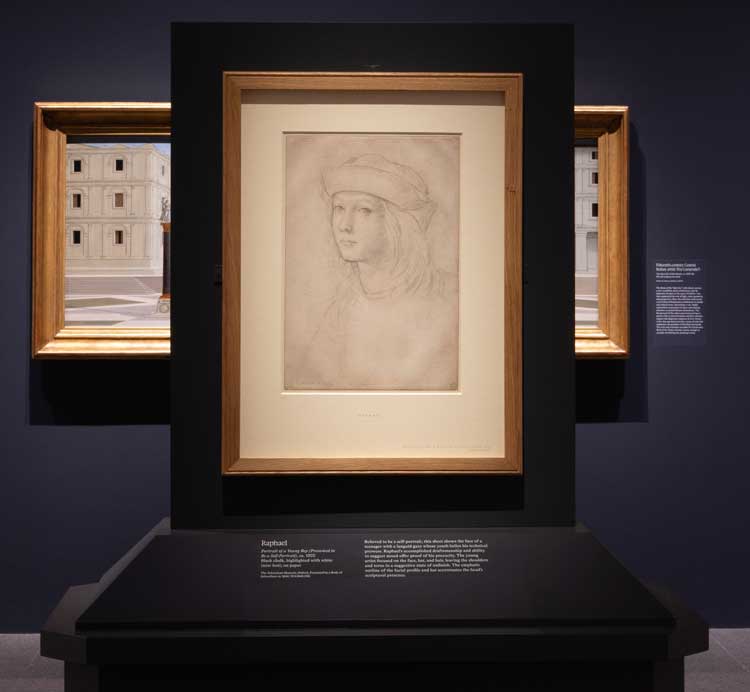
Installation view of Raphael: Sublime Poetry, on view March 29–June 28, 2026 at The Metropolitan Museum of Art. Photo; Eileen Travell, Courtesy of The Met.
The show opens with a master drawing in black chalk, believed to be a self-portrait done when Raphael was 17, in about 1500. It is reminiscent of Albrecht Dürer’s equally remarkable silverpoint self-portrait of 1484, drawn at age 12 or 13, but without the stiffness. It is extraordinary how the languid young Italian so confidently captured a likeness with just a few tight deft strokes. He always worked in three-quarter views, which were the fashion at the time, learned from the Flemish artists. This gives the self-portrait a naturalism of form, space and depth. The three dimensions of the adolescent’s head were beautifully rendered with swift parallel lines. And those clear, piercing eyes! He may have been just a boy, but his art was mature. Raphael imbued this exquisite drawing with the serenity and precision of vision that characterised all his adult work. Although he died at 37, Raphael’s life seemed to have been blessed: Raffaello Sanzio (or Santi) da Urbino was born on 6 April 1483 and died in Rome, coincidentally also on 6 April, in 1520, Good Friday. “How generous and kind Heaven sometimes proves to be,” noted his biographer, the painter and architect Giorgio Vasari in 1550, “when it brings together in a single person the boundless riches of its treasures and all those graces and rare gifts that over a period of time are usually divided among many individuals can clearly be seen in the no less excellent than gracious Raphael Sanzio of Urbino.” Vasari, a shrewd myth-maker, called him “The Prince of Painters”.
_ca-1500-01.jpg "Raphael (Raffaello Sanzio or Santi), Angel in Bust-Length (Fragment from the Baronci Altarpiece), ca. 1500-1501. Oil with gold highlights on canvas (transferred from wood), 12 3/16 × 10 7/16 in (31 × 26.5 cm). Pinacoteca Tosio Martinengo e Fondazione Brescia Musei, Brescia.")
Raphael (Raffaello Sanzio or Santi), Angel in Bust-Length (Fragment from the Baronci Altarpiece), ca. 1500-1501. Oil with gold highlights on canvas (transferred from wood), 12 3/16 × 10 7/16 in (31 × 26.5 cm). Pinacoteca Tosio Martinengo e Fondazione Brescia Musei, Brescia.
Raphael’s father, Giovanni Santi, was “a painter of no great talent,” according to Vasari. Urbino was a flourishing cultural centre of the Italian Renaissance where Santi was court painter to Duke Federico da Montefeltro. Santi gave his son his earliest instruction in art, but he died in 1494 when Raphael was 11. In about 1500, Raphael entered the studio of Pietro Perugino in Perugia, then one of the most respected painters in Italy. Evidence of his youthful precocity can be seen in the rather theatrical The Resurrection of Christ (c1499-1502) or The Kinnaird Resurrection at the São Paulo Museum of Art (it is not part of the Met exhibition). He broke with the convention of the time by depicting God the Son as very much a man rather than the Holy Ghost, reflecting Raphael’s intense humanistic approach to religious subjects. The exhibit includes an exquisite fragment of a sweetly smiling golden-haired androgynous angel from the largely destroyed Baronci Altarpiece (c1500-01) painted when he was 17. (It was damaged in an earthquake in 1789.) It looks more like the portrait of a real person than a work of pure invention. Raphael’s idealised holy subjects express the nobility of faith while still remaining human rather than mere spirits on earthly visitations. Saint Sebastian, often depicted tied to a post stripped and impaled with the executioner’s arrows, was instead, as interpreted by Raphael between 1502 and 1503, a handsome, serene, hairless youth after his canonisation in Paradise. Beyond his double hair-thin gold halo, he delicately holds a single slim arrow as a symbol of his martyrdom and to identify him as the saint. It represents the neo-Platonic ideals of perfection that Raphael applied to his interpretation of the divine. Perugino taught his apprentice infinite grace and refinement; and master and pupil often worked on the same picture. As Vasari noted, the lad absorbed his teacher’s manner so convincingly that it is often impossible to tell the two apart. But Raphael developed into his own man and soon surpassed in technique Perugino’s comparatively static style. The harmony and conviction of Raphael’s art is generally lacking in Perugino’s merely admirable painting. Unlike his protege, Perugino never reached the sublime. He never soared as Raphael did.
The ambitious young man heard rumours of what marvellous things were then being done by Michelangelo and Leonardo, and, bearing a letter of recommendation from the mother of the next Duke of Urbino to the Gonfaloniere of Florence, he departed for that city in 1504. He led a largely nomadic life through Northern Italy during the next four years. He spent much of that time in Florence. Already a celebrated painter in Urbino, Raphael at 21 immediately fell under the city's intoxicating spell with its sudden unleashing of unbridled artistic freedom. Throwing off the yoke of Perugino, he intensified his study of Michelangelo and Leonardo until he equalled them in mastery.
Raphael is arguably the most accessible of the three Italian Renaissance masters, largely due to his famous paintings of the Mother and Child often encircled with chubby cherubim or pudgy putti. He wisely learned to specialise and became celebrated in his age for his mastery of this popular genre. No one else seemed to paint the Madonna with such grace, devotion, divinity and humility or as frequently. Her radiant expression, reflective of her deep maternal love, is always so peaceful, so luminous, the symbol of divine serenity. Although Madonna di San Sisto (The Sistine Madonna, c1512-13) and the tondo Madonna della Seggiola (The Madonna of the Chair, c1513-14) are the most famous and best beloved of all these pictures, neither made it to the Met. No matter. There are many others that are just fine.
-ca-1509-11.jpg "Raphael (Raffaello Sanzio or Santi), The Virgin and Child with the Infant Saint John the Baptist in a Landscape (The Alba Madonna), ca. 1509-11. Oil on canvas, transferred from wood, 37 3/16 in (94.5 cm). National Gallery of Art, Washington, D.C.")
Raphael (Raffaello Sanzio or Santi), The Virgin and Child with the Infant Saint John the Baptist in a Landscape (The Alba Madonna), ca. 1509-11. Oil on canvas, transferred from wood, 37 3/16 in (94.5 cm). National Gallery of Art, Washington, D.C.
The met provides a temple of the Madonna and Child, a sanctuary devoted to divine motherhood. Each of these works embodies a state of grace. These religious paintings lack proper context when removed from their initial settings in church or chapel. At times they seem isolated, even lost on the gallery walls. Raphael broke with the medieval tradition of depicting Christ as a muscular infant who had emerged fully formed from his mother’s womb, more God than man. That tradition lingers in Michelangelo’s painting of the Holy Family in the Doni Tondo (c1507): the buff Baby Jesus is attended by an equally brawny Mary and her carpenter husband, Joseph, before a chorus line of naked male athletes. It is worth comparing this one with another tondo, Raphael’s Alba Madonna from about 1511. What Vasari said of another Madonna and Child is equally true here: “With the beauty of its figures and the nobility of its painting, the work seems to breathe the breath of divinity which astonishes anyone who examines it intently, causing them to wonder how the human mind working with the imperfect medium of simple colours could, with the excellence of design, make objects in a painting seem alive.” Raphael’s clarity of light is unsurpassed, the composition unexpected with its pyramid of the solid Mary, John the Baptist and Jesus placed squarely within the round painting.
In spirit, it resembles more than Michelangelo the Leonardo of the unearthly Virgin of the Rocks (c1483-86). As Vasari concluded: “Raphael came nearer to Leonardo than any other painter in the elegance of his colours.” Compositions, too, were cribbed. For example, Leonardo’s much earlier Benois Madonna (c1478-80), now in the Hermitage Museum in St Petersburg, obviously inspired Raphael’s Madonna of the Pinks (c1506-07). However, the two artists differed in sensibility: Raphael returned the Madonna and Child to the natural world. He humanised the divine. However idealised the figures may seem, they remain human beings of real flesh and blood with the sweetest expressions rather than rigid religious symbols. Raphael dressed the Madonna in graceful classical fashion in pure, bright colours rather than in the contemporary Italian mode. “Although other paintings may be called paintings,” Vasari observed, “those of Raphael are living things: for the flesh in his figures seems palpable, they breathe, their pulses beat, and their lifelike animation is conspicuous.” Mother Mary wears a blue mantle and red gown, symbolising the Church and Christ’s death. The figures seem securely fixed on terra firma. And the landscape is supernal.
Motherhood was sacred. The veneration of the Virgin Mary arose when so many women were condemned to death by childbirth. Raphael was the only one of three children to survive infancy. His mother, Màgia Ciarla, died in 1491, giving birth to a girl who lived only a few days. The boy was eight years old. (The funeral records are on display in a case at the Met.) Raphael painted with deep conviction and compassion healthy, robust women with their lively plump infants, often for private clients in search of blessings or absolution from the Holy Mother. Perhaps there is nothing more sensitive, more tender than the way she gently cups her baby’s bare bottom in her left palm in The Small Cowper Madonna (c1504-05). A short video demonstrates how infrared reflectography was used, passing through layers of pigment to reveal Raphael’s lovely underdrawing. The artist applied a divine geometry to another tondo, the gently illuminated Madonna of the Candelabra (c1514-16), with its intertwining circles of halos, eyes, faces and forms and not a straight edge anywhere. He often portrayed Mother Mary with golden tresses. He knew both the Virgin and the Whore. Mary Magdalene, staring seductively straight ahead at the viewer on the right in his majestic depiction of The Ecstasy of St Cecilia, from about 1515-16, too, is blond. In the preliminary drawing, she gazes heavenward.
Not all these paintings live up to the supreme poetry of The Alba Madonna. By comparison, The Large Cowper Madonna (c1508) is clumsily conceived and executed as the impulsive infant grabs at his mother’s bodice. The child has a sweet but elderly face. The colours are less vibrant than elsewhere. The pale, ghostly figures and overall composition of Esterhazy Madonna, also c1508, reflect Perugino’s influence. The later Madonna del Divino Amore (c1516-18) and The Madonna of the Rose (c1517-18) teeter toward caricature. The exaggerated limbs and expressions, underwhelming colour sense, and lack of balance within the overall composition foreshadow mannerism, the late Italian Renaissance art movement inspired by the elongated, stylised figures of Michelangelo’s later period.
The scale of some of his paintings is astonishing, even startling after viewing so many small intimate ones of the Virgin and Child. Bambach and her team are particularly proud of how well the Met reassembled the enormous early Colonna Altarpiece (c1504-05) of Madonna, Child and John surrounded by saints and seraphim. The museum has owned the large central piece since 1916, and gathered the missing ones to reconstruct the entire work that has been unseen in this form for centuries. The huge Madonna dell Pesce (c1512-14) is a masterpiece in restraint with its majestic figures and bright pure blues, greens and reds. It is a masterwork of balance, grace and harmony. It is almost minimalist with no gratuitous details to throw off the bold, simple composition. Not even St Jerome’s scruffy lion can distract from the overall unity of the picture. Equally impressive is The Ecstasy of Saint Cecilia, with Saints Paul, John the Evangelist, Augustine and Mary Magdalen (c1515-16): the patron saint of music welcomes a heavenly choir bursting into song. The superb preliminary red chalk drawing of St Paul in deep quiet contemplation is one of Raphael’s finest drawings: it expresses thought as convincingly as Rodin’s The Thinker.
Those bored with the religious pictures can find absolution in the portrait gallery toward the centre of the exhibition. Here lies one aspect of Raphael’s genius that tends to get lost among all the splendid Madonnas. What a superb portraitist he was! Not enough attention is paid to this aspect of his illustrious career. These pictures exhibit nuance of human emotion blessed with psychological truth. To empathise the artist’s journey as an artist, the designer Daniel Kershaw has cleverly conceived of a passageway through a series of domed octagonal chapel-like spaces. Unfortunately, the crowds consistently create a bottleneck in the opening galleries so it is best to skip the earliest ones and proceed straight to the portraits until the mass of people thins out at the front.
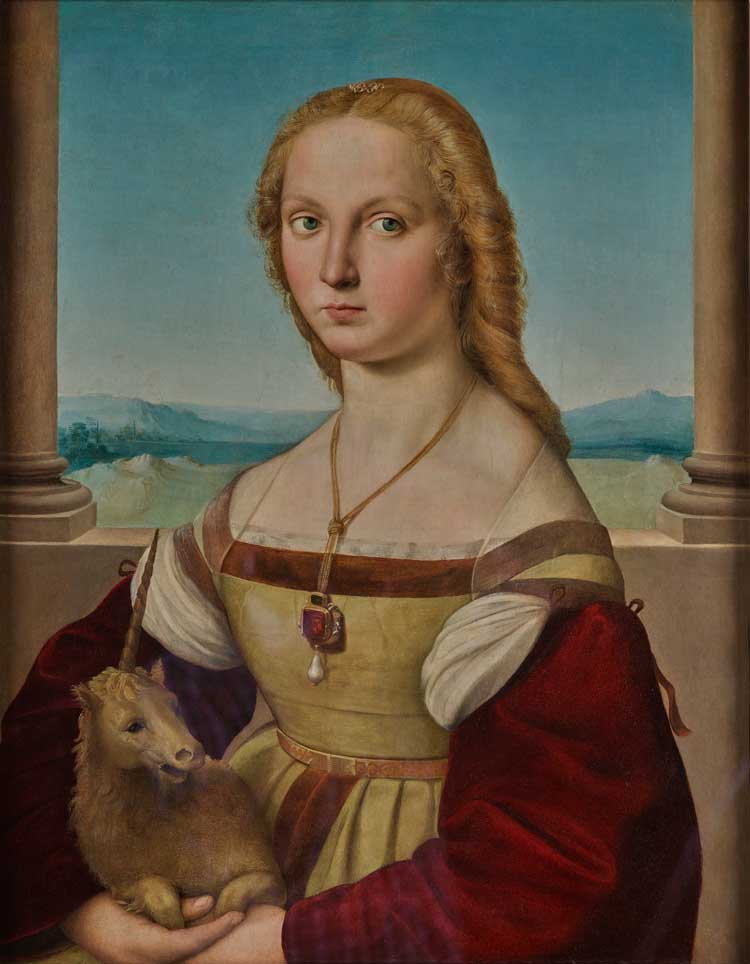
Raphael (Raffaello Sanzio or Santi), Portrait of a Young Woman with a Unicorn (Laura Orsini della Rovere?), 1505-1506. Oil on wood panel, transferred to canvas, glued to a wood support, 26 3/8 × 22 1/16 in (67 × 56 cm). Galleria Borghese, Rome.
Vasari attested that the artist cultivated, “above all else, the method of painting portraits which resemble men who seem so alive that one may recognise the person for whom they have been painted”. He did not capture merely a likeness but also the sitter’s inner character. The Met provides a sanctuary for his portraiture. Raphael’s depiction of his subjects turned slightly to the side in three-quarter view provided the subtler, more realistic illusion of depth and volume lacking in the flat full frontal views or profiles so characteristic of an earlier age. The stunning depiction of a young lady with golden locks and cradling a clumsily rendered baby unicorn, painted between 1505 and 1506, is most likely a betrothal or courtship portrait, her lap pet being a symbol or undeniable proof of her virginity. There is no ring on her hand. She may well be 13-year-old Laura Orsini della Rovere. Since girls were no more than commodities at the time, the portrait had to be as flattering and alluring as possible to entice a potential husband. Bejewelled and in her finest gown, she was being groomed her whole short life to wed the proper suitor. Her finery reflected her dowry. She has such a bewitching, even sly expression with haunting eyes. She is another of Raphael’s blondes. She reflects the ideal of feminine beauty, belle donne, defined by the great Italian poets Dante, Petrarch and Boccaccio – light hair with pale skin, blue eyes, a lovely neck and a graceful comportment. Sandro Botticelli’s Venus, Primavera and Virgin Mary were all blond (possibly inspired by the Florentine beauty Simonetta Vespucci, as Ruskin claimed). She embodied grace, virtue, nobility and divine light. Raphael’s naturalism is deceptive: the girl is rigid, her light complexion as smooth and unblemished as if it were Photoshopped. The portrait is so idealised that she appears more the idea of beauty than an actual beauty. She is more a type than a personality. Nevertheless, however unlikely the rendering may be in life, one still longs for such a face, such a landscape to exist. She continues to seduce more than 500 years after she was painted.
Portrait of a Woman (c1503-05), the painting of a wealthy maiden in all her finery, known (for some unknown reason) as La Muta (The Mute), may be another betrothal painting. Her imperious gaze makes her more an individual than the other blond prospect. Many critics and scholars have noticed the similarities between this portrait and the Mona Lisa. Raphael borrowed the pose and bearing of La Giocondo without capturing the inherent mystery that has made Leonardo’s portrait the world’s most famous picture. La Muta embodies Leonardo’s poesia muta. Painting is a kind of pantomime like silent cinema: it communicates through expressions and gestures rather than words. Raphael had that rare facility to make everything he drew or painted, however mundane, seem so effortless such as his subtle mastery of rendering sleeves and hair.
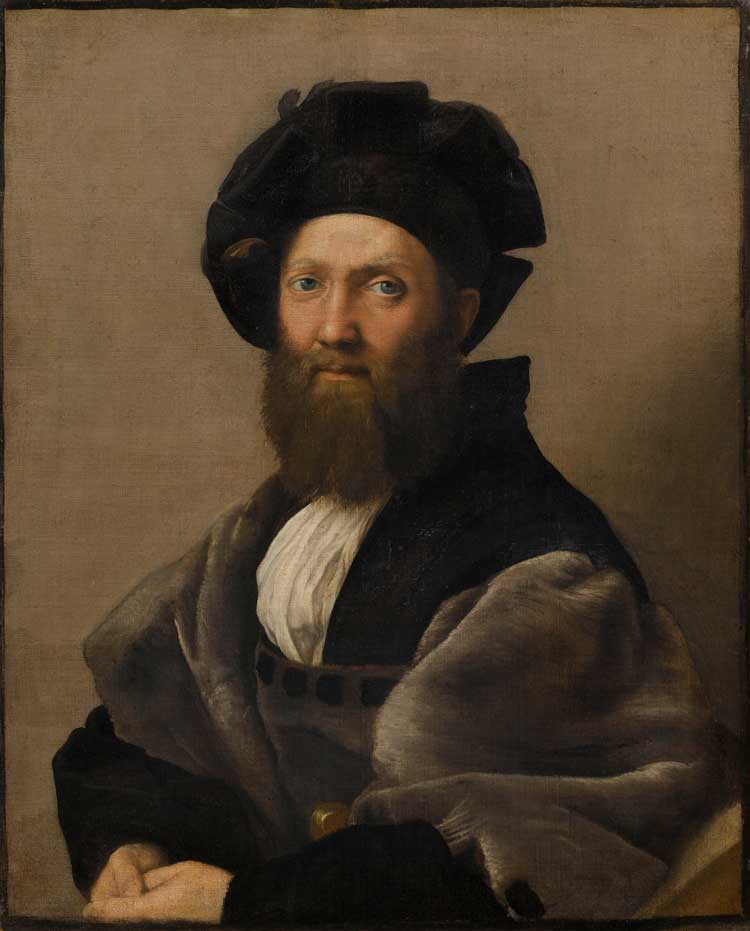
Raphael (Raffaello Sanzio or Santi), Portrait of Baldassare Castiglione, 1514-16. Oil on canvas, 32 5/16 × 26 3/8 in (82 × 67 cm). Musée du Louvre, Département des peintures, Paris.
Raphael was as gifted in depicting men as women. He painted his dear friend, the writer, humanist and diplomat Baldassare Castiglione, with such confidence and reserved dignity sometime between 1514 and 1516. The author of Il Libro del Cortegiano (1528) is depicted by Raphael as the perfect courtier himself. (He may also be Zoroaster in the famous School of Athens on the Vatican wall.) Castiglione coined the term sprezzatura (“studied nonchalance”) that he defined as “a certain nonchalance, so as to conceal all art and make whatever one does or says appear to be without effort and almost without any thought about it”. Although he was referring to the courtiers in Urbino, sprezzatura is an apt description of Raphael’s method. As Bambach has observed, the restrained pose of Raphael’s portrait may suggest Mona Lisa but without the elaborate landscape behind. Instead, the artist placed the courtier against a flat neutral-coloured wall. The unadorned simplicity of the composition is reinforced by the artist’s restrained palette that is almost monochromatic in shades of grey and black and white and brown that bring out the hands and slightly ruddy face and the sly, pale-blue eyes. The picture demonstrates the painter’s mastery of textures whether rendering the grey fur sleeves, black velvet coat and hat (covering his baldness), white linen blouse, or the subject’s pale pink flesh and lush brown beard. Raphael imbues him with courtly intelligence. It is simply one of the greatest and most influential portraits ever painted. It has lost none of its power in the last half-millennium.
No less stunning is his Portrait of Bindo Altoviti, painted in about 1515-16. With his angelic good looks, this hairless, ambitious youth was one of the pope’s bankers. With long wavy fair hair and full vermilion lips, wearing an aqua cloak set against an emerald green wall that brings out his striking blue eyes, he is the epitome of sensual androgyny as he gazes seductively over his right shoulder. More reserved is the handsome late double-portrait begun in 1518 and completed shortly before Raphael’s death. No one is certain who the central figure was. Perhaps it was a fencing master or, as the Met catalogue suggests, Giulio Romano, Raphael’s favourite pupil. The figure on the left with the fierce beard was identified in the 16th century as Raphael himself. He is almost Christ-like. To Vasari, he was a saint. His “holy behaviour” was blessed with “all those rare virtues of mind, accompanied by as much grace, study, beauty, modesty, and fine manners as would have sufficed to cover up any flaw, no matter how ugly, or any blemish, no matter how large”. His colleagues “were won over by his courtesy and his skill, but even more by the genius of his good nature, which was so full of nobility and kindness that even animals loved him, not to mention other men”. Raphael exemplified ability with virtue, talent blessed with exquisite manners. He, too, was a perfect courtier.
The real revelation of the Met’s exhibit is the vast selection of his masterful drawings. These preliminary works demonstrate the energy, skill, discipline and diligence with which Raphael composed his often complex pictures. Only Michelangelo and Leonardo drew with such authority, finesse and care as did Raphael. He made exhaustive studies before finally committing paint to surface. At times, these drawings are rather refreshing after the cold precision of the paintings. Here one can see Raphael thinking. The final paintings are exercises in polish and refinement. What is gained in perfection is often a loss in spontaneity. His drawings have a virtuosity that elevates them far above mere sketching. Faces and hands and lithe legs and bodies are all expertly committed to paper in a variety of media. Few other artists ever drew drapery so effortlessly with every fold so exquisitely rendered. It is a miracle so many of these studies survive. Due to their inherent fragility and sensitivity to light, they are seldom shown in such number.
His style of drawing radically changed after his encounters with Michelangelo and Leonardo. He learned from them bozzare pronto (“quick sketch”), a lightning-fast, improvisational style of putting down images, whether Madonnas, infants or saints, as soon they came into his head in a whirl of strokes with emphasis on spontaneity rather than laborious refinement. From Leonardo, he absorbed the technique of sfumato (smoke), what Leonardo called “rendering a subject without lines or borders in the manner of smoke or beyond the focus plane”. It gave flesh its softness and life-like qualities. It was a nonlinear approach to a subject, defining the soft contour of a form through subtle light and shade. The edges blurred in the subdued modelling of the figures while producing solid, sculptural forms. The luscious drawing for Saint Catherine of Alexandria (c1507) demonstrates his mastery of clear, clean precision and firm outline in the overall graceful composition. The martyr by her torture wheel is as handsome and tranquil as any of his Madonnas. She has weight and the loveliest expression as she gazes toward the heavens. Other excellent examples of sfumato are the tender study in tondo for The Tempi Madonna (c1505), the full-size drawing for La Belle Jardinière (c1507) and the powerful cartoon for The Mackintosh Madonna (c1509-11). Line no longer determined form. The soft contours of the figures emerged fully developed from the mist of crayon, chalk or graphite. Even here the master dared not make mistakes.
Inspired by Michelangelo, Raphael became engrossed in the study of nudes from life and even to drawing the muscles and bones beneath the skin of dissected corpses. Fascinated with anatomy, he soon knew how the body operated, how it was possible to move within space. He recognised it was futile to imitate Michelangelo, so he resolved to master other aspects of art that did not interest the older man. His male nudes, though influenced by Michelangelo, are not so concerned with the exaggerated, mannered muscularity of his rival’s art. Raphael’s are very much human beings he might have encountered stripped for swimming in the river or posing in the studio. They are not gods or titans. Like other artists, Raphael initially drew figures naked and put clothes on them only when he got around to painting them. He also differed from Michelangelo in that he was not obsessed solely with naked men. “Raphael was a very amorous man who was fond of women,” Vasari reported, “and he was always quick to serve them”. His lovingly rendered female nudes certainly prove that. It is clear from these drawings that Raphael preferred a sturdy lady. At times, when it was difficult to find a female model, an assistant might take her place in the studio for a preliminary study. The subject then transformed into a woman in the final picture.
The numerous complex drawings for the Michelangelo-esque Baglioni Altarpiece (c1507), showing the deposition of Christ, suggest the artist may have worked directly from a cadaver to emphasise Jesus as a man rather than a god. Obviously, rigor mortis has set in the greenish body in the finished painting. It is not just another crucifixion: Vasari called it “sublime painting” that was “executed with such freshness and mature love that it appears only just now to have been painted”. He praised the way the painter so beautifully captured “the pain felt by the closest and dearest relatives as they lay to rest the body of some loved one on whom the happiness, honour and profit of the entire family depend”. Here, Raphael explored earthly rather than celestial truth. But there was nothing earthy about his sacred art. Mortality, also, intrudes in The Alba Madonna through his cousin, the future John the Baptist, with the gift of a long, thin cross foreordaining the crucifixion. Except for that one unsettling detail, the picture represents pure domestic bliss.
In 1508, at the tender age of 25, Raphael was summoned to the Vatican. It was a good time to be in Rome. Pope Julius II was determined to restore the capital city to its ancient glory. Fellow Urbinate, Donato Bramante, had the responsibility of rebuilding St Peter’s Basilica; and the great architect so praised his friend’s ability that the pope hired Raphael to provide frescos for the walls of the pontiff’s private library and offices. Raphael was the right man in the right place at the right time. Painting on wet plaster was not an easy task. While Leonardo’s The Last Supper was decaying in the refectory of the Convent of Santa Maria delle Grazie in Milan, Michelangelo began decorating the Sistine ceiling the year Raphael arrived in Rome. The suite of the pope’s private rooms in the Apostolic Palace in Vatican City are now known as the “Raphael Rooms”. Between 1509 and 1511, he painted on the east wall of the Stanza della Segnatura what many consider to be his masterpiece, The School of Athens, depicting a fanciful gathering of the greatest classical mathematicians, philosophers and scientists. It is his secular altar to the worship of ancient thought. He was not the first to decorate the rooms. The new task required that he paint over completed frescos by other artists including Piero della Francesca and his mentor, Perugino. Raphael was curious as to what Michelangelo was doing in the Sistine Chapel so Bramante, who had the keys, allowed him to view the work in progress in secret and without Michelangelo’s approval. It profoundly impressed the young man from Urbino, who then altered his own work to reflect the majesty of Michelangelo’s masterpiece. All the faces in The School of Athens may be portraits. It has long been believed that Raphael included Leonardo as Plato in the central position and Bramante as Euclid; and another man sitting in the foreground is said to be brooding Michelangelo as ill-tempered philosopher Heraclitus. He was an afterthought: Raphael went back and added him after previewing the Sistine Ceiling. Raphael himself can be spotted sticking his head above the crowd of philosophers next to the astronomer Ptolemy on the far right, in effect bridging the ancient and modern worlds. These rooms provided a clear continuum from the Roman to the Christian era.
Lighter in subject and execution is the mural on the north wall, the mythological Mount Parnassus, painted probably in 1511. Dante may be seen walking across the mountaintop on the left behind Homer. A beautiful ink study for Dante, blind Homer and some other unknown poet is included at the Met. Raphael took Homer’s face from the ancient Greek sculpture Laocoön, which had only been excavated in 1506 and was then on view in the Vatican. While nine muscular muses (obviously influenced by Michelangelo) are included, the only ancient female poet, a late addition to the fresco, is identified as Sappho, another Raphael blonde. The Disputation of the Holy Sacrament appears on the west wall. “No painter could create figures more graceful or more perfect than these,” insisted Vasari. “The saints seated in a circle in the air, not only seem truly alive with colour, but are foreshortened in the usual manner and recede in just the way they would if they were depicted in relief.” His Jesus “shows all the mercy and compassion that divinity depicted in paint can display toward mortal men”. The less ambitious Cardinal and Theological Virtues frames the door through the last wall.
“As a result of having seen the painting by Michelangelo,” Vasari noted, “Raphael greatly improved and magnified his style in this work and gave it more noble proportions”. A little competition really did not hurt: it brought out the best in both of them. No two artists were less alike aesthetically and emotionally. Michelangelo’s often brutal muscularity was so unlike Raphael’s gentle, tender, far less aggressive art. Michelangelo screamed while Raphael sang. It is no surprise that Pope Julius II and his successor Pope Leo X favoured the charming Raphael over the moody Michelangelo and honoured the younger artist with commission after commission. Raphael was the one selected to paint their portraits. His studio could not have produced as much as it did without many assistants, but when finding their work wanting, Raphael went ahead and did it himself. He drew admirers and acolytes alike like bees around honey, and he travelled about the city with as many as 50 ardent apprentices, an entourage said to be larger than any other artist’s. By contrast, Michelangelo was known to be a solitary genius. Raphael rather contemptuously referred to how the older man walked alone “like an executioner”.
Raphael could do no wrong. Michelangelo hated him: he considered the younger man his chief competitor. A clash of sensibilities was inevitable. Michelangelo believed that Raphael was so envious of his talent that he came between him and Pope Julius. He thought Bramante had a hand in it, too. “Yet,” Michelangelo wrote to a friend in 1542, “Raffaello was quite right to be jealous of me, for all he knew of art he learnt from me”. That, of course, was nonsense. If anyone was jealous, it was Michelangelo. He was still stewing about it more than 30 years later. The highly competitive Michelangelo never forgave Raphael. Vasari reported that Raphael’s “friends and adherents maintained that his works were more strictly in accordance with the rules of art than Michelangelo, affirming that they were graceful in colouring, of beautiful invention, admirable in expression, and of characteristic design”. He was, therefore, considered “to be fully equal, if not superior, to Michelangelo in painting generally, and … decidedly superior to him regarding colouring in particular”. The last titan of the High Italian Renaissance hung on until 1564, when he died at 88. One word of advice: outlive your rivals.
Since they cannot be transported, the Met provides a digital video loop that projects the frescos on the walls three-quarter size of the originals. It is a less than satisfying experience. The faint images whip by so fast that there is little time to really study them. It is much wiser to concentrate on the fine selection of preliminary drawings for these paintings. The influence of Michelangelo is apparent everywhere. There is an especially powerful one of two male nudes in red chalk possibly drawn in 1515 for the fresco The Battle of Ostia in the Stanza dell’Incendio del Borgo of the Apostolic Palace. The precision and conviction in the figures is worthy of Michelangelo. Raphael thought so highly of this drawing that he sent it to Dürer “to show him his hand”. Another beautiful red chalk drawing of about 1514-15 for another wall in the same room shows the naked Aeneas carrying his bare father, Anchises, on his back to safety for Fire in the Borgo. The pose and execution echo a similar pair of entwined men desperately wading through the Flood on Michelangelo’s Sistine Ceiling.
A striking synthesis of Christian and pagan themes is the small late Ezekiel’s Vision (c1515-16): Vasari identified it as "a Christ after the manner of Jupiter in Heaven, surrounded by the four Evangelists as Ezekiel describes them”. For years it had been attributed to one of Raphael’s pupils, possibly Romano, but today it is believed to have been done by the master’s own hand. The final painting he worked on between 1519 and 1520 was another enormous altarpiece, The Transfiguration. The crowd raises their heads in ecstasy so enthralled in various states of epiphany. Their expressions range from deep contemplation to shock and awe at the moment of divine intervention. They are entrapped by the rapture. (The English art critic John Ruskin wrote rather snarkily of such euphoria: “Everybody seemed to be pointing at everybody else, and that nobody, to my notion, was worth pointing at.”) The picture could not travel, but the Met has chosen quite a few exceptional preliminary drawings for this highly ambitious work. The study of the heads and hands of two apostles is a master drawing of form and character. They appear to be thoroughly thought-out portrait drawings rather than mere studies. They are living, breathing individuals. When finally painted, they grew stylised and rather stale, losing their distinctive personalities. Equally fine is the strong study of a woman in the painting’s foreground, looking over her shoulder.
In 1517, Pope Leo appointed Raphael the prestigious Commissioner of Antiquities in Rome. He drew up an archeological map of the city and tried a different approach to restoring these treasures from that of his predecessors: he insisted on keeping them true to their original form rather than reconstructing them as had previously been favoured. “Likewise, the pope also decided to have some rich tapestries woven with gold and floss-silk,” Vasari noted; “so Raphael with his own hand designed and coloured all the cartoons in their proper form and size, and they were sent to be woven in Flanders, and once they were completed, they came back to Rome.” Only seven of the 10 full-sized cartoons done between 1515 and 1516 survive. They depict important events from the lives of Saints Peter and Paul. These enormous wall hangings, woven in Brussels, were intended to be mounted below Michelangelo’s Sistine Ceiling. Vasari was rapturous about the result: “This project was so miraculously executed that it makes anyone who sees it marvel to think that it was possible to have given such softness to the flesh with a thread: this was certainly more the result of a miracle than of human artifice, for in these tapestries there are bodies of water, animals, and buildings that are so well made they seem to be painted with the brush rather than woven”. They are disappointing. They could never fully duplicate the beauty and vibrancy of the complex cartoons. It was said that they were so absurdly costly they drove Leo X’s papacy into bankruptcy, a rumour now much disputed. Nevertheless, their excessive expense probably helped fuel the Protestant revolution. The ones hanging in the Met are worn and faded, stiff and washed-out. They do lack the brilliant colour sense of Raphael’s gigantic cartoons. They generally pale next to the bravura preliminary drawings that accompany them. The tapestries at the Met are not even the original papal ones: they are duplicates made for the King of Spain. These pictorial textiles were extraordinarily popular among kings: Henry VIII and Francis I each owned copies. Charles I of England, then Prince of Wales, bought seven of the original cartoons in 1623, and made his own set of tapestries. Louis XIV acquired those rich textiles after the English king’s execution.
If the exhibit ever falters, it is in the scanty treatment of Raphael as an architect. On Bramante’s death in 1514, Pope Leo X put the painter in charge of St Peter’s Basilica; and Agostino Chigi, the papal banker and wealthiest man in Rome, had him design chapels in Santa Maria della Pace and Santa Maria del Popolo, as well as what is now known as the Villa Farnesina. (Ironically, the patron and the artist died within days of each other; and some work had to be completed by others.) Most of this architecture was demolished after Raphael’s death, but examples of these plans are on display at the Met. A short video of what he achieved in this discipline would have been helpful. Yet by the time one gets to this gallery, one has been so dazed by this brilliance of painting and drawing that it matters little how little one learns about his architecture. Also, one particularly vulgar picture, a copy done by an unknown 16th-century artist of a lost Leonardo of Leda and the swan, adds nothing to the exhibition and should have been pulled. It is a poor substitute for a picture painted by Leonardo. Its ugliness distracts from the cool elegance of the rest of the display. It was included only to show how Leonardo inspired Raphael, but its influence must have been negligible. If Leonardo did paint such a one, its disappearance is no great loss to the history of art.
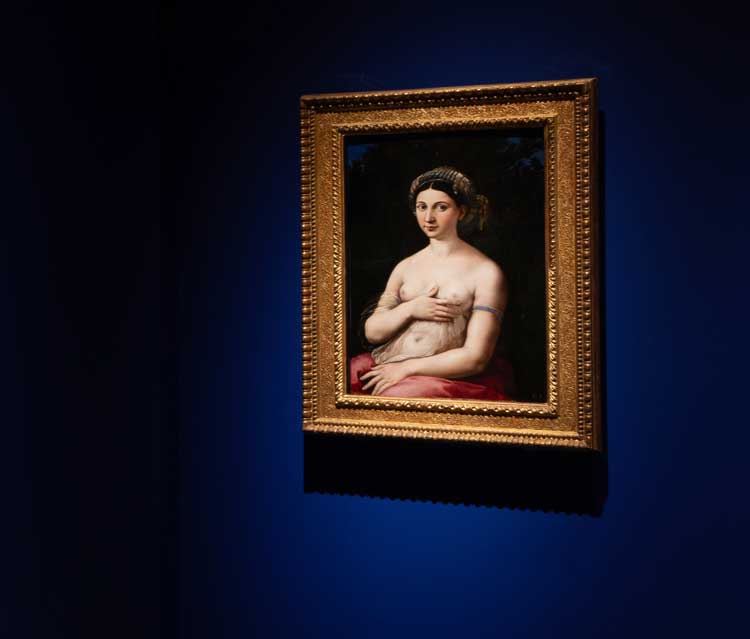
Raphael (Raffaello Sanzio or Santi), and Giulio Romano, 1499?–1546, Portrait of the Nude Fornarina (La Fornarina), ca. 1520. Installation view of Raphael: Sublime Poetry, on view March 29–June 28, 2026 at The Metropolitan Museum of Art. Photo; Eileen Travell, Courtesy of The Met.
Between 1518 and 1520, Raphael worked on another striking portrait, that of Margherita Luti, later known as “La Fornarina,” the baker’s daughter, because her Sienese father ran one. The woman dutifully served the painter as muse, model and mistress. (She may have posed for Mother Mary in The Sistine Madonna.) This erotically charged picture was not a commission: Raphael painted it purely for his own personal pleasure. Even when the lady was not physically with him, she was always near him in the studio in effigy. Fornarina, noted the French novelist Gustave Flaubert in the posthumous satirical Le Dictionnaire des Idées Reçues (1911-13), “was a beautiful woman; no need to know any more”. Nevertheless, art historians have vainly bickered over whether the picture of the dark-haired and dark-eyed beauty really represents Venus or the idealised bella donna of Italian art, or maybe even a witch. It is obvious she was the painter’s paramour. Her frankness is unsettling. Stripped to the waist, she puts her ample charms on full display as she generously offers her fair bare firm breast to the viewer. Her smile is as provocative as that of La Gioconda; and the pale complexion betrays a slight flush of the cheeks suggestive of recent lovemaking. The painter is just showing off in how beautifully he captures the translucence of the silk veil that fails to conceal the lovely upper body. About her head sits a yellow scarf, the badge of a courtesan. She points to a blue-ribbon armband commonly worn by Italian mistresses at the time; and her lover has signed it “Raphael Vrbinas” in gilt to let everyone know exactly to whom she belonged.
Raphael left the portrait unfinished in his studio; and when he died, his assistant, Giulio Romano, altered and sold it. Years later, during cleaning, X-rays revealed that Luti once wore a ruby ring on the third finger of her left hand. This token of the artist’s deep affection must have been painted over by Romano to prevent any disgrace. Italian art historian Maurizio Bernardelli Curuz has suggested that Luti and Raphael were secretly married. Also painted over behind her were myrtle and quince, symbols of romantic passion and, yes, marriage. Or was the ring an indication that they were united by a sacred love higher than any legal contract? There was just one little problem: he was already betrothed. It so distressed his friend Bernardo Dovizi, Cardinal of Bibbiena, that his beloved Raphael had never wed, he matched him up with his niece Maria Bibbiena. Raphael dared not disappoint such a powerful man, so the pair became formally engaged in 1514.
He kept putting off the wedding for six years until she died in 1520. He was still in love with the baker’s daughter. To marry someone of such low birth was scandalous and would have ruined his standing at the papal court. He could not risk it. But these fears seem not to have entirely hindered him. Vasari reported that Raphael “secretly attended other love affairs and pursued his amorous pleasures beyond all moderation”. Vasari complained that the artist “continued to pursue his carnal delights” and “was treated with too much consideration and acquiescence by his friends”. Luti supposedly so distracted Raphael from completing the frescos The Triumph of Galatea (c1511-12) and The Wedding Banquet of Cupid and Psyche (c1517) in the Villa Farnesina that Chigi had to conceal the mistress in the palace so the painter could continue working. The popular myth goes that Raphael died from too much sex with the baker’s daughter. French artist Jean-Auguste-Dominique Ingres and other 19th-century artists legitimised the legend with romantic double portraits of La Fornarina in Raphael’s arms. Picasso explored their relationship in his 1968 suite of 347 erotic etchings; and Cindy Sherman wittily posed as a pregnant La Fornarina in the self-portrait Untitled #205 (1989).
Raphael had come down with a fever, possibly pneumonia, and so exhausted himself after a night of intense lovemaking with Luti. The pope so loved him that he wept when he heard Raphael was ill and sent his physicians to treat him. Raphael did not wish to reveal his recent debauchery so they misdiagnosed his malady and fatally weakened him with bloodletting. He lingered for two weeks and was able to put his affairs in order: he made out his will, sent off his mistress with a stipend to make her an honest woman (an unusual gesture towards anyone who was not a surviving spouse), dispersed his belongings to two loyal pupils and a relative, confessed his sins, and accepted the last rights. He was 37 when he died of apparent pulmonary disease.
“Oh happy and blessed soul,” gushed Vasari of the beloved painter, “for every man gladly speaks of you, celebrates your deeds, and admires every design you left behind! When this noble artisan died, painting too might as well have died, for when he closed his eyes, painting was left almost blind”. Raphael requested that he be buried in the Pantheon in Rome. A grand procession with 100 torches carried by his fellow artists and other admirers followed his coffin, Vasari writing: “There was no artisan who did not weep in sorrow and accompany him to his tomb.” His marble sarcophagus in the rotunda reads: “Here lies that famous Raphael by whom Nature feared to be conquered while he lived, and when he was dying, feared herself to die.” Luti was so heartbroken that she withdrew from the world by entering the Convent of Santa Apollonia four months after her lover’s death. His pupils placed a plaque on his tomb in honour of his fiancee, Bibbiena. The inscription acknowledged that the girl “was carried forth as a virgin before the nuptial torches”.
Raphael remained universally acknowledged among other artists as “The Prince of Painters” well into the 19th-century. Morbid curiosity reached a climax when Pope Gregory XVI ordered his tomb be opened on 14 September 1833. For years, the Accademia di San Luca in Rome had displayed a skull said to be Raphael’s; and sceptics wanted to prove that the artist was buried where he was supposed to be. Once his remains were exhumed and authenticated, they were reinterred in a new marble sarcophagus in the Pantheon provided by the pope. But hero worship fades. John Ruskin, the pre-eminent English art critic of the Victorian age, denounced the painter in the 1840s. “To this day, the clear and tasteless poison of the art of Raphael infects with sleep of infidelity the hearts of millions of Christians,” he insisted. “It is the first cause of all that pre-eminent dulness which characterises what Protestants call sacred art.” It reeked of vile “popery”. Ruskin tolerated some of the early work, but he never forgave the painter for moving to Rome. Raphael dared to fuse paganism with Christianity by putting Jesus on one wall and Apollo on another in the papal quarters. The frescos reinforced the fact that the Roman Catholic Church was as much Roman as Catholic.
While others thought The School of Athens the height of the Italian Renaissance, Ruskin believed it marked the beginning of its decline. “The perfection of execution and the beauty of feature,” he argued, “rendered finish of execution and beauty of form the chief objects of all artists; and henceforward execution was looked for rather than thought, and beauty rather than veracity.” A group of young painters, including William Holman Hunt, John Everett Millais and Dante Gabriel Rossetti, shared his contempt for the Italian painter and formed the Pre-Raphaelite Brotherhood in protest at the rigid principles of the Royal Academy in London. They demanded a return to the aesthetics of earlier medieval art, a revival of brilliant colour, exact detail in nature, and high moral truth. Not everyone agreed. Charles Dickens responded by sarcastically suggesting that his readers “discharge from your minds all post-Raphael ideas, all religious aspirations, all elevating thoughts, all tender, awful, sorrowful, ennobling, sacred, graceful, or beautiful associations, and to prepare yourselves, as befits such a subject pre-Raphaelly considered for the lowest depths of what is mean, odious, repulsive, and revolting.” The pre-Raphaelites had their point. Raphael’s final paintings are exercises in polish and refinement. What is gained in perfection often marks a loss in spontaneity. Raphael was too perfect perhaps, even cold. Painting seemed stagnant and stale under his influence.
Raphael might have slipped into the shadows of history as Michelangelo and Leonardo were universally acknowledged as the true twin geniuses of the Italian High Renaissance. Raphael’s pretty mothers with their dimpled babies could not compete with the mysterious La Gioconda and defiant David. Cheap prints of The Sistine Madonna and The Madonna of the Chair proliferated in the last century and a half as widely as reproductions of Leonardo’s The Last Supper and miniature replicas of Michelangelo’s Pietà. They showed up in chapels, churches, schools, homes, hospitals and tourists traps to provide temporary solace for the troubled and downtrodden. They became Christmas card art. Like the Mona Lisa, Whistler’s Mother and The Scream, they were so familiar they rarely impressed. Some thought they were unworthy of serious consideration or admiration. How could something so popular be any good? The surrealist Max Ernst parodied this sort of devotional art in the blasphemous The Virgin Spanking the Christ Child before Three Witnesses (1926). All that is over. Raphael: Sublime Poetry provides a fresh reassessment of one of the greatest masters of all time. It is huge, exhausting and dazzling.
Click on the pictures below to enlarge

Copyright © 1893–2026 Studio International Foundation.
The title Studio International is the property of the Studio International Foundation and, together with the content, are bound by copyright. All rights reserved.
 |
 |
 |
|---|

-1000-300.jpg)
 Witches and Wicked Bodies
 Pre-Raphaelites – Victorian Avant-Garde
 Raphael to Renoir
 Raphael: From Urbino to Rome
 Pre-Raphaelite and other Masters: the Andrew Lloyd Webber Collection