



-Lucy-Jorge-Orta-Photo-Finn-Beales.jpg)
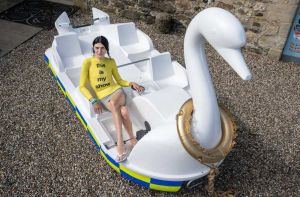
BorderLands, Lucy + Jorge Orta, Antarctica, 2015, installation view. Photo: Finn Beales.
Hay Castle, Hay-on-Wye
15 May – 31 August 2026
by DAVID TRIGG
The construction of borders is as ancient as human civilisation itself and important to maintaining the identity, security and prosperity of a nation. Yet national borders are also seen as structural barriers to freedom, causing exclusion and discrimination. The picturesque market town of Hay-on-Wye lies on the Welsh side of the ancient Wales-England border, its proximity to England resulting in strong English influences, a Hereford postal code and much confusion among outsiders as to which country it belongs. The liminal nature of the town provides an apt setting to consider the complex nature of territorial boundaries, locally and globally. Presented by Meadow Arts, Borderlands is an ambitious exhibition installed in and around Hay Castle that features more than 20 artists whose works explore the personal, cultural and political dimensions of borders.
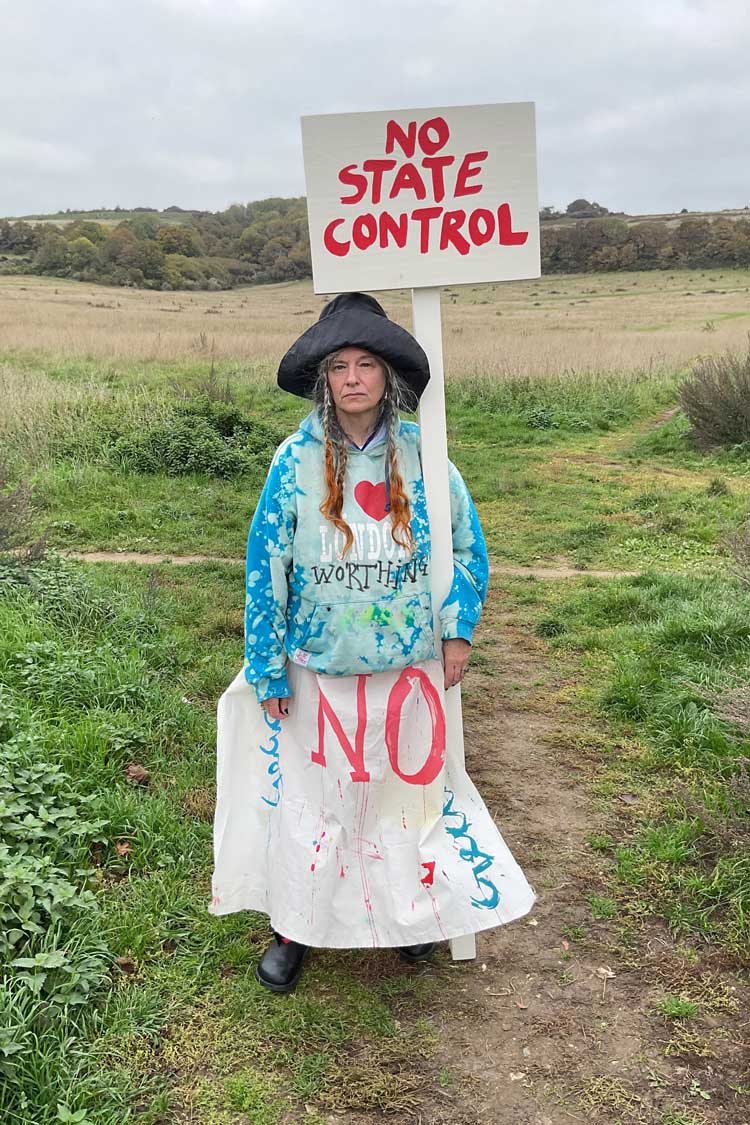
Delaine Le Bas, No State Control, photographed in Findon, West Sussex (after Horace Poolaw’s Trecil Poolaw Unap, Mountain View, Oklahoma, 1929). Photo: Lincoln Cato/Courtesy the artists.
There is an increasingly vocal movement challenging the authority of the nation state to restrict where people live, work and find refuge. This sentiment is reflected by several works in the exhibition, including Delaine Le Bas’s self-portrait No State Control (2026), in which the artist holds a placard expressing her resistance to state-imposed barriers. Elsewhere, Hilary Jack’s striking neon text installation No Borders (2026) appropriates the words of pioneer aviator Amelia Earhart: “No Borders, just horizons, only freedom.” Earhart was the first woman to fly solo across the Atlantic and her bird’s eye view of the world led her to champion boundless ambition and personal liberty. Jack’s work, which suggests that human spirit should be encouraged to soar by transcending the limitations of national boundaries, is installed in a part of the castle open to the sky – a roofless space that resonates perfectly with Earhart’s words.
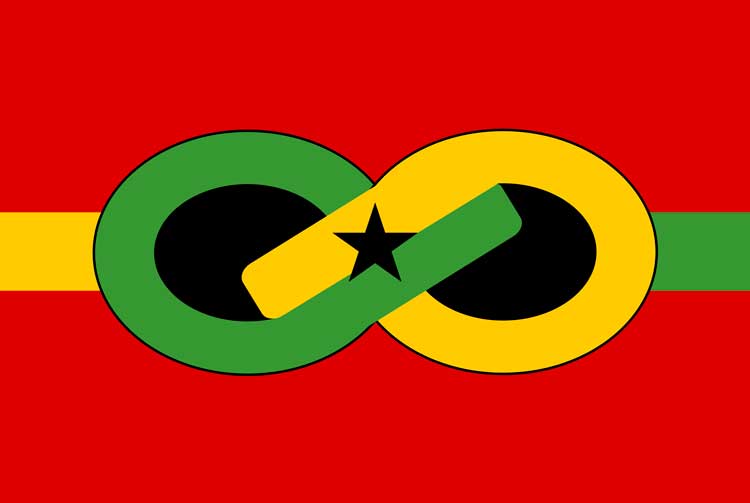
Larry Achiampong, Siblinghood, 2025.
Acting as visible markers of territory, flags are a way in which borders can be physically and symbolically denoted. Here in Wales, you might expect to see the Welsh national flag (Baner Cymru) flying proudly from Hay Castle’s medieval keep. Instead, fluttering above our heads is Larry Achiampong’s vibrant Siblinghood (2025) from his series of Pan African flags responding to the African Union’s efforts to allow freedom of movement for citizens across the world’s oldest inhabited continent. Resembling a highly stylised infinity sign in the Pan African colours of green, black, red and gold, the flag speaks to notions of unbounded potential through unity and freedom.
Lucy and Jorge Orta’s Antarctica Flag (2007-09) amalgamates a plethora of national flags, with individual designs blurring and blending into one another. The patchwork flag was originally flown in Antarctica – the world’s only politically neutral continent with no government or sovereign borders. Here, it hangs from the rafters as a supranational emblem of human solidarity. Below this is a pair of dome-shaped tents inspired by nomad shelters and assembled using traditional tent-making techniques. Adhered to each one are items of clothing and various world flags, many of which are printed with text excerpts proposing an amendment to the UN Declaration of Human Rights allowing everyone the right to “move freely and cross frontiers to their chosen territory”. These activistic tents were also exhibited in the Antarctic, which begs the question: why does the only continent on Earth without national borders also happen to be the most inhospitable?
While the idea of a borderless world seems preferable to hostile immigration policies, both positions are rooted in a naive belief that the erasure or, conversely, the strict enforcement of borders can engender utopian social conditions. That tension is felt in Leo Fitzmaurice’s Arcadia (2007), a series of road signs installed around the grounds of Hay Castle, declaring the site a mythological paradise. While Fitzmaurice’s signs predate the 2016 British referendum on EU membership by some years, they evoke the promises of Brexiters and Remainers alike. Indeed, the shadows of Brexit, the Scottish independence debate, and many current border conflicts loom large over this exhibition.
Although the Wales-England border is highly porous, the Welsh language road signs make it easy to know when it has been crossed. Welsh national identity has evolved significantly since devolution and Peter Finnemore’s Lesson 56-Wales (1997) speaks to the nation’s fraught history, focusing on the former subjugation of the Welsh people by the English. Comprising pages from his Welsh-speaking grandmother’s school textbooks, the work reveals how Welsh identity was suppressed via an English-centric version of history. Look closely and you will see a child’s attempt to humorously undermine the prejudiced text. Addressing the history of the Welsh border is Iwan Bala, whose text heavy, diagram-like works on paper reference the abundance of fortresses in the area. The lively drawing On the Borderlands (2026), created for the exhibition, references the Welsh Marches and the historical Anglo-Welsh battles along the nearby border.
Inviting us to consider borderlands as places of interaction and exchange rather than division and exclusion, is Maya Rose Edwards. The artist has worked with local communities along the Wales-England border to explore belonging and rural identity. One workshop involved the creation of local handmade town maps scrawled with idiosyncratic landmarks, while another led residents on a “beating the bounds” walk – an ancient custom practised before reliable maps were commonplace in which participants walked their local parish boundaries while swatting landmarks with sticks and branches to maintain a shared mental map of their territory. A video documenting the convivial ceremony plays in the castle’s Great Hall. Intriguingly, many of the residents with whom Edwards worked define themselves as neither Welsh nor English, but as people of the borderlands – a richly ambiguous local identity that pays no heed to the conflict and conquest that once defined the area’s border.
Also in the Great Hall is Edwards’ imposing sculpture Out of Bounds (2026), a full-sized hedge incorporating hazel sticks seen in the film and made in collaboration with a master hedge-layer. Hedgerows have a long and chequered history in Britain; while they are now protected and cherished for their ecological and cultural value, they were once central to huge political change, agricultural revolution and even violent uprisings. Yet today they are considered a quintessential feature of the British landscape, integral to our national identity. Edwards’ hedge alludes to this tangled history, presenting itself as a physical barrier but also a record of collective movement and shared connections that transcend rigid borders.
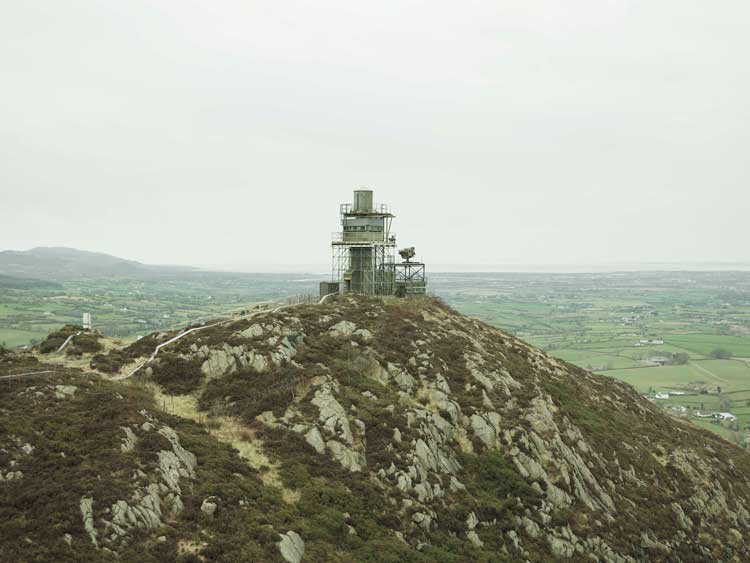
Donovan Wylie, Golf 40 Watchtower, South-East View, South Armagh, Northern Ireland, 2007.
As many of the exhibition’s most compelling works remind us, borders are not simply lines drawn on maps; they are complex political, social and psychological mechanisms of differentiation. Sometimes they can become heavily militarised zones as in the violent sectarian conflict in Northern Ireland, where the border with Ireland evolved from a partition line into a site of continual surveillance. Watchtowers were once a looming presence in the country’s landscape, as captured by Donovan Wylie, whose photograph Golf 40 Watchtower (2007) documents a highly fortified military observation post on Croslieve mountain in South Armagh. Such unsettling and incongruous structures, known as “sangars”, intimidated the locals in much the same way as the fortified castles of the middle ages.
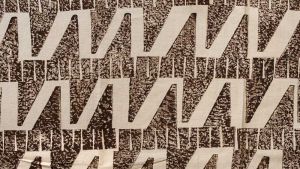
Another watchtower emerges from mist in Sally Payen’s painting Cross Stitch Through the Dirty Page of History (2017). Beneath the tower, a mesh security fence resembling cross-stitch embroidery makes poetic reference to the Greenham Common Women’s Peace Camp, where protesters attached crafted or knitted objects and banners to the perimeter fence that became the focal point of the nearly two-decade protest. The notion of surveillance also permeates Henna Asikainen’s Future Pasts (2023), a film in which immigrants carrying placards along Hadrian’s Wall are recorded by a drone. The Roman wall was constructed in about AD122 to keep out the “barbaric” tribes in the north while the Romans “civilised” the inhabitants of the south. In Asikainen’s film, the ancient border becomes a metaphor for contemporary political and social concerns, highlighting the propensity to erect barriers – physical or otherwise – that attempt to exclude people and things perceived as “other”. One placard reads “We are here, our hearts are there”, speaking to the tensions and internal conflicts experienced by those who have been subject to forced displacement.
At a time of escalating political tensions around borders and national identity in the UK and globally, BorderLands feels timely. Its strongest works prompt us to consider our place in the world, our shared humanity, and what it might mean to navigate our own borderlands.
Click on the pictures below to enlarge

-by-Sally-Payen.jpg)


Copyright © 1893–2026 Studio International Foundation.
The title Studio International is the property of the Studio International Foundation and, together with the content, are bound by copyright. All rights reserved.
 |
 |
 |
|---|
-1000-300.jpg)