Compton Verney, Warwickshire
19 September 2026 – 21 February 2027
by SABINE CASPARIE
The night is a time for darkness, mystery and magic, but Raqib Shaw: Night Sonnets surprisingly opens with a gorgeous, luminous landscape full of saturated colour. In wall-sized painting The Dream (2018-22), half the composition is taken over by a cherry tree in full blossom, foregrounding a lake and snowy mountain caps covered in spars the colour of a Caribbean sea. A herd of deer bathes in a stream or grazes the turquoise grass; some look up, as if our entry into the gallery has momentarily perturbed them. The whole scene is bathed in the light of a fat, full moon. There is such purity and innocence in this Edenic landscape that it is almost too much, until I spot the figure sitting under the cherry tree, with an intricately patterned cloak floating around him like another small lake. He is writing, one dog sitting on his lap and another one standing next to him. It is a quirky nod to the present day, adding a welcome element of bathos to the sublime, fantastical landscape.
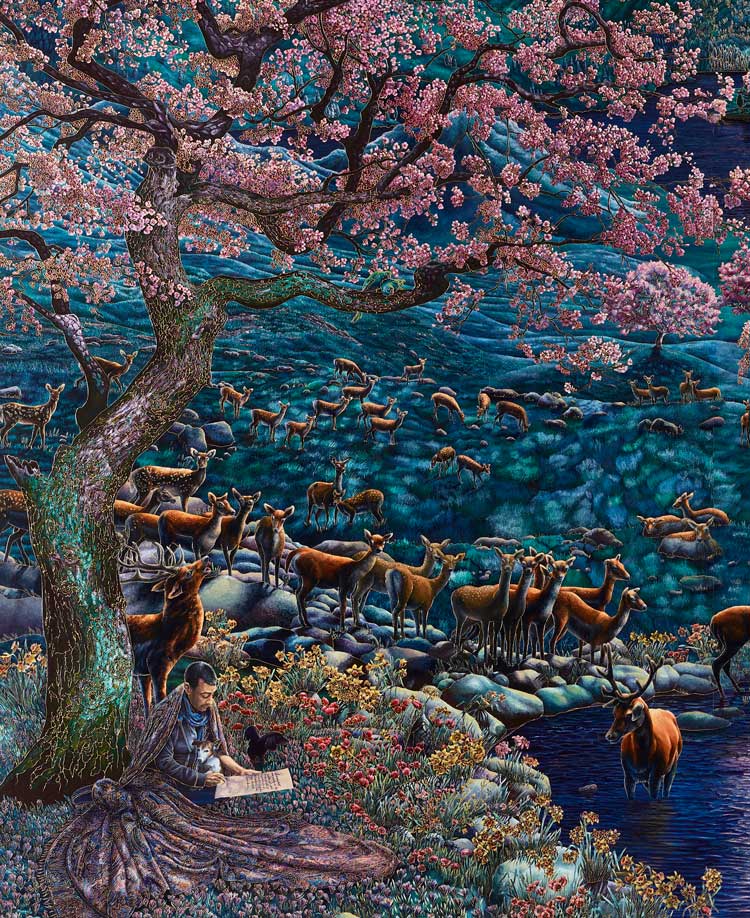
For Shaw, the exhibition text states, the night is also the time in which he often works, his laboursome paintings requiring the utmost attention and concentration. Every element in The Dream – flowers, tree bark, deer, the man’s cloak – bears Shaw’s distinctive raised outlines made from acrylic liners, inside which he has poured car enamel, manipulated using a porcupine quill. The cherry tree is perfect for showing off Shaw’s mastery of paint, with its thousands of tiny pink flowers shimmering like raindrops on the branches, the paint laid on like an intricate layer of tiny mosaic stones.
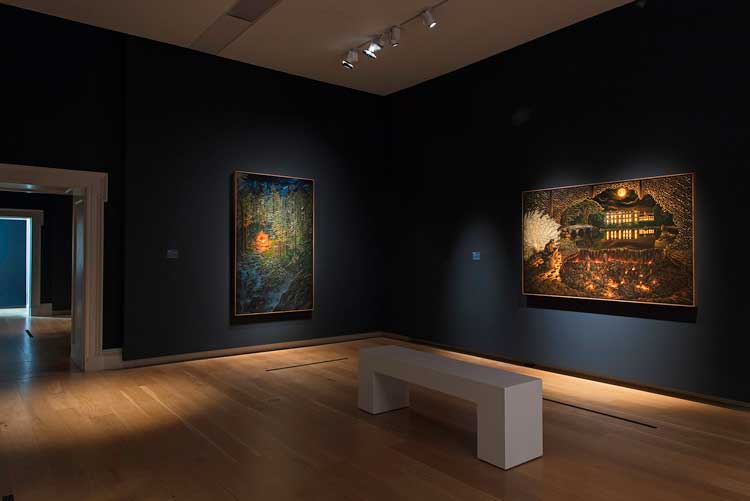
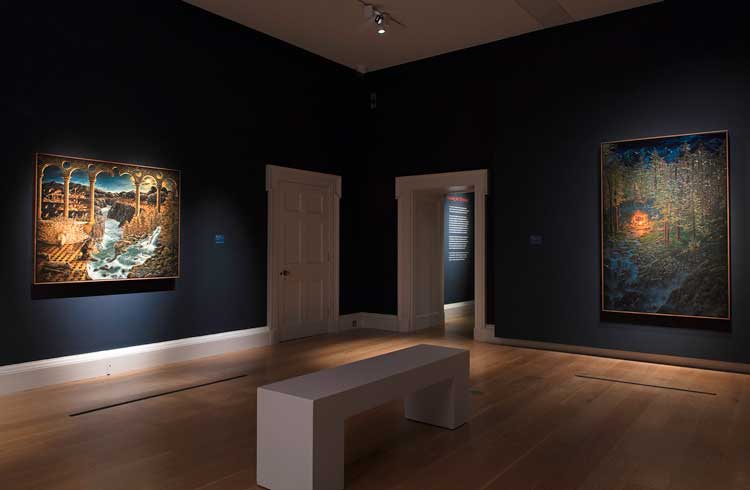
In the second gallery, the colours turn darker. The Scryer (2026) renders the landscape one layer removed, through a broken lattice, an architectural construction that reappears in the other paintings in the room. Here, it frames a lake and a large mansion with all its windows lit. The ornamental bridge and the two sphynx statues suggest it is Compton Verney; as the artist wrote in an Instagram post announcing the opening of the exhibition, it is his “favourite museum amongst the beautiful grounds landscaped by none other than the great Lancelot ‘Capability’ Brown”. In the midline of the painting, the ground pivots: the lattice frame turns into an ornamental floor and the lake into a waterfall, gushing on to an underground city, burning. The mirroring of shapes, patterns and light is outstanding, with the clever use of golden light coming from the actual light sources in the paintings: fire, lit windows, oil lamps, the moon. Its palette and golden light recall Rembrandt, except that in Shaw’s paintings it is not the people, but the landscapes that are lit up and shown in all their rich expression.
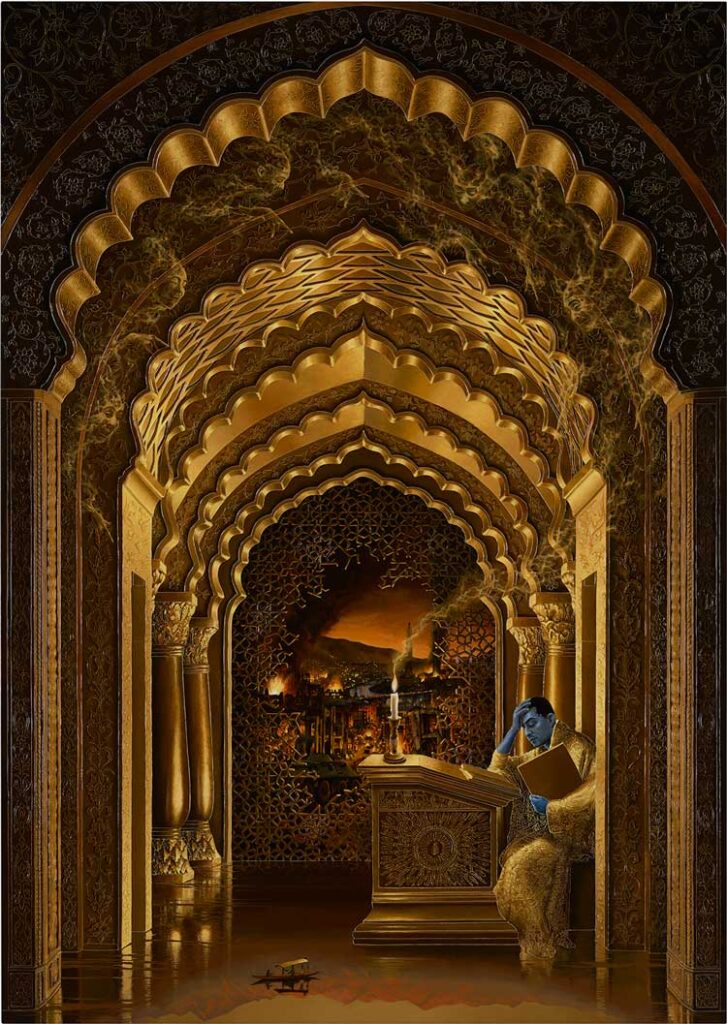
The lone figure is present in all Shaw’s paintings. It is clearly an alter ego, accompanied by his dogs and with his taste for flamboyant clothes, although it could also be seen as any human being living in our day and age, witnessing what is going around. Sometimes its presence is too self-indulgent. The Galvanised Scribe (2026) wallows its own grandeur: a blue-coloured, saint-like man behind his desk in an opulent golden palace, his pose reminiscent of Renaissance paintings of Jerome at his desk.
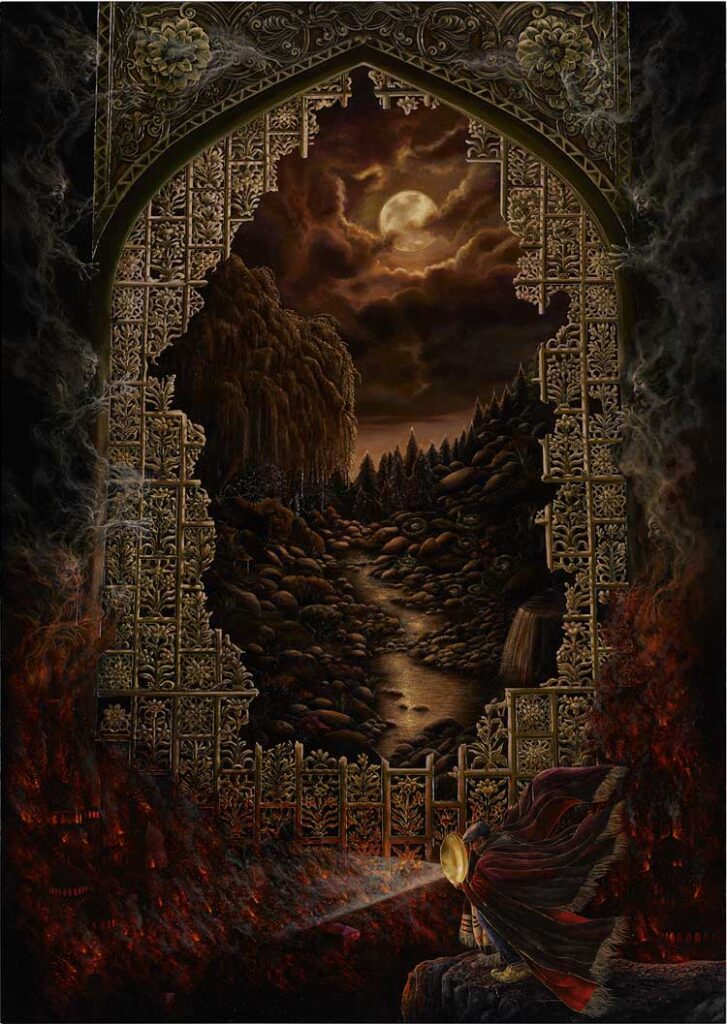
The Blind Empiricist (2026), with its moody shades of gold, dark brown and red, works much better as a composition, showing off Shaw’s incredible spatial eloquence. The smoke of another burning city dissolves into eerie ghost-like forms, swarming the golden arches; the different spatial plains dissected by the broken lattice like a knife slicing through a cake. Here, the kneeling figure with their small oil lamp is more self-aware; a humorous meta-narrative of the artist inside their own work, lighting a detail of their composition for us.
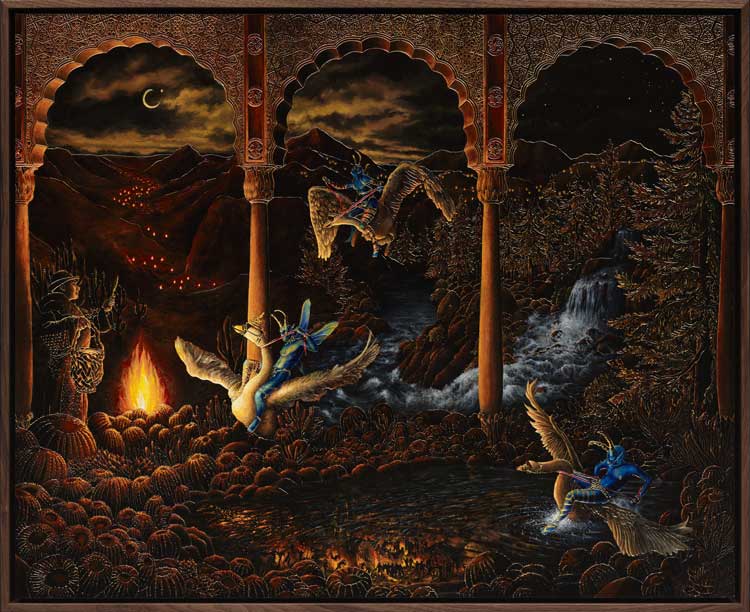
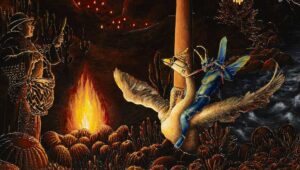
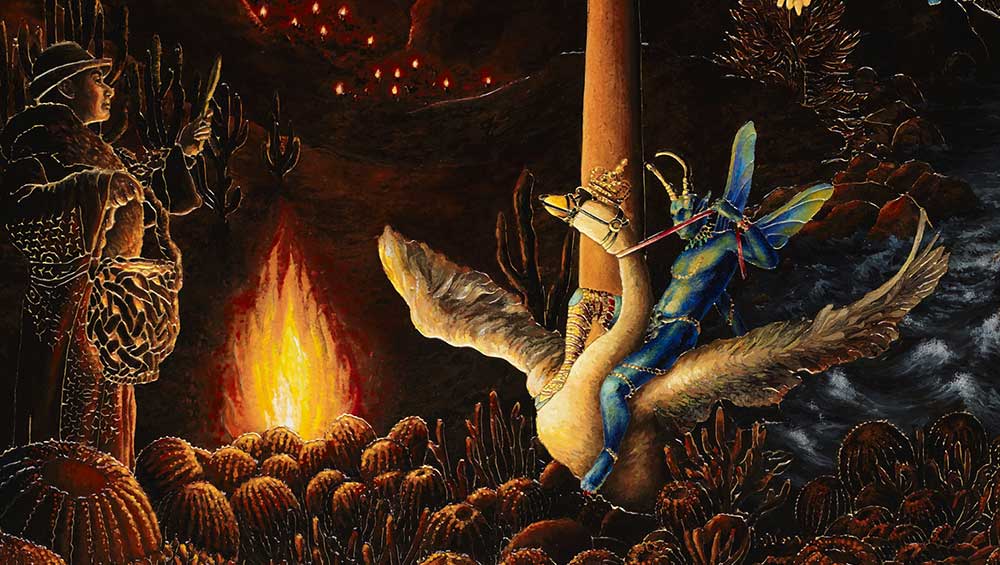
Shaw’s work is monumental and cinematic, with the interesting result that his paintings recall old masters and contemporary films. The frames breaking into pieces reminded me of Christopher Nolan’s Inception; the deep-blue human-insect hybrids riding crowned swans In Echoes Over Arabia III (2025) recall James Cameron’s Avatar (according to the catalogue for the exhibition Raqib Shaw: Reinventing the Old Masters, at the National Galleries of Scotland, the blue colour is a reference to the Hindu god Krishna, referencing Kashmir, where Shaw grew up).
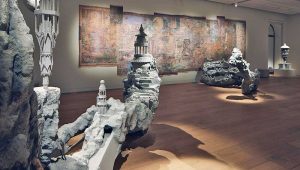
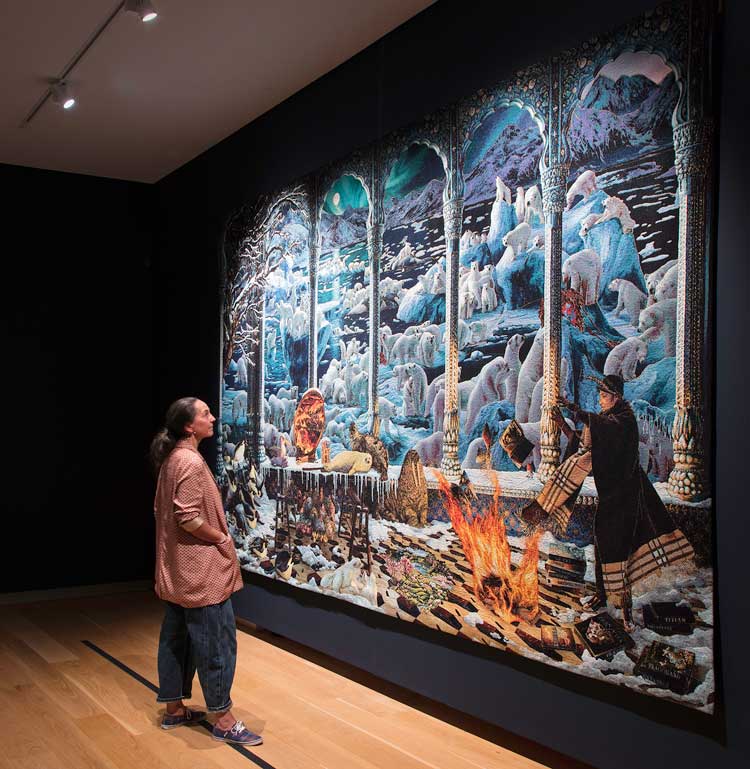
The exhibition ends with another monumental work, The Pragmatic Pessimist (2024), a tapestry. It functions as a counterpart to the lush, fertile landscape of the first painting, The Dream. Ice bears huddle together on the last remnants of ice, while the lone figure, dressed smartly in Burberry, is burning art books to stay warm. This is Shaw’s most imaginative scene, with its richness of detail, its subtle ecological message and its references to Pieter Bruegel the Elder and Hieronymus Bosch, but after the exquisite, jewel-like texture of the paintings, the medium of tapestry falls, quite literally, flat.
Shaw’s work is as hard to pin down as the artist himself (he was elusive when approached for an interview): the cutting-edge fashion intersecting the old master-inspired compositions; the storytelling combined with a sense of the sublime; the apocalypse served with a dose of humour. But there is something very appealing in the ambiguous, the strange and the unknown in our hectic 21st-century world of information overload and oversharing of personal space. “There is certainly something to be said about a man who plants trees for the future generations, knowing that he will never enjoy their shade nor admire their majestic beauty,” Shaw wrote about Capability Brown, “and perhaps something to remind artists of our time about their duty to the yet unborn.” In Scryer (2026), a white peacock stands behind the lone, kneeling figure, flaunting its feathers as if beauty alone could save the destruction of the burning city. Shaw seems to propose that it just might.