Mimosa House, London
9 October – 5 December 2026
by BETH WILLIAMSON
Mira Schor (b1950, New York) is an artist, writer and educator with a long-established international reputation for her contribution to feminist art history and critical discourse. With books such as Wet: On Painting, Feminism and Art Culture (1997) and A Decade of Negative Thinking: Essays on Art, Politics, and Daily Life (2010), her presence in art historical and art critical writing globally is a given. Her painting, however, is another matter. Her work has rarely been exhibited outside America and it is astonishing to note that this exhibition at Mimosa House in London is Schor’s first solo presentation in a UK publicly funded gallery. Wet/London is shown here as a historical corrective, if you will, addressing that lack of exposure for Schor’s work beyond the US. It also stands as an intervention in the present day, a political stance that highlights feminist knowledge and visual languages at a time when far-right views aim to legitimise misogynistic views and violence against women.
The exhibition includes painting, drawing and other works on paper from across Schor’s long career from her time as a student on the Feminist Art Programme at the California Institute of the Arts (CalArts) in the 1970s (where she studied with Judy Chicago and Miriam Schapiro), through to the present day. Schor graduated with an MFA in 1973, and her painting worked to celebrate and dignify the corporeality of paint through nebulous bodily compositions. As she explains in the introductory text to the show (originally published in Parkett No 37, 1993): “I am interested in the return of visual pleasure as a feminist intervention in painting. I bring a feminist analysis of my own body experience, of political events, and of art history, to painting, using visual language not just to illustrate temporal political battles but also to offer an empowered, expanded example of what a feminist gaze would produce.” There is a lot to unpack there and this relatively small show does a good job of exploring the full range of Schor’s work and ideas.
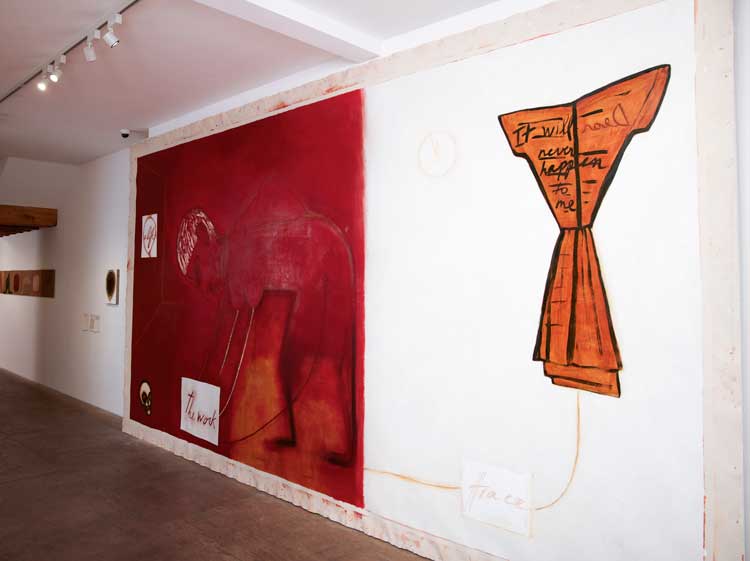
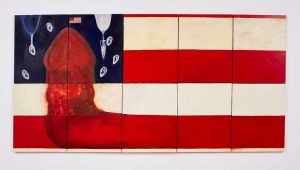
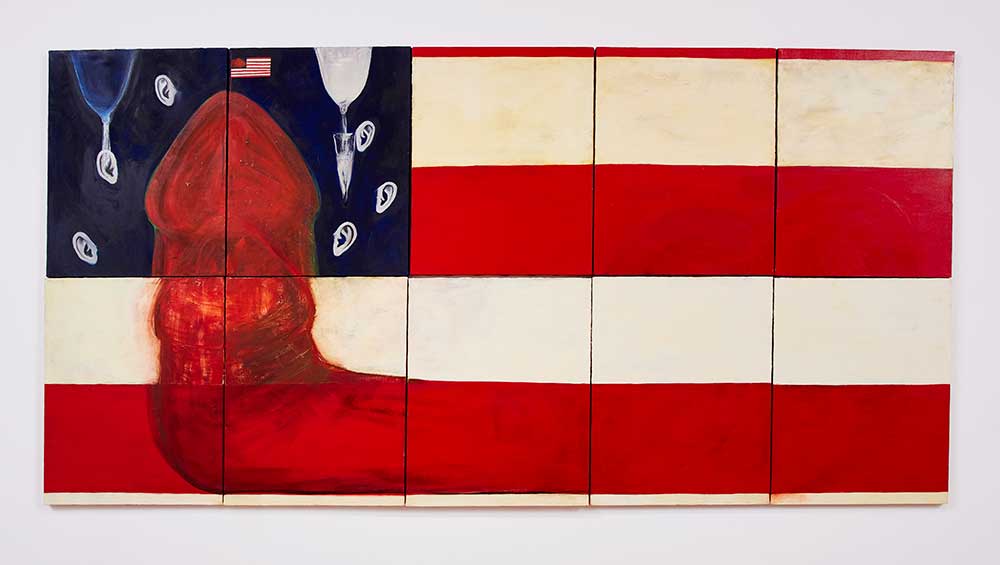
Visitors to Mimosa House are immediately faced with her painting The Work (Red Studio) (2021). In this reinterpretation of Henri Matisse’s The Red Studio (1911), Schor places the female artist (herself) at the centre with representations of some of her own paintings. In this way, Matisse’s focus on the female nude is shifted to make space for Schor’s figure of the woman engaged in making. On the opposite wall, in For Which It Stands (1989), an American flag houses an enormous red penis within its colour fields. Its stars are replaced with ears. The ear becomes a point of entry through which patriarchal power is absorbed and perpetuated.
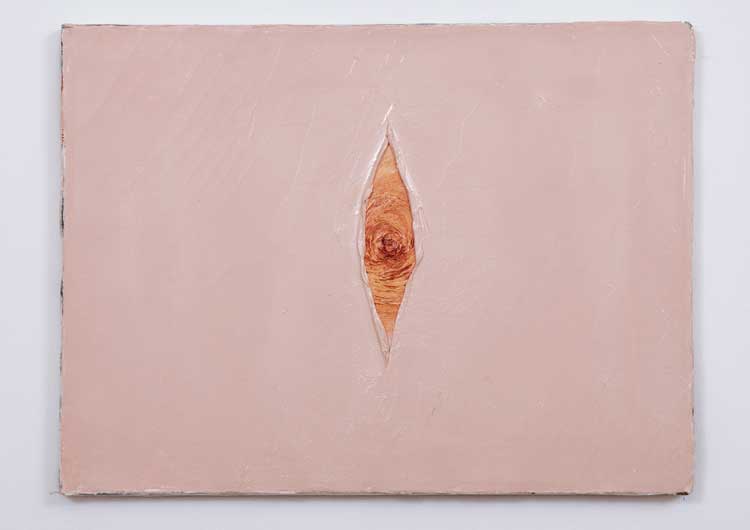
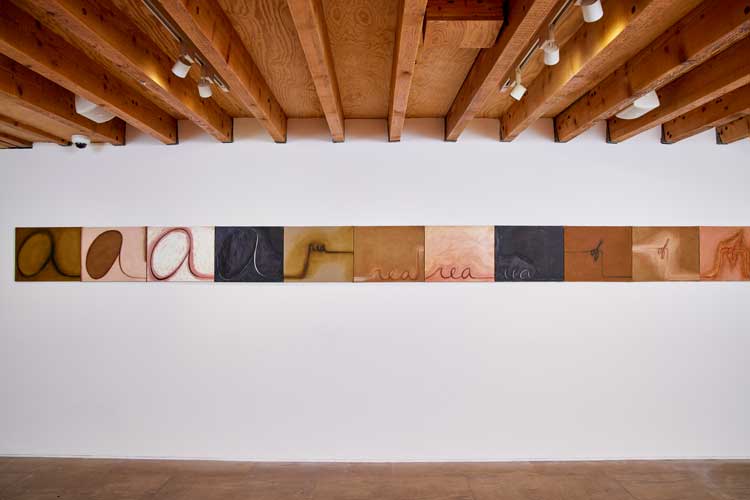
The 16 canvases and more than eight metres that make up Area of Denial I (1993) really require close looking. Schor came across the phrase in relation to the Gulf war, referring to a weapon that denies oxygen below an explosion zone. Schor associates the phrase with the female body and with painting’s contested place in feminist debates of the 1980s and 90s. Elsewhere in the downstairs gallery space, Untitled (Nipple Under Flesh) (1994) and Cunt Semi-Colon (1993) evoke flesh in different ways, both through the thickness and texture of the paint and through anatomical similarity. The latter is especially interesting since it subverts what would more usually be a sexual image by inserting a semicolon suggesting the hesitation or imminent emergence of language.
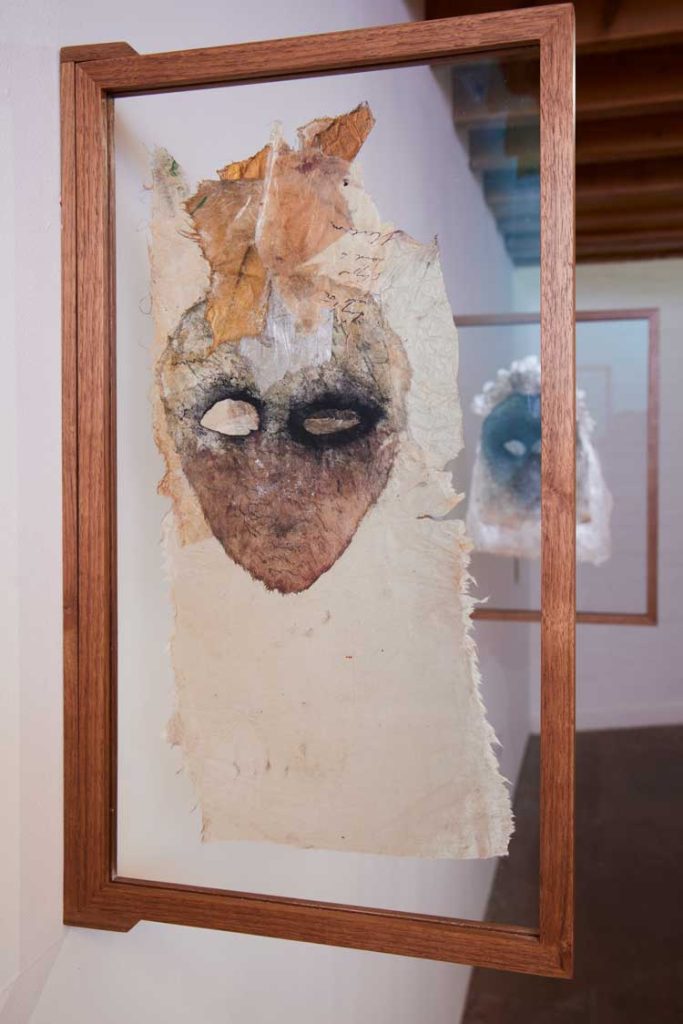
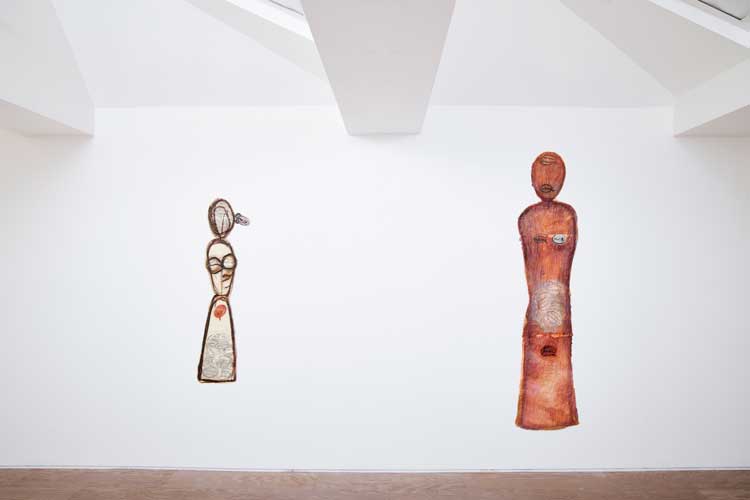
In the mid-70s Schor used rice paper to make translucent mask works that are shown to great effect in double-sided frames hinged to the wall. Veiled Mask (December 16, 1977) and Mask, both made in 1977, take the form of translucent elongated mask forms with holes for eyes. Some in this series also have openings for the mouth. These were developed from her artist’s book, Book of Pages (1976). Passages of text are handwritten across the masks, sometimes visible and sometimes overlapped or hidden completely beneath pigment. Only fragments are ever legible. Schor was interested in “enacting in the artwork the fact that women are filled with language”. More recent masks adhere directly to the gallery wall: Mask (Clamshell, May 3), Mask (#13 Treasure Yield, March 2), Mask (Banned Word: “Queer”), Mask (book) and Mask (Banned Words: Equality, Equity, Exclusion, Female, Gender, June 1), all made in 2025. The practice of working with thin Japanese paper and ink and filling faces with language and extends into figures with Dress “Women” and Womb of Banned Words, also from 2025.
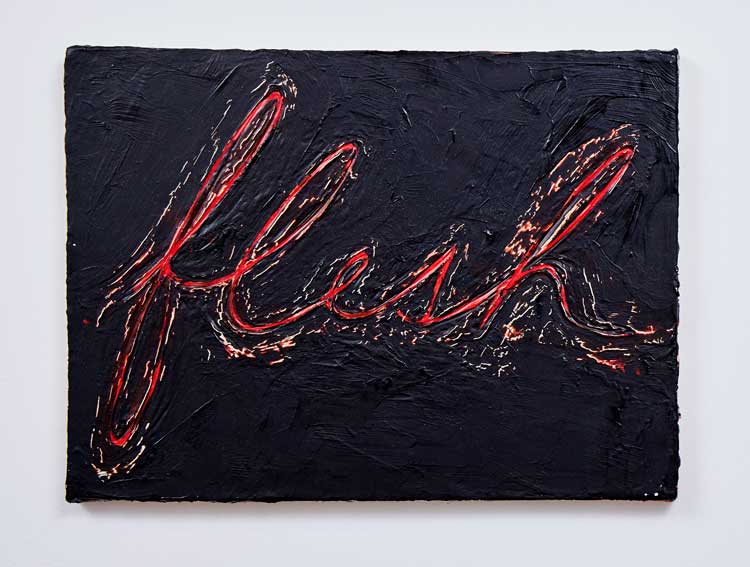
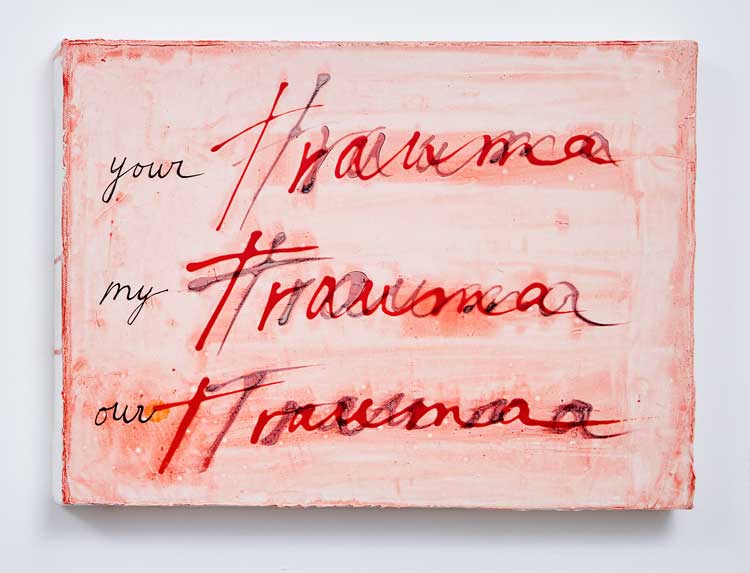
In Schor’s later word paintings Flesh (2017) and Trauma 3 (2022) hit hard. The density of the paint and the intensity of the colour lends a hard edge to how these words land in the eye and mind of the viewer. In Flesh, the word scrawls cursively across the canvas. In looping lowercase letters, the deep red scratches through the black ground. Finer pale marks in pink and white follow the shape of the deeper red script like a shadowy tremor and evoking the sense of the word painfully inscribed upon the body. Trauma 3 uses a different colour pallet to similar effect. This time, the painting recognises the shared trauma of the Covid-19 pandemic but acknowledges the individual experience through changing pronouns. Moving from “your” to “my” to “our” takes us to a collective condition and a shared responsibility for one another.
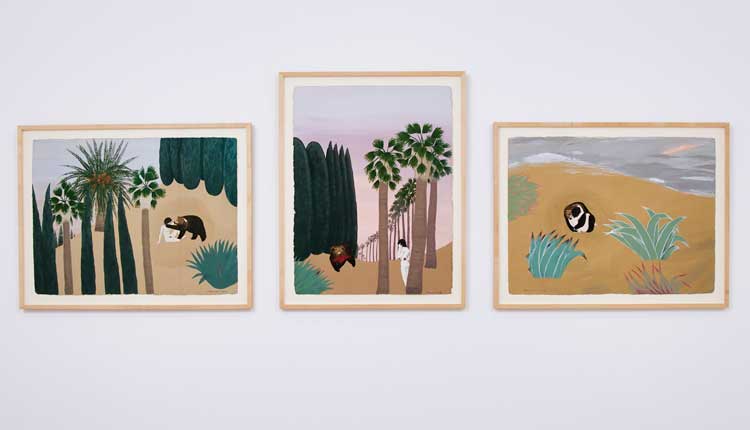
The early paintings from the 70s while at CalArts are something of a surprise. These figurative landscapes, such as Bear Triptych (1972-73) and The Two Miras (1973), bring lived experience into dream-like narratives. Sexual, psychological and artistic development unfold in paintings that take their cue from all sorts of sources, including early Renaissance painting, surrealism and Rajput Indian miniature painting and poetry. Goodbye CalArts (1972) is particularly personal, as Schor depicts herself partly unclothed and among the school’s community including teachers and students.
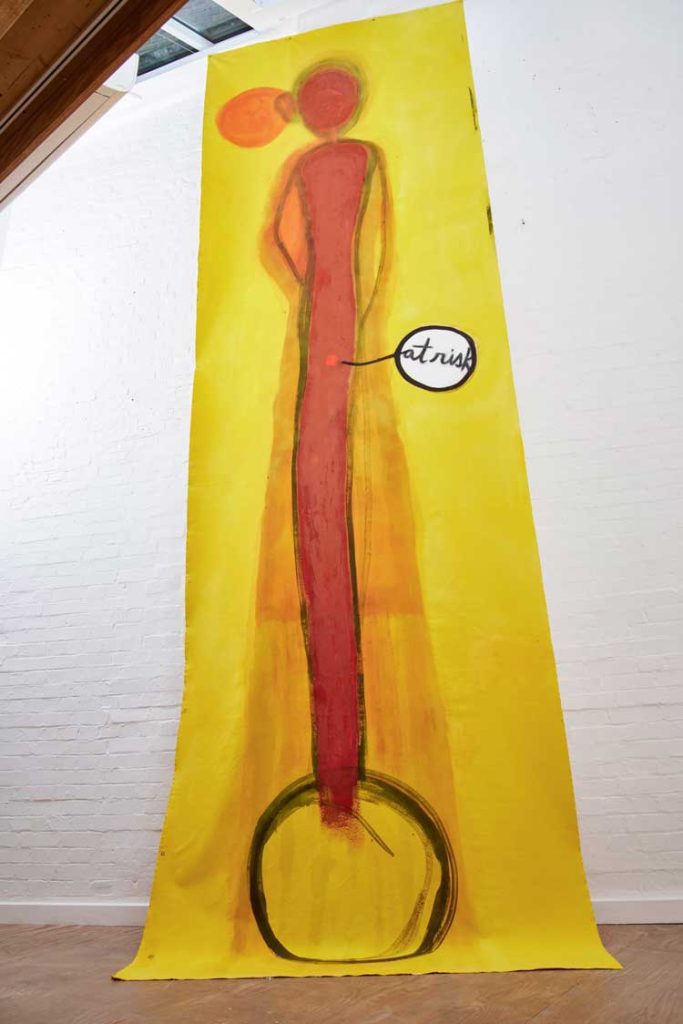
The most recent work in the show is a new work, At Risk (2026), created for Mimosa House’s disused fireplace wall. This elongated figure, almost six metres high, stretches from floor to ceiling. The title refers to Trump’s list of banned words and, following the overturning of Roe v Wade in 2022, directly confronts the use of state power over women’s bodies. In this way, Schor transforms the body subjected to regulation into a body that speaks out against it. What this suggests, to me at least, is that Schor still recognises many of the same sorts of inequalities she began addressing 50 years ago. There is, then, still a place and a need for feminist art that confronts and speaks out fearlessly, as Schor’s does.