Studio Voltaire, London
7 October 2026 – 10 January 2027
by BETH WILLIAMSON
I first came across Katherine Hubbard’s work in book form when Loose Joints published The Great Room in 2025. The book contains a series of photographs that Hubbard created in collaboration with her mother, Antonette Berger. The book was begun in 2020 in the context of the Covid-19 pandemic, when Berger began to experience memory loss and was diagnosed with LATE, a degenerative brain disease that imitates the symptoms of Alzheimer’s. I was drawn to The Great Room and its photographs as my mother had recently been diagnosed with Alzheimer’s and vascular dementia. Conversations became more difficult and my mother lost language and understanding, and other forms of communication such as visual and tactile exchanges became more important than ever. The book felt increasingly meaningful to me: not my experience, but one where I could recognise the experiences of visibility, grief and illness.
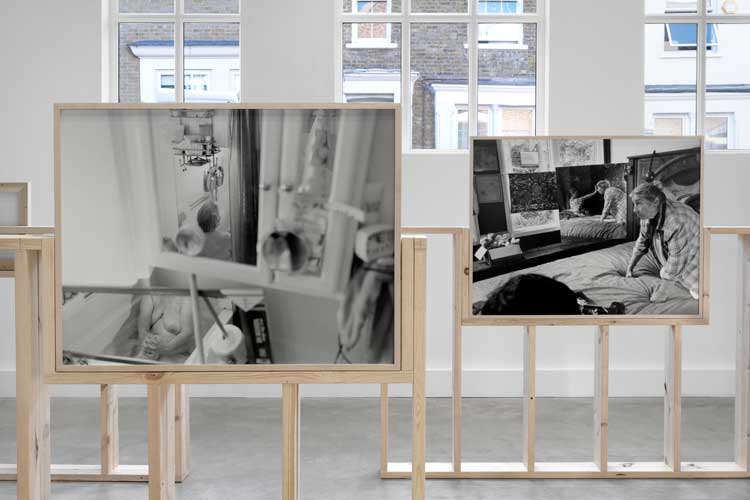
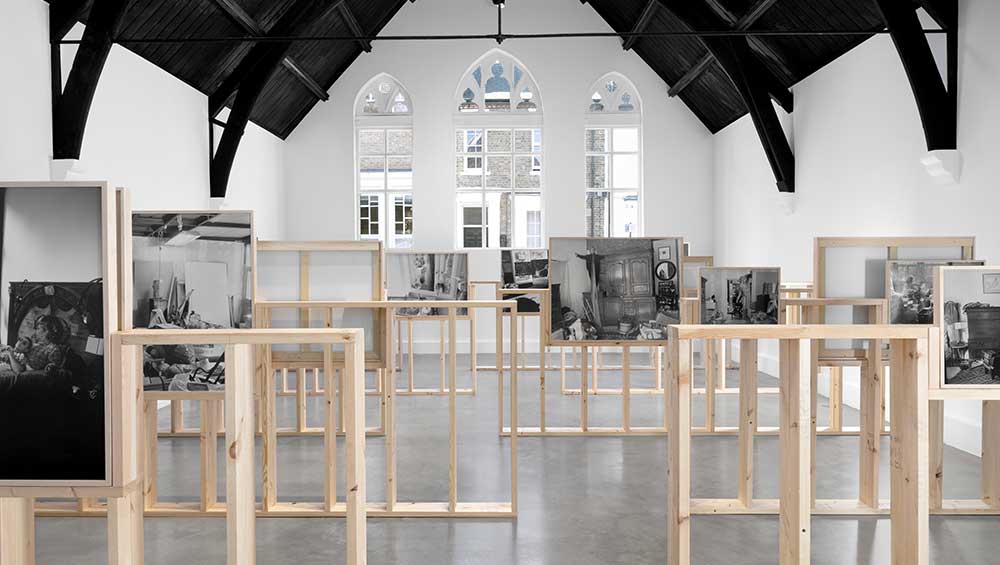
When news came of the exhibition of the same name at Studio Voltaire in London, I felt an overwhelming desire to spend time with the images in the gallery space, to get up close in a way that the book format does not enable. I should perhaps explain that. The book does enable an intimate and personal engagement with the images, of course. In the gallery, however, the large scale of the images and the intelligent use of architectural installation in the historic space allows for a more open engagement, a visibility of these sorts of illnesses and relationships that somehow validates the complex and challenging emotions that surround such experiences and holds them up for a more sympathetic and honest examination under Hubbard’s lens. The relationship between mother and daughter, between photographer and subject becomes public. Hubbard’s sensitivity to the history of the gallery space is important here too.
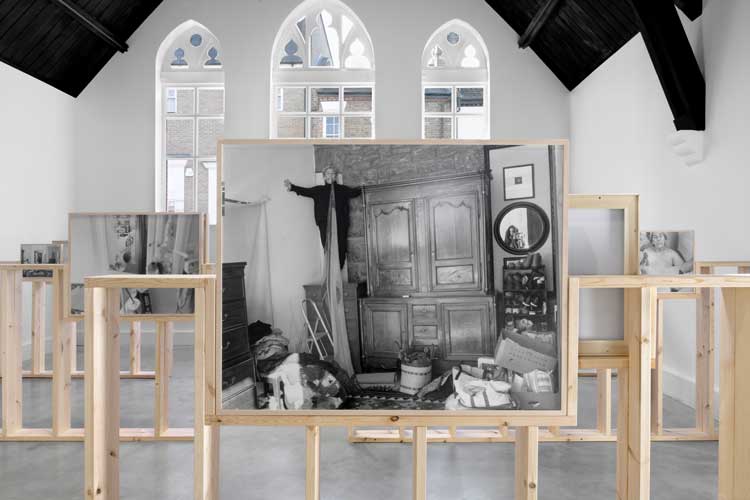
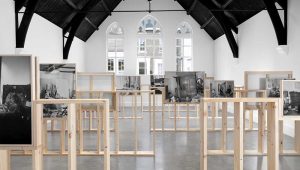
Acknowledging the chapel architecture, Hubbard installed rows of offset open wooden frames to hold up the images. There are several things worth saying about this approach. First, it gives a sense of Hubbard and Berger being held by a supportive community. It also echoes the image of a religious community holding up Bibles in the space, although Hubbard explains she was brought up in the Quaker tradition, which would imply a rather different spatial arrangement. The wooden battens also reference the incomplete stud wall that Berger built across the room known as The Great Room in her home.
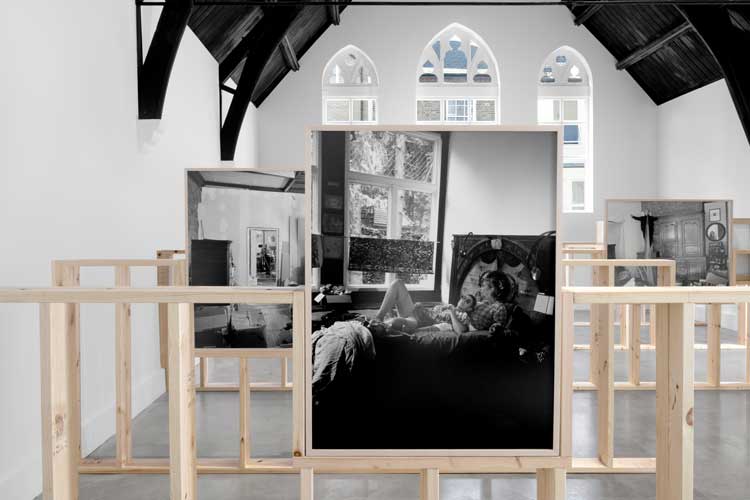
There is a lot to say about the photographs themselves. Hubbard is always mindful of Berger’s agency and voice. Most of the images were made using two large format 4×5 film cameras that moved through the house, companions to daily tasks such as bathing, packing, cleaning and watching TV. As the time came for Berger to move from the house to a care facility, the contents of the house were gradually packed up and the context changed from one busy with the presence of material possessions to another, increasingly devoid of objects and leaving just the architecture and space. This stripping back lends an increasing clarity to the figure(s) in the photographs, not only visually, but emotionally. The collaborative process of making images is one of a relationship that evidences care. Hubbard explained: the process as “using photography to enter my mom’s world as a kind of balm and relief from all the feelings born from needing her to remain in this one”. Berger also takes on the role of photographer at points and so the relationship of photographer and subject is reflected equally on Hubbard and Berger. Their mutual trust is particularly evident in One Fifty One (lying down) (2021), where mother and daughter lie atop the bed, close and completely relaxed, as conveyed by slackness of Berger’s left arm and hand. In One Fifty One (Antonette) and One Fifty One (syzygy), both from 2022, bathing scenes where daughter bathes mother, communicate a degree of vulnerability that could only be present within conditions of complete trust.
Half a dozen or so mirrored doors uncovered in the house were fixed to mobile frames and wheeled around as props for the women’s photographic collaborations. Reflecting bodies and architecture back and forth in sometimes unexpected conjunctions. In One Fifty One (2021), the performative nature of the image is evident as Berger stands atop a dresser, arms outstretched and gripping a large textile in her teeth. Over to the right, Hubbard can be seen with her camera, looking at her mother, and reflected in a small round mirror. In One Fifty One (the great room) (2022), Berger takes charge of the camera, visible through doorway with her left hand resting naturally on the shutter release.
Later images such as One Fifty One (pendulum left) (2025) show an almost empty space with just mirrors present and an ethereal air. In One Fifty One (double fisted) (2025), Berger and Hubbard both wear outdoor coats and Berger clings to her scarf with both fists, gazing off into the distance and finally taking leave of her home. The two women are deeply connected here, yet the underlying message is one of loss.
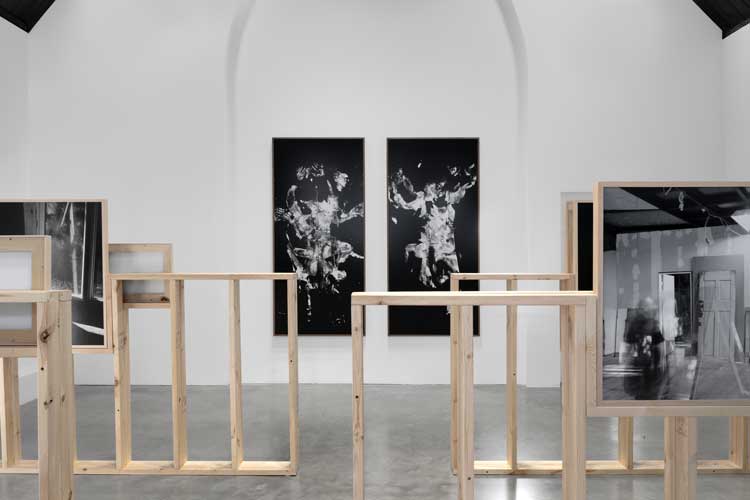
As well as using cameras, Hubbard made experimental monoprints made in the darkroom. Using the imprint of Hubbard and Berger’s skin covered in Vaseline, they made contact prints on silver gelatin paper to convey the intimacy and immediacy of the body. These poignant prints of skin and texture were a considerable undertaking. Hubbard was conscious of Berger’s energy levels and after this messy process had to help her bathe and allow her time to rest. The intimacy of these Vaseline monoprints is such that one can easily imagine embracing the bodies they represent. As with all Hubbard’s works in this project, the images are care-full, filled with the same kind of care that was necessary to give to her mother and to her mother’s home. At such a difficult and emotionally intense period in her life, Hubbard chose making as salve and balm for herself and her mother. The result in photography and installation is an ode to leave-taking and absence. It is also a mercifully hopeful response to considering how relationships can be enriched in later years.