White Box Gallery, Schwarzman Centre and Ashmolean Museum, History of Science Museum, Oxford University Museum of Natural History and Pitt Rivers Museum
2 October – 6 December 2026
by BRONAĊ FERRAN
Saad Qureshi’s studio is located in the artist-run OVADA centre, a former industrial building, close to Oxford’s railway station. It is around the corner from Paradise Street, which offers a quick cut-through to the main shopping centre. Once one hits the high street, a cluster of “gowned” university buildings dominate. Behind their tall railings and narrow gateways, entrance to walled gardens with often world-class sculptures is contingent on having the right keys or permission to access.
It is an image not that far away from the Islamic concept of paradise, as defined by Veronika Poier, fellow in Islamic Art and Material Culture, at the University of Oxford. Poier is one of the academics whom Qureshi interviewed when preparing this exceptional new exhibition, commissioned by the Schwarzman Centre for the Humanities as part of its opening year of cultural programming.
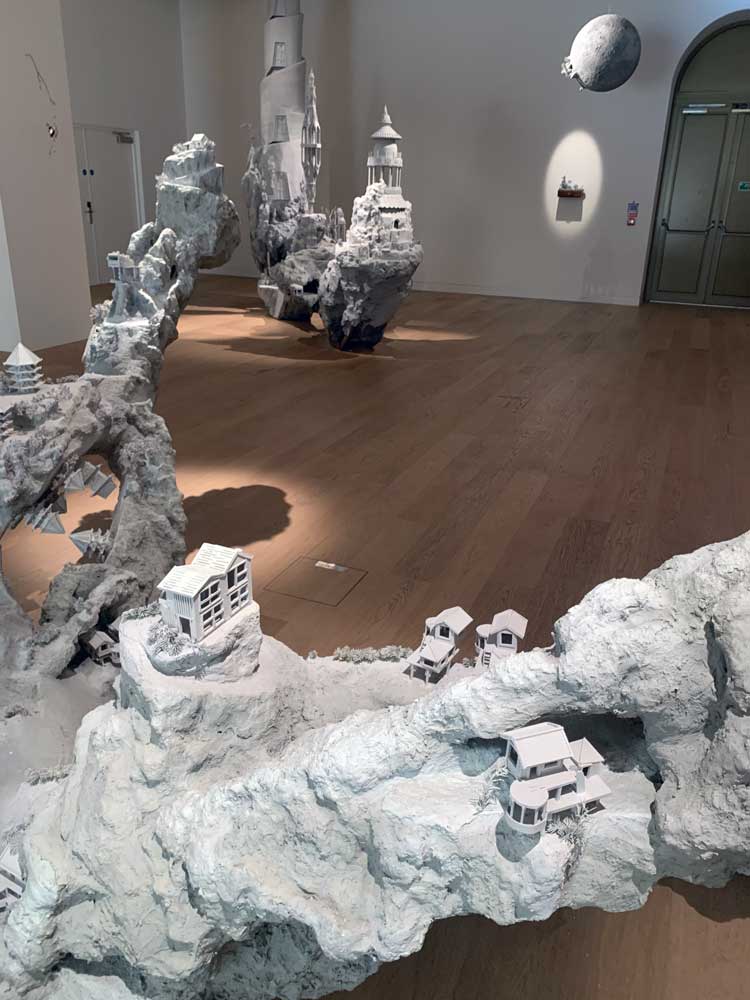
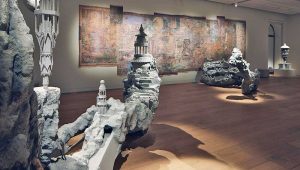
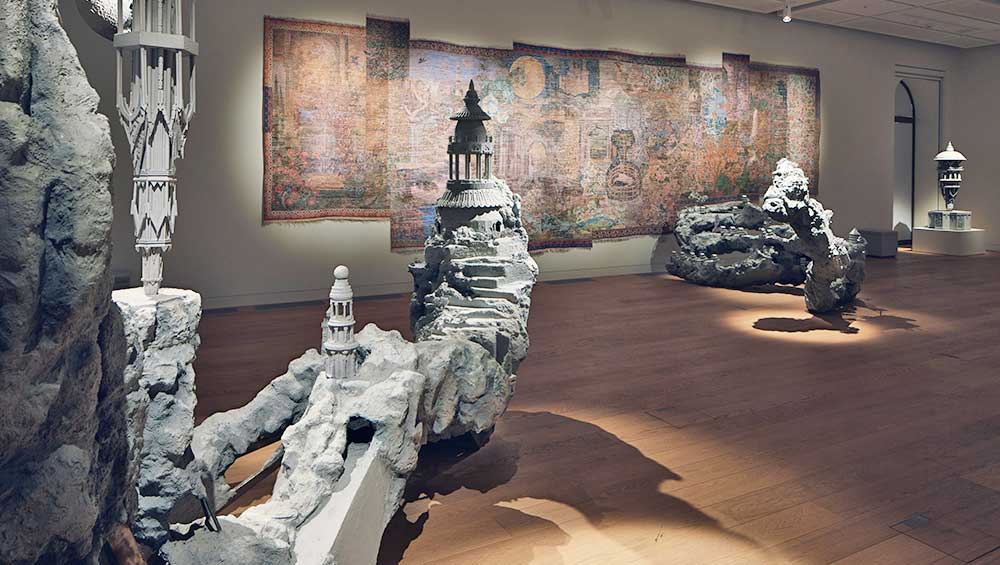
Those who visit, whether or not they are familiar with this artist’s adeptness of approach to sculpture as a fluid, neutral, rather magical, medium, through which he constructs fantastical stories and gives these material realisation, will be transfixed by what he has produced. This is sculpture as environmental assemblage; elements run at various angles, defying vertical and horizonal perspectives, some pieces seeming to hang off walls and ceilings, powerfully suspending disbelief and evoking patterns of enchantment in childhood stories. What strikes my eye clearly also is how perfectly measured are all the proportions.
The gestation of this exhibition in its current instantiation, which includes several newly commissioned works, grew from a conversation Qureshi had in 2023 with John Fulljames, who leads the cultural programme at the Schwarzman. In 2020, Qureshi had presented a related series of pieces at Yorkshire Sculpture Park, and further developed ideas within that exhibition with another in 2024 in London on the theme of paradise. What these made apparent, in a way that the Schwarzman exhibition makes explicit, was the depth of his religious imaginary. As he explains in an introductory video, he was born into a devout Qur’ani family and his grandfather was a mullah, a religious teacher in the community. He told the young Qureshi many stories about paradise and the seven heavens that the virtuous pass through to arrive there if they please God. A set of filigree-carved gates lodged against the gallery walls appear symbolic of the barriers and progressions that the faithful must make on theira
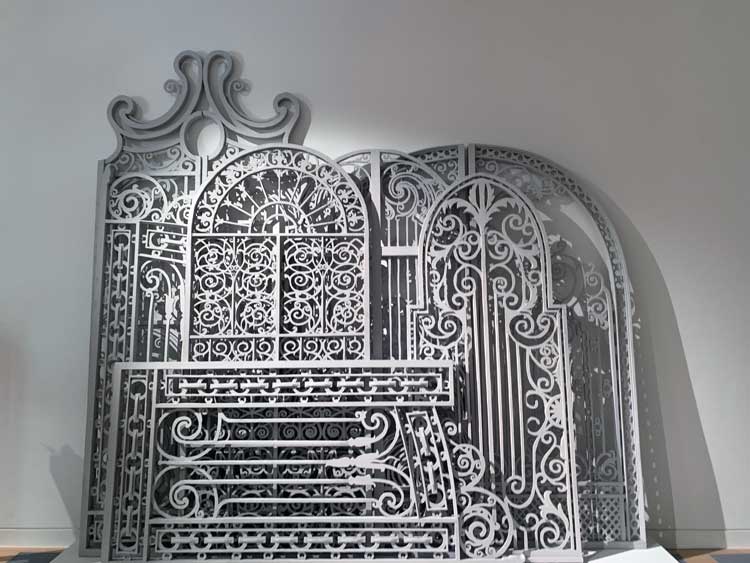
Covering almost every surface is Qureshi’s use of a mid-grey paint that fills the room with a numinous, negative quality. He told me on my visit in September that it is a shade of grey that resembles the light that happens just before sunrise. The subtitle of the exhibition is also important, signifying how all the works we see seem poised between the fragility of hope and restorative memory, as intangible yet enduring ideas, that slip and slide between cultures, faiths and disciplinary categories.
I watch as others are walking around, taking hushed steps, as if treading a lunar landscape. My eyes are drawn above my head to a compelling grey moon, all pitted surfaces and with a little paradisical outgrowth almost out of reach and view: such is the promise of paradise itself, as something eliding closeness of vision. Nearby, what looks like a fragile insect, clinging to a stick hanging off the ceiling, speaks also to a sense of broader universe of natural creatures, that may bring or bear their own paradises around inside them.
A pensive and subtle soundtrack, created by Tim Cowie, of the Light Surgeons, accompanies the exhibition. His involvement was suggested by Professor Paul Basu, an anthropologist at Oxford, who also introduced Qureshi to various other academics so as to discuss what paradise might mean across disciplines. Basu and the Light Surgeons co-directed an informative opening video which sets the scene brilliantly and is also available to watch online. It features Qureshi at work (with an assistant) deep in the precise and intensive act of laser-cutting. We also see him engaging in acts of carving and hand-painting what has been sculpted. There is no use of AI in what Qureshi is doing. This is in many ways an exhibition that renews the connection between the artist as a human and spiritual being with a cosmos that has a meaning impacting on both individual and collective consciousness.
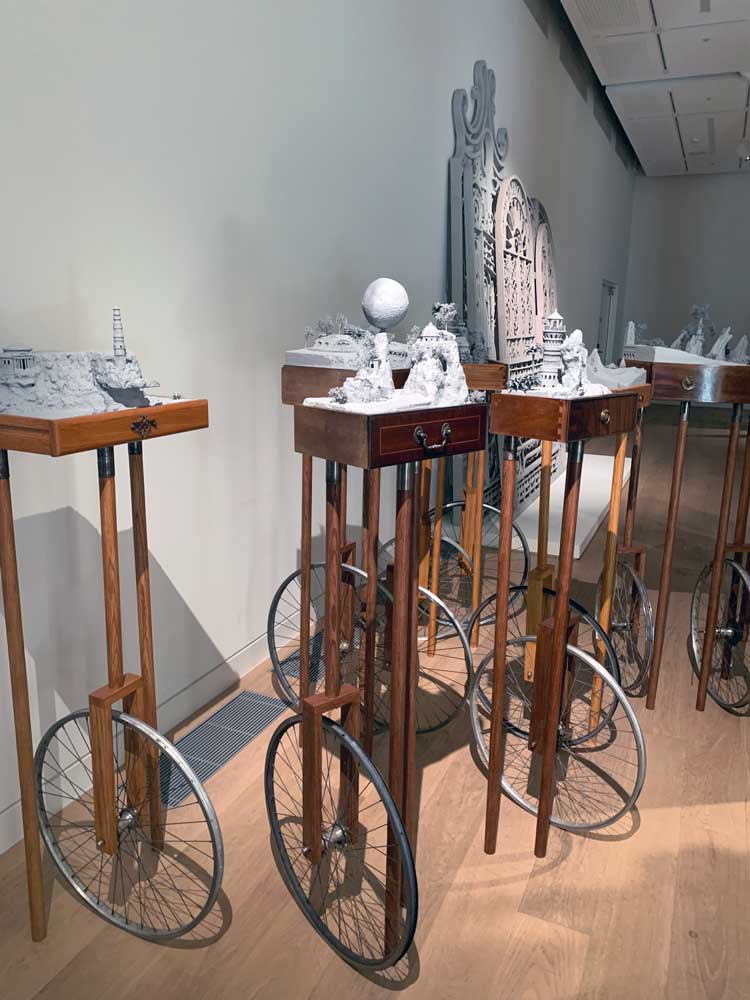
The video shows us Qureshi leading conversations with diverse members of the public who join in hands-on workshops in which they also make visual representations of their own personal concepts of paradise. Going beyond any specific references, Qureshi distilled aspects of these conversations into the series of “portable personal paradises” that seem Duchampian in their visual affordances. He has described the portable nature of these paradises as being a referent in part also to how we move through life and continue to grow and evolve, as well as to the movement of peoples whether through self-directed or forced migration. Looked at from this perspective, the drawers become carriers of memories and symbols of displaced or disrupted domesticity: the ash grey piles within them are open also to positive or negative interpretation. It is a story that applies also to his own family, who moved from Pakistan to live in Yorkshire, where they continued to work in the textile industry.
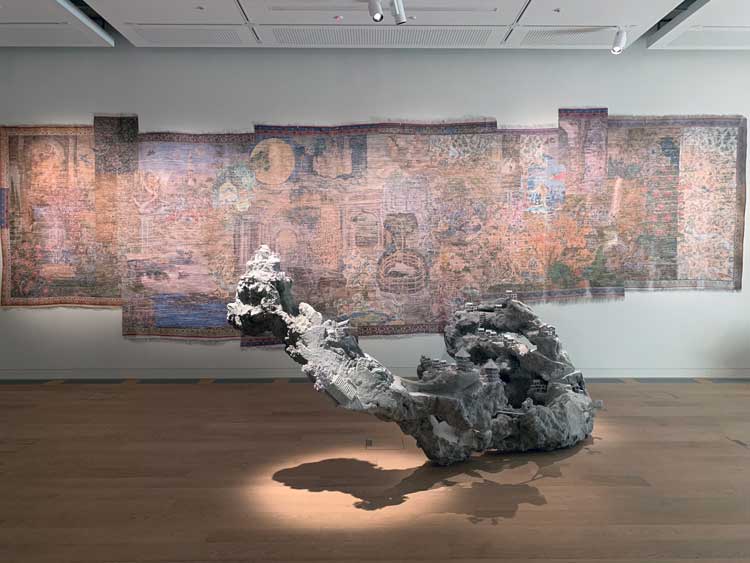
There is a sense of this heritage and of his own ancestry present within one of the major highlights of the exhibition, which is a 9-metre-wide (29.5ft) paper-based tapestry, hanging on one of the gallery walls. At first glance, it may seem reminiscent of the medieval and neo-medieval tapestries one might find in one of the university’s chapels, or in the Ashmolean Museum’s Pre-Raphaelites gallery. We may think we can recognise bits and pieces of images of arcadian pleasure gardens, romantic fantasy landscapes, waterfalls and gushing streams, beatific visions and paradisical fields. But nothing is as it was or was imagined to be. On closer looking, it becomes something highly contemporary in its fragmentations, borrowings, appropriations and fadings. Qureshi has used an Urdu technique called Tanabana, a term relating to the warp and weft of weaving, that he has been pioneering artistically this decade. In terms of its use here, he has woven together long thin strands of paper, created by shredding digital reproductions of found images of paradise and associated arcadian, romantic and theological references found in manuscripts and publications. What he is doing, in effect, is an open transference of a multiplicity of references into a new enclosed mesh or weaving. It is a truly stunning achievement and reminds us of the long-term associations of this university city, first established in the middle ages, with paper, the published word and the pursuit of ideal worlds.
It is also a place where people come and go for studies. Qureshi has had a studio here for more than 20 years. He tells me that it can seem “enchanted”, full of “altered realities” and “worlds within worlds”. With a further Duchampian twist, he describes the city as “a readymade backdrop” that helps to inspire the “fantastic fictions” that he likes to create sculpturally. He pointed out the high number of storytellers and stories in the realm of fantasy inspired by this location.
In response to my questioning, he tells me also that it was his idea to extend the Schwarzman exhibition into other museums connected to Oxford University – the Ashmolean, the History of Science Museum, the Natural History Museum and the Pitt Rivers Museum. It was received positively by Schwarzman, with its remit to connect different humanities subject areas and extend the reach of the humanities into interdisciplinary contexts, as well as by Basu, who has a curatorial association with the Pitt Rivers Museum. Qureshi engaged in dialogue with each venue and spent time in research and development so as to decide together what might work best.
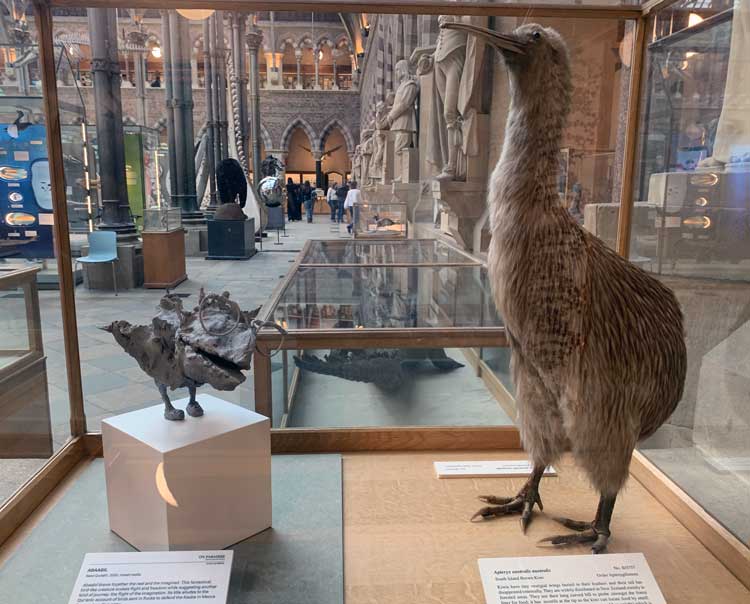
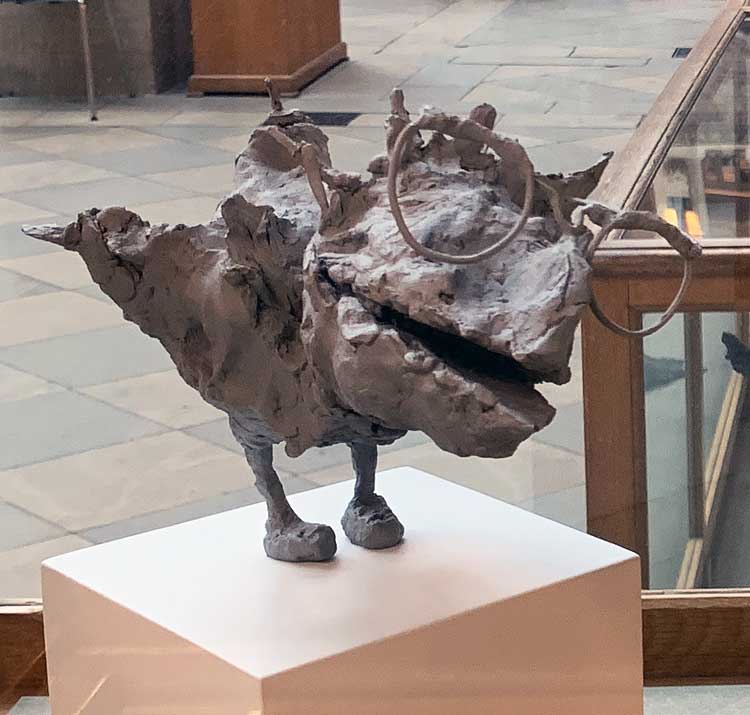
I started my extended visit at the Oxford University Natural History Museum, which, in contrast to the scholarly and subdued atmosphere at the Schwarzman Centre, I discover to be an extraordinarily lively place full of people doing their own drawings and paintings of the items on display. Here what has been installed is a sculpture by Qureshi from 2020 entitled Abaabil, which the title-card describes as “a fantastical bird-like creature”, which “draws together the real and the imagined”. I find the placement of this creature, which is rather small-bodied but has a large head and wears big spectacles, juxtaposed without fuss or clamour in a vitrine alongside a stuffed long-necked kiwi, found in New Zealand, wholly endearing and a perfect example of how well contemporary art can fit within such a context. The placement of the work within a section devoted to explaining the history of evolution, often in colourful ways, speaks also to the curatorial cleverness that has been at work here behind the scenes.
The Pitt Rivers Museum, meanwhile, is crammed with large glass vitrines and display cases, which are in turn jammed full of countless items from all over the world, from a diversity of cultures and from many centuries. I ask a person at the front desk to guide me towards the contemporary work within the thickets of glass cases. Some display cases, which until recently showed examples of shrunken human heads, now stand empty except for signs explaining the ethical reasons why these items have been removed. I find the juxtaposition of overcrowded cabinets filled with material artefacts gathered over centuries, often through forced appropriation, with the bare, minimalist statements announcing removal of said material rather powerful.
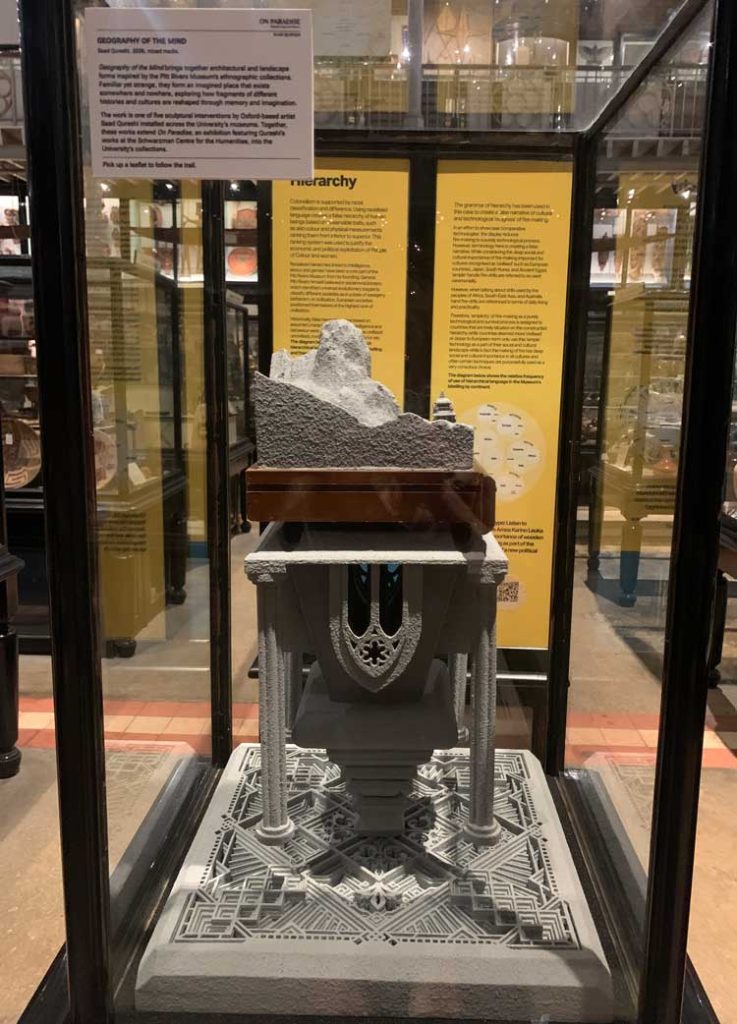
Qureshi’s installation here is a newly commissioned work entitled Geography of the Mind (2026). It sits by itself in glass vitrine where we can read that “it brings together architectural and landscape forms inspired by the Pitt River Museum’s ethnographic collections”, creating “an imagined place that exists somewhere and nowhere”. When reading about the work and gazing at it, in rather Through the Looking Glass style, we can also see information signs behind it or indeed through it, concerned with other displays in this very crowded area. What I then find myself reading is the word, Hierarchy, that shifts my view in turn of the work by Qureshi, which has a superficial resemblance to an eastern temple, formed from four levels. The construct he has created has a well-ordered, symmetrical, geometrically designed base but at the very top layer, what I begin to see is closer to a grey sandcastle falling. Such again is the power of curatorial positioning.
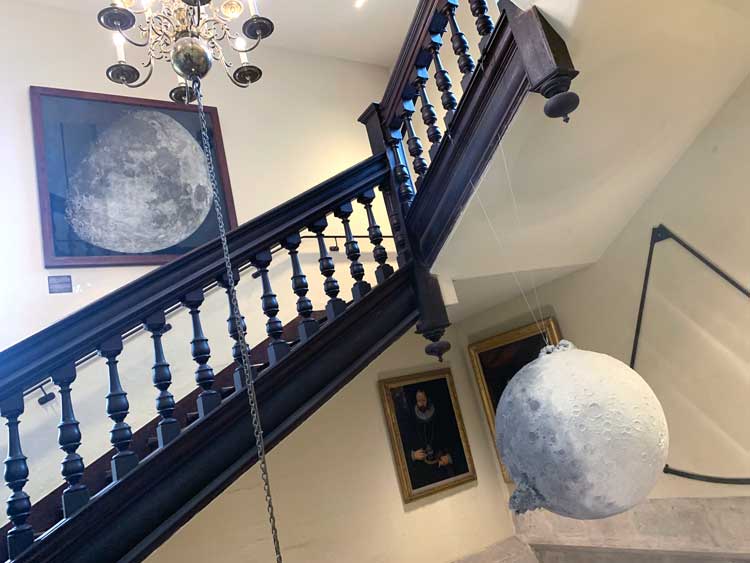
In the History of Science Museum, which dates to 1683, by contrast, the mood is of the celestial. Here Qureshi is showing Night Jewel (2023), which was inspired by a phenomenal 1.5-metre-wide (5ft) pastel drawing of the moon, developed by John Russell in the late 18th century, which hangs above the main staircase inside the museum. On display nearby is also a model of the moon that he made, which becomes a historical signifier of a specific moment of exploration, as the rear (or dark) side of the moon is left empty of any markings. The museum’s website explains that, for Russell, drawing the moon – and he made at least 187 attempts at it – was a religious “act of devotion”.
Qureshi has created a contemporary moon in synchrony here with the colour of Russell’s earlier drawing, with similar indentations on its milky, pitted, lunar surface, though he has also added an outgrowth equivalent to that which can be viewed on the moon in the Schwarzman, resembling an organic temple or palace surrounded by trees. The exhibition material refers to it as “a distant palace that evokes paradise as both an unreachable destination and as a projection of human hopes”. Qureshi has spoken of making “mindscapes” that are for him a mirroring of mind in landscape and vice versa. His work is hung from the ceiling above where the staircase curves into the basement. There are hundreds of visitors passing under it daily and the placing of Qureshi’s work in such a prime position speaks closely to the receptivity offered by each of the participating venues to being part of this extended exhibition.
Indeed, in this museum there are numerous other objects that reveal the histories of cross-fertilisation and interdependencies of what we would now try to separate into disciplinary categories. In the basement gallery area, a display about early photography includes among its pioneering figures in this area, Lewis Carroll, who was also a mathematician, under his proper name, Charles Dodgson. In my meeting with Qureshi in September at his studio, he mentioned to me that Carroll’s use of devices of “shrinking and expanding” within his Alice in Wonderland had been influential with respect to thinking through how viewers might navigate his then forthcoming exhibition.
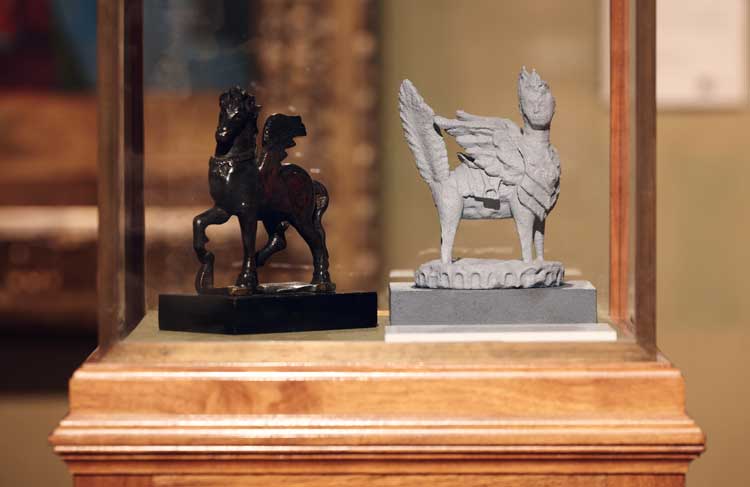
I end my day’s rather idyllic meandering from one world-class historical museum to another at the Ashmolean, where two pieces by Qureshi have been installed. One is in the Pre-Raphaelites Gallery, which was not open on the day of my visit as it was being refurbished. But the other is gorgeously placed inside the olive-green walls of the Renaissance Gallery. Pegasus, the Greek winged horse, a sculpture of which normally occupies a vitrine alone, is now accompanied by a grey equine equivalent, representing the Buraq, the mythological creature that carried Muhammad from Mecca to Jerusalem, before the Prophet’s ascent through the heavens. It is a fitting end to an uplifting exhibition, in which Qureshi’s beautifully conceived and constructed poetic sculptures charm us, rather than alarm us, into imagining better worlds.