




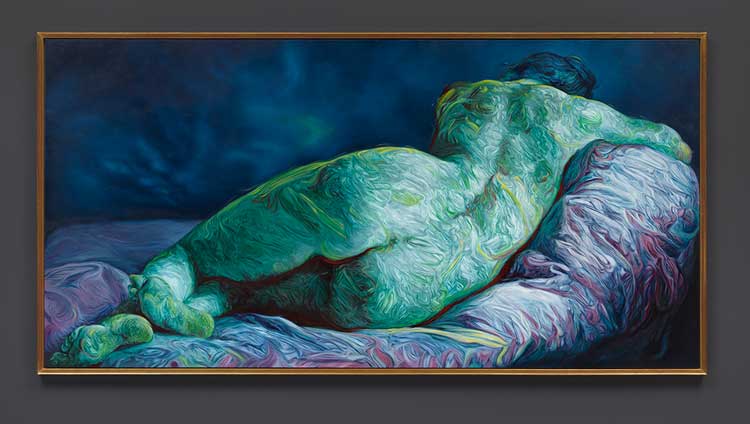
Glenn Brown, On the Way to the Leisure Centre, 2017. Image courtesy the Artist and The Brown Collection © Glenn Brown. Photo: Mike Bruce.
Arrows of Desire, Holburne Museum, Bath
16 May – 6 September 2026
Grottoesque, No 1 Royal Crescent, Bath
22 May – 6 September 2026
by DAVID TRIGG
Forty years after studying in Bath, Glenn Brown (b1966) returns to the honey-hued city for a double header – concurrent exhibitions at the Holburne Museum and No 1 Royal Crescent. Brown describes his time in Bath as “the genesis” of his artistic journey, which saw him become one of the most celebrated painters of the Young British Artists generation. The skewed reimaginings of historical paintings with which he made his name began as an ironic gesture in which Frank Auerbach’s expressive, impasto-laden compositions were rendered perfectly flat. These early, labour-intensive appropriations have evolved into a surrealist-inflected signature style where mutated figures plucked from art history mutate into fantastical grotesques, modelled with accumulations of sinuous brushstrokes and acrid palettes. Disintegrating bodies and phantasmagorical forms abound in these two shows, where fragile beauty is balanced with abject horror.
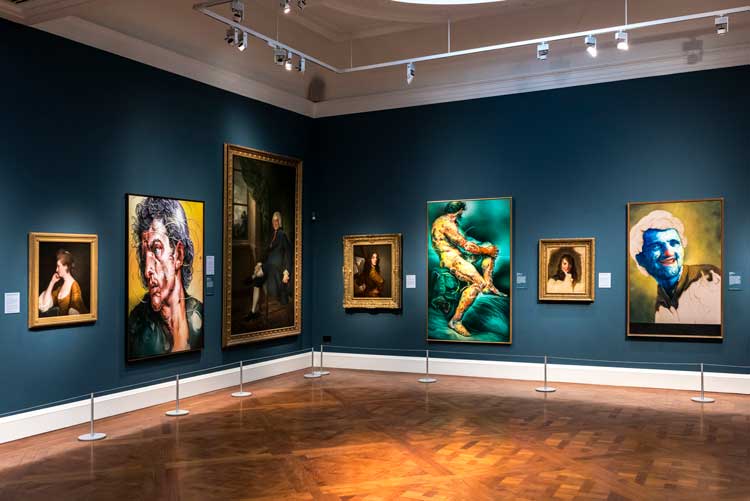
Glenn Brown, installation view, Holburne Museum, Bath, 2026. Photo: Jo Hounsome Photography.
At the Holburne, Brown has disrupted the gallery’s refined atmosphere by inserting a selection of his ghoulish paintings into the museum’s renowned collection of 18th-century portraits by artists including Thomas Gainsborough and Thomas Lawrence – a mischievous and darkly humorous intervention that, to the casual viewer at least, belies Brown’s reverence for the art of the past. On one wall, a reclining nude woman turns away from the viewer. Modelled after a work by Pierre Subleyras (1699-1749), the figure is covered with acid-green brushstrokes that resemble lacerations or some horrific flesh-eating disease. Prosaically titled On the Way to the Leisure Centre (2017), it hangs between portraits of female landowners by Angelica Kauffman and Arthur Devis, achieving a jarring visual dissonance.
The disorienting effect continues with Searched Hard for You and Your Special Ways (1995), an upside-down image of a child based on Jean-Honoré Fragonard’s A Boy as Pierrot (1785), in which a cherubic youth wears an oversized clown costume. In Brown’s version, the costume looks more like a straitjacket, while the child’s staring eyes are echoed by the direct gaze of John Sargent’s wife Rosamund, whose 1749 portrait by Allan Ramsay hangs below. This early work from the mid-1990s reveals how Brown’s style has evolved; the flattened impasto brushstrokes that form the boy’s costume don’t extend to his soft-focus face, whereas in recent, more macabre works, entire bodies seem to be made from lashings of swirling impasto brushstrokes.
-Glenn-Brown.jpg "Glenn Brown, Rabbit Hole, 2025. Image courtesy the Artist and Gagosian © Glenn Brown. Photo: Joe Humphrys.")
Glenn Brown, Rabbit Hole, 2025. Image courtesy the Artist and Gagosian © Glenn Brown. Photo: Joe Humphrys.
In Die Mutter des Künstlers (2016), a headless blue female holds up a finger dripping with blood. Small wounds in its hand and side allude to Christ’s suffering, but there is nothing redemptive about this unhappy image. The painting is surrounded by gesturing figures in theatrical pictures by Johan Zoffany, Henry Walton and Francis Hayman. While the Georgian portraits all depict real people who once lived and breathed, Brown’s figures conversely exist in a virtual world, several stages removed from actuality. In the creation of his works, appropriated source imagery is layered, twisted and mangled with digital tools before being meticulously hand-painted. This imbues them with a contemporaneity that speaks to the mass-mediated hyperreality of 21st-century life, where the lines between the real and the artificial grow increasingly convoluted.
In recent years, Brown’s practice has expanded to include an exploration of drawing, leading to more playful and expressive forms of mark-making. In the side galleries, a selection of smaller works derived from old master drawings and created with acrylic and Indian ink brim with vitality, exuding a lightness of touch that contrasts with the more laboured oil paintings. Some feature antique frames, their baroque forms echoed by clouds of swirling lines that coalesce into hallucinatory faces and double images. Many seem fragile and vaporous, as if ready to dissipate at the slightest breeze. Indeed, the illusion of solid form created by the sinuous crisscrossing lines dissolves as you near the works’ glassy surfaces. This quality is also seen in the show’s most recent painting, Grapefruit Juggernaught (2026), in which the head of a man animated by agitated lines appears to be disintegrating.
This sense of flux and metamorphosis continues in the exhibition Grottoesque at No 1 Royal Crescent, a magnificently restored town-house museum and gallery located in Bath’s most famous terrace. Outside, tourists are snapping selfies in front of the grand architecture while, inside, the Georgian decorum is upset by works such as The Bleating Shoe (2020) in which a man’s head becomes a surreal toadstool (after a satirical print by James Gillray). Elsewhere, in a subversion of an early 18th-century vegetable still life by the Florentine painter Bartolomeo Bimbi, a turnip has become a multi-limbed Humpty Dumptyish character named Saint Bimbo (2024/25). There are also several exquisite black-and-white drawings of gnarled and knotted trees composed of layers of squirming, graphic lines that balance quiet elegance and wild distortion.
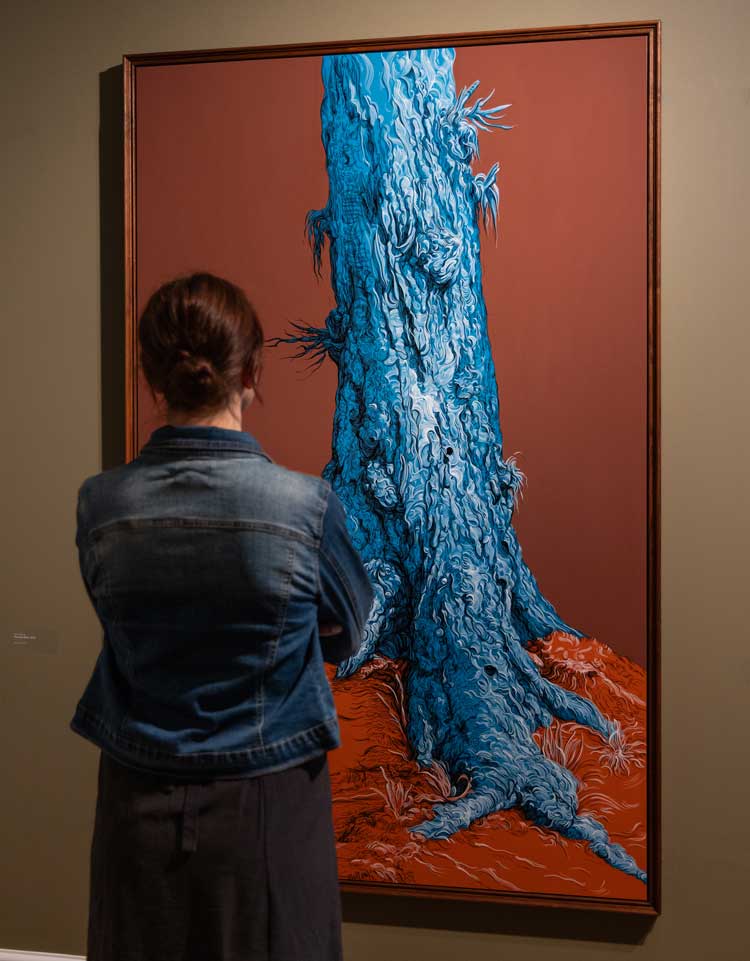
Glenn Brown, The Holy Bible, 2022, installation view, No. 1 Royal Crescent, Bath, 2026.
Trees are an apt subject for Brown, who likens their twisted forms to the way human bodies and faces are weathered by the passage of time. These works suggest that, rather than standing apart from nature (a view stemming from Enlightenment thinking), we are intimately bound up with the natural world and its processes. That said, Brown’s penchant for the artificial shines through in the strikingly vivid painting The Holy Bible (2022), in which a gnarly blue tree is set against a flat, orange background; its bold contour lines, uniform planes of saturated colour and absence of blending represent a significant departure, recalling the graphic sensibility of artists such as Patrick Caulfield.
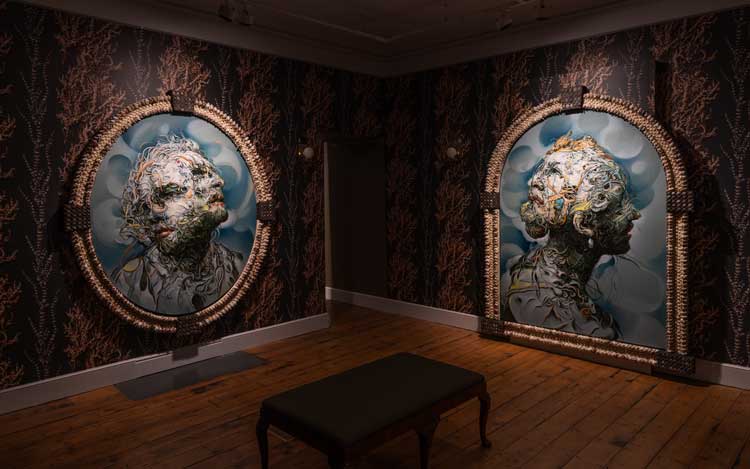
Glenn Brown, Suffolk Grotto Paintings I and II, installation view, No. 1 Royal Crescent, Bath, 2026.
At the Holburne, Brown’s works felt like interlopers, but at the Royal Crescent we very much enter into the artist’s world. At the heart of the show, is a grotto-like installation echoing the shell grotto in the grounds of Brown’s 17th-century manor house in Suffolk. Grottoes were essential features of Georgian landscape gardens, evoking the sublime through their blend of raw nature and artistic design. Brown’s theatrical recreation is atmospheric, ostentatious and enjoyably camp. Here, three large paintings with imposing shell-encrusted frames are hung against custom-designed wallpaper decorated with a repeating coral motif. Each one features an ethereal, Janus-like head composed of wispy brushstrokes that seem to be in the process of unravelling. Caught in varying states of reverie, oblivious to the viewer’s gaze, they simultaneously look backwards and forwards – a dual perspective that mirrors Brown’s own approach to art-making and which seems especially apposite in a city where the past and the present are deeply intertwined.
Click on the pictures below to enlarge

Copyright © 1893–2026 Studio International Foundation.
The title Studio International is the property of the Studio International Foundation and, together with the content, are bound by copyright. All rights reserved.
 |
 |
 |
|---|
-1000-300.jpg)
 The Shape of Things: Still Life in Britain
 Sara Shamma – interview: ‘When I paint, I am in a state like meditation’
 Glenn Brown: Come to Dust
 Collateral Drawing: ‘It’s like revealing the magic trick’